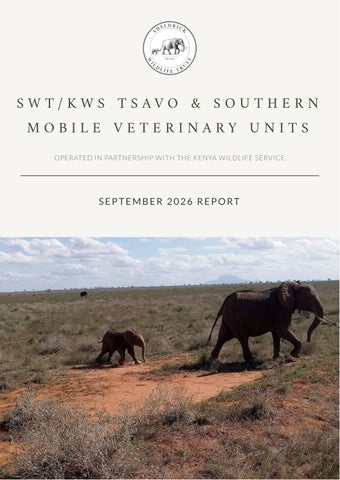
SWT/KWS TSAVO & SOUTHERN MOBILE VETERINARY UNITS OPERATED IN PARTNERSHIP WITH THE KENYA WILDLIFE SERVICE
SEPTEMBER 2026 REPORT
Tsavo & Southern Mobile Vet Units: September 2026 D R . C A M PA I G N L I M O & D R . L AW I K I P L I M O, K W S V E T E R I N A R I A N S
The conservation area received no meaningful precipitation during the period under review, however some parts South of the conservation area received moderate rains. A few water pans are full and the vegetation is rapidly drying off though some few areas still have good vegetation cover. Both grazers and browsers have enough food and are in good body condition. Acknowledgement: The Tsavo and Southern Mobile Vet Units would like to appreciate all stakeholders who aided in reporting cases that required veterinary intervention. Special thanks to the Kenya Wildlife Service for their technical assistance and to the Sheldrick Wildlife Trust Wildlife Trust for their continuous funding of and facilitation to the unit.
MONTH AT A GLANCE: Total cases:
21
27,678 4 12 Case snapshot:
ELEPHANT CASES
PREDATOR CASES
2
GIRAFFE CASES
A R E A O F O P E R AT I O N S :
TSAVO & SOUTHERN MOBILE VET UNITS
S W T/ K W S T S AVO & S O U T H E R N M O B I L E V E T U N I T S
2
CASE 1:
ELEPHANT
DATE
SPECIES
SEX
AGE
LOCATION
OUTCOME
03/09/2026
Elephant
Female
Adult
Bachuma
Good prognosis
History TMVU team on their way to attend a reported case, spotted an injured elephant with a herd near a water hole in Bachuma area. They decided to attend to this case first.. Immobilization, Examination and Treatment She was successfully immobilized using 20 mg etorphine hydrochloride delivered remotely through a 3 cc Dan inject dart. Darting was done from a vehicle and it took 7 minutes for full anaesthesia to be attained. Examination revealed there was a swelling on the caudal aspect of the left abdomen with an opening that had little pus exudate. On palpation, the swelling was firm and with small amount of pus. The wound was caused by an arrow which had dislodged. The wound was deep and a drainage was created on the more ventral side. The wound was then cleaned thoroughly with water, flushed with hydrogen peroxide, rinsed with water, dried with gauze swabs and then infused with tincture of iodine. Antibiotic pessaries were packed in and topical antibiotic spray was then applied. In addition, amoxicillin antibiotics and meloxicam anti-inflammatories were administered parenterally. Revival She was then reversed successfully from anaesthesia using 250 mg of naltrexone hydrochloride administered intravenously via a prominent ear vein. She rose up after 3 minutes and walked away to join her herd. Prognosis Good- She had good body condition.
S W T/ K W S T S AVO M O B I L E V E T U N I T
3
CASE 1
S W T/ K W S T S AVO M O B I L E V E T U N I T
4
CASE 2:
ELEPHANT
DATE
SPECIES
SEX
AGE
LOCATION
OUTCOME
03/09/2026
Elephant
Female
Calf
Dika Plains
Fair to good prognosis
History A visitor spotted a limping elephant calf around the Dika plains area and reported. TMVU team were informed and they responded to the case. Immobilization, Examination and Treatment To attend to the calf, both the mother and the calf were immobilized successfully using 18 mg and 1.5 mg etorphine hydrochloride delivered in a 3 cc and 1.5 cc Dan inject darts respectively. The darting was done from a vehicle and it took approximately 7 minutes for the anaesthetic drugs to achieve full effects. Examination revealed she had extensive septic bite wounds on the right carpal joint. The wounds were on medial and lateral sides of the joint. The injuries were suspected to be predator inflicted. The wounds were cleaned thoroughly with water, flushed with hydrogen peroxide, rinsed with water, dried with gauze swabs and then infused with tincture of iodine. Antibiotic pessaries were packed in and topical antibiotic spray was then applied. In addition, amoxicillin antibiotics and flunixin meglumine anti-inflammatories were administered parentally. Reversal The mother and the calf were successfully reversed simultaneously using 200mg and 20 mg of naltrexone hydrochloride respectively. Both were administered intravenously via prominent ear veins. They both rose up after 3 minutes and walked away together. Prognosis Fair to good- The wounds were deep and septic. With the treatment given she is expected to respond well. Monitoring was advised.
S W T/ K W S T S AVO M O B I L E V E T U N I T
5
CASE 2
S W T/ K W S T S AVO M O B I L E V E T U N I T
6
CASE 3:
ELEPHANT
DATE
SPECIES
SEX
AGE
LOCATION
OUTCOME
04/09/2026
Elephant
Male
Calf
Sentrim
Task successful
History A report was made by Sentrim lodge management about a newborn elephant calf that was trapped inside a water trough outside the lodge. TMVU team in collaboration with SWT-Voi stockade team were informed and responded to attend to the case. Rescue The mother was tactfully separated to a short distance away from the calf and the rangers swiftly moved in to remove the calf from the trough. The calf was in good body condition. The mother and the calf were successfully reunited and they walked together to join the bigger family.
S W T/ K W S T S AVO M O B I L E V E T U N I T
7
CASE 3
S W T/ K W S T S AVO M O B I L E V E T U N I T
8
CASE4:
ELEPHANT
DATE
SPECIES
SEX
AGE
LOCATION
OUTCOME
05/09/2026
Elephant
Male
Adult
Taita Sisal Estate
Postmortem
History A report was made of an adult bull elephant lying lifeless in Teita sisal estate. TMVU team was requested to go and determine the cause of his death. They responded and attended to the case. Post-mortem examination A full post-mortem examination was conducted and the following were the findings: -
He appeared to have been a relatively poor body condition before death. . On rectal palpation, a mass of hard faecal balls was retrieved on the proximal rectum.
On opening the carcass, the findings were: -
There was a perforation/tear at the proximal rectum Marked congestion of the visceral organs Traces of faecal matter on the necrotized omentum.
Conclusion. He died of septic shock due to chronic peritonitis.
S W T/ K W S S O U T H E R N M O B I L E V E T U N I T
9
CASE 4
S W T/ K W S T S AVO M O B I L E V E T U N I T
10
CASE 5:
GIRAFFE
DATE
SPECIES
SEX
AGE
LOCATION
OUTCOME
05/09/2026
Giraffe
Male
Adult
Ziwani Tsavo West
Good to fair prognosis
History The KWS teams in Ziwani sighted an adult male giraffe limping with a snare on his right hind leg. The SMVU was notified and responded quickly to attend the case. Immobilization., Examination and Treatment This adult male giraffe was successfully immobilized using a combination of 11mg of etorphine Hcl and 50mg Azaperone delivered using a 1.5 cc Dan Inject Dart. Darting was done from vehicle. It took seven minutes for full anaesthesia to be achieved. On examination the SMVU found: • • •
He had a tightly bound plain wire snare on his right tarsal joint that resulted in the lameness. The plain wire snare had not inflicted and wounds on this adult giraffe. He had a significant tick load.
He was treated by removal of the cable snare and received parental antibiotic cover [amoxicillin], antiparasitic (ivermectin) and anti-inflammatory treatment [meloxicam]. Reversal He was reversed immediately using 110mg of naltrexone Hcl administered intravenously. Treatment progressed with the animal under physical restraint. Prognosis Good to fair prognosis: The snare had not caused any injury and its recovery would ensure enough blood supply and innervation of the distal limb resulting in his recovery from lameness.
S W T/ K W S T S AVO M O B I L E V E T U N I T
11
CASE 5
S W T/ K W S T S AVO M O B I L E V E T U N I T
12
CASE 6:
BUFFALO
DATE
SPECIES
SEX
AGE
LOCATION
OUTCOME
05/09/2026
Buffalo
Female
Adult
Kaluku
Guarded prognosis
History The SWT/KWS teams reported of an adult female buffalo with a limp and had sustained injuries on her back following a predator-prey interaction. The SMVU teams responded quickly and attended the case. Immobilisation, examination and treatment She was immobilized using 5mg etorphine Hcl and 50mg Azaperone delivered remotely using a 1.5 cc Dan Inject Dart. Darting was carried out on foot and it took ten minutes for narcosis to be achieved. Examination revealed that, she had sustained injuries on her spine, base of the tail and her right rear limb. Her wounds were cleaned thoroughly using clean water, dilute hydrogen peroxide was used to dislodge devitalised tissues before being flushed using clean water. The wounds were thereafter infused with povidone iodine and a topical antibiotic spray applied. Additionally, she received parental antibiotic [amoxicillin] and anti-inflammatories [Meloxicam]. Reversal 50mg of Naltrexone Hcl was administered intravenously and she was able to raise up two minutes later. Prognosis Guarded - she was in poor body condition with severely infected wounds.
S W T/ K W S S O U T H E R N M O B I L E V E T U N I T
13
CASE 6
S W T/ K W S S O U T H E R N M O B I L E V E T U N I T
14
CASE 7:
LION
DATE
SPECIES
SEX
AGE
LOCATION
OUTCOME
08/09/2026
Lion
Female
Adult
Tsavo East NP
Good
History The SWT/KWS teams reported of sighting an adult female lion with porcupine quills on her sternum. The SMVU in conjunction with TMVU team responded quickly and attended the case. Immobilization, Examination and Treatment She was successfully immobilized using a combination of 4.8mg medetomidine and 200mg ketamine that was delivered remotely using a 3 cc Dan Inject Dart. Darting was done on a vehicle and it took 10 minutes for full anaesthesia to be achieved. On examination she had four porcupine quills on her brisket, one on lateral right front leg and another on the medial thigh. The porcupine quills were retrieved with the resultant wounds infused with povidone iodine and an antibiotic ointment. All the wounds were thereafter sprayed with an antibiotic spray. She was given parental antibiotics [ amoxicillin] and NSAID [meloxicam]. Reversal She was reversed by administration of 25mg atipamezole intramuscularly and was able to wake up fifteen minutes later. Prognosis Good Prognosis: The quills were causing extreme discomfort, with the quills removed the lioness will be free of pain and discomfort.
S W T/ K W S T S AVO M O B I L E V E T U N I T
15
CASE 7
S W T/ K W S T S AVO M O B I L E V E T U N I T
16
CASE 8:
ELEPHANT
DATE
SPECIES
SEX
AGE
LOCATION
OUTCOME
10/09/2026
Elephant
Male
Adult
Ithumba
Good
History The SWT/KWS teams reported of an adult bull elephant that had been sighted limping. The SMVU in conjunction with TMVU responded quickly and attended the case. Immobilisation, examination and treatment He was successfully immobilized using 17mg Etorphine Hcl delivered remotely using a 3 cc Dan Inject Dart. Darting was done on foot and it took ten minutes for narcosis to effect. Examination revealed that the elephant had septic spear wound on the lateral aspect of his right forelimb slightly above the elbow joint. The affected leg was slightly swollen with the elephant slightly abducting that leg while walking. The wound was thoroughly cleaned using clean water, dislodging of pus using dilute hydrogen peroxide, flushing of hydrogen peroxide, rinsing with clean water, swabbing of the wound using clean sterile swab and infusing the wound with povidone iodine. Antibiotic pessaries were packed into the wound followed by topical antibiotic spray. Additionally, he received antibiotic therapy [amoxicillin] and non-steroidal anti-inflammatory drug [flunixin meglumine]. Reversal He was reversed from narcosis using 170mg naltrexone intravenously and it took 3 minutes for her to wake up. Prognosis Good prognosis: He was able to use the affected limb to bear weight while walking and with the treatment administered, he should be able to recover.
S W T/ K W S S O U T H E R N M O B I L E V E T U N I T
17
CASE 8
S W T/ K W S S O U T H E R N M O B I L E V E T U N I T
18
CASE 9:
ELEPHANT
DATE
SPECIES
SEX
AGE
LOCATION
OUTCOME
11/09/2026
Elephant
Male
Adult
Nyango, Kilabasi
Postmortem
History The SWT/KWS patrol teams reported of having sighted an adult bull elephant carcass within Nyango area. The SMVU responded quickly and attended the case Postmortem findings The SMVU team noted the following findings: • • •
He was on left lateral recumbency. On rectal palpation, there were no faecal material was retrieved from his rectum. He had a distended abdomen.
Internal examination • On opening his abdominal cavity, he had fibrinopurulent material attached to the serosal surfaces of his intestinal organs with adhesions to the peritoneum. • He had a blood-tinged peritoneal fluid. • There was generalised haemorrhage on the serosa of the spleen, the small intestines and the caecum. • A large hardened dried faecal mass was retrieved stuck within his caecum. • The mesenteric blood vessels were heavily engorged with blood. • There was mesenteric lymphadenitis • He had a rupture on his colon resulting in leaking of digestive material into the peritoneum. Conclusion The immediate cause of death was attributed to septic shock following a chronic fibrinopurulent peritonitis.
S W T/ K W S S O U T H E R N M O B I L E V E T U N I T
19
CASE 9
S W T/ K W S S O U T H E R N M O B I L E V E T U N I T
20
CASE 10:
ELEPHANT
DATE
SPECIES
SEX
AGE
LOCATION
OUTCOME
15/09/2026
Elephant
Male
Adult
Komboyo
Task successful
History A complaint was raised about a rogue fence breaking elephant that was escaping the Tsavo west national park and invading farms in the nearby villages of Mangeleti. A request was made to KWS and TMVU/SMVU/ SWT teams to assist in translocating the elephants away from the area. All the teams responded and attended to carry out the translocation exercise. Immobilization, Examination and Translocation The bull was successfully immobilized using 22mg etorphine hydrochloride delivered remotely through a 3 cc Dan inject dart. Darting was made from a helicopter and it took 8 minutes for the anaesthesia to be fully achieved. General examination revealed the animal was in a good body condition. He was successfully loaded onto a crane truck and transported safely to Emusaya area in Tsavo East national park. He was then offloaded upon reaching the destination. Reversal He was thereafter reversed successfully from anaesthesia using 220 mg naltrexone hydrochloride administered intravenously via a prominent ear vein. He woke up after 3 minutes and explored his new home.
S W T/ K W S S O U T H E R N M O B I L E V E T U N I T
21
CASE 10
S W T/ K W S S O U T H E R N M O B I L E V E T U N I T
22
CASE 11:
ELEPHANT
DATE
SPECIES
SEX
AGE
LOCATION
OUTCOME
16/09/2026
Elephant
Male
Adult
Emusaya
Task successful
History This was the second elephant among those that were disturbing the nearby community farms in the Mangelete villages near Komboyo in Tsavo west national park. A request had been made to KWS and TMVU/SMVU/SWT teams to assist in translocating the elephants away from the area. All the teams responded and attended the exercise. Immobilization, Examination and Translocation He was successfully immobilized using 22mg etorphine hydrochloride delivered remotely through a 3 cc Dan inject dart. Darting was done from a helicopter and it took 8 minutes for the drugs to achieve full effects. Examination revealed the animal was in good body condition but with an open wound at the face near the right eye. The wound was suspected to be spear inflicted. The wound was cleaned thoroughly with water, flushed with hydrogen peroxide, rinsed with water, dried with gauze swabs and infused with povidone iodine. A topical antibiotic spray was then applied. In addition, he was given amoxicillin antibiotics and meloxicam antiinflammatories parenterally. He was thereafter successfully lifted up by the crane to the crane truck and transported safely with close monitoring to Emusaya area in Tsavo East national park. Upon reaching the destination, he was offloaded and reversed. Reversal He was reversed successfully from anaesthesia using 220 mg naltrexone hydrochloride administered intravenously via a prominent ear vein. He woke up after 3 minutes and walked away.
S W T/ K W S S O U T H E R N M O B I L E V E T U N I T
23
CASE 11
S W T/ K W S S O U T H E R N M O B I L E V E T U N I T
24
CASE 12:
LION
DATE
SPECIES
SEX
AGE
LOCATION
OUTCOME
17/09/2026
Lion
Female
Adult
Voi, Tsavo East
Good
History The adult female lion was spotted with Porcupine quills and in a poor body condition near Voi Airstrip. The observation and report were made by visitors to the park. TMVU team was alerted and responded quickly to attend to the case. Immobilisation, examination and collaring She was anaesthetised successfully using a combination of 4.8 mg medetomidine and 180 mg ketamine delivered remotely in a 3 cc Dan inject dart. Darting was done from a vehicle and it took 10 minutes for the anaesthetic drugs to achieve full effects. Examination revealed she had a relatively poor body condition, had suffered a closed fracture on the tail with active healing and had porcupine quills on the medial aspect of her neck, sternum and distal left limb. The quills were carefully and successfully pulled out and the wounds were then cleaned with povidone iodine and a topical antibiotic ointment applied. She was in addition administered with amoxicillin antibiotics and meloxicam anti-inflammatories parenterally. Reversal She was successfully thereafter reversed from anaesthesia using 25 mg atipamezole hydrochloride administered intramuscularly. She rose after 10 minutes and walked away. Prognosis Good-With the treatment and one-off supplementation, she is expected to regain her strength and hunt on her own.
S W T/ K W S S O U T H E R N M O B I L E V E T U N I T
25
CASE 12
S W T/ K W S S O U T H E R N M O B I L E V E T U N I T
26
CASE 13:
GIRAFFE
DATE
SPECIES
SEX
AGE
LOCATION
OUTCOME
19/09/2026
Giraffe
Female
Adult
Kari
Fair prognosis
History The SWT/KWS patrol teams reported of having sighted an adult giraffe with a snare on her left hindlimb. The SMVU responded quickly and attended the case. Immobilisation, examination and treatment She was successfully immobilized using a combination of 12mg etorphine Hcl and 50mg azaperone administered remotely using a 1.5 cc Dan Inject Dart. She was darted from a helicopter and it took ten minutes to achieve narcosis. On close examination the SMVU team found: • She had a tightly bound winch wire snare on her left tarsal joint region. • The snare had caused a deep open wound and had completely cut through the skin resulting in exposing of the tarsal bone. The wire snare was immediately cut using wire cutters and the injury thoroughly cleaned using water, dilute hydrogen peroxide to dislodge any pus/bacteria, rinsing with clean water and infusing the wound with povidone iodine. Topical antibiotic spray was also applied on the injury. She received parental antibiotic therapy [amoxicillin] and anti-inflammatory [meloxicam]. Additionally, antiparasitic (ivermectin) was administered subcutaneously to manage heavy tick load. Reversal She was reversed immediately by administration of 120mg Naltrexone Hcl intravenously and held down by means of physical restraint as treatment proceeded. Prognosis Fair Prognosis: She was in a good body condition and was able to assume a sternal posture within a few minutes after release.
S W T/ K W S S O U T H E R N M O B I L E V E T U N I T
27
CASE 13
S W T/ K W S S O U T H E R N M O B I L E V E T U N I T
28
CASE 14:
ELEPHANT
DATE
SPECIES
SEX
AGE
LOCATION
OUTCOME
20/09/2026
Elephant
Male
Adult
Emusaya
Task successful
History This was the third elephant among those that were disturbing the nearby community farms in the Mangeleti village near Komboyo in Tsavo west national park. A request had been made to KWS and TMVU/SMVU/SWT teams to assist in translocating the elephants away from the area. Both teams responded and attended the exercise. Immobilization, Examination and Translocation He was successfully immobilized using 22mg etorphine hydrochloride delivered remotely through a 3 cc Dan inject dart. Darting was done from a helicopter and it took 7 minutes for the anaesthetic drugs to achieve full effects. Examination showed he was in good body condition. He was successfully loaded into the crane truck and transported safely with close monitoring to Emusaya area in Tsavo East national park. He was then safely offloaded upon reaching the destination. Reversal He was successfully reversed from anaesthesia using 220 mg naltrexone hydrochloride administered intravenously via a prominent ear vein. He woke up after 3 minutes and walked away to his new home.
S W T/ K W S S O U T H E R N M O B I L E V E T U N I T
29
CASE 14
S W T/ K W S S O U T H E R N M O B I L E V E T U N I T
30
CASE 15:
ZEBRA
DATE
SPECIES
SEX
AGE
LOCATION
OUTCOME
21/09/2026
Zebra
Female
Adult
Manyani
Good prognosis
History The SWT/KWS patrol teams reported of having sighted an adult female zebra in a herd with a snare bound to its neck. The SMVU responded quickly and attended the case. Immobilization, examination and treatment She was successfully immobilized using 5mg Etorphine Hcl and 40mg Azaperone administered remotely using a 1.5 cc Dan Injected dart. She was successfully darted from a vehicle and it took seven minutes for narcosis to effect. On close examination, the SMVU team found: • She had a wire snare loosely fastened onto her proximal neck portion with its free end dangling on the animal’s lateral aspect. • The snare did not cause any injury on her. The dart was retrieved and the region sprayed with an antibiotic spray. Reversal She was reversed using 50mg naltrexone Hcl administered intravenously. She rose 3 minutes later and walked away. Prognosis Good Prognosis: The snare was loosely bound to her neck and hadn’t caused any injury on her.
S W T/ K W S S O U T H E R N M O B I L E V E T U N I T
31
CASE 15
S W T/ K W S S O U T H E R N M O B I L E V E T U N I T
32
CASE 16:
LION
DATE
SPECIES
SEX
AGE
LOCATION
OUTCOME
25/09/2026
Lion
Female
Adult
Lualenyi, Tsavo West
Good
History The Lualenyi/KWS patrol teams reported of having sighted an adult female lion with a swelling on left eye region suspected to have been attributed to a fight. The SMVU responded quickly and attended the case. Immobilisation, examination and treatment She was successfully immobilized using a combination of 4.8mg medetomidine and 200mg Ketamine Hcl delivered in a 3cc Dan inject dart. Darting was done from the vehicle and It took ten minutes for full anaesthesia to be achieved. On close examination the SMVU found: • She had a massive swelling that covered the entire left eyes Orbicularis oris muscle. • She had an open wound on the medial aspect distal- lateral to the medial canthus of the left eye. The injuries were suspected to be prey inflicted. • Due to the severity of the swelling, it occluded visualization of her eye. She was treated by carefully irrigating and washing the wound using normal saline, the margins of the swelling were infused with lidocaine to help reduce sensitivity during treatment. The wound was infused with povidone iodine and an antibiotic ointment. She was given sub-conjunctival antibiotics on the affected eye [amoxicillin] and anti-inflammatory drugs [dexamethasone]. Additionally, she received parental antibiotic therapy [amoxicillin] and anti-inflammatory. Reversal She was successfully reversed using 25mg Atipamezole administered intravenously. She rose 15 minutes later and rejoined the rest of the pride. Prognosis Good Prognosis: She had a good body condition score of 3/5 [with 0 being poor and 5 being obese] the treatment administered would assist in her healing.
S W T/ K W S S O U T H E R N M O B I L E V E T U N I T
33
CASE 16
S W T/ K W S S O U T H E R N M O B I L E V E T U N I T
34
CASE 17
ELEPHANT
DATE
SPECIES
SEX
AGE
LOCATION
OUTCOME
25/09/2026
Elephant
Female
Calf
Kaluku
Fair prognosis
History The SWT teams had sighted and rescued a female juvenile elephant calf from a septic pit entrapment. She was attacked by predator, likely hyenas while entrapped in the pit. The SMVU responded quickly and attended the case. Immobilisation, examination and treatment She was successfully sedated using 15mg Azaperone administered remotely using a 1.5 cc Dan Inject Dart. The drug was delivered remotely while on foot and it took ten minutes for her to be sedated. She was placed on lateral recumbency and physical restrained. On close examination the SMVU found: • She had bite wounds on both her right and left proximal ear margins. • She had lost her distal trunk portion that was severed following a predator attack resulting in complete severing of the trunk and all the blood vessels and nerves innervating the distal portion. • She presented with dyspnoea due to the extent of damage to her trunk that resulted in partial blocking of her nasal airways. • She had also aspirated septic water and was noted to have laboured breathing. Her trunk was carefully cleaned using clean water, debrided thoroughly, dis-infected using povidone iodine and sutured using absorbable suture material to allow the airways to remain patent. All the affected blood vessels and nerves were ligated to prevent further bleeding. The regions of the ear that had lost perfusion were carefully trimmed off and the remaining tissue flushed using povidone iodine. Antibiotic ointment was applied on all the wounds followed by green clay application. Additionally, she received parental antibiotic therapy [amoxicillin] and anti-inflammatory therapy [ dexamethasone]. Prognosis Fair prognosis: Following the treatment administered there was an immediate improvement noted on her breathing.
S W T/ K W S S O U T H E R N M O B I L E V E T U N I T
35
CASE 17
S W T/ K W S S O U T H E R N M O B I L E V E T U N I T
36
CASE 18
ELEPHANT
DATE
SPECIES
SEX
AGE
LOCATION
OUTCOME
26/09/2026
Elephant
Female
Calf
Voi, Tsavo East
Taken to Kaluku
History The Ngutuni/ KWS teams reported of having sighted an abandoned elephant infant unable to raise and walk. The SMVU responded quickly and attended the case Examination and treatment She was found on left lateral recumbency, was active, alert and responsive to external stimuli. She had an umbilical wound attributed to its premature tearing and there was evidence that the dam had given birth at the site. There was significant elephant activity and also dried and decomposing afterbirth material. She had no visible signs of external injuries; however, she was unable to raise and walk. She received supportive intravenous lactated ringers’ solution. She was also given parental antibiotics [amoxicillin], anti-inflammatories [dexamethasone] and metabolic stimulants. Her umbilical wound was thoroughly cleaned using normal saline, infused with povidone iodine, antibiotic ointment and sprayed using topical antibiotic spray. The decision to rescue her was made and she was relocated to Kaluku elephant stockades where she continues to receive round the clock care and nutrition. Prognosis Fair Prognosis: The calf was in good body condition and following its rescue and progressive care may improve and recover.
S W T/ K W S S O U T H E R N M O B I L E V E T U N I T
37
CASE 18
S W T/ K W S S O U T H E R N M O B I L E V E T U N I T
38
CASE 19
ELEPHANT
DATE
SPECIES
SEX
AGE
LOCATION
OUTCOME
27/09/2026
Elephant
Male
Adult
Kutima Ranch Tsavo West
Postmortem
History She was found on left lateral recumbency. At the time of the post mortem examination, her tusks had been retrieved by KWS officers for safe custody. Post mortem findings Internal examination On opening the peritoneum ingesta was found within the peritoneal cavity. Fibrinous material was found suspended within the peritoneal fluid. She had generalized congestion on her spleen, and portions of her small intestines and caecum were haemorrhagic. She had multiple perforations on the small intestine with a metallic high velocity projectile retrieved within the mucosal layer of the small intestine. Her carcass had evidence of scavenging with parts of the intestines being pulled out through the anal opening and a portion of the medial lateral thoracic wall musculature. Conclusion The immediate cause of death was attributed to septic shock secondary to an acute peritonitis following perforation of the intestines by the high velocity projectile and seepage of the intestinal contents into the peritoneum.
S W T/ K W S S O U T H E R N M O B I L E V E T U N I T
39
CASE 19
S W T/ K W S S O U T H E R N M O B I L E V E T U N I T
40
CASE 20
WILDEBEEST
DATE
SPECIES
SEX
AGE
LOCATION
OUTCOME
29/09/2026
Wildebeest
Male
Adult
Northern Chyulu
Good
History The SWT/KWS patrol units at Kari area reported of having sighted a wildebeest with a cable snare on its neck dragging a branch. The SMVU team responded quickly and attended the case. Immobilisation, examination and treatment He was successfully immobilized using 5mg etorphine Hcl and 60mg Azaperone delivered using a 1.5 cc Dan Inject Dart that was delivered remotely from a helicopter. It took ten minutes for narcosis to be achieved. On close examination the SMVU team found: • He had a braided wire snare on his proximal neck with its free end fastened to a shrub. • The snare had not caused any injuries to the neck region but had bruised his proximal right lateral tarsal region. The snare was retrieved and the bruises sprayed using topical antibiotic spray. Reversal He was reversed from narcosis using 50mg of naltrexone Hcl administered intravenously via the saphenous vein. He rose and slowly walked away 3 minutes later. Prognosis Good prognosis: the snare had not inflicted any injuries.
S W T/ K W S S O U T H E R N M O B I L E V E T U N I T
41
CASE 20
S W T/ K W S S O U T H E R N M O B I L E V E T U N I T
42
CASE 21
LION
DATE
SPECIES
SEX
AGE
LOCATION
OUTCOME
29/09/2026
Lion
Male
Adult
Sobo, Tsavo East NP
Good
History The SWT/KWS mobile patrol teams reported of having sighted an adult male lion limping. The SMVU team responded rapidly and attended the case. Immobilisation, examination and treatment He was successfully immobilized using a combination of 230mg ketamine and 7mg Medetomidine delivered in a 3 cc Dan Inject Dart. Darting was done from the vehicle and it took seven minutes for full anaesthesia to be achieved. On close examination the SMVU found: • • •
He had bite wounds suspected to be from a fight on his left medial thigh region at the biceps femoris. He had a deep puncture wound on his left limb proximal to the metatarsal pad. He suffered a deep puncture wound on his right maxilla bone area, cranial medial to the right eye.
All his wounds were thoroughly cleaned using clean water, dilute hydrogen peroxide was added to dislodge any pus or bacteria, the wounds were flushed using clean water before being infused with povidone iodine and an antibiotic ointment. Topical antibiotic spray was applied on the wounds. In addition to this treatment, the wound on his maxilla bone region was sutured using absorbable sutures. He was given shots of antibiotics (amoxicillin) and anti-inflammatories (Meloxicam) parenterally. Reversal He was reversed by administration of 35mg atipamezole intramuscularly. He rose 11 minutes later and slowly walked away. Prognosis Good Prognosis: The wounds were relatively fresh; treatment would ensure his timely recovery.
S W T/ K W S S O U T H E R N M O B I L E V E T U N I T
43
CASE 21
S W T/ K W S S O U T H E R N M O B I L E V E T U N I T
44
SWT/KWS Mobile Veterinary Units, like all Sheldrick Wildlife Trust's conservation projects, is a donor-funded initiative. Thank you to our global supporters, who help us secure Kenya's habitats for the future and make an impact in the field, each and every day. © 2026 The David Sheldrick Wildlife Trust
45