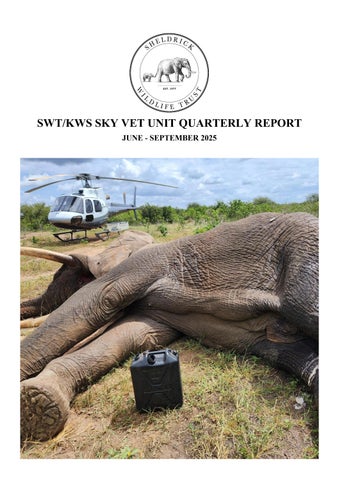
SWT/KWS SKY VET UNIT QUARTERLY REPORT JUNE - SEPTEMBER 2025
SKY VET QUARTERLY OVERVIEW
26 Cases
20 Poaching Cases
22 Elephant Cases
During June to September 2025 the SWT/KWS Sky Vet program was called to handle 26 wildlife cases involving 22 elephants, 1 lion, 4 rhino and 1 giraffe with poaching being the most common cause for treatment. Of the 20 poaching cases, 19 involved elephants and the 1 giraffe. The giraffe was treated for a snare injury and was given a good prognosis. Two elephants were also treated for snare injuries, 7 for spear injuries, 8 for arrow injuries, 1 for a bullet wound and another for a spike injury all of which were also given a good prognosis for a full recovery. The other 3 elephants were treated for natural causes, including one bull which was stuck in mud. One of the elephants was given a guarded prognosis whilst the other two were attended to successfully. The 1 human-wildlife conflict case that was attended to involved a lion which was speared. Following treatment, he was loaded on to a vehicle and relocated away from the community and moved to a safer location. One White rhino was treated in Meru National Park for wounds caused by territorial fights with other rhinos. Three Black rhinos were captured and translocated to Segera Rhino Sanctuary. This was an approved rhino translocation activity to reduce congestion in Lake Nakuru NP. Out of the cases treated there was an overall 96% success rate. The Sky Vet program has deployed KWS vets to the following locations during this reporting period
26 Cases Attended to by the SWT/KWS Sky Vet Unit June - September 2025 25
20
15
Giraffe Rhinos Predators
10
Elephant
5
0 Poaching
Human Wildlife Conflict
Natural Causes
Relocation
Outcomes of Cases Attended to by the SWT/KWS Sky Vet Unit June - September 2025
Successful Cases 96%
Prognosis Poor 4%
Case 1 – 4th June 2025 Elephant
Snared
Nasaru Conservancy
A male elephant was found lame and reported to AMVU. The vet team travelled to the site using an SWT Helicopter, and the same helped in immobilising the bull for examination and treatment.
Immobilisation, examination and treatment The elephant was successfully immobilised using 18mg of Etorphine HCl and attained full immobilisation in 8 minutes. The elephant had a cable wire around the right limb and below the tarsal joint. The affected right hindlimb resulted in a wound with necrotic tissue, pus, and maggots. The cable wire was removed using a wire cutter. The wound was first washed with water to remove debris, then debrided using Hydrogen peroxide. Povidone Iodine was irrigated into the wound, and Alamycin spray was applied to counter local infection. Lastly, a layer of green clay was applied around the wound. A systemic antibiotic, Amoxicillin 100ml, was given intramuscularly. Dexamethasone 20mg was administered to reduce pain and swelling. Prognosis The elephant was revived and favourably woke up shortly after drug administration with a good prognosis.
Case 2 – 5th June 2025 Elephant
Spear
Goshi, North Coast
A male elephant was found lame and reported to AMVU. The vet team travelled to the site using a helicopter, and the same helped in immobilising the bull for examination and treatment. Immobilisation, examination and treatment The elephant was successfully immobilised using 20mg of Etorphine HCl. Full immobilisation was attained in 10 minutes. The bull had a wound on the right hindlimb suspected to be from a spear. Hydrogen peroxide was used to debride the wound, povidone Iodine was used for irrigation, and the wound was locally covered with Oxytetracycline spray. A systemic antibiotic, Amoxicillin 100ml, was administered intramuscularly, and 20ml Dexamethasone was given to reduce pain and inflammation. Prognosis The elephant was revived using 4ml Naltrexone (an antagonist for the immobilisation drug) and favourably woke up four minutes after drug administration. Prognosis is good.
Case 3 – 5th June 2025 Elephant
Arrow
Sala, Tsavo East National Park
A SWT pilot spotted a lame elephant and reported to AMVU. The helicopter helped in immobilising the bull for examination and treatment.
Immobilisation, examination and treatment The elephant was successfully immobilised using 23mg of Etorphine HCl. The elephant was fully immobilised in 8 minutes. Physical examination revealed a wound on the proximal aspect of the left forelimb and another on the thigh region of the left hindlimb. Hydrogen peroxide was used for debridement of the wounds, povidone Iodine was used for irrigation and Oxytetracycline spray was used to act as a fly repellent. Amoxicillin 100ml was used to cover systemic infections, and Dexamethasone 20ml was given to reduce pain and inflammation. Prognosis The elephant was revived using 4ml Naltrexone intravenously (an antagonist for the immobilisation drug) and favourably woke up shortly after drug administration.
Case 4 – 6th June 2025 White Rhino
Natural Causes
Meru National Park
An adult male white rhino was exhibiting marked lameness of the right hind limb. Preliminary observations indicated the animal had sustained multiple injuries suspected of being from a fight with another bull. Immobilisation, examination and treatment The white rhinoceros was darted from a helicopter with 5mgs Etorphine and 80mgs Azaperone. Prior to the commencement of the clinical examination, 50mgs of Butorphanol tartrate was administered intravenously to antagonize the undesirable side effects of etorphine—respiratory depression and systemic hypertension. The injured rhino was found to have sustained multiple traumatic injuries involving the head, thoracic region, and hind limbs, consistent with injuries, likely from a territorial fight with another adult male. Notably, a deep puncture wound was observed on the right hind limb leading to marked lameness. All the wounds were cleaned with water and debrided using Hydrogen peroxide to remove necrotic tissue. This was followed by flushing with Iodine for disinfection. The wounds were then packed with Oxytetracycline pessaries and covered with green clay, known for its wound-healing properties. An antibiotic aerosol spray was applied topically to deter fly infestation and minimize the risk of myiasis. The rhino was given 2,500 mgs of Flunixin, 18,000mgs of long-acting Amoxicillin as a broad-spectrum antimicrobial and 6,000mgs of Metabolic stimulants were administered to enhance physiological recovery and support systemic function. Prognosis Given the extent of the injuries, the prognosis for full recovery was assessed as poor to favourable.
Case 5 – 7th June 2025 Black Rhino
Relocation
Lake Nakuru National Park
This was an approved rhino translocation activity to reduce congestion in Lake Nakuru NP, with necessary approval(s) to Segera Wildlife Sanctuary. This was a part of large operation exercise of translocating 21 rhinos to Segera Wildlife Sanctuary to populate and enhance the genetic diversity of this meta population.
Immobilisation The rhinos were searched through support of a SWT helicopter and driven to a clear grassland area. The rhinos were darted with a combination of Etorphine Hcl and Azaperone Tartrate with dosages varying depending on age and size. We rapidly administered intravenously 5mg Butorphanol plus 40mg Doxapram, to ensure stable and safe levels of anaesthesia. Rhino respiration was supplemented with oxygen and vital parameters were monitored. The rhinos was ear tagged and clean animals were ear notched. A total of three rhinos were darted, one at a time, then loaded into the transport crate. Samples were also collected from each rhino such as blood, fecal matter, ticks and tissue/hair samples. Relocation, revival and prognosis After reversal of anaesthesia each rhino was loaded onto the translocation crate and lifted using a lifting crane onto the transport lorry and transported successfully the same day to Segera Wildlife Sanctuary.
.
Case 6 – 15th June 2025 Elephant
Spike
Kari Ranch, Chyulu Hills
This injured elephant was spotted limping on his right forelimb at KARI area by the SWT pilot during the routine patrols. Immobilisation, examination and treatment This bull was immobilized using 20mg Etorphine hydrochloride delivered remotely in a 3 cc Dan inject dart. Darting was done from the helicopter, and it took 10 minutes for full anaesthesia to be achieved. Examination revealed sand and small rocks lodged between the foot pad and a spike wound on the foot area on his right forelimb. The wound was thoroughly cleaned, debrided and flushed with Hydrogen peroxide, rinsed with clean water, infused with tincture of Iodine and then packed with antibiotic pessaries and a topical antibiotic spray was applied on the wound. He was additionally given Amoxicillin antibiotics and Flunixin anti-inflammatory parenterally. Reversal and prognosis He was reversed from anaesthesia using 200mg Naltrexone hydrochloride given intravenously via a prominent ear vein. He rose few minutes later and slowly walked away. Prognosis is good. .
Case 7 – 16th June 2025 Lion
Human-Wildlife Conflict
Mbirikani Ranch
This injured lion was spotted by KWS team in Mbirikani community area and close to a school. He was alone and wounded. He was also reported to be off feed for approximately 42 hours.
Immobilisation, examination and treatment The lion was successfully immobilized using a combination of 5mg Medetomidine and 200mg Ketamine delivered. Darting was done from the vehicle, and it took 8 minutes for the drug to achieve its full effects. He was loaded on to a vehicle and relocated away from the community and moved to a safer location within the ranch. Examination revealed several fight wounds on the left flank, spine and the left hind limb. He also had a spear wound on the left shoulder with a chip fracture of the scapular blade. The wounds were thoroughly cleaned with water and infused with Iodine and antibiotic ointment then sprayed with a topical antibiotic. Additionally, he received shots of Amoxicillin antibiotics and Meloxicam antiinflammatory. Prognosis He was revived from anaesthesia and he rose 10 minutes later and walked away slowly. Prognosis is fair. .
Case 8 – 26th June 2025 Elephant
Natural Causes
Kaluku, Tsavo
This elephant was spotted by the SWT Rangers in Kaluku airstrip area having a swelling on her right forelimb. Immobilisation, examination and treatment This bull was successfully immobilized from a helicopter using 18mg Etorphine hydrochloride delivered remotely in a 3cc Dan inject dart and it took 8 minutes for the drug to achieve its full effect. Examination revealed an inflamed carpal joint anteriorly. Upon further examination, the swollen area appeared to contain a small pocket of pus which on lancing, a small thorn was recovered. The injury was confined to subcutis with little muscle involvement. The joint was intact. The wound was cleaned and the pus completely evacuated from the wound. This was followed by flushing with Hydrogen peroxide, rinsing thoroughly with water and infusing with tincture of Iodine. The wound was then packed with Antibiotic pessaries and topical Antibiotic spray application. Additionally, he received shots of Amoxicillin antibiotics and flunixin anti-inflammatory parenterally. Prognosis He was given a good prognosis. .
Case 9 – 28th June 2025 Elephant
Spear
Ithumba, Tsavo East National Park
This injured elephant was spotted by the SWT pilot during patrols in the Ithumba area injured and limping on his right forelimb. Immobilisation, examination and treatment This bull was successfully immobilized using 20mg Etorphine hydrochloride delivered remotely in a 3cc Dan inject dart. Darting was done from a helicopter and was under anaesthesia 8 minutes later. Examination revealed a deep septic spear wound on the lateral aspect of the proximal right humerus. The wound was thoroughly cleaned and the pus evacuated from the wound. All devitalized tissues within the wound were removed, followed by flushing with Hydrogen peroxide and rinsing the wound thoroughly with water. The wound was thereafter infused with tincture of Iodine and packed with Antibiotic pessaries. Green clay was packed into the wound and then sprayed with a topical antibiotic. He was additionally given Amoxicillin antibiotics and flunixin anti-inflamatories parenterally. Prognosis He was revived from anaesthesia. He rose 3 minutes later and slowly walked away. Prognosis is good.
.
Case 10 – 1st July 2025 Elephant
Spear
Kajiado West
This male elephant bull was sighted and reported by the ‘SORALO ( South Rift Association of Land Owners) rangers while on patrol. The bull had severe limp, and his right front limp was severely swollen
Immobilisation, examination and relocation The animal was darted from a helicopter using Etorphine hydrochloride. Anaesthesia took effect within 10 minutes, and the animal went down on a right lateral recumbence. There was a penetrating wound at the carpal joint of the right front limb. The wound at the front appeared to have ‘healed” while there was a septic wound at the back. The front part was lanced, and copious amounts of pus was drained from the abscess, while the back wound was thoroughly cleaned. The abscess was drained, the capsule was flushed with Hydrogen peroxide, then Metronidazole IV fluid, and finally Iodine then sprayed with Alamycin spray. The same treatment was applied to the back wound. 22,500mg Amoxicillin and 100mg Meloxicam were given intramuscularly. Reversal and prognosis Prognosis is fair. .
Case 11 – 2nd July 2025 Elephant
Spear
Vitengeni, North Coast
This elephant was spotted by the SWT pilot during routine patrols in Vitengeni area having a wound on his perianal area. Immobilisation, examination and treatment This bull was successfully immobilized using 20mg Etorphine delivered remotely in a 3cc Dan-inject dart. Darting was done from the helicopter, and it took 8 minutes for the drug to achieve its full effects. Examination revealed a deep septic spear wound on the perianal area, left rump and left flank. The wounds were thoroughly cleaned with water, flushed with Hydrogen peroxide, rinsed with water and infused with tincture of iodine. The wounds were thereafter packed with antibiotic pessaries, green clay and then sprayed with a topical antibiotic. He also received shots of Amoxicillin antibiotics and Flunixin anti-inflammatory parenterally. Reversal and prognosis He was reversed from narcosis using 200mg of Naltrexone hydrochloride given intravenously via the ear vein. He rose 3 minutes later and walked away. Prognosis is good.
Case 12 – 2nd July 2025 Elephant
Arrow
Vitengeni, North Coast
This injured elephant was spotted with a wound on his right lower abdomen at Vitengeni area by the SWT pilot during the routine patrols.
Immobilisation, examination and treatment This bull was immobilized from the helicopter using 20mg Etorphine hydrochloride delivered remotely in a 3 cc Dan-inject dart. It took 10 minutes for full anaesthesia to be achieved. Examination revealed a septic arrow wound on his right abdominal area. An arrowhead was also discovered lodged in the abdominal muscles. The arrow was surgically retrieved. The wound was thoroughly cleaned, debrided, flushed with Hydrogen peroxide, rinsed with clean water, infused with tincture of Iodine and then packed with antibiotic pessaries and a topical antibiotic spray was applied. He was additionally given Amoxicillin antibiotics, Flunixin anti-inflammatory parenterally and dexamethasone intravenously. Reversal and prognosis He was reversed from anaesthesia using 200mg Naltrexone hydrochloride given intravenously via a prominent ear vein. He rose few minutes later and slowly walked away. Prognosis is good.
.
Case 13 – 5th July 2025 Elephant
Arrow
Komboyo, Tsavo East National Park
This elephant was spotted by the SWT pilot during routine patrols in Komboyo limping on his left forelimb.
Immobilisation, examination and treatment This bull was successfully immobilized using 20mg Etorphine hydrochloride delivered remotely in a 3cc Dan inject dart. Darting was done from the helicopter, and it took 10 minutes for full anaesthesia to be achieved. Examination revealed a deep septic arrow wound on the lateral side of the left humerus. The septic wound was cleaned and pus completely evacuated. This was followed by flushing with Hydrogen peroxide, rinsing thoroughly with water and infusing with tincture of Iodine. The wound was then packed with antibiotic pessaries, green clay and topical antibiotic spray application. Additionally, he received shots of Amoxicillin antibiotics and Flunixin anti-inflammatory parenterally. Reversal and prognosis He was reversed from anaesthesia using 200mg Naltrexone hydrochloride given intravenously via a prominent ear vein. He rose few minutes later and slowly walked away. Prognosis is good.
.
Case 14 – 12th July 2025 Giraffe
Snared
Sagala Ranch, Taita
This giraffe was spotted by KWS and Wildlife Works Rangers with a winch wire snare on his neck.
Immobilisation, examination and treatment This giraffe was successfully immobilized using 13mg Etorphine hydrochloride and 60mg Azaperone delivered remotely in a 3cc Dan inject dart. Darting was done from the helicopter, and it took 8 minutes for the drug to achieve its full effects. Examination revealed a winch wire snare on his neck which had inflicted a cut wound on the neck region. The wound was cleaned thoroughly and disinfected using tincture of Iodine and sprayed using a topical antibiotic. He was additionally given Amoxicillin antibiotic parenterally. Reversal and prognosis He was revived using 130 mg of Naltrexone hydrochloride given intravenously via the jugular vein. He rose 3 minutes later and walked away. Prognosis is good.
.
Case 15 – 1st August 2025 Elephant
Arrow
Naibosho Conservancy
The rangers reported the injured male elephant exhibiting signs of lameness and behavioural distress. Immobilisation, examination and treatment Upon visual assessment, the elephant had a unilateral penetrating wound located on the lateral aspect of the right forelimb, specifically involving the carpal joint. The injury was consistent with trauma caused by an arrow, which had subsequently dislodged, likely due to tissue necrosis and movement. The elephant was immobilized with 16mg of Etorphine in the hip muscles using the Dan-inject system from a safe distance. The elephant was safely immobilized within 6 minutes post-darting. Examination revealed a wound measuring approximately 6-8 cm in diameter, with associated swelling and purulent discharge, localized cellulitis and marked sensitivity to palpation of the carpal joint. Evidence of penetrating trauma with a high risk of septic arthritis due to proximity to the joint capsule. No evidence of systemic debilitation (normal mucous membranes, respiratory rate, and no signs of dehydration). The necrotic tissues in the infected wounds were debrided, and the pus was drained. The wounds were thoroughly cleaned with water and Hydrogen peroxide then flushed with Iodine. Topical Oxytetracycline spray and Cloxacillin cream 3,340 mgs were applied to the wounds topically. Anti-inflammatory: 4,000 mgs Flunixin and Antibiotic: 25,000 mgs Amoxicillin were administered. Prognosis Absence of systemic illness and systemic treatment make the prognosis favourable.
.
Case 16 – 3rd August 2025 Elephant
Snared
Gazi, Tsavo East National Park
This elephant was spotted by the SWT pilot during routine patrols in with a snare on his left forelimb. Immobilisation, examination and treatment This bull was successfully immobilized using 20mg Etorphine hydrochloride delivered remotely in a 3cc Dan inject dart. Darting was done from the helicopter, and it took 10minutes for the drug to achieve its full effects. Examination revealed a deep septic winch snare wound on the foot area of the left forelimb and had inflicted a deep wound on the area. The snare was cut using a wire cutter and the wound thoroughly cleaned with water, flushed with Hydrogen peroxide, rinsed with water and infused with tincture of Iodine. The wound was thereafter applied with green clay and topically sprayed with an antibiotic. He also received shots of Amoxicillin antibiotics and Flunixin anti-inflammatory parenterally. Prognosis He was reversed from narcosis using 200mg Naltrexone hydrochloride given intravenously via the ear vein. He rose 3 minutes later and walked away. Prognosis is good.
Case 17 – 5th August 2025 Elephant
Rescue
Kilifi, North Coast
These two elephants were reported by the KWS team of Arabuko Sokoke to have been stuck in the mud at Kilifi creek on the night of 4th August.
Rescue One bull was stuck on its side while the other was standing with all limbs stuck in the mud. The terrain was extremely bad, and cars could not get near the elephants. They stood approximately a kilometre away and this made it difficult for the rescue operation. The first bull was tied with ropes and a bulldozer pulled him out of the mud. He was immediately given rehydrating fluids and Dexamethasone. He later succumbed due to exhaustion. Likewise, the second bull was tied with ropes. The ropes broke multiple times after several attempts to rescue him and as it was late at night they could not be replaced immediately. The rescue operation was stopped and was to be continued the following day. The next morning the elephant was pulled out of the mud by the bulldozer after being tied with ropes. He rose and slowly walked away a few meters from where he was stuck. On the morning of 7th August, he was reported stuck again in the mud at Kilifi creek a few meters from where he was previously stuck. This time he showed signs of body weakness. The TMVU team went to his rescue, gave him rehydrating fluids and pulled him out of the mud. He rose and walked away slowly. He was driven out of the muddy environment by a helicopter.
.
Case 18 – 10th August 2025 Elephant
Arrow
Chai Rock, Tsavo East National Park
This injured elephant was spotted by the SWT pilot during routine patrols near chai rock area with a wound on the right rump.
Immobilisation, examination and treatment This bull was darted from a helicopter with 20mg Etorphine hydrochloride delivered remotely in a 3cc Dan inject dart. It took 10 minutes for the drug to achieve its full effects. Examination revealed a shallow septic arrow wound on the right rump area. The wound was thoroughly cleaned and the pus completely evacuated from the wound. This was followed by flushing with Hydrogen peroxide and rinsing the wound thoroughly with water. The wound was thereafter infused with tincture of Iodine, packed with antibiotic pessaries and topical antibiotic spray applied. Additionally, he received shots of Amoxicillin antibiotics parenterally. Prognosis He was reversed from narcosis using 200mg of Naltrexone hydrochloride given intravenously via a prominent ear vein. He rose 3 minutes later and walked away slowly. Prognosis is good.
.
Case 19 – 3rd September 2025 Elephant
Spear
Kuku Group Ranch
This injured elephant was spotted with a wound on his left dorsal flank at Kuku ranch area by KWS rangers in the area. Immobilisation, examination and treatment He was immobilized from a helicopter with 20mg Etorphine hydrochloride delivered remotely in a 3cc Dan inject dart. It took 10 minutes for full anaesthesia to be achieved. Examination revealed a deep fresh spear wound on his left flank area. The wound was thoroughly cleaned and infused with tincture of Iodine then packed with antibiotic pessaries. Topical antibiotic spray was applied on the wound. He was additionally given Amoxicillin antibiotics and flunixin anti-inflammatories parenterally Prognosis Prognosis is grave and recommended for euthanasia on animal welfare grounds.
.
Case 20 – 18th September 2025 Elephant
Arrow
Taita Sisal Estate
This elephant was spotted by the Taita sisal management with a wound on his left rump.
Immobilisation, examination and treatment This bull was darted from a helicopter and successfully immobilized using 20mg Etorphine hydrochloride delivered remotely in a 3cc Dan inject dart. It took 10 minutes for full anaesthesia to be achieved. Examination revealed a deep septic arrow wound on the left rump and on the right elbow joint. An arrowhead was surgically retrieved from the muscles of the rump. The wounds were thoroughly cleaned. This was followed by flushing with Hydrogen peroxide, rinsing thoroughly with water and infusing with tincture of Iodine. The wounds were then packed with antibiotic pessaries and topical antibiotic spray application. Additionally, he received shots of amoxicillin antibiotics and flunixin anti-inflammatory. Prognosis He was reversed from anaesthesia using 200 mg of Naltrexone hydrochloride given intravenously via the ear vein. He rose few minutes later and walked away into the bushes. Prognosis is good.
.
Case 21 – 18th September 2025 Elephant
Spear
Taita Sisal Estate
This elephant was spotted by the Taita sisal management at the area with a wound on his right flank. Immobilisation, examination and treatment This bull was successfully immobilized using 20mg Etorphine hydrochloride delivered remotely in a 3cc Dan inject dart. Darting was done from the helicopter, and the elephant was under full anaesthesia in 10 minutes. Examination revealed a deep septic spear wound on the right flank. The wound was thoroughly cleaned with water, Hydrogen peroxide, rinsed with water and infused with tincture of Iodine. The wound was thereafter packed with antibiotic pessaries, green clay application and sprayed with a topical antibiotic. He also received shots of Amoxicillin antibiotics parenterally. Prognosis Prognosis is good.
.
Case 22 – 18th September 2025 Elephant
Spear
Olare Conservancy
A solitary adult female African elephant exhibiting signs of injury and behavioral signs was reported. Given the challenging terrain and the evasive nature of the animal, helicopter support was requested.
Immobilisation, examination and treatment The elephant was immobilized with 15mg Etorphine intramuscularly using the Dan-inject system from a helicopter. The elephant was safely immobilized within 3 minutes. Examination revealed multiple puncture wounds on the dorsal right flank consistent with spear injury, extensive soft tissue swelling and superficial abrasions at the left lumbosacral region, a minor superficial laceration with minimal exudate at the ventral abdomen, and a large fluctuant abscess approximately 20cm in diameter. The abscess was lanced to evacuate purulent material then the necrotic tissues were debrided and pus drained. The wound was then lavaged with water, Hydrogen peroxide and Iodine, packed with Cloxacillin ointment and green clay then sprayed with Oxytetracycline. The elephant was also administered with 10,000mg Flunixin and 30,000mg Oxytetracycline. Prognosis Although the wound was deep and septic, the prompt treatment gives the elephant a good prognosis.
.
Case 23 – 18th September 2025 Elephant
Arrow
Ripoi Wildlife Conservancy
The elephant was observed with visible external wounds, including one suspected to be caused by an embedded arrow. Due to the elephant’s large size and rough terrain, aerial support was requested.
Immobilisation, examination and treatment The elephant was immobilized with 18mg Etorphine using the Dan-inject system delivered from a helicopter. The elephant was safely immobilized within 7 minutes on the left lateral recumbency. Examination revealed a fresh soft tissue laceration about 10cm diameter, with a mild haemorrhagic exudate but no foreign object on the right dorsal flank and a penetrating wound with a retained arrowhead visible subcutaneously on the left dorsal thoracic region. The arrowhead was successfully retrieved then the wounds were cleaned with water, debrided with Hydrogen peroxide and Iodine to remove and necrotic and inflamed tissue. Cloxacillin cream and topical Oxytetracycline spray were then applied. The elephant was also given 400mg Dexamethasone anti-inflammatory and 150,000mg Oxytetracycline antibiotic. Prognosis Prognosis is good following timely treatment and removal of the arrowhead. The wounds were fresh, with minimal necrosis or signs of chronic infection, further supporting a favourable outcome
.
Case 24 – 26th September 2025 Elephant
Natural Causes
Kirimon Conservancy, Laikipia
The elephant was reported by the Community Conservancy Rangers to be limping on her left front forelimb.
Immobilisation, examination and treatment The elephant was immobilized by darting from a helicopter with a dart containing 17mg Etorphine. The immobilization took effect in 8 minutes where she went into sternal recumbency. She was positioned to right lateral recumbency for treatment. The distal limb and carpal joint of the left forelimb was swollen, with no external lesions. A supportive treatment was indicated and administered to cover for secondary infections and pain relief as follows: • •
Long-acting Amoxicillin, 30,000 mg IM. Phenylbutazone, 12,000 mg, IM.
Prognosis The cause of lameness could not be established from the external examination of the limb. The swollen part of the left forelimb around the carpal joint was suspected to be attributed to possible strain (injury to muscle or ligament). Therefore, a strong non-steroidal anti-inflammatory drug was administered to offer pain relief, and a long-acting antibiotic was administered to prevent secondary infection. The condition has a guarded prognosis.
.
Case 25 – 28th September 2025 Elephant
Bullet Wound
Galana Ranch
This elephant was spotted by the SWT pilot in Galana area wounded on his left forelimb.
Immobilisation, examination and treatment This elephant was successfully immobilized using 18mg Etorphine hydrochloride delivered in a 3cc Dan inject dart. Darting was done from the helicopter, and it took 11 minutes for the drug to achieve its full effect. Examination revealed a through and through wound, from a high velocity projectile entering the medially through the distal humerus and exiting near the elbow joint. The wound was thoroughly cleaned with water, debrided with Hydrogen peroxide, rinsed with water and infused with tincture of Iodine. The wound was thereafter packed with antibiotic pessaries and sprayed with a topical antibiotic. He was given Amoxicillin antibiotics and Meloxicam parenterally. Prognosis Prognosis is good. No bony tissue was involved. Only soft tissues were affected.
Case 26 – 30th September 2025 Elephant
Arrow
Ndatani, Kilifi
This elephant was spotted by an SWT pilot during routine patrols with having a wound on her right flank.
Immobilisation, examination and treatment This elephant was successfully immobilized using 20mg Etorphine hydrochloride delivered remotely from the helicopter, and it took 9 minutes for the elephant to be fully anaesthetised. Examination revealed a deep septic arrow wound on the right flank area. The septic wound was cleaned thoroughly, followed by flushing with Hydrogen peroxide, rinsing thoroughly with water and infusing with tincture of Iodine. The wound was then sprayed with a topical antibiotic Additionally, she received shots of Amoxicillin antibiotics and Meloxicam anti-inflammatory parenterally. Prognosis Prognosis is good. She was reversed from anaesthesia using 200mg of Naltrexone hydrochloride given intravenously via the ear vein. She rose 3 minutes later and walked away into the bushes.