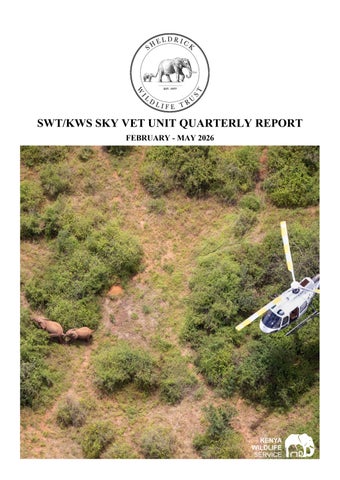
SWT/KWS SKY VET UNIT QUARTERLY REPORT FEBRUARY - MAY 2026
SKY VET QUARTERLY OVERVIEW
10 Cases
5 Poaching Cases
3 Elephant Cases
During February to May 2026 the SWT/KWS Sky Vet program, which assists the Ground Units and operates independently to treat animals in remote/inaccessible terrain, was called to handle 10 wildlife cases. The Sky Vet Unit assisted in the rescue of 3 elephant calves which were taken to the Neonate Unit in Kaluku and treatment of 2 buffalo, and 1 zebra with snares in the coastal region. Two giraffes were also treated for snare injuries within the Chyulu Hills and 2 for natural causes at the Coast and in Tsavo West. The 3 elephant rescues came from all over Kenya, Masai Mara, Laikipia and Tsavo Ecosystem, highlighting the extent and importance of the Sky Vet Unit. With the ever-growing aerial fleet, increased aerial patrols and additional helicopters increases the chance of SWT finding and treating an animal in time. This is reflected in the outcomes with only one giraffe given a guarded prognosis as the snare injury was severe and body condition poor. The remaining 6 cases were all given a good prognosis and should recovery fully in the wild. These animals may have succumbed to their injuries without the expert collaboration and support between SWT Units, KWS, KWS and other organisations. The Sky Vet program has deployed KWS vets to the following locations during this reporting period
10 Cases attended to by SWT/KWS Sky Vet Unit February - May 2026 6
5
4 Buffalo Giraffe
3
Plains Game Elephant 2
1
0 Poaching
Human Wildlife Conflict
Natural Causes
Rescue
Outcomes of Cases attended to by SWT/KWS Sky Vet Unit February - May 2026
Prognosis Poor 10%
Successful Cases 60%
Taken to Orphanage 30%
Case 1 – 5th February 2026 Elephant
Rescue
Masai Mara National Reserve
The SWT/KWS Mara Mobile Veterinary Unit received a distress call reporting a young male elephant calf found abandoned in the Zachariah area within the Masai Mara National Reserve.
Rescue Upon examination, the calf was estimated to be less than one month old and still fully milk dependent. A rapid physical assessment revealed that although he appeared weak, he was stable, with vital parameters within normal limits. The Masai Mara National Reserve Rangers made efforts to locate nearby elephant herds in the hope of facilitating a possible mother-calf reunion; however, no herds were identified in the vicinity. The exact circumstances leading to the calf’s abandonment remain unknown. Given his young age and milk dependency, survival in the wild without maternal care was not possible. It was therefore decided that the calf be rescued and transferred to an orphanage for continued care, rehabilitation, and eventual rewilding. Due to the late hour, the calf was monitored overnight at the Mara Veterinary Camp, with rescue logistics scheduled for implementation the following morning. The calf remained stable overnight, although he was still weak. He was kept in a room and wrapped in a blanket to keep him warm and comfortable. However, early the following morning, he became weaker and had difficulty standing, despite his vital parameters remaining within normal limits. He was placed on intravenous fluids for stabilization and subsequently airlifted to the Sheldrick Wildlife Trust Kaluku Stockades. The prognosis is ranging from fair to poor.
.
.
Case 2 – 7th February 2026 Elephant
Rescue
Ol Jogi Ranch, Laikipia
The SWT/KWS Unit were called after receiving a report in Ol Jogi Ranch, Laikipia. Unfortunately, the calf had been beaten, had her tail cut off, injuries to the hind legs most likely from a rungu (a traditional wooden throwing club used in East Africa it features a long, slender handle and a heavy rounded knob at the end) and slashes from a panga (machete. Curiously there were two holes in her ear which is one way the locals “mark” their animals. Young boys are the most likely culprits. M
Case 3 – 1st March 2026 Giraffe
Snared
Chyulu Hills
This giraffe was reported in the Chyulu area having a winch wire snare on her left hind leg. Immobilisation, examination and treatment This giraffe was successfully immobilized using 13.5mg Etorphine hydrochloride and 40mg Azaperone delivered remotely in a 3cc Dan inject dart. Darting was done from the helicopter, and it took 8 minutes for the drug to achieve its full effects. Examination revealed a snare on the distal hind limb. The snare had inflicted a deep wound to the leg. The snare was immediately cut free using wire cutters and the wound thoroughly cleaned with water then debrided using Hydrogen peroxide and infused with tincture of Iodine. It was thereafter sprayed with a topical antibiotic. She was additionally given Amoxicillin antibiotic parenterally. Prognosis She was revived using 135mg of Naltrexone hydrochloride given intravenously via the jugular vein. She rose 3 minutes later and walked away. Prognosis is good.
.
Case 4 – 3rd March 2026 Giraffe
Snared
Kari Ranch, Chyulu
This giraffe was spotted with a wire on his neck by the KWS rangers in Kari.
Immobilisation, examination and treatment This giraffe was darted from a helicopter and immobilized successfully using 14mg Etorphine hydrochloride and 40mg Azaperone delivered remotely in a 3cc Dan inject dart. It took 9 minutes for the drug to achieve its full effect. Examination revealed a winch wire snare around the neck. The snare had inflicted a deep septic wound to the neck. The wire snare was cut using wire cutters. The wound was then cleaned with water, debrided with Hydrogen peroxide and infused with tincture of Iodine. Topical antibiotic spray was also applied to the wound. Additionally, he was given Amoxicillin antibiotic parenterally. Prognosis Reversal from narcosis and after 2 minutes he woke up and walked away. Prognosis is good.
.
Case 5 – 27th March 2026 Zebra
Snared
Amu Ranch, North Coast
This snared zebra was spotted at the edge Amu ranch. She was limping and had a cable snare on her distal right fore-limb. Immobilisation, examination and treatment This zebra was successfully immobilized using a combination of 6mg Etorphine hydrochloride and 50mg azaperone delivered remotely in a 1.5cc Dan- inject dart. Darting was done from foot, and it took 6 minutes for full anaesthesia to be achieved. Examination revealed a cable wire snare on the distal right forelimb, at the pastern level. The snare had inflicted a wound on the area. The snare was cut using wire cutters and the wound thoroughly debrided. This was followed by flushing with hydrogen peroxide, rinsing with water and infusing with tincture of iodine. Topical antibiotic spray was also applied on the wound. Additionally, she received Meloxicam antiinflammatories and amoxicillin antibiotics parenterally. Prognosis Prognosis is good.
.
Case 6 – 6th April 2026 Buffalo
Snared
Kipini Conservancy, North Coast
This snared buffalo was spotted by the SWT pilot during routine patrols in the Conservancy. The Southern Veterinary Team was notified and airlifted to attend to the buffalo.
Immobilisation, examination and treatment This buffalo was successfully immobilized using a combination of 5mg Etorphine and 50mg Azaperone delivered in a dart from the helicopter and it took 6 minutes for full anaesthesia to be achieved. Examination revealed a thick winch wire snare tightly bound around the neck of the buffalo. The snare had inflicted a deep wound on the ventral neck, partially severing the trachea. The snare was cut using wire cutters and the resultant injuries cleaned thoroughly. The wound was then infused with tincture of Iodine followed by a topical antibiotic spray. She was additionally given Amoxicillin antibiotics and Meloxicam antiinflammatories parenterally. Prognosis She rose 3 minutes after the anaesthetic was reversed and dashed to join her herd. Prognosis is fair.
.
Case 7 – 6th May 2026 Giraffe
Natural Causes
Bora Bora, Diani
The Bora Bora wildlife sanctuary reported that one giraffe had been observed with blepharospasm, tearing, bleeding and blindness on the left eye. Immobilisation, examination and treatment The giraffe was sedated using 10mg of Etorphine hcl and 40mg Azaperone. The combination was delivered from foot, and it took ten minutes for full anaesthesia to be achieved. On examination the giraffe had a poor body condition score of 2/5 and was blind in the left eye. The eye was actively tearing, with pan-ophthalmitis from an injury that affected the cornea and the sub-conjunctiva of the upper and lower eyelid. The giraffe was given a subconjunctival injection of Amoxicillin and dexamethasone followed by infusion of a Cloxacillin eye ointment. Parenteral Amoxicillin antibiotics, Quinapramine and anti- inflammatories were also administered. Prognosis Prognosis is guarded as the giraffe’s body condition was poor.
.
Case 8 – 11th May 2026 Giraffe
Natural Causes
Tsavo West National Park
A SWT helicopter doing a patrol in Rombo area spotted a giraffe with an injury to the back and reported it to the Unit immediately. Immobilisation, examination and treatment The giraffe was successfully immobilised using a combination 13mg Etorphine hydrochloride and 50mg Azaperone. Darting was done from the helicopter, and it took 10 minutes for the anaesthesia to achieve its full effects. After successfully and safely roping down the animal, she was reversed immediately from narcosis then restrained manually. Examination revealed that she had a benign ulcerative wound at the right upper lumbar region. The wound was cleaned thoroughly with water, flushed with Hydrogen peroxide infused with Iodine then sprayed with an antibiotic topical spray. In addition, she was given Amoxicillin antibiotics and Ivermectin parasiticide, Prognosis The animal was then released and she rose immediately and walked away. Prognosis is good. The animal was in good body condition, and the benign wound was treated.
Case 9 – 16th May 2026 Buffalo
Snared
Manda Bay, Lamu
This buffalo was spotted by the Manda Bay Beach resort management. She was limping with a snare deeply bound on its left hind limb. Immobilisation, examination and treatment The adult female buffalo was sedated using 5mg Etorphine and 50mg Azaperone. She was darted from a vehicle using a 1.5 cc Dan inject dart and took approximately eight minutes to be fully subdued. On examination the buffalo had a poor body condition score with a sunken perineum and prominent ribs and spinous processes. The nylon rope snare was tightly bound to the animals left interphalangeal joint region resulting in skin and soft tissue injury. The snare was promptly cut and the wound thoroughly cleaned using clean water, Hydrogen peroxide, povidone Iodine and antibiotic spray. The buffalo was given parental Amoxicillin antibiotics and Meloxicam anti-inflammatories respectively. Prognosis Good. Most vital structures on the affected area were intact. .
Case 10– 20th May 2026 Elephant
Human – Wildlife Conflict
Voi, Tsavo East National Park
Voi Safari Lodge reported that a young elephant calf had been discovered trapped inside a septic tank. That she had been found at all was a miracle: The calf very easily could have gone undetected until morning — at which point it probably would have been too late.
Immobilisation, examination and rescue After coordinating with the Kenya Wildlife Service (KWS), the SWT Ground and Aerial teams made their way to the scene with the neccesary rescue equuiment. The tank was dark and so deep that the calf was almost fully submerged and was flailing around to keep her head above water. The team managed to loop ropes around her and hauled her to firm ground, where they cleaned her off and after a through assessment found her to be physically unharmed. Given the late hour and the complete lack of elephants in the area, KWS deemed a rescue necessary. She needed to be fed, warmed up, and shown that she was safe and no longer alone. The little elephant was driven to our nearby Voi stockades, where she was placed in a stockade surrounded by our orphans and given a bottle of milk. She has a good prognosis for making a full recovery.
.