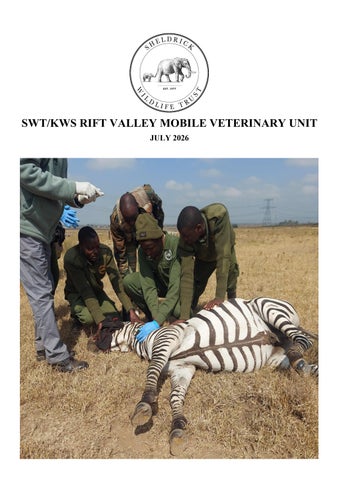
SWT/KWS RIFT VALLEY MOBILE VETERINARY UNIT JULY 2026
Introduction
16 Cases in July 2026
88% Success
11 Poaching Cases
July Report by Dr. Titus Kaitho The Vet Unit attended to 16 cases during July. Thankfully most of these cases had a positive outcome. Bushmeat poaching continues to be the main cause for treatment, targeting herbivores such a as zebra and giraffe. The Unit also relocated an ostrich and a leopard that were instigating human-wildlife conflict. A baby hyena cub was rescued after it was found alone, and two zebras were treated for natural injuries. Acknowledgement We sincerely thank Sheldrick Wildlife Trust (SWT) for support, resources & sponsorship of the Rift Valley Mobile Veterinary Unit. Special appreciation goes to SWT and Angela Sheldrick, for their unwavering support in the work undertaken by the Unit. Kenya Wildlife Service is acknowledged for operational & leadership support. We sincerely thank all stakeholders and scouts and all who reported wildlife cases in distress.
SWT/KWS Rift Valley Mobile Vet Unit Treatment Locations July 2026
Case Details Date
Species
Area Found
10-Jul-26
Giraffe
Naivasha
Snared
Prognosis of this case is good
Successfully Treated
13-Jul-26
Zebra
Mt Longonot
Snared
Prognosis of this case is good
Successfully Treated
13-Jul-26
Giraffe
Naivasha
Snared
Snared by a tight wire snare on right front leg.
Successfully Treated
13-Jul-26
Hyena
Naivasha
Rescue
The hyena cub was dehydrated and not eating anything
Taken to Orphanage
15-Jul-26
Ostrich
Naivasha
HWC
Female ostrich was rogue and had badly injured a worker in the Island
Task Successful
15-Jul-26
Leopard
Soysambu Conservancy
HWC
The leopard had been trapped in the reception area of the hotel
Task Successful
17-Jul-26
Giraffe
Crater Lake Conservancy
Snared
The giraffe had a tight wire snare on the right hind leg
Prognosis Poor
17-Jul-26
Giraffe
Crater Lake Conservancy
Snared
The giraffe had a wire snare on the left hind leg
Successfully Treated
20-Jul-26
Zebra
Gilgil
Snared
Snared by a nylon rope which had severely wounded the right hind leg
Successfully Treated
24-Jul-26
Zebra
Gilgil
Natural Causes
Cause of severe lameness was fusion due to chronic arthritis
Successfully Treated
24-Jul-26
Zebra
Gilgil
Snared
On examination the zebra had a wound caused by a snare on the neck
Successfully Treated
24-Jul-26
Zebra
Gilgil
Snared
The zebra had been snared on the neck by a wire snare
Successfully Treated
24-Jul-26
Zebra
Gilgil
Snared
The zebra had been snared around the by a long wire snare
Successfully Treated
24-Jul-26
Zebra
Gilgil
Snared
On examination the zebra had been snared on the neck by a wire snare
Successfully Treated
27-Jul-26
Zebra
Gilgil
Natural Causes
The zebra has a heavy tick infestation. The wounds were maggot infested
Successfully Treated
28-Jul-26
Zebra
Gilgil
Snared
The zebra had a nylon rope snare wrapped around the left hindleg
Prognosis Poor
Reason for Intervention
Outcome
Case 1 – 10th July 2026 Giraffe
Snared
Meru Environs
On examination the giraffe had been snared by a tight wire snare on the left front leg. The snared giraffe was driven out of the thick bush & chemically immobilized with 15mg Etorphine and 80mg Azaperone in open grassland but wandered into a corn plantation. The giraffe had a tight wire snare on the left front leg which was slightly swollen. We promptly retrieved the wire snare and administered 60ml Catasol, 1,000mg Flumeg and pour on Bayticol anti-parastic. Prognosis of this case is good.
Case 2 – 13th July 2026 Zebra
Snared
Mt Longonot
The zebra was darted using 5mg Etorphine plus 80mg Azaperone. On examination the male zebra had double winch wire snares which had brutally wounded both left front & hind legs. The wounds were cleaned with water, rinsed with Iodine and sprayed with a fly repellent (Alamycin). Damox (Amoxicillin 9,000mg), Flumeg (anti-inflammatory 300mg), Noromectin (antiparasitic) and Butasal (40ml) were also administered. Prognosis of this case is good.
Case 3 – 13th July 2026 Giraffe
Snared
Wileli Wildlife Conservancy
The giraffe was darted with 15mg Etorphine plus 80mg Azaperone. On examination the giraffe had been snared by a tight wire snare on right front leg which was slightly swollen. The snare was retrieved and the giraffe was administered 1,000mg Flumeg and pour on Bayticol. Prognosis of this case is good.
Case 4 – 13th July 2026 Hyena
Rescue
Naivasha
The baby hyena less than one month old was rescued after several attempts to reunite with mother failed. He was picked at the gate of Naivasha Wildlife Sanctuary at WRTI – Opposite Heritage Hotel. The hyena was dehydrated and not eating anything. The hyena was given normal saline, 5% Dextrose, 2mg Colvasone and Damox anti-biotic as well as Dextrose orally. The next day the hyena was able to drink milk through a syringe and later through a baby feeding teat and meat by mouth. The baby hyena was in good health was moved to Kaluku SWT for specialized care & nurturing.
Case 5 – 15th July 2026 Ostrich
Human - Wildlife Conflict
Crescent Island
This case was reported by Cresent Island management. This was a conflict associated ostrich. The female ostrich was rogue and had badly injured a worker in the Island. She was a real threat to workers, visitors and Island community. Approval for translocation was confirmed by KWS. Immobilization, examination & translocation The female ostrich was darted using 4mg Etorphine plus 80mg Ketamine 10% in a single dart. The ostrich was immediately reversed from anaesthesia on knock down using 100mg Naltrexone given rapidly through. On recovery from anaesthesia the ostrich was walked into a waiting boat in the waterway. The ostrich was translocated by boat by physically restraining the bird by a least 3 - 4 men and later loaded on a Canter Lorry on dryland at Sanctuary farm. The ostrich was transported and safely released at Kedong Wildlife Conservancy, GPS coordinates (a fenced off conservancy). The exercise was successful. Prognosis Prognosis of the case is good.
Case 6 – 15th July 2026 Leopard
Human – Wildlife Conflict
Soysambu Conservancy
The leopard had been trapped in the reception area of the hotel. The leopard was darted using 3mg Medetomidine plus 240mg Ketamine. On examination the leopard was young & in excellent health. The leopard was for immediate release at Lake Nakuru NP. We reversed the leopard from anaesthesia using 20mg Atipamizole given by IM route after one hour of general anaesthesia. The exercise was successful.
Case 7 – 17th July 2026 Giraffe
Snared
Crater Lake Conservancy
The giraffe was darted using 15mg Etorphine plus 80mg Azaperone. The snared giraffe was driven out of the thick bush & roped to knockdown. On examination the giraffe had a tight wire snare on right hind leg which was swollen. The snare was removed and the giraffe given 24,000mg Alamycin, 1,000mg Flumeg, 12ml Noromectin and 80ml Butasal. Prognosis is poor.
Case 8 – 17th July 2026 Giraffe
Snared
Crate Lake Conservancy
The giraffe was darted using 10mg Etorphine plus 60mg Azaperone. The snared giraffe was driven out the bush & roped to knockdown. On examination the giraffe had a wire snare on left hind leg. Working together with SWT/KWS snare retrieval team the wire snare was removed. Fortunately, the giraffe had suffered no injuries Prognosis of this case is good.
Case 9 – 20th July 2026 Zebra
Snared
Naivasha
The zebra was darted using 5mg Etorphine plus 80mg Azaperone. On examination the female zebra had been snared by a nylon rope which had brutally wounded the right hind leg. The wound was cleaned with water, rinsed with Iodine and sprayed with a fly repellent (Alamycin). The zebra was also administered 18,000mg Alamycin, 300mg Flumeg and 7ml Noromectin and 40ml Butasal. Prognosis is good.
Case 10 – 24th July 2026 Zebra
Natural Causes
Naivasha
The zebra was darted using 5mg Etorphine plus 60mg Azaperone. The cause of severe lameness was fusion due to chronic arthritis of the carpus of right front leg. The zebra was administered 5ml Noromectin, 40ml Catasol and pour on Bayticol. Prognosis of this case is good.
Case 11 – 24th July 2026 Zebra
Snared
Naivasha
The zebra was darted using 5mg Etorphine plus 60mg Azaperone. On examination the zebra had been snared and been wounded on the neck by a long wire. The wound was cleaned with water, rinsed with Iodine and sprayed with a fly repellent. Alamycin (Oxytetracycline 18,000mg), Flumeg (Flunixin 300mg), Noromectin (Ivermectin 6ml), Catasol (40ml) and Bayticol (Pour on). Prognosis is good.
Case 12 – 24th July 2026 Zebra
Snared
Naivasha
The zebra was darted using 5mg Etorphine and 60mg Azaperone. On examination the zebra had been snared on the neck by a wire snare. Fortunately, the zebra had suffered no injuries. The zebra was administered 8ml Noromectin, 40ml Catasol, and Bayticol Pour on. Prognosis of this case is good.
Case 13 – 24th July 2026 Zebra
Snared
Naivasha
The zebra was darted using 5mg Etorphine plus 60mg Azaperone. On examination the zebra had been snared by a long wire snare on her neck. Fortunately, the zebra had not suffered any injuries. No treatment was required but the zebra received 8ml Noromectin, 40ml Catasol and Bayticol pour on. Prognosis is good.
Case 14 – 24th July 2026 Zebra
Snared
WRTI, Naivasha
The zebra was darted using 5mg Etorphine and 60mg Azaperone. Examination revealed a wire snare around the neck that was not tight and had caused no injuries so once the snare was removed, no treatment was required. The zebra was administered 8ml Noromectin, 40ml Catasol, and Bayticol Pour on. Prognosis of this case is good.
Case 15 – 27th July 2026 Zebra
Natural Causes
Green Park, Naivasha
The zebra was darted using 4mg Etorphine plus 80mg Azaperone. On examination the female zebra had suffered a brutal tick initiated myasis of the ears. The zebra had a heavy tick infestation. The wounds were maggot infested and had the zebra had lost both external ears. The wounds were cleaned with water, rinsed with Iodine and sprayed with a fly repellent. The zebra was a;sp giben 18,000mg Alamycin, 7ml Flumeg, 40ml Butasal and Bayticol pour on for parasites. Prognosis is guarded.
Case 16 – 28th July 2026 Zebra
Snared
Olmagogo, Naivasha
This case was reported by SW/KWS snare retrieval team. Immobilization, examination and treatment The zebra was darted using 5mg Etorphine plus 80mg Azaperone. On examination the female zebra had been snared by a nylon rope on left hind leg. The lacerations were cleaned with water, rinsed with tincture of Iodine and sprayed with a fly repellent (Alamycin Aerosol). We also administered the following; • • •
Flumeg (Flunixin Meglumine 5%) 300 mg by IM route Noromectin® 1% w/v (Ivermectin) 7mL by SQ route Bayticol Pour on (Flumethrin1%)
The anaesthesia was reversed and the zebra moved off with a good prognosis.