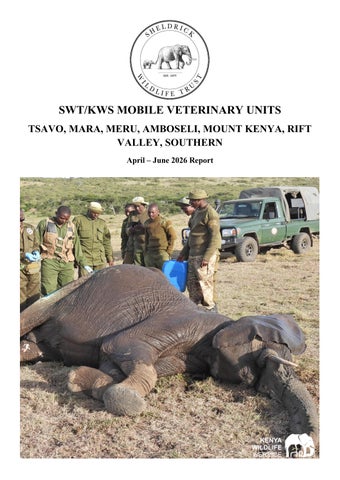
SWT/KWS MOBILE VETERINARY UNITS TSAVO, MARA, MERU, AMBOSELI, MOUNT KENYA, RIFT VALLEY, SOUTHERN April – June 2026 Report
Introduction
159 Cases
52 Poaching Cases
49 Elephant Cases
28 Predator Cases
24 HWC Cases
55% Success
April – June 2026 Report for Tsavo/Southern, Mara, Meru, Amboseli, Mt Kenya and Rift Valley Units. This year, the Sheldrick Wildlife Trust (SWT), launched its newest Vet Unit that operates in the Tsavo and Costal Ecosystems, bring the total of Mobile Vet Units based in Kenya to seven. Across Kenya, the Vet Units have reported moderate rainfall which stopped by June, marking the onset of the dry season. Thankfully due to the heavy rainfall at the beginning of the year there is still access to water and green vegetation, so the animals are in general, in good condition. Overall, the Vet Units attended to 159 cases involving 360 animals primarily attending arrow or speared elephants but also herbivores, zebra, buffalo and giraffes that were caught in snares. The Units also responded to 24 cases of human-wildlife conflict (HWC). The HWC Cases had a variety of causes including relocation due to fencing of important migration corridors, road accidents, poisoning and spearing due to retaliation for livestock predation. As farmland expands, settlements spread, and infrastructure projects encroach upon natural ecosystems, the spaces that once supported diverse species have become fragmented and increasingly scarce which results in increased HWC. In an attempt to find solutions, the Unit conducted assessments on various fragmented land and areas where dangerous animals are residing (buffalo and hippo) to offer their recommendation on mitigating this problem. The Unit also assisted in 2 elephant rescues, collaring of lions and wild dog and tail tagging of 19 giraffes. The other cases were all due to natural causes such as territorial fights amongst other. Overall , the Units had a 55% success rate with 4% and 8% attributed to poaching and HWC respectively.
Case Details Ailment
Elephant
Predators
Rhinos
Poaching HWC Natural Causes Research/ Survey Postmortem Technical Cases Rescue Relocation Collared Grand Total
18 6 13
2 8 7
1
8
2
2 2
20 7 10 2 3 1
1
1
2
Plains Game Giraffe Buffalo 5
5
3 1 1
1
Other 1 3 4 1 3
2 2 49
9 28
8
44
1 11
6
1 13
Grand Total 52 24 40 4 16 6 2 2 13 159
159 Cases attended to by SWT/KWS Vet Units April - June 2026 60
50
40 Other 30
Buffalo Giraffe Plains Game
20
Rhinos Predators
10
Elephant 0
76 Poachng and HWC Cases attended to by SWT/KWS Vet Units April - June 2026 35 30 Other
25
Buffalo Giraffe
20
Plains Game 15
Rhinos Predators
10
Elephant
5
Poaching
Human Wildlife Conflict
Wildlife death
Manmade Hole
Poisoning
Machete
RTA
Human Malice
Fencing
Spear
Animal Attack
Relocation
Poaching Postmortem
Arrow
Spear
Snared
0
Outcomes of Cases attended to by SWT/KWS Vet Units April - June 2026
Prognosis Poor 13% Successful Cases 55%
Died 18%
HWC Death 8%
Not Located 1%
Poaching Death 4%
Taken to Orphanage 1%
Outcomes of Cases attended to by SWT/KWS Vet Units April - June 2026 Southern
10
5
Rift Valley
4
2
1 1
23
Ambo
6
Meru
1
5
1 1
Mt Kenya
4
4
4
2
11
Tsavo 5
3
2
13 0
1 1
2
20
Mara
5
5
4 10
15
8
2
1
1 1
2
1 20
2 25
30
35
Prognosis Poor Died HWC Death Poaching Death Taken to Orphanage Not Located SWT/KWS Mobile Vet Unit Treatment Locations
Successful Cases
40
Tsavo – Mara – Meru – Ambo – Mt Kenya – Rift Valley - Southern April – June 2026
SWT/KWS TSAVO MOBILE VETERINARY UNIT OVERVIEW April – June 2026
22 Cases
7 Poaching Cases
7 Elephant Cases
The conservation area received little to no rain during this quarter, however, most water pans were full and there is still enough vegetation for herbivore to utilise. Unfortunately, poaching and human – wildlife conflict (HWC) cases have escalated; possibly as a reflection of the drier ecosystem which forces humans to graze livestock in the park, leaving them open to predation, and crop raiding in the settlements on the edge of the park. Of the 22 cases attended to, 7 were attributed to poaching, including 1 snared Wild dog, a speared pangolin, an arrowed zebra and 4 arrowed/speared elephants. There were also 4 HWC cases, which involved 1 zebra trapped in a man-made pit, an elephant hit by a speeding vehicle, a python that was attacked by a panga (machete) and 2 poisoned lions.
22 Cases attended to by SWT/KWS Tsavo Vet Unit April - June 2026
8 7 6
.
5
Other Giraffe
4
Plains Game 3
Predators Elephant
2 1 0 Poaching
Human Wildlife Conflict
Natural Causes
Postmortem
Collared
Outcomes of Cases attended to by SWT/KWS Tsavo Vet Unit April - June 2026
Successful Cases 59%
Prognosis Poor 18%
Died 9% Poaching Death 9% HWC Death 5%
SWT/KWS Tsavo Mobile Vet Unit Treatment Locations April – June 2026
April 2026
The Tsavo Vet Unit were for the month of April 2026
May 2026
To see the full report for Tsavo Vet Unit for the month of May 2026 click here
June 2026
To see the full report for Tsavo Vet Unit for the month of June 2026 click here
SWT/KWS MARA MOBILE VETERINARY UNIT OVERVIEW April – June 2026
20 Cases
8 Poaching Cases
7 Elephant Cases
The better part of April - May remained mostly dry, with very little rain, that petered out completely by the end of May. Despite this variation in the weather pattern, the rivers continued to flow, and the grass is in plenty, largely due to the rejuvenation of the ecosystem following the substantial rainfall received in March. June was characterised by dry seasonal conditions across the Mara ecosystem. The roar of vehicle engines across the landscape would often be followed by large brown clouds of dust billowing into the air. These conditions influenced wildlife distribution, with herbivores concentrating in areas that still supported short green grasses. Towards the end of June, the first groups of migratory wildebeest and zebras were seen crossing from Serengeti into the Mara ecosystem, marking the onset of the annual migration. 20 Cases attended to by SWT/KWS Mara Vet Unit April - June 2026 9 8 7
.6 Giraffe
5
Plains Game
4
Predators
3
Elephant
2
1 0 Poaching
Human Wildlife Natural Causes Conflict
Research/ Survey
Postmortem
Collared
Outcomes of Cases attended to by SWT/KWS Mara Vet Unit April - June 2026
Prognosis Poor 10% Successful Cases 55% Died 25%
Poaching Death 5%
HWC Death 5%
SWT/KWS Mara Mobile Vet Unit Treatment Locations April – June 2026
April 2026
To see the full report for Mara Vet Unit for April 2026 click here
May 2026
To see the full report for Mara Vet Unit for the month of May 2026 click here
June 2026
To see the full report for Mara Vet Unit for the month of June 2026 click here
SWT/KWS MERU MOBILE VETERINARY UNIT OVERVIEW April – June 2026
9 Cases
2 HWC Cases
5 Elephant Cases
The Meru Vet Unit attended to 9 cases in this quarter. There were no poaching incidents during this time but 3 Human – Wildlife Conflict cases. These included a postmortem of a lion where poisoning was most likely the cause due to retaliation for livestock predation, an elephant with a machete injury and relocation of 5 adult bull elephants that were known fence breakers and crop raiders. The bulls were moved from Meru National Park where they had caused significant damage to fences, and infrastructure and posed a security threat to human life in the neighbouring communities, to Tsavo West National Park where they will have more space to roam and are further away from human settlements. The Meru Unit also assisted the Rift Valley Vet Unit in a mass translocation exercise to reduce HWC caused by expanding human settlements.
9 Cases attended to by SWT/KWS Meru Vet Unit April - June 2026
5
4
. 3
Other Rhinos Predators
2
Elephant
1
0 Human Wildlife Conflict
Natural Causes
Technical Cases
Rescue
Outcomes of Cases attended to by SWT/KWS Meru Vet Unit April - June 2026
Prognosis Poor 11% Successful Cases 56%
Died 11%
HWC Death 22%
SWT/KWS Meru Mobile Vet Unit Treatment Locations April – June 2026
To see the full report for Meru Vet Unit for April – June click here
SWT/KWS AMBOSELI MOBILE VETERINARY UNIT OVERVIEW April – June 2026
17 Cases
4 Poaching Cases
7 Elephant Cases
The Amboseli Ecosystem experienced a rainy period in April; hence, animals were difficult to trace and monitor and, movement in the mud was difficult. By June, the Ecosystem began to dry out, and the rainy season was over. Out of the 17 cases, 2 elephants and a giraffe were treated for spear wounds. There was another elephant case where a postmortem indicated clear signs of human involvement, but the actual weapon used was not determined due. There were 7 HWC cases where a hyena was poisoned, 1 lion was hit by a vehicle, and 2 lions were speared in retaliation for livestock predation. One zebra was rescued from a man-made pit whilst another had to be put down as it was attacking people possibly due to rabies. A hippo was euthanised as it was trapped in community land and could not be relocated. 17 Cases attended to by SWT/KWS Amboseli Vet Unit April - June 2026 8 7 6
.
5
Other Giraffe
4
Plains Game 3
Predators Elephant
2 1 0 Poaching
Human Wildlife Conflict
Natural Causes
Postmortem
Collared
Outcomes of Cases attended to by SWT/KWS Amboseli Vet Unit April - June 2026 Prognosis Poor 6%
Died 23%
Successful Cases 35%
HWC Death 24%
Poaching Death 12%
SWT/KWS Amboseli Mobile Vet Unit Treatment Locations April – June 2026
April 2026
The Amboseli Vet Unit for were on leave for the month of April 2026
May 2026
To see the full report for Amboseli Vet Unit for May 2026 click here
June 2026
To see the full report for Amboseli Vet Unit for June 2026 click here
SWT/KWS MT KENYA MOBILE VETERINARY UNIT OVERVIEW April – June 2026
34 Cases
6 Poaching Cases
8 Elephant Cases
The Mountain Conservation Area received significant rainfall in May resulting in abundant vegetation growth across the wildlife ecosystem. By June, the rains ceased and the once lush vegetation dried out with only sporadic green pasture and waterholes found throughout the ecosystem. The Mount Kenya Veterinary Unit carry out 34 successful interventions comprising of medical cases, translocations, animal capture, collaring and habitat assessments. Of the 34 cases, there were 6 poaching cases involving a speared and a snared elephant, waterbuck, hyena, and rhino. The 3 HWC cases involved two zebras trapped in fencing or community land and a poisoned lion. In collaboration with other organisations, the Unit have been involved in the Northern White Rhino Biorescue program, by assisting with relocation, ovum pickup etc.
7
34 Cases attended to by SWT/KWS Mt Kenya Vet Unit April - June 2026
6 5
.4 3
2 1 0
Other Giraffe Plains Game Rhinos Predators Elephant
Outcomes of Cases attended to by SWT/KWS Mt Kenya Vet Unit April - June 2026
Prognosis Poor 9%
Successful Cases 59%
Died 23%
Taken to Orphanage 3%
HWC Death 6%
SWT/KWS Mt Kenya Mobile Vet Unit Treatment Locations April – June 2026
April 2026
To see the full report for Mt Kenya Vet Unit for the month of April 2026 click here
May 2026
To see the full report for Mt Kenya Vet Unit for the month of May 2026 click here
June 2026
To see the full report for Mt Kenya Vet Unit for the month of June 2026 click here
SWT/KWS RIFT VALLEY MOBILE VETERINARY UNIT OVERVIEW April – June 2026
34 Cases
15 Poaching Cases
67% Success
The Unit continue to work tirelessly to attend to animals in need within the Rift Valley, going as far as Lake Baringo, Lake Nakuru and even to the Kajiado area from their base in Naivasha. Bushmeat poaching by means of snares remains a significant problem with 14 snared herbivores (buffalo, zebra, waterbuck, eland and an elephant) attended too. Human–wildlife conflict remains a significant challenge in areas where wildlife habitats overlap with human settlements. In paticular,the once open area of Kedong Ranch which was an important widlife corridor is now fenced farms resulting in animals trapped with little to no water or green vegetation. Buffaloes have frequently invaded farms, causing substantial destruction and economic losses to local farmers aswell as attacking people. The Unit has provided assitance in relocating these animals. 34 Cases attended to by SWT/KWS Rift Valley Vet Unit April - June 2026 16 14 12
. 10
Other Buffalo
8
Giraffe Plains Game
6
Predators 4
Elephant
2 0 Poaching
Human Wildlife Conflict
Natural Causes
Research/ Survey
Postmortem
Technical Cases
Collared
Outcomes of Cases attended to by SWT/KWS Rift Valley Vet Unit April - June 2026
Successful Cases 67% Prognosis Poor 12%
Died 15%
Not Located HWC Death 3% 3%
SWT/KWS Rift Valley Mobile Vet Unit Treatment Locations April – June 2026
April 2026
To see the full report for Rift Valley Vet Unit for the month of April 2026 click here
May 2026
To see the full report for Rift Valley Vet Unit for the month of May 2026 click here
June 2026
To see the full report for Rift Valley Vet Unit for the month of June 2026 click here
SWT/KWS SOUTHERN MOBILE VETERINARY UNIT OVERVIEW April – June 2026
23 Cases
12 Poaching Cases
11 Elephant Cases
The Southern Vet Unit is the newest SWT/KWS Unit, and it was launched this year to provide support within the Tsavo and Coastal ecosystems. The Unit hit the ground running for its first independent months and attended to 23 cases. The majority of these cases were poaching related and involved elephants. The area received sporadic rainfall which came to a halt as the cold dry season set in. There are fewer full waterpans and the vegetation was already drying off, though most animals remained in good condition; hopefully this won’t result in an increase in poaching/HWC cases. Of the poaching cases, 6 were elephants with spear or arrow injuries as well as a buffalo, 3 zebras and 1 giraffe for snares. An elephant was also monitored after being hit by s speeding vehicle, sadly dying 2 days later, and a zebra was rescued from a man –made pit. 23 Cases attended to by SWT/KWS Southern Vet Unit April - June 2026 14 12 10
. Buffalo
8
Giraffe Plains Game
6
Predators Elephant
4 2 0 Poaching
Human Wildlife Conflict
Natural Causes
Postmortem
Technical Cases
Outcomes of Cases attended to by SWT/KWS Southern Vet Unit April - June 2026
Prognosis Poor 22%
Successful Cases 44%
Died 17%
HWC Death 9%
Taken to Orphanage 4%
Poaching Death 4%
SWT/KWS Southern Mobile Vet Unit Treatment Locations April – June 2026
April 2026
To see the full report for Southern Vet Unit for the month of April 2026 click here
May 2026
To see the full report for Southern Vet Unit for the month of May 2026 click here
June 2026
To see the full report for Southern Vet Unit for the month of June 2026 click here