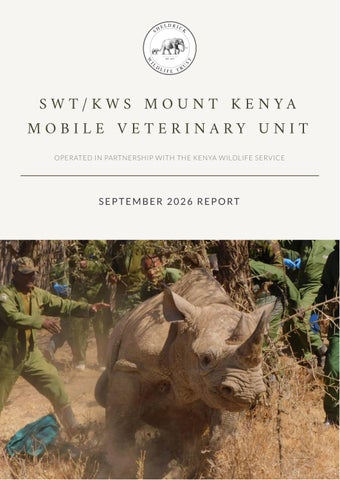
SWT/KWS MOUNT KENYA MOBILE VETERINARY UNIT OPERATED IN PARTNERSHIP WITH THE KENYA WILDLIFE SERVICE
SEPTEMBER 2026 REPORT
Mount Kenya Mobile Vet Unit: September 2026 BY DR. JEREMIAH POGHON
Hot and dry weather conditions were experienced in large parts of the Mountain Conservation Area mainly in September with sporadic rainfall in a few locations therefore resulting in feed and water stress across the wildlife ecosystem. September 2026 has seen the Mount Kenya Mobile Veterinary Unit carry out various interventions during the reporting period mainly comprising of clinical interventions, collaring, ear notching, disease surveillance and animal capture for translocation. Acknowledgement Sincere appreciations are extended to the Sheldrick Wildlife Trust for logistical and material support which enabled prompt response to cases. We are grateful for the collaboration and coordination extended from the various stakeholders and conservancies we have worked with during this period; these partnerships have been instrumental in ensuring timely and effective veterinary interventions when required. We thank the Kenya Wildlife Service for continued stewardship which makes our work possible.
MONTH AT A GLANCE:
27,678 6 4
Total cases:
Case snapshot:
15
ELEPHANT CASES
RHINO CASES
3
PREDATOR CASES
A R E A O F O P E R AT I O N S :
MOUNT KENYA MOBILE VET UNIT
S W T/ K W S M O U N T K E N YA M O B I L E V E T U N I T
2
CASE 1:
RHINO
DATE
SPECIES
SEX
AGE
LOCATION
OUTCOME
01/09/202605/09/2026
Rhino
Males & Females
Adults
Lewa
Task successful
History This activity was carried out as part of the rhino ear notching program at the Lewa Borana Landscape which is made up of Lewa Wildlife Conservancy and Borana Conservancy. The target Black Rhinoceros and Southern White Rhinoceros candidate animals were pre-selected. Chemical immobilisation was by intramuscular injection of an etorphine and azaperone anaesthesia drug combination protocol by either vehicle or helicopter darting. The subjects were restrained for safety, stabilised using butorphanol and provided with oxygen supplementation maintained at a pressure of between 5-10 atmospheres. Ear notching was then performed based on predetermined patterns per subject. Manual anaesthesia monitoring was done since available pulse oximeters malfunctioned. The anaesthetised subject’s body measurements were then taken and photographs recorded. Ear tissues, faecal, and blood samples in EDTA vacutainer, citrate vacutainer and red vacutainer tube with coagulant were then collected. The ear-notched rhinos would then be monitored closely to assess and respond to impacts of the procedure on their wellbeing. Conclusion This ear notching exercise was successfully completed and was a collaborative endeavour. 24 rhinoceroses consisting of 12 black rhinos and 12 white rhinos were notched against an initial target of 35 candidates. We are grateful to stakeholders who contributed to the successful outcome. Some ear notching candidates could not be sighted during the dry season since they had moved to hilly areas in Ngarendare Forest and due to terrain challenges are not often seen by rhino monitors. It is recommended that a follow up ear notching activity be organised during the rainy season when they head downslope to open areas with abundant herbage.
S W T/ K W S M O U N T K E N YA M O B I L E V E T U N I T
3
CASE 1
S W T/ K W S M A R A M O B I L E V E T U N I T
4
CASE 2:
RHINO
DATE
SPECIES
SEX
AGE
LOCATION
OUTCOME
03/09/2026
Rhino
Female
Adult
Lewa Wildlife Conservancy
Guarded to fair prognosis
History The rhino was reported to have been seen with a wound on the right thigh by Lewa Wildlife Conservancy rangers. Veterinary assessment and care were therefore requested. Immobilization The animal was darted from a helicopter using a combination of 4mg etorphine hydrochloride and 60mg azaperone. Anaesthesia took effect within 5 minutes and the animal went down in right lateral recumbency. 25 mg of butorphanol was given intravenously to improve the quality of anaesthesia. Supplementary oxygen was provided using a nasal tube. Anaesthesia was monitored using manual respiration counts. Interventions A clinical assessment of the patient was conducted with a penetrating wound observed on the right hind limb on the caudal aspect of the thigh. The wound was explored, cleaned and sharp debridement was then used to remove devitalised tissues. Chemical debridement using hydrogen peroxide solution was done to remove all devitalized tissues. Dilute povidone iodine was then applied to the wound pocket which was thereafter packed with oxytetracycline pessaries and dressed with bentonite clay to eliminate dead space and minimize contamination. The injury was finally sprayed with oxytetracycline aerosol wound spray. We also administered 15000mg Amoxicillin, 300mg flunixin meglumine and 40ml Catosal. Reversal Reversal from anaesthesia was done using naltrexone hydrochloride, 100mg was injected intramuscularly and 100mg injected intravenously with a smooth recovery observed. Prognosis The patient received a guarded to fair prognosis with gradual healing of the lesion expected due the extensive injury sustained. Patient monitoring was advised to assess progress following the intervention.
S W T/ K W S M O U N T K E N YA M O B I L E V E T U N I T
5
CASE 2
S W T/ K W S M A R A M O B I L E V E T U N I T
6
CASE 3:
RHINO
DATE
SPECIES
SEX
AGE
LOCATION
OUTCOME
09/09/2026
Rhino
Female
Adult
Solio Wildlife Reserve
Fair prognosis
History The rhino cow which had a calf was reported to have been seen lame with a wound on the left hindlimb by Solio Wildlife Reserve rangers. Veterinary assessment and care were requested and the veterinary team travelled to attend to this urgent case. Immobilization The animal was darted from a helicopter using a combination of 4mg etorphine hydrochloride and 60mg azaperone. Anaesthesia took effect within 7 minutes and the animal went down in right lateral recumbency. 10 mg of butorphanol was given intravenously to improve the quality of anaesthesia. Supplementary oxygen was provided using a nasal tube at a rate of 10 atmospheres. Anaesthesia was monitored using manual respiration counts. Interventions A clinical assessment of the patient was conducted with a penetrating wound observed on the left hind limb on the cranio-lateral aspect of the crus. The wound was explored, cleaned and chemical debridement using hydrogen peroxide solution was done to remove all devitalized tissues. Dilute povidone iodine was then liberally doused on the wound to clean the pocket which was thereafter packed with oxytetracycline pessaries and dressed with bentonite clay to eliminate dead space and minimize contamination. The injury was finally sprayed with oxytetracycline aerosol wound spray. We also administered 12000mg Amoxicillin trihydrate, 300mg flunixin meglumine and 40ml Catosal. Opportunistic ear notching was then done with the patient identified as 62. Reversal Reversal from anaesthesia was done using naltrexone hydrochloride, 80mg was injected intravenously with a smooth recovery observed. Prognosis The patient received a fair prognosis with gradual healing of the hind limb lesion expected. Patient monitoring was advised to assess progress following the intervention and to assess reunion with her calf.
S W T/ K W S M O U N T K E N YA M O B I L E V E T U N I T
7
CASE 3
S W T/ K W S M A R A M O B I L E V E T U N I T
8
CASE 4
ELEPHANT
DATE
SPECIES
SEX
AGE
LOCATION
OUTCOME
11/09/2026
Elephant
Female
Adult
Marmanet Forest
Guarded prognosis
History A lone female elephant had been reported to have been found recumbent by rangers from the Nyandarua KWS Station who were on patrol at Marmanet Forest. The elephant was unable to rise and had a dead calf lying next to her. Veterinary intervention was requested to save the elephant cow and the veterinary team immediately set out to attend to this emergency case. Clinical Examination Findings The elephant was found in right lateral recumbency attempting to move limbs but unable to rise. A dead calf that appeared recently born was found next to the patient with lochia in the vicinity. Immobilisation The elephant was immobilised by intravenous injection hand injection of 4 mg etorphine hydrochloride. The left ear was then flipped forward to cover the eye once the patient was anaesthetised. Physical Examination Findings The patient had a poor body condition score and appeared dehydrated with otherwise stable vitals. Examination of the musculoskeletal system showed no abnormalities. Differential diagnosis Due to the patient’s poor body condition score, it was suspected that hypoglycaemia occurred secondary to parturition in an emaciated condition. Post parturient hypocalcaemia was suspected due to a history of recent calving. A right hindlimb fracture or hip dislocation was suspected. Reversal 80 mg of naltrexone was administered intravenously to reverse the anaesthesia. The elephant was then assisted to stand by rope manipulation. Prognosis This patient received a guarded prognosis. The patient responded well to treatment and was able to stand. It was recommended that this elephant be monitored closely to assess her performance. S W T/ K W S M O U N T K E N YA M O B I L E V E T U N I T
9
CASE 4
S W T/ K W S M A R A M O B I L E V E T U N I T
10
CASE 5:
LION
DATE
SPECIES
SEX
AGE
LOCATION
OUTCOME
14/09/2026
Lion
Female
Adult
Mugie Wildlife Conservancy
Task successful
History The Mt. Kenya KWS Mobile Veterinary Unit set out to deploy a collar to an adult lioness at Mugie Wildlife Conservancy. The collaring was undertaken to enhance monitoring of the lioness spatial-temporal movement patterns, with the primary objective of mitigating human-wildlife conflict in the conservancy, surrounding community and to protect livestock from predation through informed management interventions. Chemical immobilization The lioness was free darted using a drug combination of medetomidine 6 mg and ketamine 300 mg at 16:38 hrs. A top up of 200 mg ketamine was hand injected intramuscularly at 16:48. Sternal recumbency with optimum anaesthesia was confirmed 13 minutes after darting, the patient was placed in lateral recumbency and blindfolded to minimize visual and auditory stimulation during anaesthesia. Physiological parameters were monitored throughout the immobilization. Interventions The body condition score was good. Collaring was done by digital GPS neck collar placement. Morphometric measurements were recorded. Prophylactic antibiotic treatment initiated by intramuscular administration of 2250 mg amoxicillin trihydrate. The dart wound pocket was infused with 835 mg cloxacillin ointment. 30 mg meloxicam was administered subcutaneously as supportive anti-inflammatory medication. Reversal Reversal by intramuscular administration of 30 mg atipamezole was done at 17:38 hrs. The patient recovered uneventfully after reversal. Prognosis The patient received an excellent prognosis with rapid recovery from anaesthesia expected since the lioness was in good health. The lioness collaring activity at Mugie Wildlife Conservancy was successfully completed with the patient monitored from a distance until she became ambulatory.
S W T/ K W S M O U N T K E N YA M O B I L E V E T U N I T
11
CASE 5
S W T/ K W S M A R A M O B I L E V E T U N I T
12
CASE 6:
LION
DATE
SPECIES
SEX
AGE
LOCATION
OUTCOME
14/09/2026
Lion
Female
Adult
Mugie Wildlife Conservancy
Task successful
Introduction The Mt. Kenya KWS Mobile Veterinary Unit set out to deploy a collar to an adult lioness at Mugie Wildlife Conservancy. The recollaring was undertaken to enhance monitoring of the lioness spatial-temporal movement patterns, with the primary objective of mitigating human-wildlife conflict in the conservancy, surrounding community and to protect livestock from predation through informed management interventions. Chemical immobilization The lioness was free darted using a drug combination of medetomidine 6 mg and ketamine 300 mg at 18:34 hrs. A top up of 150 mg ketamine was hand injected intramuscularly at 18:46 hrs. Sternal recumbency with optimum anaesthesia was confirmed 15 minutes after darting, the patient was placed in lateral recumbency and blindfolded to minimize visual and auditory stimulation during anaesthesia. Physiological parameters were monitored throughout the immobilization by manual monitoring of respiration and rectal temperature. Reversal by intramuscular administration of 30 mg atipamezole was done at 19:27 hrs. The patient recovered uneventfully after reversal. Interventions The old malfunctioning collar was removed and recollaring was done by digital GPS neck collar placement. Morphometric measurements were recorded. Prophylactic antibiotic treatment initiated by intramuscular administration of 1800 mg amoxicillin trihydrate. An incidental cut wound found in the left axilla was debrided using cotton gauze soaked in dilute iodine, washed with iodine solution, infused with cloxacillin ointment and an aerosol wound spray was applied smf 24 mg meloxicam was administered subcutaneously as supportive anti-inflammatory medication. Prognosis The patient received a good prognosis with rapid recovery from anaesthesia expected since the lioness was in good health.
S W T/ K W S M O U N T K E N YA M O B I L E V E T U N I T
13
CASE 6
S W T/ K W S M A R A M O B I L E V E T U N I T
14
CASE 7:
ELEPHANT
DATE
SPECIES
SEX
AGE
LOCATION
OUTCOME
15/09/2026
Elephant
Male
Adult
Mugie Wildlife Conservancy
Postmortem
History A carcass of an adult male elephant was found at Mugie Wildlife Conservancy and a necropsy was requested. The elephant had last been seen with forelimb lameness Physical Examination Findings The carcass which was in early autolysis was found in right lateral recumbency facing a South-Eastern direction. The tusks had been removed and the carcass had signs of significant depredation or scavenging. The time of death was estimated to have occurred within the previous 72 hours based on carcass condition at presentation. Physical examination revealed a puncture wound on the left forelimb at the humeral region. Abnormal limb instability, strongly suggestive of a complete humeral fracture was revealed on orthopaedic examination. A field necropsy was therefore conducted Post-Mortem Examination Findings The puncture wound was explored and exceeded a depth of 20 cm.
Dissection of the left forelimb showed
subcutaneous haemorrhage with two puncture wounds. A bullet was found the biceps muscle mass. A complete fracture of the left humerus., consistent with the clinical findings. There was severe soft tissue damage with haemorrhage extending into the surrounding soft tissues. Conclusion The elephant sustained a complete fracture of the left humerus due to projectile injury resulting from a bullet. The gross diagnosis of the immediate cause of death is acute septic shock secondary to a gunshot injury.
S W T/ K W S M O U N T K E N YA M O B I L E V E T U N I T
15
CASE 7
S W T/ K W S M A R A M O B I L E V E T U N I T
16
CASE 8:
LION
DATE
SPECIES
SEX
AGE
LOCATION
OUTCOME
16/09/2026
Lion
Female
Adult
Mugie Wildlife Conservancy
Task successful
Introduction The Mt. Kenya KWS Mobile Veterinary Unit set out to deploy a collar to an adult lioness at Mugie Wildlife Conservancy. The recollaring was undertaken to enhance monitoring of the lioness spatial-temporal movement patterns, with the primary objective of mitigating human-wildlife conflict in the conservancy, surrounding community and to protect livestock from predation through informed management interventions. Chemical immobilization The lioness was free darted using a drug combination of medetomidine 6 mg and ketamine 300 mg at 08:25 hrs. A top up of 200 mg ketamine was hand injected intramuscularly at 08:36. Sternal recumbency with optimum anaesthesia was confirmed 15 minutes after darting, the patient was placed in lateral recumbency and blindfolded to minimize visual and auditory stimulation during anaesthesia. Physiological parameters were monitored throughout the immobilization. Interventions The old collar was removed and recollaring was done by digital GPS neck collar placement. Morphometric measurements were recorded. Prophylactic antibiotic treatment initiated by intramuscular administration of 2250 mg amoxicillin trihydrate. Reversal Reversal by intramuscular administration of 30 mg atipamezole was done at 19:30 hrs. The patient recovered uneventfully after reversal. Prognosis The patient received an excellent prognosis with rapid recovery from anaesthesia expected since the lioness was in good health. A puncture wound injury on the lateral aspect of the right thigh was opportunistically treated.
S W T/ K W S M O U N T K E N YA M O B I L E V E T U N I T
17
CASE 8
S W T/ K W S M A R A M O B I L E V E T U N I T
18
CASE 9:
RHINO
DATE
SPECIES
SEX
AGE
LOCATION
OUTCOME
16/09/2026
Rhino
Male
Adult
Solio Wildlife Reserve
Good prognosis
History The rhino was reported to have been seen with a fencing wire coiled around hindlimbs by Solio Wildlife Reserve rangers. Veterinary care to remove the wire therefore requested. Immobilization The animal was darted from a vehicle using a combination of 5.5 mg etorphine hydrochloride and 60mg azaperone. Anaesthesia took effect within 5 minutes and the animal went down in right lateral recumbency. 25 mg of butorphanol was given intravenously to improve the quality of anaesthesia. The patient was doused liberally with cold water to cool down. Anaesthesia was monitored using manual respiration counts. Interventions A clinical assessment of the patient was conducted with no other injuries being noted. The fencing wire was removed using a wire cutter. Superficial abrasion injuries were sprayed with oxytetracycline aerosol wound spray. Reversal from anaesthesia was then promptly done using naltrexone hydrochloride, 110mg was injected intramuscularly and 110mg injected intravenously with a smooth recovery observed. Prognosis The patient received a good prognosis since the wire was noticed early and removed before causing injury Conclusion The rhino fencing wire removal activity was completed successfully with the patient receiving a good prognosis.
S W T/ K W S M O U N T K E N YA M O B I L E V E T U N I T
19
CASE 9
S W T/ K W S M A R A M O B I L E V E T U N I T
20
CASE 10:
RHINO
DATE
SPECIES
SEX
AGE
LOCATION
OUTCOME
16/09/2026
Rhino
Male
Adult
Solio Wildlife Reserve
Good prognosis
History The rhino was reported to have been seen with a fencing wire coiled around the thorax by Solio Wildlife Reserve rangers. Veterinary care to remove the wire therefore requested. Immobilization The animal was darted from a vehicle using a combination of 5.5 mg etorphine hydrochloride and 60mg azaperone. Anaesthesia took effect within 6 minutes and the animal went down in right lateral recumbency. 25 mg of butorphanol was given intravenously to improve the quality of anaesthesia. The patient was doused liberally with cold water to cool down. Interventions A clinical assessment of the patient was conducted with no other injuries being noted. The fencing wire was removed using a wire cutter. Superficial abrasion injuries were sprayed with oxytetracycline aerosol wound spray. Reversal Reversal from anaesthesia was then promptly done using naltrexone hydrochloride, 110mg was injected intramuscularly and 110mg injected intravenously with a smooth recovery observed. Prognosis The patient received a good prognosis since the wire was noticed early and removed before causing injury, It was recommended that all fencing wire and other potentially injurious materials be removed from areas that are accessed by wildlife.
S W T/ K W S M O U N T K E N YA M O B I L E V E T U N I T
21
CASE 10
S W T/ K W S M A R A M O B I L E V E T U N I T
22
CASE 11:
ELEPHANT
DATE
SPECIES
SEX
AGE
LOCATION
OUTCOME
17/09/2026
Elephant
Female
Adult
Naibunga Community Conservancy
Task successful
History A lone female elephant had been reported to have been found in mud in a dam by community members who alerted rangers from the Doldol KWS Outpost and they set out to secure the distressed cow. The elephant was unable to extricate herself and the veterinary team immediately set out to attend to the elephant cow rescue. Clinical Examination Findings The elephant was found in right lateral recumbency attempting to move limbs but unable to rise. The patient had a good body condition score and appeared to be in excellent health with stable vitals. Examination of the musculoskeletal system showed no abnormalities. Chemical Immobilisation The elephant was darted from the vehicle at 15:20 Hrs using 21mg etorphine hydrochloride. The elephant went into right lateral recumbence at 15:30 Hrs. The left ear was flipped forward to cover the eye and water was poured on the body to cool the animal. Clinical Examination Findings The patient had a good body condition score and appeared to be in excellent health with stable vitals. Intervention Supportive treatment was instituted. 40 ml of Catosal® was administered by intramuscular injection to act as a metabolic stimulant. 20 ml of Introvit® containing vitamin E and selenium was administered by intramuscular injection for antioxidant properties The elephant was then assisted to stand by rope manipulation using a vehicle to pull her out of the mud. The elephant moved away after getting out of the quagmire Prognosis This patient received a good prognosis. The elephant cow was safely pulled out of the mud and was able to rejoin her herd. Prompt response and efficient coordination between community members, the local administration and the Kenya Wildlife Service allowed for timely intervention.
S W T/ K W S M O U N T K E N YA M O B I L E V E T U N I T
23
CASE 11
S W T/ K W S M A R A M O B I L E V E T U N I T
24
CASE 12:
ELEPHANT
DATE
SPECIES
SEX
AGE
LOCATION
OUTCOME
17/09/2026
Elephant
Male
Adult
Lewa Wildlife Conservancy
Task successful
History An elephant bachelor herd had been reported to have broken conservancy fences to enter agricultural community areas for crop raiding. A notorious adult male had therefore been identified for collaring to for monitoring to mitigate human wildlife conflict using the resulting geolocation data. Chemical Immobilisation The elephant was darted from the vehicle at 15:20 Hrs using 21mg etorphine hydrochloride. The elephant went into right lateral recumbence at 15:30 Hrs. The left ear was flipped forward to cover the eye and water was poured on the body to cool the animal. Clinical Examination Findings The patient had a good body condition score and appeared to be in excellent health with stable vitals. Intervention Blood & tick samples were collected for biobanking and surveillance. Digital collar application. Morphometric measurements. Prognosis This patient received a good prognosis. The elephant collaring activity was successfully completed with the target candidate now under monitoring.
S W T/ K W S M O U N T K E N YA M O B I L E V E T U N I T
25
CASE 12
S W T/ K W S M A R A M O B I L E V E T U N I T
26
CASE 13:
RHINO
DATE
SPECIES
SEX
AGE
LOCATION
OUTCOME
20/09/2026
Elephant
Female
Adult
Solio Wildlife Reserve
Task successful
History One adult female black rhinoceros was reported to have breached the Solio Game Reserve rhino sanctuary fence and needed to be transferred back. A decision was made to relocate the rhinoceros back to the samctuary reserve by the veterinary and capture unit. Chemical immobilisation, Reversal and Loading. The rhinoceros was chemically immobilised by darting on a vehicle at 2:00 pm using a Dan inject rifle, 1.5cc dart and 2.0×60mm needle loaded with 4 mg etorphine and 60mg azaperone. Once the patient was manipulated into left lateral recumbency, the patient’s anaesthesia was stabilized by intravenous administration of 10 mg butorphanol. 60 mg doxapram hydrochloride was administered intravenously to improve respiration. Ear notches were then applied opportunistically for identification with the patient receiving identification number 97. The loading crate was positioned in front of the animal; ropes were tied to guide the patient into the crate. The patient was positioned in sternal recumbency and anaesthesia reversed by administration of 60 mg naltrexone hydrochloride intravenously. The rhinoceros was then aroused to stand. Three ropes were placed on the animal: one on the head for guiding the animal to the crate, and another two behind the rump and fixed to the outer sides of the crate to help in getting the rhinoceros to the loading crate. Transportation, Monitoring and complete reversal Releasing The rhinoceros was transported by road on a truck back to the reserve. It was off-loaded from the truck at the release site, near a watering point. Conclusion The capture and relocation operation was duly executed ensuring the animal was released back safely.
S W T/ K W S M O U N T K E N YA M O B I L E V E T U N I T
27
CASE 13
S W T/ K W S M A R A M O B I L E V E T U N I T
28
CASE 14:
RHINO
DATE
SPECIES
SEX
AGE
LOCATION
OUTCOME
23/09/2026
Rhino
Unconfirmed
Adult
Solio Wildlife Reserve
Remains
History A report was received that remains of a juvenile rhinoceros had been found by Solio Rhino Monitoring Unit KWS rangers and a necropsy was requested. The Mt Kenya Mobile Veterinary team set out to investigate this case. Findings The remains were found in scattered distribution, an observation consistent with carcass depredation. The horns had been recovered and were in custody Vertebral column consisted of thoracic and lumbar vertebrae remains, attached ribs with some muscles attached and a portion of skin. Skull sutures were clearly delineated and non-ossified. The snout was pointed as is typical of a black rhinoceros. Located approximately 6 metres south from the vertebral column location. Unerupted teeth were observed. Some short bones and a lot of ingesta were found at this site which had evidence of extensive activity with flattened vegetation. Approximately 3 metres south east from the vertebral column location. Conclusion Due to the condition of the carcass, a definitive cause of death could not be determined. It is suspected that at the juvenile rhinoceros may have succumbed to predation due to the gut fill as indicated by the ingesta at the suspected scene of death.
S W T/ K W S M O U N T K E N YA M O B I L E V E T U N I T
29
CASE 14
S W T/ K W S M A R A M O B I L E V E T U N I T
30
CASE 15:
GIRAFFE
DATE
SPECIES
SEX
AGE
LOCATION
OUTCOME
24/09/2026
Giraffe
Male
Adult
Ngarendare Wildlife Trust
Postmortem
History The carcass of an adult male giraffe was found by Ngarendare Wildlife Trust personnel and a request for postmortem examination was made to the veterinary department to aid in investigation of the suspected poaching incident. Findings The depredated carcass was found fresh in right sternolateral recumbency and death estimated to have occurred within the previous 48 hours. Visceral organs had undergone significant scavenging. There were longitudinal incisions along the skin at the dorsum with the vertebral muscles bearing incision marks consistent with use of a sharp object. 3 penetrating wounds with an average length of 4 cm and sharp margins were observed on the right flank. There was subcutaneous haemorrhage at the penetrating wounds below the on opening up the skin. The penetrating extended into the thoracic cavity between the 4th and 5th ribs, on the 5th rib and between 9th and 10th. The three wounds were determined to be antemortem and extended into the thoracic cavity. Morphological Diagnoses • •
traumatic shock haemorrhagic shock
Discussion Gross post mortem findings of 3 penetrating wounds with an average length of 4 cm were observed on the right flank extending up to the thoracic cavity. The immediate cause of death is suspected to be haemorrhagic shock secondary to a malicious traumatic injury inflicted using sharp objects.
S W T/ K W S M O U N T K E N YA M O B I L E V E T U N I T
31
CASE 15
S W T/ K W S M A R A M O B I L E V E T U N I T
32
SWT/KWS Mobile Veterinary Units, like all Sheldrick Wildlife Trust's conservation projects, is a donor-funded initiative. Thank you to our global supporters, who help us secure Kenya's habitats for the future and make an impact in the field, each and every day. © 2026 The David Sheldrick Wildlife Trust
33