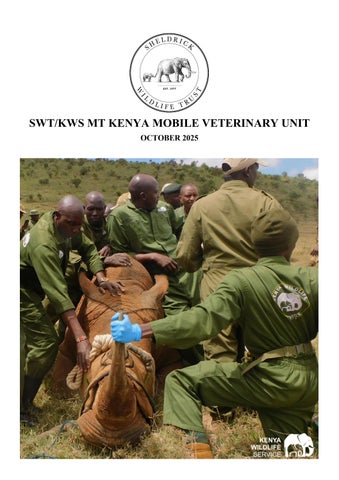
SWT/KWS MT KENYA MOBILE VETERINARY UNIT OCTOBER 2025
Introduction
16 Cases in October 2025
3 Poaching Cases
6 Elephant Cases
October Report by Dr. Jeremiah Poghon The month of October 2025 was marked by significant and varied clinical activities for the Veterinary Unit. In collaboration with our partner and capture units, we undertook 16 field interventions. Our work encompassed the successful relocation of rhinos, buffaloes and elephants, the treatment of elephants and rhinos, the rescue of a colobus monkey and the de-snaring of a giraffe and a rhino, as well as the collaring of lions. Furthermore, we conducted crucial autopsies on an elephant, a hippopotamus, and a rhino. Acknowledgement The Mt. Kenya Mobile Wildlife Veterinary Unit thanks the Kenya Wildlife Service for providing leadership and technical expertise. The veterinary team also appreciates The Sheldrick Wildlife Trust (SWT) for providing the financial and logistical support that enables the Unit to fulfil its mandate.
SWT/KWS Mt Kenya Mobile Vet Unit Treatment Locations October 2025
Case Details Date
Species
Area Found
Reason for Intervention
Outcome
1-Oct-25
Lion
Mugie Conservancy
Collared
A GPS-transmiting collar was mounted on the neck of each of the captured lions
Task Successful
3-Oct-25
Giraffe
Enasoit Conservancy
Snared
A wire snare was found on the right hind limb
Successfully Treated
5-Oct-25
Elephant
Chololo Ranch
Spear
Several puncture wounds and possible dislocation
Prognosis Poor
8-Oct-25
Rhino White
Loisaba Ranch
Natural Causes
The rhino had an irregular-shaped deep abrasion wound
Prognosis Poor
9-Oct-25
Elephant
Nannapa Conservancy
Postmortem
The consequent of the obstruction was acute colic
Died
10-Oct-25
Buffalo
Laikipia Environs
HWC
The buffaloes were reported in the property after areas were fenced
Task Successful
12-Oct-25
Rhino White
Olenaishu Conservancy
Relocation
Two adult male rhinos were reported to have breached the Borana Conservancy
Task Successful
18-Oct-25
Elephant
Solio Ranch
HWC
The bulls were causing human wildlife conflict by raiding farms
Task Successful
19-Oct-25
Elephant
Loldaiga Conservancy
Natural Causes
The carpal joint was swollen with no external injuries
Prognosis Poor
20-Oct-25
Elephant
Imenti Forest
Natural Causes
A possible fracture of the femur of the right hind limb was suspected
Prognosis Poor
21-Oct-25
Other
Tundra Conservancy
Postmortem
A severe haemorrhagic enteritis of an unconfirmed ethology
Died
21-Oct-25
Elephant
Dol dol
Postmortem
The elephant walked into a narrow gully and he slipped down the slope
Died
22-Oct-25
Rhino White
Solio Ranch
Snared
A long fencing wire was found snaring around the left hind limb
Successfully Treated
26-Oct-25
Rhino White
Ol Pejeta Conservancy
Natural Causes
The rhino was found with a deep wound at the left side of the neck
Successfully Treated
29-Oct-25
Primate
Laikipia Environs
HWC
A male Colobus monkey reported to have been injured on a road accident
Taken to Orphanage
30-Oct-25
Rhino Black
Ol Jogi Ranch
Postmortem
The rhino was reported dead, it had a history of fights with other males
Died
Case 1 – 1st October 2025 Lion
Collaring
Mugie Conservancy
Three lions, 2 adults and 1 young adult, (a male and two females) were captured and collared to mitigate wildlife-livestock-and-human conflict and enhance monitoring of lions at Mugie Conservancy and the neighbouring community. Immobilisation, examination and collaring The lions were darted from a vehicle using various dosage of Ketamine, Medetomidine and Atipamezole depending on size and age. They were individually examined and general body measurements taken. Blood and tick samples were collected for disease surveillance. A fresh laceration wound, about 3cm was found on the medial thigh of the right hind leg of the first female. The lesion was managed with topical antibiotic spray (Oxytetracycline), as well as 1500mg of long-acting Amoxicillin. A GPS-transmitting collar was mounted on the neck of each of the captured lions.
Case 2 – 3rd October 2025 Giraffe
Snared
Enasoit Conservancy
The giraffe was reported sighted with a wire snare tied around the lower part of the right hind limb. Immobilisation, examination and treatment The giraffe was darted on vehicle with a dart of 15mg of Etorphine. A wire snare was found on the proximal aspect of the metacarpal joint of the right hind limb. The wire had caused pressure abrasions on the skin it was encircling on the limb. The wire was cut and removed from the limb with the help of a wire-cutter. The abrasion wound was flushed with Iodine solution and sprayed with a topical antibiotic (Oxytetracycline). A parenteral non-steroidal anti-inflammatory was administered: Phenylbutazone, 8,000 mg, IM. Prognosis The giraffe was revived using 300mg Naltrexone after he was secured on the ground, while the treatment and the removal of the snare was in progress and held manually. The giraffe was de-snared successfully, and the Conservancy Rangers advised to remove any snares to avoid similar cases. The prognosis is good.
Case 3 – 5th October 2025 Elephant
Spear
Chololo Ranch
The bull was reported limping on his left forelimb which was affecting his movement.
Immobilisation, examination and treatment The elephant was darted from a vehicle with 20mg Etorphine. The bull went on sternal recumbency after 11 minutes. With the help of ropes placed on the tusks, the bull was pulled by a car to right lateral recumbency. On a general examination the bull had a swollen carpal joint possibly due to a dislocation. A puncture wound, about 15cm deep, with purulent exudate was found on the ventral proximal aspect of the trunk; three other puncture wounds were found to the face some with maggots present. The wounds were flushed with Hydrogen peroxide and Iodine solution. Opticlox ointment, Oxytetracycline pessaries and green clay were deposited into the deep wounds. The wounds were then sprayed with Oxytetracycline. A parenteral antibiotic and anti-inflammatory were also administered to cover against secondary infections of the wounds and to offer relief to the pain on the affected joint. Prognosis The definitive cause of lameness could not be determined. The prognosis of the major condition of the bull is guarded.
.
Case 4 – 8th October 2025 White Rhino
Natural Causes
Loisaba Conservancy
The rhino was reported to be limping, with the lameness affecting the right hind limb. The rhino was introduced to the Conservancy on August 26 2025 from Lewa-Borana Conservancies. The rhino had been noted with the lameness from the mother site and during the translocation process.
Immobilisation, examination and treatment The rhino was darted from a vehicle with 5mg Etorphine and 60mg Azaperone, which caused the animal to go down on his hindlimbs within 6 minutes where he was positioned to the right sternal recumbency. The general body condition was good, given a score of 3 out of 5. An irregular-shaped deep abrasion wound, with fresh blood was found on the middle toe. The wound was estimated be about 4 cm in depth. The proximal surface of the middle toe was also cracked exposing more part of the coronet from the injury. The wound was cleaned of debris and flushed with Hydrogen peroxide, and Iodine. An Oxytetracycline pessary, opticlox ointment and green clay were deposited into the deeper part of the wound. The wound was then sprayed with Oxytetracycline topical antibiotic. Amoxicillin, 15,000mg, Flunixin meglumine, 2500mg, Butaphosphan 400mg and Vitamin B were adminstered for pain-relief and prevent secondary infection. Prognosis The prognosis of the lesion is guarded.
.
Case 5 – 9th October 2025 Elephant
Postmortem
Nanapa community Conservancy
The elephant was reported to have been discovered dead early that morning at a dried stream. Postmortem examination The fresh elephant was found lying on left lateral recumbency in good body condition. A puncture wound about 5cm in diameter and 8cm deep, with purulent exudate was found on the the right hind limb. The abdomen was bloated. Internally, there was froth on the brochi, and brochials and hepatization of the lung parenchyma. Three cysts with threadlike roundworms were found on the liver. The stomach was almost empty of digested ingesta. The small intestines were ballooned, and empty of contents with heavy infestation of gastrointestinal flukes. The mucosal surface was dark red. The small volumes of ingesta in the stomach and duodenum was covered in mucus. The mid-section of the transverse colon was found twisted from the normal its normal flow and anatomical positioning. The proximal segment of the transverse colon was ballooned with small quantities of impacted digested ingesta. The distal segments of the transverse colon were gas-filled and empty of contents. Cause of death The autopsy revealed intestinal torsion, causing obstruction, acute colic, shock and death..
.
Case 6 – 10th October 2025 Buffalo
Human-Wildlife Conflict
Loldaiga Conservancy
The buffalos were reported in the Hurt’s family property after the fencing of the Loldaiga Valley land. One of the buffalos was reported to be limping on the left hind leg, with a lesion suspected to be a wire snare.
Immobilisation, examination and relocation The two buffalos were darted from a helicopter with a composition of 9mg Etorphine and 80mg Azaperone for each animal. They went down on the bank of the stream on the downside of the farm. The bull that was limping was examined and was found to have a healing wound around the fetlock joint of the left hind leg from a wire snare that had detached. The bull was given a supportive parenteral treatment of 7,500mg of long-acting amoxicillin and 40mg Dexamethasone administered intramuscularly. The buffalos were moved individually by slings tied to the horns, and capture teams pulling in front and pushing from behind to the transport container which could only get as close as 30m from where the animals were. The two buffalos were loaded side to side, on the crate before they were reversed of anaesthesia. The animals were loaded onto a truck by a crane and transported by road to Loldaiga Conservancy. The crate was offloaded at a release site, about a 100m from a drinking point (dam) where the buffaloes were released into their safe home removing possible threat to the community in the close vicinity.
.
Case 7 – 12th October 2025 White Rhino
Relocation
Loldaiga Conservancy
Two adult male Southern white rhinos were reported to have breached the Borana Conservancy fence on the night of 12th October and escaped to Loldaiga Conservancy. The section of the fence had been damaged by elephants transiting through the Conservancies. A decision was made to relocate the two rhinos back to Lewa-Borana and be released at Lewa Conservancy by the Monitoring Teams and Veterinary Unit.
Immobilisation, examination and relocation The two rhinos were darted from a helicopter with 5mg Etorphine and 20mg Azaperone, per animal. Tumaini was immobilised first, and loaded into a crate, then Mugumo followed. The animals were loaded onto a truck by a crane and transported by road to Loldaiga Conservancy. The crate was offloaded at a release site, about a 100m from a drinking point (dam) where the buffaloes were released into their safe home removing possible threat to the community in the close vicinity. The anaesthesia was partially reversed using 1mg Diprenorphine and 1.2mg titrated diprenorphine. This partial reversal lightened up the anaesthesia to stabilise the animal for sampling, ear tagging, roping, and walking to the loading crate. Once in the loading crate, an extra dose of 12mg Diprenorphine. The second dose of partial reversal ensured the rhinos were calm and light enough to stand during the transportation to the release site. The rhinos were transported by road on trucks to Lewa Conservancy, occasionally monitored while on transit. They were offloaded from the truck at the release site, near a watering point and fully reversed from anaesthesia.
.
Case 8 – 18th October 2025 Elephant
Human-Wildlife Conflict
Solio Ranch
An operation to translocate four problematic bull elephants was undertaken by the veterinary and capture teams. The bulls were causing human-wildlife conflict by raiding farms and posing a threat to human life. Immobilisation, examination and relocation The elephants were chemically immobilized by darting from a helicopter using darts loaded with Etorphine. The first and second bulls were darted with 20mg Etorphine and 40mg Azaperone, whereas the 3rd and 4th elephants were both darted with 18mg Etorphine. Two mature adult bulls were selected from the group and collared with GPS installed trackers, by the assistance of Save the Elephants team, to allow for tracking and monitoring at the release site. Various samples, such as faecal material, whole blood and ticks were also collected. After immobilization, the elephants were loaded onto a lorry using a crane transported to the loading site where they were loaded into a recovery container moved by a conveyor belt using a winch. They were finally allowed in the transporting container after reversal. The four elephants were transported in big elephant transport containers with two compartments by road and monitored while in transit. A good release site was identified at Meru National Park and the elephants released simultaneously in pairs at the same site.
.
Case 9 – 19th October 2025 Elephant
Natural Causes
Loldaiga Conservancy
This elephant was reported after she was found walking solitary, distant from the rest of her family. She was reported with lameness affecting her left forelimb. Immobilisation, examination and treatment The elephant was darted from a vehicle with a dart of 16mg Etorphine hydrochloride. When the elephant went down it was helped to right lateral recumbency to allow examination of the affected left forelimb. The carpal joint and the surrounding musculature distal to the joint was swollen. No external lesion could be identified. An incidental deep laceration wound, about 5 cm in diameter, with irregular depths of 5-10 cm was found on the back above the shoulder joint. The wound was producing some purulent exudates. The findings on the carpal joint of the left forelimb suggested possible joint injury through a sprain or strain. The wound was irrigated with Hydrogen peroxide to clean out the exudates and irrigated with Iodine. Opticlox ointment and a Oxytetracycline pessary were deposited into the deeper parts the wound. The wounds were then sealed with green clay paste and sprayed with Oxytetracycline. Supportive treatment of Amoxicillin, 30,000mg, Flunixin, 3, 000mg, Butaphosphan, 500g, and vitamin B12 250mg were administered. Prognosis The lesion carries a guarded prognosis.
.
Case 10 – 20th October 2025 Elephant
Natural Causes
Imenti Forest, Meru County
The elephant was reported with a big swelling on the right hind limb and having difficult moving. Immobilisation, examination and treatment The elephant was darted from foot with a dart of 18mg Etorphine hydrochloride. The bull went down on left lateral recumbency after about 9 minutes. Distal femoral shaft and the knee joint of the right hindlimb and the surrounding tissues were markedly swollen. The swelling was more pronounced on the anterior aspect of the limb. A small volume, about 1ml, of straw-coloured effusion was aspirated from the soft swelling. There was difficulty in moving the knee joint upon manipulation. A possible fracture of the femur of the right hindlimb was suspected. A supportive treatment was given to reduce pain from the inflammation and protect from secondary infection. The following treatment was given: Amoxicillin, 30,000 mg, Flunixin 5,000 mg, Dexamethasone, 100 mg, Butaphosphan, 600g, and vitamin B12 300mg. Prognosis The definitive confirmation and correction of the suspected fracture is a challenge in the wild setting therefore the elephant has a poor prognosis.
.
Case 11 – 21st October 2025 Hippo
Natural Causes
Tundra Conservancy
The hippopotamus was discovered dead at the banks of a dam at Tundra conservancy on the evening of 20th October 2025. Postmortem examination The carcass was found on left lateral recumbency near the banks of the dam. It was lifted away from the dam using a bulldozer to an open field for the autopsy and away from the water body. The perineum and the area around where the carcass were soiled with bloody diarrhoea. The general body condition score of the hippo was good. Internal findings revealed adhesions on the pleura and surface of the lungs and there was scanty pleural fluid. - There was froth on the bronchioles and lung parenchyma of the left lung. There were diffuse haemorrhages on the pericardium, and endocardium of the heart. The small intestines were ballooned (gasfilled). On dissection, the small intestines were found with dark-red fluid contents. The mucosa of the small intestines was found with diffuse haemorrhages. Cause of death The autopsy indicated a severe haemorrhagic enteritis of an unconfirmed ethology, which caused the spread of toxins to other systems through blood circulation. The hippopotamus could have succumbed to toxic-shock from the toxins absorbed and circulated from the small intestines.
.
Case 12 – 21st October 2025 Elephant
Natural Causes
Kantana, Dol dol, Laikipia
The Dol dol KWS team responded and arrived at the scene of a reported elephant that had accidental fallen into a gully. It was established that the elephant walked into a narrow gully to chew on a sisal plant; on his attempt to climb out of the gully he slipped down the slope. The gully was estimated to be over 15m deep. Examination The elephant was found lying on right lateral recumbency and was unable to move. It was suspected to have sustained severe fractures leading to paralysis. Cause of death The bull elephant was found to have succumbed following its fall into a gully as it sustained severe fractures.
Case 13 – 22nd October 2025 White Rhino
Snared
Solio Ranch
The bull was reported by the rhino monitoring unit to be having a wire snared on the left hind limb.
Immobilisation, examination and treatment The rhino was darted from a vehicle with 5mg Etorphine and 60mg Azaperone, placed on the right shoulder. The animal was helped to left lateral recumbency by restraining with ropes and pushing by the capture team. The animal was found to be on a light plane of anaesthesia so 25mg Butorphanol was given intravenously to stabilize the animal. A long fencing wire was found snaring around the tarsus and metatarsals of the left hind limb. The skin on the sides encircled by the wire were slightly bruised. Incidental small laceration wounds were found on the lower neck. The wire snare was cut away and removed using a wire cutter. The small laceration wounds were managed topically with Oxytetracycline spray. A parenteral anti-inflammatory 8,000mg Phenylbutazone, and antibiotic, 9,000mg Amoxicillin were administered. Prognosis The prognosis is good. It was reported to the management to remove any wires that could have been dropped around the rhino sanctuary to avoid future recurrence.
Case 14 – 26th October 2025 White Rhino
Natural Causes
Ol Pejeta Conservancy
The rhino had been reported by the monitoring team to have been involved in a territorial fight with another male on Monday 20th October 2025.
Immobilisation, examination and treatment The rhino was darted from a helicopter with 5mg Etorphine and 60mg Azaperone. The anaesthesia was topped up with 50mg Butorphanol intravenously to stabilize the animal. The wounds were debrided with Hydrogen peroxide, cleaned out with water and flushed all round with Iodine solution. Opticlox ointment was infiltrated into the wounds and Alamycin spray (Oxytetracycline) was also topically on the wounds. Finally the wounds were sealed with green clay. A parenteral treatment was indicated to cover for secondary bacterial infection from the wound, reduce inflammation and provide analgesia as follows: Amoxicillin, 12,000mg, Phenylbutazone, 8,000mg. Prognosis The prognosis is good. The rhino is to be monitored to track progress.
Case 15 – 29th October 2025 Colobus Monkey
Human-Wildlife Conflict
Ontulili, Laikipia
A male Colobus monkey was reported to have been injured on a road accident at Ontulili, along NanyukiMeru Road. Immobilisation and rescue The colobus was immobilized by darting on foot with 50mg Ketamine and 0.2mg Medetomidine. When the animal was calm enough to be approached, a top up of 50mg Ketamine was administered intramuscularly. The monkey was handled by holding the neck scruff and supporting the body by the belly and carried onto transport cruiser. He was monitored and kept on sternal recumbency on transit to Animal Orphanage at Mount Kenya Wildlife Conservancy. The colobus was found dragging the hindlimbs, showing difficulty in locomotion. Crepitation was felt on the distal femur and the knee joint of the left hind limb. the Colobus was given Amoxicillin 300mg and Dexamethasone, 4mg at the Animal Orphanage. Prognosis The prognosis is fair. The Colobus monkey was rescued, translocated and placed under confinement at the Animal orphanage for further clinical examination and treatment.
Case 16 – 30th October 2025 White Rhino
Postmortem
Ol Jogi Conservancy
The rhino was reported earlier in the day recumbent and unable to rise. It was reported dead, with an history on fights with other territorial males in the Conservancy. Postmortem examination • • •
The carcass was found lying on right lateral recumbency. The carcass was still fresh The body condition score was poor, given a score of 2 out of 5. Multiple laceration and puncture wounds were found on the perineal area, thighs and hind
• • • •
legs, anus, lower abdomen, chest, front limbs, neck, lower jaw and the face The stomach had scanty quantity of ingesta The small intestines were empty of contents There were mucosal haemorrhages on the colon Adhesions were found on the peritoneum
Cause of death The cause of death of the male black rhino was established caused by fight wounds from other territorial males. The rhino succumbed to the injuries and loss of body condition.