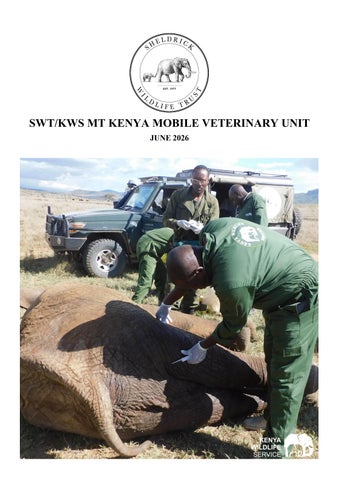
SWT/KWS MT KENYA MOBILE VETERINARY UNIT JUNE 2026
Introduction
15 Cases in June 2026
2 Poaching Cases
3 Elephant Cases
June Report by Dr. Jeremiah Poghorn The Mt Kenya ecosystem experienced dry conditions in June with sporadic rainfall resulting in loss of vegetation and water sources. During June 2026 the Mount Kenya Mobile Veterinary Unit attended to 15 cases mainly comprising of clinical interventions, translocations, assessments and animal capture. Acknowledgement Sincere appreciations to the Sheldrick Wildlife Trust for logistical support which enabled prompt response to cases. We are grateful for the collaboration and coordination extended from the various stakeholders and conservancies we have worked with during this period; these partnerships have been instrumental in ensuring timely and effective veterinary interventions when required. We thank the Kenya Wildlife Service for continued stewardship which makes our work possible.
SWT/KWS Mt Kenya Mobile Vet Unit Treatment Locations June 2026
Case Details Date
Species
Area Found
2-Jun-26
Elephant
Naboisho Conservancy
Spear
The spear wound was deep and penetrating through the left hindlimb
Successfully Treated
3-Jun-26
Hyena
Loisaba Ranch
Collared
Hyena collaring was indicated to monitor individual and pack movement patterns
Successfully Treated
4-Jun-26
Elephant
Olengishu Conservancy
Natural Causes
The patient had a non-weight bearing lameness of the right hindlimb
Prognosis Poor
5-Jun-26
Rhino Black
Ol Pejeta Postmortem Conservancy
The skeleton fragments were found in scattered distribution
Died
5-Jun-26
Zebra
Rumuruti
Research/ Survey
After claims of crop damage by wildlife at the farm, an assessment was conducted
Task Successful
6-Jun-26
Elephant
Olengishu Conservancy
Natural Causes
It was observed that there was increased mobility at the metatarsal joint area
Prognosis Poor
16-Jun-26
Waterbuck
Naromoru
Snared
A snare was around the right forelimb and tied to a tree
Successfully Treated
8-Jun-26
Zebra
Laikipia Environs
Postmortem
Respiratory failure secondary to pneumonia
Died
19-Jun-26
Rhino White
Ol Pejeta Conservancy
Technical Cases
Transfer of a Northern white rhino embryo to Amo, a Southern white rhino
Task Successful
21-Jun-26
Hippo
Rumuruti
Research/ Survey
Claims of crop damage by hippos raiding nearby farms, required an assessment
Task Successful
22-Jun-26
Zebra
Laikipia Environs
HWC
Stranded in a human settlement area with a rope tied around her neck
Task Successful
23-Jun-26
Zebra
Loldiaga Conservancy
Natural Causes
A complete open dislocation of the fetlock joint of the left hind limb
Died
24-Jun-26
Rhino Black
Ol Pejeta Postmortem Conservancy
Septic shock and respiratory failure secondary to pneumonia and colitis
Died
26-Jun-26
Elephant
Ol Maisor Conservancy
Rescue
An infant male elephant had been reported to be abandoned
Taken to Orphanage
26-Jun-26
Hippo
Rumuruti
Technical Cases
Prepare for translocation of 25 hippos to a suitable habitat to prevent human wildlife conflict
Task Successful
Reason for Intervention
Outcome
Case 1 – 2nd June 2026 Elephant
Spear
Naboisho Conservancy
A report was received from Naboisho Conservancy of the recent sighting of a young adult male elephant that was observed by field staff with severe hind limb lameness.
Immobilisation, examination and treatment The elephant was free darted from foot with 15mg Etorphine as he was in a forested location. He went into left lateral recumbence and was turned into right lateral recumbence to facilitate wound management. After initial patient assessment, the wound was explored. It was observed that the wound was deep and penetrating through the soft tissues of the left hind limb stifle area resulting in mild tissue devitalisation. The wound was cleaned; devitalised tissues were debrided by flushing with Hydrogen peroxide and rinsing with Iodine. Oxytetracycline pessaries were placed in the wound then it was sprayed with an antibiotic spray and packed with green clay to protect the wound and minimize external contamination. In addition, the elephant was administered with 2,000mg of Flunixin as an anti-inflammatory, 22,500mg Amoxicillin to provide prophylactic antibiotic cover and 20ml Catosal as a metabolic stimulant. Prognosis Fair prognosis. Smooth recovery is expected with return to functionality of the affected limb.
.
Case 2 – 3rd June 2026 Hyena
Collaring
Loisaba Conservancy
A female hyena entered a trap set for leopard capture. Hyena collaring was indicated to monitor individual and pack movement patterns and home range to proactively prevent and manage human wildlife conflict by deterring livestock predation as well as to serve as a research tool from the hyena location data collected. Immobilisation and collaring The adult female hyena was in a cage trap covered with a shade net and was observed in good health. The hyena was darted in the cage with 3mg Medetomidine and 200mg Ketamine. A blindfold was applied and the patient was removed from the cage trap. A digital GPS neck collar was fitted around the hyena’s neck. Body and weight measurements of the subject were taken and recorded. Samples were also collected, including blood sample collection in EDTA and clot activator impregnated vacutainer tubes. Ear tissue samples and tick samples. Anaesthesia reversal was done by intramuscular injection of 15mg Atipamezole and the patient recovered uneventfully. Prognosis Prognosis is good.
Case 3 – 4th June 2026 Elephant
Natural Causes
Ole Naisho Conservancy
A lone female elephant had been reported to be lame at Ole naisho Conservancy.
Immobilisation, examination and treatment It was noted on distant examination that the patient had a non-weight bearing lameness of the right hindlimb. Asymmetry of the hind limbs was observed with distension noted at the metatarsal area of the right hindlimb. The elephant was darted from the vehicle with 12mg Etorphine hydrochloride. During orthopaedic examination of the right hind limb, it was observed that there was increased mobility at
the metatarsal joint area. The findings were consistent with suspected metatarsal dislocation. The elephant was administered 1,500mg Flunixin meglumine intravenously as an anti-inflammatory agent, 6,000mg Amoxicillin trihydrate was administered intramuscularly to provide prophylactic antibiotic cover and 20ml Catosal as a metabolic stimulant. Prognosis This patient received a guarded prognosis due to the severity of the injury and chances of survival and was determined to be medium. It was recommended that the elephant be monitored to assess her recovery.
Case 4 – 5th June 2026 Rhino
Postmortem
Olpejeta Conservancy
A report was received from the Ol Pejeta Conservancy regarding suspected rhino skeleton fragments found during routine patrols. Subsequent scouting of the area revealed additional skeleton pieces. Postmortem examination The skeleton fragments were found in scattered distribution as outlined below. This observation is consistent with carcass depredation. •
Lower mandible - extensive teeth wear was observed
• • • • •
Pelvic Girdle - Approximately 97 metres from the lower mandible’s location Vertebral column - Approximately 9 metres from the pelvic girdle’s location Toes, a rib and ingesta were found at the site which had extensive activity with flattened vegetation Front horn - Approximately 100 metres from the suspected scene Cranium
Cause of death It was recommended that an extended search be made to find the hind horn and missing skeleton pieces. Due to the condition of the carcass a definitive cause of death could not be determined.
Case 5 – 5th June 2026 Zebra
Research/Survey
Rumuruti
Following claims of crop damage by wildlife at the farm, an assessment was conducted. Assessment A herd of 26 zebras was sighted as well as two gazelle herds with the total population estimated at 200 to 300 individuals. Recommendation Translocation of the zebra and gazelle herds to a suitable habitat. Fencing of the property to minimize future wildlife intrusion.
Case 6 – 6th June 2026 Elephant
Natural Causes
Ole Naisho Conservancy
A juvenile male elephant had been reported to be lame at Olenaisho Conservancy.
Immobilisation, examination and treatment Prior to darting, it was noted that the patient had a non-weight bearing lameness of the right hindlimb. The elephant dam was darted from the vehicle using 12mg Etorphine hydrochloride and the calf darted four minutes later with 2mg Etorphine. During orthopaedic examination of the right hind limb, it was observed that there was increased mobility at the metatarsal joint area. The findings were consistent with suspected metatarsal dislocation. The young calf was given 75mg Meloxicam as an anti-inflammatory agent, 3,000mg Amoxicillin to provide prophylactic antibiotic cover and 8ml Catosal to act as a metabolic stimulant. Prognosis The prognosis is guarded to fair due to the severity of the injury but as he was young rapid healing was possible. It was recommended that this juvenile elephant be closely monitored.
Case 7 – 16th June 2026 Waterbuck
Snared
Naromoru Forest
A report was received from rangers of the recent sighting of an adult waterbuck that was observed by field staff to have a snare lodged on the right forelimb that was tied to a tree.
Immobilisation, examination and treatment The adult male waterbuck, who had a good body condition score, was observed standing while fastened to a tree by a snare. The waterbuck was free darted from foot as he was in a forested location. The dart contained 5mg Etorphine hydrochloride and 40mg Azaperone. After initial assessment, the nylon rope around the left forelimb was cut off. It was observed that the rope snare had cut into the skin resulting in a fresh wound. The wound was cleaned with Iodine and sprayed with an aerosol wound spray. In addition, the waterbuck was given 750mg Flunixin meglumine as an antinflammatory agent and 600mg Amoxicillin trihydrate was administered intramuscularly to provide prophylactic antibiotic cover and 10ml Catosal as a metabolic stimulant. Prognosis The patient received a fair prognosis since the rope snare was removed before causing irreparable damage.
Case 8 – 17th June 2026 Zebra
Postmortem
Nanyuki, Laikipia
A fresh carcass of a young adult female zebra was found and necropsy required. The zebra belonged to a herd of five zebras. Postmortem examination The carcass was in good body condition without evidence of injury, though rectal prolapse was noted as a potential postmortem change. There was copious straw coloured pericardial, pleural and peritoneal fluid, suggestive of effusion. There was copious froth in the trachea and lungs with significant hepatization. Cause of death Respiratory failure secondary to pneumonia was suspected to be the cause of death on gross diagnosis.
Case 9 – 19th June 2026 White Rhino
Technical Case
Ol Pejeta Conservancy
Transfer of a Northern white rhino embryo to Amo, a Southern white rhino female surrogate was done as part of the Northern White Rhino Biorescue Breeding Program.
Immobilisation, examination and embryo transfer The rhino was darted from the helicopter with 35mg Medetomidine, 100mg Butorphanol and 100mg Ketamine in the first dart and 50 mg Butorphanol, 25mg Midazolam and 160mg Ketamine. A blowpipe was then used to dart 240 mg Ketamine. The rhino was blindfolded, restrained using ropes and manipulated into sternal recumbency. Patient monitoring was maintained during anaesthesia by use of a portable pulse oximeter, intraarterial blood pressure monitoring, I-STAT blood analysis and manual monitoring of respiration. Oxygen supplementation was done using a nasal tube throughout the anaesthesia. Intravenous fluid therapy was maintained during the procedure to improve the patient’s hydration status using lactated Ringer’s solution. Rectal evacuation, flushing and disinfection was done followed by ultrasound-guided transrectal embryo transfer into the left horn of the uterus. 2,500mg Flunixin and 6,000mg Amoxicillin was administered. Oxytetracycline wound spray was then applied to wounds and scratches on the patient’s body. Prognosis The exercise was successfully completed.
Case 10 – 21st June 2026 Hippo
Research/Survey
Rumuruti
Following claims of crop damage by hippos raiding nearby farms, an assessment was conducted by the Mount Kenya Mobile Veterinary Unit on 21st June 2026 to prepare for the translocation of resident hippos away from the area and into suitable habitat.
Assessment Approximately 25 hippos live in Mukindu Dam. Views from residents were listened to and recorded during public participation to guide the translocation. A suitable camping site and habituation boma were identified. Habituation is vital to facilitate a smooth translocation. Recommendation Translocation of the population of approximately 25 hippos to a suitable habitat is recommended to prevent human wildlife conflict.
Case 11 – 22nd June 2026 Zebra
Human- Wildlife Conflict
Mia Moja, Laikpia
An adult female plains zebra was reported to have been observed stranded in a human settlement area with a rope tied around her neck. Immobilisation and rescue The animal was free darted from foot using a combination of 6mg Etorphine and 60mg Azaperone. Upon onset of sedation, the patient was then led by rope closer to the vehicle where full anaesthesia set in. A clinical assessment of the patient was conducted with the mare determined to be in apparent good health. The anaesthetized mare was placed on a sling and transported to Ole Lekurruki, a suitable habitat by car. Cloxacillin eye ointment was applied topically to both eyes to manage keratoconjunctivitis. The zebra was adminstered 450mg Amoxicillin trihydrate and 40mg Dexamethasone sodium phosphate to manage shock. As metabolic stimulant was provided by adminstering 10ml of Catosal and Fluid therapy was carried out by administration of 5% dextrose and normal saline intravenously. Cause of death The patient was translocated to a suitable habitat and expected to adapt well to her new environment.
Case 12 – 23rd June 2026 Zebra
Natural Causes
Lol Daiga Conservancy
An adult male zebra was reported to have been observed with left hind limb lameness on 22 nd June 2026 but couldn’t be located until the next day and the vet unit responded to the case. Immobilisation and examination The animal was darted from the vehicle using a combination of 7mg Etorphine and 40mg Azaperone and fell on the right side. A clinical assessment of the patient was conducted which revealed a complete open dislocation of the fetlock joint of the left hind limb diagnosed. Prognosis The patient received a poor prognosis due to the gravity of the injury. The patient was euthanized on animal welfare grounds as the injury was unlikely to heal in the wild and subjected the patient to immense suffering.
Case 13 – 24th June 2026 Black Rhino
Postmortem
Ol Pejeta Conservancy
An adult male fresh rhino carcass was reported to have been found in the morning of 24th June. It had been recorded earlier to exhibit progressive loss of body condition and was under monitoring. Postmortem examination • • •
The carcass was in poor body condition with filarial worm lesions There was copious froth in the trachea and lungs with significant hepatization There were extensive stomatitis, glossitis and pharyngitis with the tongue having an ulcerated portion
• •
Submandibular oedema was observed The liver had a cooked appearance Colitis was seen.
Cause of death Septic shock and respiratory failure secondary to pneumonia and colitis was suspected to be the cause of death on gross diagnosis.
Case 14 – 21st June 2026 Elephant
Rescue
Ol Maisor Conservancy
A juvenile male elephant aged approximately five months old had been reported to be abandoned and in need of urgent veterinary intervention. Immobilisation, examination and rescue It was noted that the patient was dehydrated during clinical examination. An intravenous catheter was placed in the ear veins for administration of fluid therapy. Ringer’s lactate normal saline and Dextrose were administered during the journey to Sheldrick Wildlife Trust Elephant Orphanage in Nairobi. The patient was strapped down in the plane. On getting to the orphanage, the calf was offloaded and offered replacer milk which was consumed well. Prognosis This patient received a good prognosis due to the rapid improvement after fluid therapy and quick adaptation to bottle feeding.
Case 13 – 26th June 2026 Hippo
Technical Case
Ol Kalou, Rumuruti
Following claims of crop damage by hippos raiding nearby farms, an assessment was conducted by the Mount Kenya Mobile Veterinary Unit on 21st June 2026 to prepare for the translocation of resident hippos away from the area and into suitable habitat. The translocation exercise started on 26th June 2026 Preparation The Unit assisted with the following measures to aid in the translocation process. • • •
Habituation of hippos by providing them with food. Building barriers to prevent access to other feed sources Night patrols to prevent crop raiding
Habituation is ongoing to facilitate the capture and translocation of the population of approximately 25 hippos to a suitable habitat to prevent human wildlife conflict.