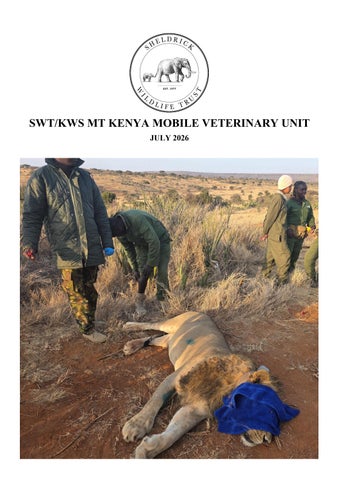
SWT/KWS MT KENYA MOBILE VETERINARY UNIT JULY 2026
Introduction
4 Cases in July 2026
2 Lion Cases
100% Success
July Report by Dr. Poghon J The Mt Kenya Conservation Area mainly experienced dry conditions with sporadic rainfall therefore resulting in some forage and water loss across the wildlife ecosystem. The Mt Kenya Vet Unit attended to 4 cases, one of which is an ongoing translocation of hippos in the Rift Valley that were causing a constant threat to the local community. The task went on throughout the month with habituation to trap cages being key. A total of 12 hippos were successfully relocated in July, and the operation will continue into the next coming months. For research purposes a lion and lioness at Loisaba Conservancy received digital GPS neck collars which will help provide information on movement patterns, disease surveillance and mitigate HWC. Clinical interventions included treatment of a heron at Mukindu area. Acknowledgement Sincere appreciations are extended to the Sheldrick Wildlife Trust for logistical and material support which enabled prompt response to cases. We are grateful for the collaboration and coordination extended from the various stakeholders and conservancies we have worked with during this period; these partnerships have been instrumental in ensuring timely and effective veterinary interventions when required. We thank the Kenya Wildlife Service for continued stewardship which makes our work possible.
Case Details Date
1-Jul-26
23-Jul-26
28-Jul-26
29-Jul-26
Species
Area Found
Hippo
Nyahururu County
Heron
Nyahururu County
Lion
Loisaba Ranch
Lion
Loisaba Ranch
Reason for Intervention
Outcome
Human Wildlife Conflict
After complaints of crop damage by hippopotami raiding neighbouring farms, translocation of resident hippos was conducted
Task Successful
Natural Causes
An adult black-headed heron was stranded in the hippopotamus enclosure area on the ground
Successfully Treated
Collared
The collaring was undertaken to enhance monitoring of the lioness spatial-temporal movement patterns
Task Successful
Collared
The collaring was undertaken to enhance monitoring of the lioness spatial-temporal movement patterns
Task Successful
SWT/KWS Mt Kenya Mobile Vet Unit Treatment Locations July 2026
Case 1 – 1st – 31st July 2026 Hippo
Human – Wildlife Conflict
Nyahururu County
Following complaints of crop damage by hippopotami raiding neighbouring farms, an assessment was conducted by the Mount Kenya Mobile Veterinary Unit on 21st June 2026 to prepare for the translocation of resident hippos away from the area and into a suitable habitat. Translocation began in July.
Relocation •
26th June 2026 – Start of habituation by providing food, building barriers to prevent access to other food sources and night patrols to prevent crop raiding
• • • • •
06th – 16th July 2026 – Enclosure construction 10th – 19th July 2026 – Digging of trenches 17th July 2026 – Outer enclosure gate construction 22nd July 2026 – Capture of 5 hippos (one adult male, two adult females and two juveniles) 24th July 2026 – Capture of 7 hippos (two adult males, four adult females and one juvenile)
Two hippos were immobilized by free darting with 150mg Etorphine, 150mg Azaperone and 60mg Medetomidine after being trapped in the trenches. A total of 12 hippopotami were captured and translocated. The activity is ongoing to facilitate the capture and translocation of the remaining 2 hippos to a suitable habitat to prevent human wildlife conflict.
.
Case 2 – 23rd July 2026 Heron
Natural Causes
Nyahururu County
An adult black-headed heron was reported to have been observed stranded in the hippopotamus enclosure area on the ground. The patient was collected for management. Immobilisation, examination and treatment The bird was secured by supporting legs and holding the beak to prevent pecking. A clinical examination of the patient was conducted with the skeletal system determined to be intact on palpation and joint manipulation. The bird’s body condition score was poor and estimated at 2/5 and it seemed unable to fly. Oral fluid therapy was carried out by administration of 40 ml of 10% Dextrose, and the bird started to show signs of recovery. Prognosis The patient received a fair prognosis due to her stable condition. The patient was released to a suitable habitat and recovery is expected.
Case 3 – 28th July 2026 Lion
Collaring
Loisaba Ranch
Mt. Kenya Vet Unit joined efforts with the Loisaba Veterinary Unit to fit a collar to an adult lioness. The collaring was undertaken to enhance monitoring of the lioness spatial-temporal movement patterns, with the primary objective of mitigating human-wildlife conflict in the conservancy, surrounding community and to protect critically endangered rhinos from predation through informed management interventions. Immobilisation and collaring The lioness was free darted using a combination of 6mg Medetomidine and 300mg Ketamine. Sternal recumbency with optimum anaesthesia was confirmed 10 minutes after darting. Physiological parameters were monitored throughout the immobilization. The lion had a good body condition score, with moderate parasite infestation and a minor injury at the medial phalange of the right hindlimb. The wound was cleaned with Hydrogen peroxide and flushed with Iodine. Morphometric measurements and biological samples were collected for bio-banking, research and surveillance. Prophylactic treatment was given by administration of 1,500 mg Amoxicillin antibiotic, 50mg Meloxicam anti-inflammatory and anti-parasitic treatment using topical fipronil spray. The lion was then fitted with a digital GPS neck collar and the anaesthetic reversed. The patient received an excellent prognosis since the lioness was in good health.
Case 4 – 29th July 2026 Lion
Collaring
Loisaba Ranch
Mt. Kenya Veterinary Unit and Loisaba Vet Unit to deploy a collar to an adult lion at Loisaba Conservancy. The coalition of these two brothers had been moving near the community settlements increasing the risk of livestock predation. The collaring was undertaken to enhance monitoring of the lion spatial-temporal movement patterns, with the primary objective of mitigating human-wildlife conflict in the conservancy. Immobilisation and collaring The lion was darted using a drug combination of 8mg Medetomidine and 500mg Ketamine. Sternal recumbency with optimum anaesthesia confirmed 12 minutes after darting, the patient was blindfolded to minimize visual and auditory stimulation during sedation. Physiological parameters were monitored throughout the immobilization. Morphometric measurements were recorded and biological samples including blood was collected for research and surveillance. The lion was also administered 4,500 mg Amoxicillin antibiotic, 100mg Meloxicam anti-inflammatory and Fipronil antiparasitic spray as prophylactic treatment, after which the collar was fitted. The patient received an excellent prognosis since the lion was in good health. The lion recovered uneventfully a few minutes after reversal and reunited with his brother.