SWT/KWS MERU MOBILE VETERINARY UNIT NOVEMBER 2025
Introduction
4 Cases in November 2025
1 Poaching Case
1 Rhino Case
November Report by Dr. Aminga Duncan The month of October marked the transition from the prolonged dry season to the onset of the rainy season within the Meru ecosystem, following the receipt of light showers during the final week of the month. The rains rejuvenated the landscape, with vegetation slowly sprouting and gradually restoring a green cover across the ecosystem. Increased bird activity characterized by heightened vocalizations signifies ecological revival and optimism for improved resource availability. November experienced variable weather patterns across the Conservation Area. While some regions continued to experience dry conditions, others received intermittent rainfall. Despite the fluctuating weather, it is anticipated that the ecosystem will receive substantial rains in the coming months, providing adequate drinking water and forage for wildlife. Acknowledgement We extend our heartfelt appreciation to Sylvie Chantecaille for the invaluable support, provided through the Sheldrick Wildlife Trust, which has been instrumental in enabling the Meru Mobile Veterinary Unit to respond to and manage a wide range of wildlife interventions throughout the Eastern Conservation Area. We also gratefully recognize the Kenya Wildlife Service for their steadfast leadership, coordination, and logistical backing, offered through the Office of the Senior Assistant Director, Eastern Conservation Area, and the Department of Veterinary Services.
Case Details Date
Species
Area Found
24-Oct-25
Eland
Meru NP
1-Nov-25
Rhino White
10-Nov-25
Giraffe
Wajir
11-Nov-25
Giraffe
Naserian Conservancy
Reason for Intervention
Outcome
The injury may have been caused by a tensioned wire snare that fell off
Successfully Treated
Multiple laceration wounds were present on a carcass consistent with fight injuries
Died
Relocation
Wildlife translocation plays a pivotal role in population recovery and reinforcement,
Task Successful
Natural Causes
Resident m giraffes had been observed to be inactive and not feeding
Died
Snared
Lewa Postmortem Conservancy
SWT/KWS Meru Mobile Vet Unit Treatment Locations November 2025
Case 1 – 24th October 2025 Elephant
Snared
Meru National Park
The Unit received a distress report from the Head of the SWT Meru Rhino Sanctuary Fence Maintenance Team, regarding an elephant bull with a severe trunk injury. He was promptly advised to monitor the elephant’s movements to facilitate its location, as there was a high risk of losing sight of the animal due to approaching nightfall before the veterinary team could reach the site. Upon arrival, the elephant was located feeding on an Acacia tree, exhibiting visible distress and difficulty in foraging due to the severe trunk injury. The distal portion of the trunk was hanging loosely, significantly impairing its normal prehensile function. Immobilisation, examination, treatment and prognosis The elephant was carefully approached using a vehicle and darted with 17mgs Etorphine. He was in fair body condition, though with slightly sunken eyeballs, suggesting possible dehydration likely due to difficulty in drinking water because of the trunk injury. The appearance of the injury suggested that it may have been caused either by a wire snare that slipped during the animal’s struggle. The distal portion of the trunk was determined to be cold, necrotic, and non-viable, with only minimal vascularization and sensory innervation. The necrotic hanging segment served as a potential source of infection and fly infestation, and it markedly impaired the elephant’s ability to feed and utilize the trunk effectively. Surgical removal of the affected portion was deemed necessary to prevent further complications. A surgical amputation of the affected trunk portion was undertaken to establish a clean viable, and manageable stump that the elephant could readily adapt to. This was followed by debridement with Hydrogen peroxide and flushing with Iodine. Haemorrhage control was achieved through ligation of bleeders using absorbable sutures, application of forceps, and direct pressure with sterile swabs. Once haemostasis was secured, the amputation site was covered with an antibiotic aerosol spray to deter fly infestation and promote wound healing. The elephant was administered with 30,000 mgs Amoxicillin, Metabolic stimulants and 100mgs Dexamethasone to mitigate inflammation. The elephant regained its footing approximately three minutes after reversal, appearing relieved and subsequently walked away calmly. The prognosis for full recovery is considered good, with expectations of successful adaptation to the modified trunk
.
Case 2 – 1st November 2025 White Rhino
Postmortem
Lewa Wildlife Conservancy
The carcass was sighted on the evening of 31st October and was estimated to have been dead for approximately 3 days. Both horns were recovered and handed over to KWS Meru Station for safe custody. Postmortem examination The carcass was observed to be in good body condition (3/5) and was found lying on its right side, with extensive scavenging noted on the perineal and dorsal cervical regions. Multiple laceration wounds were present on the neck and flanks, consistent with injuries sustained during a territorial fight. The carcass was turned over for further examination; however, no major puncture wounds were observed on the intact areas of the skin. Fighting trails and significant vegetation damage were evident in the surrounding area. Another adult bull, suspected to have been involved in the altercation, was sighted nearby in the company of a female. Cause of death The findings suggest that the rhino likely succumbed to fatal injuries sustained after a fall during the territorial fight.
Case 3 – 10th October 2025 Giraffe
Relocation
KWS Wajir, Northeastern Kenya
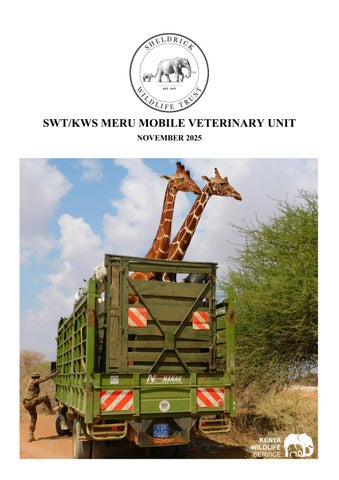
Wildlife translocation plays a pivotal role in population recovery and reinforcement, enhancement of genetic diversity, habitat management, and maintaining ecological balance, among other conservation functions. The Meru Vet Team was tasked with the translocation of two adult male reticulated giraffes that had been rescued and raised within the KWS Wajir Station camp and subsequently relocating them to a protected area to support genetic biodiversity.
Relocation Each of the two giraffes was approached on foot and darted with a combination of 15mgs Etorphine and 20mgs Azaperone. Induction occurred rapidly, and once the animal was recumbent, it was secured by pinning the head and neck on the ground. Anaesthesia was then reversed using 150mgs Naltrexone. Three ropes with slip knots were carefully positioned around the neck: one near the head as a lead rope and the other two on either side of the neck for lateral control. Once the ropes were properly set, the animal was released from the ground and, upon regaining its feet, guided into a standby standard transport truck fitted with a giraffe-specific transport crate. Upon loading, the blindfold was removed and the animals were periodically offered water during transit to prevent dehydration. Both giraffes were successfully released at the destination in good health and are expected to positively contribute to the genetic and demographic diversity of the resident population.
.
Case 4 – 11th November 2025 Giraffe
Natural Causes
Naserian Wildlife Conservancy
On the afternoon of 11th November 2025, the Meru Mobile Veterinary Unit received a report from the manager of Naserian Wildlife Conservancy indicating that one of their resident male reticulated giraffes had been observed to be inactive, not feeding, and intermittently lowering its head with noticeable salivation. Immobilisation and examination The giraffe was found standing with an extended neck and appeared markedly weak, making it an unsuitable candidate for chemical immobilization. The team therefore opted for a manual restraint approach using ropes to safely bring the animal down for thorough examination and treatment. Once restrained, the giraffe was secured and blindfolded to minimize visual stimulation. Clinical assessment revealed laboured breathing, and the animal was suspected to be suffering from a respiratory condition. Unfortunately, the giraffe succumbed during the examination. A subsequent postmortem examination confirmed that the cause of death was acute pneumonia.