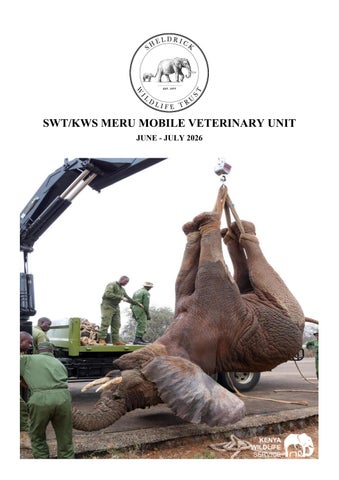
SWT/KWS MERU MOBILE VETERINARY UNIT JUNE - JULY 2026
Introduction
9 Cases
2 HWC Cases
8 Elephant Cases
June/July Report by Dr. Michael Njoroge During the reporting period, the veterinary team conducted regular vehicle patrols within the park and its surrounding areas. The period was characterized by hot and dry weather conditions, with forage gradually drying up and many shrubs shedding their green leaves. Various wildlife species were observed either as solitary individuals, in small groups, or in large herds, depending on their behaviour and habitat preference. Most animals appeared active and were feeding, resting, or moving normally within their ranges. Acknowledgement We extend our sincere gratitude to Sylvie Chantecaille and the Sheldrick Wildlife Trust for their unwavering support of the Meru Mobile Veterinary Unit. Their generous funding continues to play a vital role in safeguarding the health and survival of wildlife within the Meru ecosystem. We also acknowledge the Kenya Wildlife Service for its exemplary leadership and coordination. The strategic guidance provided by the KWS Head of Veterinary Services and the Senior Assistant Director of the Eastern Conservation Area has been instrumental in strengthening conservation efforts and advancing the welfare of wildlife across the region.
Case Details Date
Species
Area Found
22-Jun-26
Other
Meru NP
30-Jun-26
Elephant
16-Jul-26
Reason for Intervention
Outcome
Natural Causes
Sep was presented for clinical evaluation following reports of vomiting
Successfully Treated
Meru NP
Natural Causes
Several old injuries on the body
Successfully Treated
Elephant
Samburu Environs
Postmortem
Natural death due to a suspected noninfectious disease
Died
16-Jul-26
Elephant
Baragoi
HWC
Human-wildlife conflict resulting in a severe left forelimb fracture
HWC Death
16-Jul-26
Elephant
Meru Environs
Postmortem
Natural mortality due to a suspected acute non-infectious disease
Died
24-Jul-26
Elephant
Mwea Conservancy
HWC
Translocated four notorious adult bull elephants
Task Successful
27-Jul-26
Elephant
Namunyak
Postmortem
Suspected acute clostridial infection resulting in a haemorrhagic syndrome
Died
28-Jul-26
Elephant
Wamba
Natural Causes
A long-standing injury around the hock joint, resulting in difficulty in movement
Prognosis Poor
30-Jul-26
Elephant
Marsabit
Postmortem
The external examination revealed multiple chronic traumatic
Died
SWT/KWS Meru Mobile Vet Unit Treatment Locations June/July 2026
Case 1 – 22nd June 2026 Security Dog
Natural Causes
Meru National Park
Sep was presented for clinical evaluation following reports of vomiting on two occasions after a routine walk.
Immobilisation, examination and treatment On physical examination, the dog was observed to have congested mucous membranes, suggestive of an underlying systemic inflammatory or infectious process. Based on the clinical findings, a presumptive diagnosis of a systemic infection was made. Sep was given 600mg Amoxicillin and 6mg Dexamethasone. Recommendations and prognosis SEP will remain under close observation, and continued monitoring is recommended to assess response to treatment and detect any progression or recurrence of clinical signs.
.
Case 2 – 30th June 2026 Elephant
Natural Causes
Meru National Park
KWS reported a case of an injured male elephant with old injuries on the body. The elephant was spotted by the KWS rangers in need for intervention. This was the third attempt to access and treat the elephant. The previous two attempts were unsuccessful due to difficult terrain characterized by dense thick bush and rocky outcrops, which hindered safe approach and immobilization.
Immobilisation, examination and treatment The elephant was immobilized with 10mg Etorphine hydrochloride intramuscularly at the shoulder musculature using the Dan-inject system from a vehicle. The elephant was safely immobilized within 5 minutes and went to lateral recumbency. The trunk was extended to be patent to avoid obstruction. The clinical examination revealed several old soft tissues injuries on the body. The wounds were cleaned with water, Hydrogen peroxide then flushed with Iodine and sprayed with topical Oxytetracycline spray. Prognosis Prognosis is good.
.
Case 3 – 22nd July 2026 Elephant
Postmortem
Samburu
The carcass was recovered at Leorer area. No other wildlife mortalities were reported in the surrounding area. The carcass had been partially scavenged Postmortem examination The elephant carcass was on left lateral recumbency. The carcass was in fresh state of decomposition with evidence of scavenger activity. No external traumatic injuries or lesions suggestive or poaching were observed. Both tusks were intact. • • •
Internal examination revealed pathological changes consistent with a suspected non-infectious disease process No evidence of trauma, haemorrhage or infectious lesions was observed Findings were consistent with a natural death
Cause of death Natural death due to a suspected non-infectious disease. The condition is considered non-transmissible.
Case 4 – 16h July 2026 Elephant
Human – Wildlife Conflict
Baragoi, Samburu
The elephant had sustained a severe fracture of the left forelimb and had previously received treatment. Despite interventions, the injury failed to heal due to its severity, resulting in lateral recumbency and poor welfare. Humane euthanasia was performed to alleviate prolonged pain and suffering. Postmortem examination • •
The carcass was fresh with evidence of scavenger activity A complete fracture of the left forelimb was observed
• • •
Both tusks were intact Extensive traumatic damage and fracture of the left forelimb No evidence of trauma, haemorrhage or infectious lesions was observed
Cause of death Human-wildlife conflict resulting in a severe left forelimb fracture, necessitating humane euthanasia due to irreversible injury and poor prognosis.
Case 5 – 22nd July 2026 Elephant
Postmortem
Meru Environs
A fresh male elephant carcass was reported at Kinyaritha Water Catchment, Themba. No evidence of trauma or human-induced mortality was observed. A field necropsy was conducted to establish the cause of death. Postmortem examination The carcass was fresh and in good body condition. No external wounds, body openings or other injuries were observed. Both tusks were intact. • • •
Internal examination revealed no evidence of traumatic injury or infectious pathology Findings were consistent with acute non-infectious disease process The elephant was considered to have likely been in an immunocompromised state associated with reduced forage availability during the current dry season, predisposing it to an acute fatal illness
Cause of death Human-wildlife conflict resulting in a severe left forelimb fracture, necessitating humane euthanasia due to irreversible injury and poor prognosis.
Case 6 – 24th July 2026 Elephant
Human-Wildlife Conflict
Mwea National Park
Human-elephant conflict has remained a persistent challenge within the Mwea landscape, particularly in the Kaburu area and the adjoining farming communities. Several adult bull elephants have repeatedly broken fences and raided crops, resulting in significant losses to the local community and increasing the risk of human-wildlife conflict. A two-week survey was conducted to identify elephants most likely responsibly for damage and establish their movement patterns for translocation which the Meru Unit assisted with.
Immobilisation, examination and treatment Target elephants, based on their known conflict history, were located and monitored from a helicopter. Immobilization was carried out by darting from the helicopter using 18mg Etorphine. Following induction, ground teams secured each animal and ensured proper positioning to prevent capture-related complications. A physical examination was conducted on each elephant during immobilization. All four bulls were found to be in good body condition with no significant injuries, disease conditions or abnormalities that would compromise translocation. The immobilized elephants were carefully loaded into transport crates using established capture equipment and procedures. The journey from Mwea National Park to Tsavo West National Park was completed without major incidents. On arrival at the release site in Tsavo West National Park, the elephants were overloaded and anaesthetic was reversed with all 4 recovering smoothly.
.
Case 7 – 27th July 2026 Elephant
Postmortem
Namunyak, Samburu
A fresh male elephant carcass was reported at Borish area, Garbatula location, Isiolo North sub-county. Postmortem examination The carcass was fresh and in good body condition, fresh with an early stage of decomposition. Bloodstains were observed from the natural body openings, an old, healed injury was noted over the mid-back region but no fresh external injuries were observed. Both tusks were present and intact. Suspected acute clostridial infection (consistent with clostridial septicaemia/enterotoxaemia), resulting in a haemorrhagic syndrome and sudden death. The condition was considered likely to have been precipitated by an immunocompromised state associated with advanced age and the prevailing dry season. Cause of death Cause of death was natural, and the carcass was disposed of safely in accordance to Kenya Wildlife Service procedures.
Unfortunately, there are no pictures for this case.
Case 8 – 28th July 2026 Elephant
Natural Causes
Wamba, Samburu
The Meru Mobile Vet received a report of an injured elephant within Sarara area of Samburu. The vet responded to by a helicopter while undertaking the ongoing exercise at Mwea of elephant translocation. With the response conducted in between the translocation activity. Immobilisation, examination and treatment The elephant was immobilized with 18mg of Etorphine using the Dan-inject system from a helicopter. The elephant was safely immobilized within 5 minutes post-darting and went to lateral recumbency. The trunk was extended to be patent to avoid obstruction. The bull was observed with severe lameness involving the right hindlimb. Examination revealed a long-standing injury around the hock joint, resulting in difficulty in movement due to pain and discomfort. This is likely caused by arthritis. Oxytetracycline spray was applied to the wound then 2,000mg Flunixin and 25,000mg Amoxicillin were given systemically. Prognosis After treatment the elephant was reversed with Naltrexone hydrochloride 300mgs intravenously through the ear vein. The elephant recovered uneventfully. Prognosis is guarded and the Reteti team will continue to monitor the bull’s progress.
.
Case 9 – 30th July 2026 Elephant
Postmortem
Marsabit, Samburu
A dead adult male elephant was reported at Langata Lengaina river area in Laisamis Sub-county, Marsabit County. Based on the degree of decomposition, post-mortem changes and environmental conditions; the elephant was estimated to have died approximately 2-3 days prior to necropsy examination Postmortem examination The external examination revealed multiple chronic traumatic lesions involving the ventral thoracic region, the wounds exhibited features of chronicity including fibrosis, localized tissue necrosis with no evidence of fresh haemorrhage. No projectile wounds, snare injuries or evidence of poaching was found. There were moderate quantities of serosanguinous fluids, chronic thoracic injuries with extensive fibrous tissue, chronic inflammatory changes and necrotic tissue. Surrounding musculature was congested and localized abscessation with purulent exudate, indicative of a long-standing injury. Generalized congestion of major visceral organs were observed. The liver and spleen appeared enlarged and congested, while the lungs exhibited diffuse congestion and oedema. Cause of death Chronic thoracic trauma complicated by secondary bacterial infection resulting in septic shock.