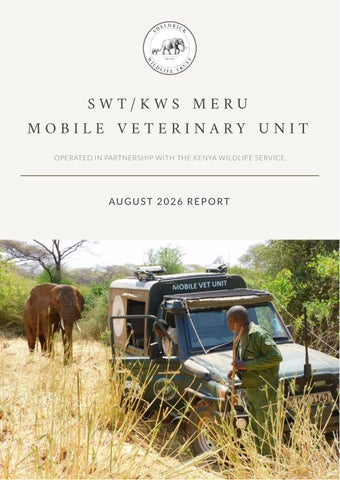
SWT/KWS MERU MOBILE VETERINARY UNIT OPERATED IN PARTNERSHIP WITH THE KENYA WILDLIFE SERVICE
AUGUST 2026 REPORT
Meru Mobile Vet Unit: August 2026 B Y D R . M I C H A E L N J O RO G E
During August 2026, the ECA–Meru Veterinary Unit undertook wildlife health surveillance, mortality investigations, human-wildlife conflict response and emergency veterinary interventions within the Eastern Conservation Area and surrounding landscapes. The month was characterized by several elephant-related incidents, including investigations of elephant mortalities associated with human-wildlife conflict, suspected weapon-inflicted injuries and a successful emergency rescue of a trapped elephant. The veterinary team also supported wildlife conservation operations through field assessments, carcass examinations, trophy recovery and coordination with KWS security and rapid response teams. Acknowledgement: The Meru Mobile Vet Unit would like to appreciate all stakeholders who aided in reporting cases that required veterinary intervention. Special thanks to the Kenya Wildlife Service for their technical assistance and to the Sheldrick Wildlife Trust Wildlife Trust for their continuous facilitation to the unit.
MONTH AT A GLANCE: Total cases:
4
27,678 3 4
Case snapshot:
ELEPHANT CASES
POSTMORTEM CASES
1
ELEPHANT RESCUE
A R E A O F O P E R AT I O N S :
MERU MOBILE VET UNIT
S W T/ K W S M E RU M O B I L E V E T U N I T
2
CASE 1:
ELEPHANT
DATE
SPECIES
SEX
AGE
LOCATION
PROGNOSIS
19/08/2026
Elephant
Male
Adult
Meru National Park
Postmortem
History The carcass was reported and examined about 3 days after the Elephant had died Carcass Examination The carcass was examined following a mortality report. The elephant was in fair body condition, although its condition was considered compromised by advanced age and systemic infection. Numerous penetrating wounds consistent with arrow or spear injuries were observed on the hindquarters and forelimbs. The wounds had severe suppurative and necrotizing inflammation, with extensive purulent tracking through the subcutaneous and fascial tissues. The findings were consistent with severe chronic wound infection progressing to septicemia. Due to advanced decomposition and scavenger activity, suitable biological samples could not be collected for laboratory confirmation. Both tusks were intact and were recovered by KWS security personnel for safe custody. Cause of death The post-mortem assessment concluded that the cause of death was severe septicemia secondary to numerous penetrating arrow and spear injuries, complicated by the animal's advanced age.
S W T/ K W S M E RU M O B I L E V E T U N I T
3
CASE 1
S W T/ K W S M E RU M O B I L E V E T U N I T
4
CASE 2:
ELEPHANT
DATE
SPECIES
SEX
AGE
LOCATION
PROGNOSIS
21/08/2026
Elephant
Female
Adult
Muchuro
Task successful
History On 21st August 2026, the ECA Mobile Veterinary Unit, working together with the KWS Rapid Response Team (RRT), the Sheldrick Wildlife Trust (SWT), and local community members, successfully rescued an adult female elephant trapped in a deep mud pit at Muchuro Rescue The alarm was raised late in the evening when community members spotted a lone female elephant hopelessly trapped in a drying, cement-like muddy ditch. Because of the vast distance and the perils of navigating the bush after dark, an immediate night rescue was impossible. Understanding the gravity of the situation, the KWS Rapid Response Team (RRT) rushed to the scene to secure the area and spent the entire night by the elephant's side, keeping predators at bay and monitoring her condition. At dawn, the ECA Mobile Vet Unit embarked on a grueling 5-hour drive toward the site. While navigating the treacherous, shifting desert terrain, the team’s vehicle flipped completely over onto the sandy road. The determined team pooled their strength, flipped the heavy cruiser back onto its wheels, and pressed onward. Upon arrival, the team found the elephant completely caked in dried, suffocating mud. She had been trapped for nearly 24 hours, was exhausted, unable to move, and beginning to suffer from severe numbness on her left lateral side due to her weight pressing down for so long. The rescue operation involved manual mud clearance, threading heavy-duty industrial straps under the jumbo frame, anchoring them to two 4x4 Mobile Vet Unit vehicles, and executing a coordinated synchronized pull. Following 4.5 hours of strenuous pulling, lifting, and repositioning, the elephant successfully stood up independently. She then delivered a forceful 'thank-you knock' charge into the back of the Mobile Vet Unit vehicle—completely shattering the rear canopy window and ripping the canvas cover—before safely turning to rejoin her resident family herd in stable condition.
S W T/ K W S M E RU M O B I L E V E T U N I T
5
CASE 2
S W T/ K W S M E RU M O B I L E V E T U N I T
6
CASE 3:
ELEPHANT
DATE
SPECIES
SEX
AGE
LOCATION
PROGNOSIS
28/08/2026
Elephant
Male
Adult
Isiolo County
Postmorte
History The veterinary team investigated the death of an adult male elephant following a reported human-wildlife conflict incident. The carcass was relatively fresh, with blood oozing from the body. Both tusks were present. Cause of death The reported means of death was gunshot, and the incident was classified as conflict-related. The case was documented for further investigation and appropriate management of the carcass and recovered trophies.
S W T/ K W S M E RU M O B I L E V E T U N I T
7
CASE 3
S W T/ K W S M E RU M O B I L E V E T U N I T
8
CASE 4:
ELEPHANT
DATE
SPECIES
SEX
AGE
LOCATION
PROGNOSIS
30/08/2026
Elephant
Male
Adult
Meru National Park
Postmortem
History A further elephant mortality was investigated in Mike 9. A deep penetrating wound was observed on the left side of the body, extending almost to the spinal region. The injury was suspected to have been caused by a spear and was located within the thoracic region, with penetration towards the spinal area. The case was classified as human-wildlife conflict related. The carcass was at an early stage of decomposition. The tusks were intact and were retrieved for safe custody.
S W T/ K W S M E RU M O B I L E V E T U N I T
9
CASE 4
S W T/ K W S M E RU M O B I L E V E T U N I T
10
SWT/KWS Mobile Veterinary Units, like all Sheldrick Wildlife Trust's conservation projects, is a donor-funded initiative. Thank you to our global supporters, who help us secure Kenya's habitats for the future and make an impact in the field, each and every day. © 2026 The David Sheldrick Wildlife Trust
11