SWT/KWS MERU MOBILE VETERINARY UNIT OPERATED IN PARTNERSHIP WITH THE KENYA WILDLIFE SERVICE
SEPTEMBER 2026 REPORT
Meru Mobile Vet Unit: September 2026 B Y D R . M I C H A E L N J O RO G E
During the September 2026 operational cycle, the Kenya Wildlife Service (KWS) Veterinary and Capture Department achieved major milestone objectives under the National Black Rhino Action Plan and the largecarnivore regional surveillance framework. Field resources were primarily deployed to Ruma National Park to eliminate monitoring vulnerabilities caused by unmarked animals within the sanctuary. Concurrently, carnivore tracking teams executed intensive satellite telemetry monitoring of key prides in the Ol Pejeta Conservancy (OPC) to mitigate border-line human-wildlife conflict (HWC) and safeguard local community livelihoods. Acknowledgement: The Meru Mobile Vet Unit would like to appreciate all stakeholders who aided in reporting cases that required veterinary intervention. Special thanks to the Kenya Wildlife Service for their technical assistance and to the Sheldrick Wildlife Trust Wildlife Trust for their continuous facilitation to the unit.
MONTH AT A GLANCE: Total cases:
1
27,678 3 15 Case snapshot: WHITE RHINOS
BLACK RHINOS
18
EAR NOTCHING
A R E A O F O P E R AT I O N S :
MERU MOBILE VET UNIT
S W T/ K W S M E RU M O B I L E V E T U N I T
2
CASE 1:
RHINO
DATE
SPECIES
SEX
AGE
LOCATION
PROGNOSIS
3/09/202630/09/2026
Rhino
Mix
Adults
Ruma National Park
Task Successful
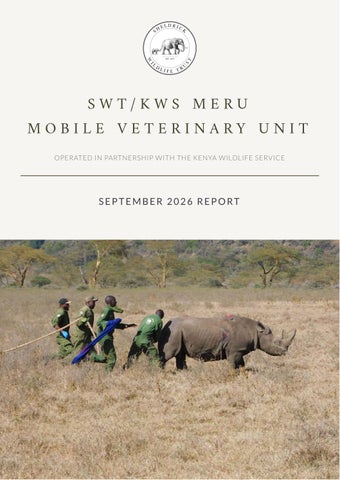
History To satisfy strict national metadata and security requirements, the National Black Rhino Action Plan mandates that at least 60% to 80% of any sanctuary population possess unique, easily identifiable visual tracking profiles. Prior to the September operation, an influx of mature calves led to an increase in 'clean' (unidentified) individuals in Ruma National Park. This targeted veterinary intervention was executed to establish permanent alphanumeric visual markers, substantially enhancing long-term anti-poaching patrol efficiency and demographic monitoring precision. Field Methodology & Veterinary Protocol Chemical Immobilization: Target animals were located via advanced ground tracking and systematically darted from a KWS helicopter using a potent, customized narcotic cocktail of Etorphine Hydrochloride (M99) combined with Azaperone. Surgical Processing: Once the animal was safely down, the ground crew immediately secured the site and enforced a strict 15-minute operational window to minimize physiological stress. Blindfolds and earplugs were fitted to lower sensory inputs. Respiration, blood oxygenation, and temperature vitals were tracked continuously. Standardized V-shaped patterns were cleanly excised into the ear pinnae using sterile surgical notched tools matching the uniform national ID registry. Concurrently, biological samples (blood, tissue, and hair) were gathered for archiving in the National Rhino DNA Database. Reversal: The narcotic effect was reversed cleanly using intravenous administration of Naltrexone. All 18 processed individuals achieved a complete, un-complications recovery, standing and returning to their natural social groupings within minutes. Next Steps & Phase II Projections This specific field exercise has been successfully concluded. The localized monitoring unit will temporarily pause further field captures to allow the newly processed individuals to fully settle into their home ranges. Phase II is scheduled to resume later in the fiscal year, shifting specific focus to catching the remaining resident black rhino population to perform complementary alphanumeric ear-notching and fit high-priority individuals with advanced, horn-embedded telemetry tracking transmitters.
S W T/ K W S M E RU M O B I L E V E T U N I T
3
CASE 1
S W T/ K W S M E RU M O B I L E V E T U N I T
4
CASE 1
S W T/ K W S M E RU M O B I L E V E T U N I T
5
CASE 1
S W T/ K W S M E RU M O B I L E V E T U N I T
6
CASE 1
S W T/ K W S M E RU M O B I L E V E T U N I T
7
CASE 2:
LION & RHINO
DATE
SPECIES
SEX
AGE
LOCATION
PROGNOSIS
21/08/2026
Lion & Rhino
Mix
Adult
Ol Pejeta
Task successful
History In parallel with mega-herbivore protection programs, KWS carnivore ecologists tracked satellite-collared lionesses across the wider Ol Pejeta landscape. Monitoring dominant female matrix leaders represents a core management strategy; selecting fertile, middle-aged adult lionesses that remain loyal to their core prides provides real-time geographic data characterizing absolute group movements, reproductive health, and territory expansion dynamics. Strategic Objectives Achieved Human-Wildlife Conflict Mitigation: Real-time data feeds from the GPS tracking collars were piped directly into the centralized EarthRanger wildlife management software, tracking pride movements relative to agricultural boundaries. This configuration allowed automated geofence alert triggers to warn perimeter rapid response units before prides could target localized community livestock herd vectors. Demographic & Behavioral Mapping: Receiving field teams confirmed highly stable pride dynamics, noting zero conflict-related injuries. Critical behavioral datasets regarding prey selection indexes and cross-boundary dispersal pressures inside the buffer zone were successfully cataloged. Strategic Field Recommendations Ruma Post-Operative Patrols: Intensive tracking ranger teams must maintain rigorous visual monitoring schedules for the 18 newly notched rhinos for the next 45 days to check and verify completely clean aseptic healing of the ear tissue incisions. Ecosystem Wildfire Countermeasures: Due to acute seasonal bushfire threats in Ruma National Park, field rangers must track home range parameters closely, mapping if the processed rhinos disproportionately shift their ranges toward perimeter electric fences or fire-scorched zones. OPC Corridor Integrity: Maintain continuous, 24-hour satellite data verification loops on the monitored lioness channels to facilitate instant rapid response deployment along active pastoralist buffer strips.
S W T/ K W S M E RU M O B I L E V E T U N I T
8
SWT/KWS Mobile Veterinary Units, like all Sheldrick Wildlife Trust's conservation projects, is a donor-funded initiative. Thank you to our global supporters, who help us secure Kenya's habitats for the future and make an impact in the field, each and every day. © 2026 The David Sheldrick Wildlife Trust
9