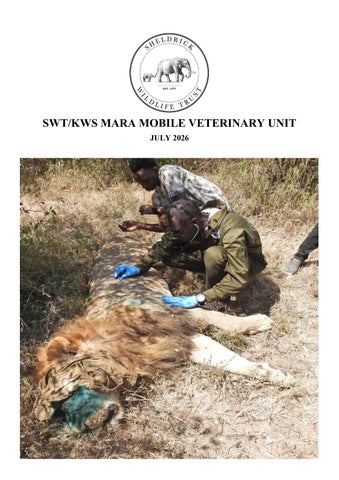
SWT/KWS MARA MOBILE VETERINARY UNIT JULY 2026
Introduction
10 Cases in July 2026
3 Poaching Cases
7 Lion Cases
July Report by Dr. Aminga Duncan July remained generally dry, with high daytime temperatures prevailing across the Mara ecosystem. Intermittent showers were received unevenly across different areas. Despite these conditions, patches of lush short grass attracted hundreds of migratory wildebeest and zebras, creating spectacular wildlife concentrations across the ecosystem. In total, the veterinary team responded to ten wildlife cases during the month. Several lions were successfully treated for fight wounds and one for a hunting injury. Three others were fitted with collars to help monitor the lions and mitigate HWC as the previous month saw and upward trend of lion-related cases due to increased movements in search of prey. Acknowledgement The Unit sincerely acknowledges the generous and continued support of Elizabeth Scarlett and the Sheldrick Wildlife Trust, whose commitment has significantly strengthened our capacity to deliver timely and effective veterinary interventions across the Mara ecosystem. We are equally grateful to the Kenya Wildlife Service for its steadfast leadership and administrative support through. We also extend our sincere appreciation to the Conservancy managers, rangers, and all partner organizations who promptly reported the wildlife incidents and assisted during the field operations during the month.
Case Details Date
Species
Area Found
Reason for Intervention
Outcome
10-Jul-26
Lion
OlKinyei Conservancy
Natural Causes
He was noted to have suffered a severe injury likely sustained during a fight
Successfully Treated
11-Jul-26
Lion
Masai Mara NR
Natural Causes
Injuries to the hip and base of the tail sustained during a territorial confrontation
Successfully Treated
15-Jul-26
Elephant
Olare Motorogi
Arrow
The lodged arrowhead was removed
Successfully Treated
15-Jul-26
Lion
Masai Mara NR
Collared
The failed tracking collar was carefully removed and replaced
Task Successful
16-Jul-26
Lion
Masai Mara NR
Collared
LoRaWAN tracking collar was successfully fitted
Task Successful
18-Jul-26
Lion
Masai Mara NR
Collared
LoRaWAN tracking collar was successfully fitted
Task Successful
22-Jul-26
Lion
Masai Mara NR
Natural Causes
Deep puncture wound suspected to have been inflicted by a buffalo
Successfully Treated
24-Jul-26
Zebra
Nashulai Conservancy
Snared
A single strand wire snare tightly encircled its hindlimb
Successfully Treated
27-Jul-26
Elephant
Naboisho Conservancy
Spear
A deep penetrating spear wound to the left thigh that extended into the knee joint
Successfully Treated
29-Jul-26
Lion
Masai Mara NR
Natural Causes
Suffered puncture wounds suspected to have been caused during a fight
Successfully Treated
SWT/KWS Mara Mobile Vet Unit Treatment Locations July 2026
Case 1 – 10th July 2026 Lion
Natural Causes
OlKiyei Conservancy
The OlKinyei Conservancy Warden made a report regarding Letabo, an adult male lion who is part of a three males coalition. Letabo was reported to have sustained a severe injury to the left side of the eye and periocular tissues with suspicion that he might have lost his left eye.
Immobilization, examination and treatment Letabo was found resting in some croton shrubs. He was darted from a vehicle with a combination of 8mgs Metomidine and 280mgs Ketamine. He was startled and ran deep into the shrubs where the drugs slowly took effect. Since he was in a dense area, he was secured and moved to a shade with more open space to allow for ease of treatment. He was noted to have suffered a severe injury likely sustained during a fight. There was an extensive area of exposed granulation tissue and necrotic debris on the left cheek and marked inflammation. Fortunately, the left eye was intact and there was no involvement of the underlying facial bones. The wound was heavily infested with maggots, but the lion was otherwise in good body condition, indicating that his ability to hunt had not been significantly compromised. The maggots were manually removed, then wound was flushed with Hydrogen peroxide and Iodine and infused with antibiotic ointment and covered with green clay to promote healing. He received 8mgs antiparasitic medication, Amoxicillin and Meloxicam for the management of parasites, bacterial infection and inflammation respectively. Prognosis He recovered smoothly from the anaesthesia with a good prognosis for full recovery.
Case 2 – 11th July 2026 Lion
Natural Causes
Masai Mara National Reserve
The Vet Unit received reports a severely injured sub-adult lioness within Maasai Mara National Reserve who was identified as the daughter of Bearface and Lorkulup and a member of the Rongai Pride. Apparently, she was separated from her pride members after sustaining the injuries which made tracking her down difficulty as she stayed isolated and in hiding. For over a week, the veterinary team kept following leads to be able to find her. Immobilization, examination and treatment She was found to have injuries to the hip and base of the tail suspected to have been sustained during a territorial confrontation with a rival pride, resulting in ambulatory difficulties. She was darted on the left shoulder from a vehicle with a combination of 4mgs Medetomidine and 250mgs Ketamine. The veterinary team noted that her pride members were a few kilometres away. A decision was made to transport her close to her pride members for the treatment to facilitate reunion, ensuring she would have the protection of the group and sufficient access to food through hunting. The wounds were thoroughly cleaned with water, debrided with Hydrogen peroxide and flushed with Iodine solution. They were infused with an antibiotic ointment and dressed with green clay to promoted healing. She received 3,000mgs Amoxicillin and 100mgs Meloxicam for the management of bacterial infections and inflammation respectively. Prognosis Prognosis is good. She recovered smoothly from the anaesthesia and was rejoined by the rest of her pride members.
Case 3 – 15th July 2026 Elephant
Arrow
Olare Motorogi Conservancy
The Mara Vet Unit received a report regarding the sighting of an adult elephant bull by guests from Mara Plains Camp with an arrow lodged in the right side of its head, a few inches below the right eye, as well as a second arrow wound on the right flank.
Immobilization, examination and treatment The bull was found in the company of two other bulls browsing on some dense riverine shrubs. To facilitate assessment and darting, the trio were gently pushed out of the dense vegetation into open grassland. Once the injured bull was identified, a dart was prepared and he was darted on the right rump with 17mgs Etorphine. The area was thoroughly cleaned with water and the arrowhead carefully retrieved. The resultant wound was flushed with clean water and disinfected with Iodine. It was infused with an antibiotic ointment and packed with green clay to enhance wound healing. An antibiotic aerosol cover was also applied to deter flies. Intramuscularly, he received 3,000mgs Flunixin meglumine and 9,000mgs Amoxicillin for the management of inflammation and systemic infections. Prognosis He recovered very well from the anaesthesia with a good prognosis for full recovery as the offending foreign object had been removed and there was plenty of feed and drink within the ecosystem.
Case 4 – 15th July 2026 Lion
Collaring
Masai Mara National Reserve
The Mara ecosystem supports one of the highest lion populations and densities in Kenya. The close proximity of the Reserve to surrounding community conservancies and human settlements makes the ecosystem particularly vulnerable to human–wildlife conflict as local communities are predominantly pastoralists. To approach these challengers, The Vet Unit, in collaboration with other organisations re-collared Sukari, an adult lioness from the Figtree Pride whose collar had failed. Immobilization and collaring The lioness was darted from a vehicle using a combination of 6mgs Medetomidine and 280mgs Ketamine. The remaining pride members were pushed to a safe distance, allowing for a thorough examination and collar replacement. The lioness was carefully relocated to a shaded open area to facilitate examination and collaring. Morphometric measurements were recorded and tick samples collected for laboratory analysis. The failed tracking collar was carefully removed and replaced with a new LoRaWAN tracking collar. The collar was adjusted to ensure an appropriate fit, allowing sufficient clearance to prevent discomfort, or interference with the lioness's normal behaviour. The lioness has since been sighted following the procedure with members of her pride with no signs of distress or complications and no disruption to her normal social interactions.
Case 5 – 16th July 2026 Lion
Collaring
Masai Mara National Reserve
As human populations continue to grow, the demand for land for settlement, agriculture, and livestock
grazing has increased substantially. These competing land-use pressures have increased interactions between people, livestock, and wildlife, exacerbating HWC, particularly involving large carnivores. As part of an ongoing conservation and conflict mitigation efforts within the Mara ecosystem, organisations came together to collar Vuli, an adult male from the Topi Boys collation. Immobilization and collaring The lioness was found in the company of another adult lioness and was darted from a vehicle using a combination of 6 mgs medetomidine and 250 mgs ketamine. Following darting, both lionesses were briefly startled but remained within visual range, allowing continuous monitoring throughout induction. As the drugs took effect, the lioness regurgitated. After approximately 1.4 hours under anaesthesia, reversal was achieved using 30 mgs of atipamezole hydrochloride administered intramuscularly. Recovery was smooth and full mobility was achieved after 20 minutes. Following the procedure, the lioness has regularly been sighted with members of her pride with no signs of distress or complications and no disruption to her normal social interactions or behaviour.
Case 6 – 18th July 2026 Lion
Collaring
Olare Motorogi Conservancy
Due to the increase human-wildlife conflict in the Mara, primarily caused by invasion of livestock into the
reserve and increased movements of lions in search of food. The Mara Vet and other organisations identified another female lion, Naeku, for collaring to follow her movements.
Immobilization and collaring The lioness was found in the company of another adult lioness and was darted from a vehicle using a combination of 6mgs Medetomidine and 250mgs Ketamine. Following darting, both lionesses were briefly startled but remained within visual range, allowing continuous monitoring throughout induction. As the drugs took effect, the lioness regurgitated having recently fed on a kill. When she was fully sedated. The other lioness moved into a nearby thicket, providing a safe working area for the veterinary team. The lioness was carefully retrieved to a shaded open area to facilitate examination and collaring. The trachea and oesophagus were carefully examined and cleared to ensure there was no obstruction from regurgitated material. procedure. Morphometric measurements were taken and tick samples collected for laboratory analysis. A LoRaWAN tracking collar was successfully deployed and will aid in continuous monitoring of the pride’s movements, providing critical data for conflict mitigation.
Case 7 – 22nd July 2026 Lion
Natural Causes
Masai Mara National Reserve
The Mara Vet Unit received a report regarding a severely injured adult male lion within Maasai Mara National Reserve. The individual was identified to be from the Rongai Rockers Coalition and son of renowned lion Olobor.
Immobilization, examination and treatment He was found resting under a shade in some shrub within the Rekero Pride Territory. He was noted to have visible injuries to the head, flanks and neck. He was darted from a vehicle with a combination of 8mgs Medetomidine and 280mgs Ketamine. The drugs quickly took effect and after 15 minutes he was sedated. However, with manipulation of the injuries he could respond to pain which prompted the addition of 50mgs Ketamine to allow for proper management of the wounds. The puncture wounds were suspected to have been inflicted by a buffalo during a failed hunting attempt. He also had multiple puncture wounds to the head and flanks and laceration wounds on the paws suspected to have been inflicted during a territorial conflict. The wounds were cleaned with water, flushed with Iodine and infused with an antibiotic ointment. The puncture wounds were packed with green clay while the laceration wounds were appropriately sutured. He received 150mgs Meloxicam, 4,500mgs Amoxicillin, and 8mg Ivermectin for management of inflammation, bacterial infections and parasites. Prognosis Following anaesthetic reversal, he retreated back into the shrub with a good prognosis being indicated as he was in good body condition and his movement wasn’t severely compromised.
Case 8 – 24th July 2026 Zebra
Snared
Nashulai Conservancy
The Mara Vet Unit received a report from Nashulai Conservancy Rangers about the sighting of a male common zebra with a single strand wire snare tightly encircling its hindlimb. The team advised the rangers to keep track of the zebra while they were enroute. Immobilization, examination and treatment On arrival, the zebra was found with noticeable ambulatory difficulties and a severe snare inflicted injury. The stallion was darted from a vehicle with 5mgs Etorphine and 60mgs Azaperone. The drugs quickly took effect, and the zebra went down in left lateral recumbency. He was blindfolded and carried to a shade before being repositioned to lie on right lateral to allow for ease of examination of the affected limb. The single strand wire snare was removed and the resultant wound thoroughly cleaned with water, debrided with Hydrogen peroxide and flushed with Iodine. It was also dressed with green clay and covered with an antibiotic aerosol to deter flies. Intramuscularly, he received 3,000mgs Amoxicillin and 1,000mgs Flunixin meglumine to manage bacterial infection and inflammation. Prognosis He was given a good prognosis for full recovery since the offending wire was timely removed.
Case 9 – 27th July 2026 Elephant
Spear
Naboisho Conservancy
After weeks of monitoring his recovery progress, the Naboisho Conservancy Rangers reported that a subadult elephant bull that had been treated in early June for a deep penetrating spear wound to the left thigh that extended into the left knee joint was exudating pus from the injury area.
Immobilization, examination and treatment The elephant was darted from a vehicle with 10mgs Etorphine. The drugs quickly took effect and after 5 minutes he went on sternal recumbency. He was pushed to lie on the right lateral to ensure his respiration was not compromised and to allow for ease of examination of the injury. A metal detector was used to check for any metallic foreign objects with negative results being obtained. The wound was flushed with water and the pus pressed out. It was debrided with Hydrogen peroxide and flushed with Iodine. It was packed with antibiotic pessaries for slow antibiotic release and infused with an antibiotic ointment. Intramuscularly the elephant received 140mgs Dexamethasone sodium and 9,000mgs Amoxicillin to manage inflammation and bacterial infection. Prognosis Due to joint involvement, the prognosis for full recovery remains poor. While the bull may recover, he is likely to have a permanent limp.
Case 10 – 29th July 2026 Lion
Natural Causes
Masai Mara National Reserve
The Mara Mobile Vet Unit received a report of an injured sub-adult male lion, a member of the Rongai pride. He had multiple puncture wounds on the thigh of the left hind leg and what appeared to be a foreign object protruding from one of the wounds and was causing ambulatory difficulties. The male was found in the company of other pride members and was noted to have fresh injuries. Immobilization, examination and treatment The male was darted with a combination of 6mgs Medetomidine, 10mgs Azaperone and 25mgs Butorphanol. The induction was smooth and after about 20 minutes, the lion was sufficiently sedated. Clinical examination revealed he had suffered puncture wounds suspected to have been inflicted by another lion. From examination, no foreign objects were found in the wounds. The wounds were thoroughly cleaned with water, flushed with Hydrogen peroxide and Iodine and infused with an antibiotic ointment and covered with antibiotic aerosol. Intramuscularly, he received 75mgs Meloxicam to manage pain and inflammation and a subcutaneous injection of 3mgs of ivermectin for the management of endoparasites and ectoparasites. Prognosis Once the treatment was done, the anaesthesia was reversed and he woke up and moved into a small shrub nearby to avoid the scorching sun. Due to timely intervention, the prognosis for full recovery is good.