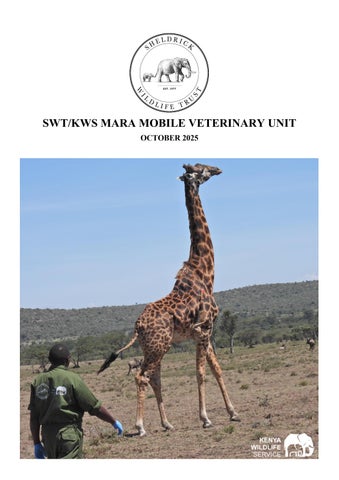
SWT/KWS MARA MOBILE VETERINARY UNIT OCTOBER 2025
Introduction
8 Cases in October 2025
4 Poaching Cases
2 Elephant Cases
October Report by Dr. Michael Njoroge There was a reduction in cases in October from September, with only 8 cases attended to and only 2 involving elephants. Both elephant cases were poaching related with one snared and one arrowed. One zebra was also treated for a snare injury, and a giraffe was treated for a spear wound. A giraffe and two lions were attended to for natural causes, whereas the other lion case was a postmortem; the lion possibly died during the fight with the other treated lion but was heavily scavenged upon so couldn’t be determined definitively. Acknowledgement The Mara Mobile Veterinary Team greatly appreciates Elizabeth Scarlett for funding the Unit through the Sheldrick Wildlife Trust. The team also thanks Kenya Wildlife Service for providing technical support and all the conservation partners who contributed to the success of veterinary interventions through timely reporting of veterinary cases and monitoring of treated animals.
Case Details Date
Species
Area Found
Reason for Intervention
Outcome
1-Oct-25
Lion
Masai Mara NR
Postmortem
Loishipai had a severe fight with Olepolos and Osapuk
Died
2-Oct-25
Lion
Masai Mara NR
Natural Causes
The lion had visible external injuries suggesting a territorial fight
Successfully Treated
12-Oct-25 Elephant
Mau Forest
Arrow
Two penetrating injuries consistent with poisoned arrow injuries
Successfully Treated
14-Oct-25
Giraffe
Olaro Conservancy
Spear
Had abnormal gait and visible purulent discharge from the neck
Successfully Treated
16-Oct-25
Giraffe
Koiyaaki Group Ranch
Natural Causes
Had a closed compound fracture of the joint
Died
17-Oct-25
Elephant
Masai Mara NR
Snared
Had a metallic snare tightly constricting its left ear
Successfully Treated
18-Oct-25
Zebra
Masai Mara NR
Snared
An adult male common zebra observed with a tight snare around his neck
Successfully Treated
26-Oct-25
Lion
Masai Mara NR
Natural Causes
Complete paralysis of the pelvic limbs and absence of reflexes
Died
SWT/KWS Mara Mobile Vet Unit Treatment Locations October 2025
Case 1 – 1st October 2025 Lion
Postmortem
Masai Mara National Reserve
Oloishipai, an adult male lion and dominant member of the Rongai and Fig tree prides, was reported deceased in the Double-cross area. Oloishipai had been involved in a severe conspecific fight with Olepolos and Osapuk, the dominant males of the Topi pride six days prior. This altercation was reported to have occurred in the same vicinity where the remains were located. Postmortem examination Upon field investigation, only partial remains were recovered, consisting of a scapula, hair and fragmented intestinal sections. These remains were found approximately 150m from the site of the reported fight, adjacent to a blind predator den. The carcass was in advanced state of decomposition with extensive tissue loss and skeletal exposure. Evidence of scavenger activity, likely hyenas, including displacement and dispersal of remains was apparent. No tracks, droppings or other indicators suggested recent livestock intrusion or human interference within the area. Cause of death Due to advanced decomposition, a full necropsy examination was not feasible. The death of Oloishipai was most likely the result of fatal trauma incurred during a conspecific confrontation with rival males.
Case 2 – 2nd October 2025 Lion
Natural Causes
Masai Mara National Reserve
The Unit attended to an adult male lion, Oloimina, following reports of injury and subsequent disappearance. Through coordinated efforts involving the local guides and county rangers, the lion was successfully located. On assessment the lion was alert but subdued, with a visible external injuries suggesting a territorial fight.
Immobilisation, examination and treatment The lion was immobilized 300mg Ketamine mixed with 8mg Medetomidine administered from a vehicle at a safe distance. The onset of sedation occurred within 6 minutes, with full sedation taking effect in 15 minutes. A thorough clinical examination revealed deep puncture injuries on the ventral midline and on the extensor carpi radialis muscle exuding seropurulent discharge, wounds on the lower gums and tail, abrasion on the rostral aspect of the nose. The wounds were thoroughly cleaned using water to remove debris, lavaged with Hydrogen peroxide, disinfected with Iodine, covered with 3,340mg Cloaxcillin ointment and sprayed with Oxytetracycline. The lion was also given long-acting broad-spectrum antibiotic: Amoxicillin 2000mgs, Antiinflammatory: Dexamethasone 150 mgs and Ivermectin 60mgs for controlling external parasites. Prognosis The lion walked away in a stable gait, showing no signs of pain relief posttreatment. Prognosis is fair to good.
Case 3 – 12th October 2025 Elephant
Arrow
Mau Forest
The Unit was called to attend to an injured adult male elephant that was observed with lameness and apparent wounds on the right forelimb and right hindlimb. The terrain was heavily forested and uneven, necessitating aerial assistance for a safe approach and immobilization. Immobilisation, examination and treatment The elephant was immobilized with 18mg of Etorphine using the Dan-inject system from a helicopter. The elephant was safely immobilized within 4 minutes post-darting on the left lateral recumbency. Examination revealed, two penetrating injuries consistent with poisoned arrow injuries. A penetrating wound located laterally on the mid-carpal region of the right forelimb exhibited swelling, necrotic margins, and purulent discharge. A smaller but also necrotic wound was observed on the lateral aspect of the thigh of the right hind limb. The wounds were thoroughly lavaged with a copious amount of water and Hydrogen peroxide, followed by antiseptic irrigation with Iodine. Cloxacillin cream and Oxytetracycline spray were also applied. Anti-inflammatory: 8,000 mgs Flunixin, and Antibiotic: 30,000mgs Amoxicillin were adminstered. Prognosis The prognosis is good following intervention, and continued monitoring is recommended for full recovery.
Case 4 – 14th October 2025 Giraffe
Spear
Olare Wildlife Conservancy
The Unit received a report concerning a giraffe exhibiting signs of distress at Mara Olaro Wildlife Conservancy. On-site rangers noted abnormal gait and visible purulent discharge from the neck region.
Immobilisation, examination and treatment The giraffe was immobilized using a combination of 15mg Etorphine hydrochloride mixed with 40mg Azaperone hydrochloride for tranquilization and muscle relaxation. The drug was administered using a dart gun from a safe distance. The giraffe took approximately 8 minutes to full sedation. The giraffe was guided into lateral recumbency with the aid of experienced ground personnel using ropes to avoid injury. It was quickly revived using 300mg Naltrexone through the jugular vein and a third of the drug intramuscularly. The giraffe was maintained in the ground by manual pinning of the head and neck to the ground. Clinical examination revealed a spear injury at the cervical region. The wound was thoroughly cleaned using antiseptic solution, then irrigated with Iodine and Hydrogen Peroxide and sprayed with Oxytetracycline spray. The giraffe was also given Long-acting broad-spectrum antibiotic: Oxytetracycline 16,000 mgs. Prognosis As the giraffe is in good body condition and had stable physiological parameter the prognosis is fair to good.
Case 5 – 16th October 2025 Giraffe
Natural Causes
Pardamat Conservancy
The Unit received a distress report regarding an adult male giraffe that was observed recumbent and unable to bear weight on its forelimbs. The giraffe had been sighted in the same location for two days. Immobilization and examination Upon arrival, the giraffe was found in sternal recumbency, unable to rise, and showing signs of exhaustion and distress. Due to the giraffe’s recumbent state, immobilisation was not required. Clinical examination revealed the presence of a closed compound fracture involving the carpal and glenohumeral joint, with extensive swelling, crepitus, and abnormal limb angulation indicative of severe musculoskeletal disruption. Evidence of secondary trauma, including superficial abrasions and soft tissue injuries, likely sustained during attempts to regain stance. Prognosis The prognosis was determined to be grave. Given the severity and anatomical location of the fractures, the likelihood of fracture reduction and healing was deemed negligible. The inability of the giraffe to bear weight on even a single forelimb, rendered the giraffe incapable of standing, feeding or escaping predators thereby compromising his welfare and survival potential. The giraffe was euthanised on welfare grounds.
Case 6 – 17th October 2025 Elephant
Snared
Sand River, Masai Mara NR
The Unit were alerted to an adult female elephant observed to have a metallic snare tightly constricting its left ear, resulting in visible injuries on the left ear and partial pedunculating mass of the ear hanging leading to partial tissue loss. The elephant showed signs of discomfort.
Immobilisation, examination and treatment The elephant was immobilized with 20mg Etorphine from a vehicle. The elephant was safely immobilized within 5 minutes post-darting on the right lateral recumbency. Examination showed that the left ear had a deep circumferential laceration caused by a wire snare that had partially amputated the distal half of the pinna. The wound margins were irregular, necrotic in some areas, and contaminated with debris with the distal portion infested heavily with maggots. There was localized swelling but no signs of systemic signs of septicaemia. The wire was carefully removed. The necrotic tissues in the infected wounds were debrided to promote granulation, and the pus was drained. The wounds were thoroughly lavaged with water, followed by Hydrogen peroxide, Iodine and sprayed with Oxytetracycline then packed with green clay. The elephant was also given 15,000mg Flunixin and 30,000mgs Amoxicillin. Prognosis The wound is expected to heal with minimal complications. Prognosis is fair to good.
Case 7 – 18th October 2025 Zebra
Snared
Masai Mara NR
The Unit responded to a report regarding an adult male common zebra observed with a tight snare around his neck. The zebra exhibited signs of distress and reduced mobility.
Immobilisation, examination and treatment The zebra was immobilized by chemical immobilization protocol involving a combination of 7mg Etorphine hydrochloride and 60mg of Azaperone hydrochloride. The drugs were administered using the dart delivery system from a vehicle at a safe distance to the hip muscles. The induction time was 5 minutes; the zebra was blind folded and positioned onto right lateral recumbency for treatment. Clinical examination revealed a tight metallic snare constricting around the neck causing injury and oozing pus. The snare was carefully removed, then the wound cleaned with water to remove the debris, Hydrogen peroxide for debridement, and flushed with Iodine to disinfect the area. Cloxacillin ointment and topical antibiotic spray were applied to the wound. The zebra was then administered 2,000mg Amoxicillin and 100mg Flunixin Meglumine. Prognosis The animal was observed standing steadily and rejoined a nearby herd without any complications. Following treatment, good general health and body condition indicate strong healing potential the prognosis is good.
Case 8 – 26th October 2025 Lion
Natural Causes
Masai Mara National Reserve
The Unit received a report of an injured, immobile male sub-adult lion sighted at Tipilikuan area. Field observation suggested that the animal was a dispersing individual likely from Naboisho Wildlife Conservancy or the Maasai Mara NR pride. On arrival, the lion was found recumbent, showing signs of extreme distress, with laboured breathing and complete loss of hindlimb mobility. Immobilization and examination The lion was immobilized involving the administration of 300mg Ketamine mixed with 6mg Medetomidine via dart from a vehicle at a safe distance. Examination revealed a complete paralysis of the pelvic limbs, absence of reflexes, pain in the hindlimb, no external traumatic wounds, palpable crepitus, and misalignment along the lumbar spine. No conspecifics were observed nearby, suggesting a possible kick sustained during hunting. Prognosis Given the severity of the injury, absence of movements in the hindlimb, poor prognosis, a decision was made to humanely euthanize the lion to prevent prolonged suffering. Postmortem revealed a complete fracture of the spinal cord at the lumbar vertebrae which is involved in supporting the majority of the body’s weight.