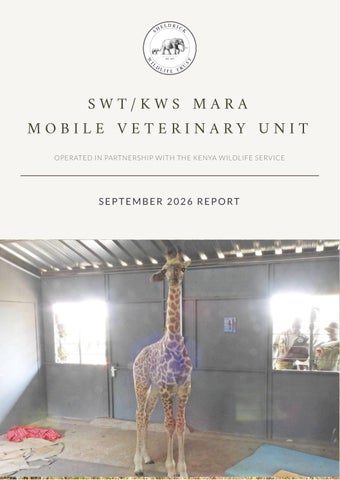
SWT/KWS MARA MOBILE VETERINARY UNIT OPERATED IN PARTNERSHIP WITH THE KENYA WILDLIFE SERVICE
SEPTEMBER 2026 REPORT
Mara Mobile Vet Unit: September 2026 BY DR. DUNCAN AMINGA
The month of September saw intermittent showers received unevenly across the Greater Mara ecosystem during the early part of the month. However, the remainder of the month was generally dry, with noticeable variations in both daytime and night-time temperatures. The brief rains provided only temporary relief, as the green coloration of the landscape quickly faded, giving way to extensive carpets of dry grass with some patches of bare ground. The prevailing dry conditions contributed to a notable increase in wildlife cases attended to by the SWT/KWS Mara Mobile Veterinary Unit, with the team responding to a total of 15 cases during the month, the majority of which were related to human-wildlife conflict. Acknowledgement: The Mara Mobile Veterinary Unit is grateful for the generous and continued support of Elizabeth Scarlett and the Sheldrick Wildlife Trust. We also extend our appreciation to the Kenya Wildlife Service for its continued leadership and administrative support through the Assistant Director, Narok County, and the Head of Veterinary Services. Our sincere gratitude also goes to the rangers and partner organizations who reported and supported us during the various interventions during the month.
MONTH AT A GLANCE: Total cases:
15
27,678 4 5
Case snapshot:
ELEPHANT CASES
CARNIVORE CASES
2
GIRAFFE CASES
A R E A O F O P E R AT I O N S :
MARA MOBILE VET UNIT
S W T/ K W S M A R A M O B I L E V E T U N I T
2
CASE 1:
ELEPHANT
DATE
SPECIES
SEX
AGE
LOCATION
PROGNOSIS
07/09/2026
Elephant
Female
Sub-Adult
Mara North Conservancy
Postmortem
History The Mara Mobile Veterinary Unit received a report regarding the sighting of a sub-adult female elephant carcass in Mara Saruni general Area within Mara North Conservancy. The animal was found dead in a densely vegetated area. No history of illness, injury, human-wildlife conflict, or other preceding clinical signs was available at the time of examination. The team was requested to help ascertain the possible cause of death. Post-Mortem Findings The carcass was found in right lateral recumbency within dense woodland/vegetation and in fair-to-good body condition with no marked external emaciation. From external examination, no obvious penetrating wounds, or other significant traumatic lesions were observed except for slight scavenging on lower ventral abdomen. The visible skin and limbs did not show obvious major traumatic abnormalities. The eyes and visible mucous membranes showed changes consistent with post-mortem changes. Dry, compacted faecal material was noted at the anal opening. Several dry faecal boluses were also visible immediately caudal to the carcass. The faecal material appeared relatively dry and firm, suggesting possible prolonged faecal retention or reduced gastrointestinal motility. Conclusion The most notable finding from the examination was the presence of dry, retained faecal material at the anal opening in the absence of obvious external trauma. This finding raises suspicion of a gastrointestinal disorder, particularly gastrointestinal impaction. A severe obstruction or impaction could result in progressive intestinal distension, compromised intestinal blood supply, endotoxemia, shock and death.
S W T/ K W S M A R A M O B I L E V E T U N I T
3
CASE 1
S W T/ K W S M A R A M O B I L E V E T U N I T
4
CASE 2:
GIRAFFE
DATE
SPECIES
SEX
AGE
LOCATION
OUTCOME
10/09/2026
Giraffe
Male
Juvenile
Mara Siana
Taken to SWT
History The Mara Veterinary Unit received a distress call on the night of 9th September 2026 from the Elephant Aware team, who had located a juvenile male Maasai giraffe entangled in a fence wire and had been abandoned by its mother. The team advised the Elephant Aware personnel to retrieve the calf and keep it safely at their camp overnight to minimize the risk of predation. A plan was then made for the team to conduct a veterinary assessment the following day and search for the giraffe's group in an effort to reunite the calf with its mother. Clinical Immobilization and Treatment On the morning of 10th September 2026, the veterinary team visited the area and found the calf to be stable, active, and alert. Clinical examination revealed cranial injuries on the right side of the head, accompanied by mild haemorrhage from the right ear and partial blindness of the right eye. The calf had also sustained multiple abrasion wounds on the limbs and a laceration wound on the ventral aspect of the neck. The Elephant Aware team reported that no giraffe towers had been sighted around the area, making reunification with the mother unlikely and necessitating rescue to an appropriate facility for further care and nurturing. The haemorrhage was managed using pressure bandages, and an antibiotic aerosol spray was applied to the wounds to prevent fly infestation. The laceration wound was cleaned with water, flushed with hydrogen peroxide, and disinfected using iodine. The calf was administered 40 mg of dexamethasone sodium intramuscularly to reduce inflammation and subsequently received oral rehydration. Following treatment, the giraffe calf was airlifted by an aircraft chartered by the Sheldrick Wildlife Trust to the Kaluku Stockades for specialized care and nurturing. Owing to the timely intervention and anticipated intensive supportive management, the prognosis for full recovery is considered favourable.
S W T/ K W S M A R A M O B I L E V E T U N I T
5
CASE 2
S W T/ K W S M A R A M O B I L E V E T U N I T
6
CASE 3:
LION
DATE
SPECIES
SEX
AGE
LOCATION
OUTCOME
10/09/2026
Lion
Male
Sub-Adult
Naboisho Conservancy
Euthanized
History After the Giraffe rescue, the Mara Mobile Veterinary Unit received a distress report regarding the sighting of a sub-adult male lion in Naboisho Conservancy that had sustained severe injuries following a territorial fight and was subsequently injured by a buffalo, with suspected spinal involvement leading to impaired mobility. Immobilization and Treatment He was found in small shrubs under the scorching heat with visible bite wounds and pucture wounds with impaired mobility from paralyzed hindlegs prompting for immobilization and further assessment. He was cautiously approached with a vehicle and darted with 4mgs medetomidine and 280mgs ketamine. The drugs quickly took effect and he was recumbent after 5 minutes with complete cessation of reflexes in 8 minutes. He was secured, blindfolded to prevent ocular damage and moved to a shaded area to protect from the scorching sun. water was doused on his body to aid with thermoregulation before proceeding with examination. From assessment, he was found to have suffered a deep bite wounds and a penetrating wound over the dorsal aspect of the back suspected to have been inflicted by a rival lion and a buffalo respectively. Prognosis Given the severity of the injuries, complete hind-limb paralysis and the grave prognosis, clinical management was deemed neither feasible nor likely to result in a meaningful recovery. In consideration of the animal’s welfare and to alleviate further pain and suffering, he was humanely euthanized. A post-mortem examination confirmed a complete fracture of the lower lumbar vertebrae and a dislocation of the right hind limb.
S W T/ K W S M A R A M O B I L E V E T U N I T
7
CASE 3
S W T/ K W S M A R A M O B I L E V E T U N I T
8
CASE 4:
ELEPHANT
DATE
SPECIES
SEX
AGE
LOCATION
OUTCOME
11/09/2026
Elephant
Female & Male
Sub Adult
Olare Motorogi Conservancy
Good prognosis
History The SWT/KWS Mara Mobile Veterinary Unit received a report from the Warden of Olare Motorogi Conservancy regarding a sub-adult male elephant that had been sighted around Ole Muli Dam within the conservancy. The elephant was reported to have an infected spear wound on the right rump. The team was advised to monitor the elephant's movements as the veterinary team mobilized and proceeded to the reported location to provide the necessary veterinary intervention. Upon arrival, the elephant was found browsing within a herd of approximately 15 elephants of mixed age groups. The bull was notably skittish and wary of the approaching vehicle, making it challenging to maintain a close and stable approach for darting. Immobilization and Treatment Due to the elephant's skittish behaviour, he was darted in the right rump following a short chase, using 12 mgs of etorphine hydrochloride and ran back into the herd. Approximately five minutes later, the drugs took effect, causing him to separate from the rest of the herd and went down on right lateral recumbency. Once recumbent, the elephant was doused with water to assist with thermoregulation. The trunk was positioned in a straight and patent position, with a small stick used to maintain the airway and facilitate normal respiration while the veterinary team proceeded with the clinical examination. Unfortunately, the elephant had fallen onto the injured right side, limiting access to the wound and making proper examination and treatment difficult. With assistance from the conservancy rangers, the elephant was carefully repositioned using straps to allow adequate access to the affected area. Examination revealed a deep, penetrating spear wound on the right rump, which had become infected. The wound was thoroughly cleaned with water, debrided using hydrogen peroxide, and flushed with iodine solution. An antibiotic ointment was infused into the wound, which was dressed with green clay to support wound healing. To manage inflammation and bacterial infection, the elephant was administered 3,000 mgs of flunixin meglumine and 9,000 mgs of amoxicillin intramuscularly. The anaesthesia was reversed using 150 mgs of naltrexone administered through a prominent ear vein. The elephant regained consciousness and rose approximately two minutes later. He slowly walked towards a nearby stream and rejoined his herd. Given the nature of the injury and the response to treatment, the prognosis for full recovery was considered good.
S W T/ K W S M A R A M O B I L E V E T U N I T
9
CASE 4
S W T/ K W S M A R A M O B I L E V E T U N I T
10
CASE 5:
LION
DATE
SPECIES
SEX
AGE
LOCATION
OUTCOME
12/09/2026
Lion
Male
Juvenile
Masai Mara NR
Euthanized
History The Mara Veterinary Unit received a report of a juvenile male lion in the Mpuuai area within Maasai Mara National Reserve that was recumbent and unable to move. The animal was reportedly unable to use its hind limbs, raising concern about a potentially severe traumatic or neurological condition. The veterinary team responded and visited the said location to assess the animal, determine the underlying cause of the paralysis, and establish an appropriate course of action based on the animal's welfare and prognosis. The juvenile male is suspected to be a member of the Topi Breakaway Pride. He was sighted by tour operators in the early hours of 12th September at approximately 0500 hours in the Mpuuai area, recumbent and unable to stand or move. The lion had visible bite wounds to the back, some of which were actively bleeding at the time of observation. It was suspected a territorial confrontation with the Figtree Pride. Immobilization and Treatment On arrival, the lion was found recumbent and unable to ambulate. The animal showed complete paralysis of both hind limbs, with severe impairment of motor function of the caudal part of the body consistent with a severe spinal cord injury. He was approached carefully from a vehicle and darted with 2mgs of medetomidine and 250mgs of ketamine to allow for further detailed examination. He was fully sedated after 15 minutes and was blindfolded, doused with water to help cool the body and relocated to a shade to allow for examination.
Given the extent of the injury, the likelihood of meaningful neurological recovery was considered extremely poor to non-existent and therefore, therapeutic intervention was not considered as a viable option. Additionally, attempted long-term management or rehabilitation was also considered infeasible. Continued survival in this condition would therefore be associated with prolonged suffering and severely compromised welfare. Based on this assessment, and in consideration of the animal’s welfare, humane euthanasia was undertaken to prevent further suffering.
S W T/ K W S M A R A M O B I L E V E T U N I T
11
CASE 5
S W T/ K W S M A R A M O B I L E V E T U N I T
12
CASE 6:
ELEPHANT
DATE
SPECIES
SEX
AGE
LOCATION
OUTCOME
14/09/2026
Elephant
Male
Sub Adult
Naboisho Conservancy
Euthanized
History The Mara Mobile Veterinary Unit received a distress call on the late evening of September 14th 2026 concerning a recumbent sub-adult male elephant in Naboisho Conservancy that had an infected open wound and was having difficulties getting back on his feet. The veterinary team quickly mobilized and visited the location to conduct a detailed clinical assessment, establish the extent of the injury, and make an appropriate management decision. The elephant had a history of a traumatic injury to the left hind limb. He was initially treated on 2nd June 2026 in Naboisho Conservancy by the Mt. Kenya Veterinary Unit for a spear injury to the left thigh, with suspected involvement of the knee joint, with a guarded prognosis. A repeat treatment was subsequently undertaken on 27th July 2026 by the Mara Veterinary Unit. Following the repeat intervention, the elephant appeared to respond well to treatment and demonstrated progressive clinical improvement. Immobilization and Treatment On arrival, the elephant was found on right lateral recumbency. He was in a fair body condition, active and alert. From examination, the previously injured left hind limb was noted to have a severely infected wound that was exudating copious amount of pus. During wound exploration, a bone fragment was retrieved from the affected wound. This raised strong suspicion of an underlying fracture involving the femur, since the elephant wasn’t bearing weight on the affected limb. Several attempts were made to assist the elephant to regain a standing position. Despite these efforts, the elephant was unable to rise. Based on the severity of the injury, poor prognosis for recovery, and welfare considerations, humane euthanasia was recommended and carried out on welfare grounds.
S W T/ K W S M A R A M O B I L E V E T U N I T
13
CASE 6
S W T/ K W S M A R A M O B I L E V E T U N I T
14
CASE 7:
CHEETAH
DATE
SPECIES
SEX
AGE
LOCATION
OUTCOME
16/09/2026
Cheetah
Female
Adult
Masai Mara NR
Good prognosis
History The Mara Mobile Veterinary Unit received a report of an injured female cheetah sighted around the Survey area within the Maasai Mara National Reserve. She was reported to have a superficial subcutaneous laceration wound over the mid-ulnar region of the left forelimb, as well as a small laceration on the left flank, suspected to have been sustained from prey during a hunt. By the time the veterinary team received the report, the cheetah had moved out of the area and subsequent search efforts were unsuccessful. However, since the area forms part of her established territory and since she had been reported to have a slight limp, it was considered unlikely that she had moved far. The team therefore planned to continue searching within the area over the following days to locate her and assess her condition. Fortunately, on the morning of 16th September, the cheetah was sighted by reserve rangers, who immediately alerted the veterinary team. The team was also in the vicinity conducting routine wildlife health assessments and promptly proceeded to the reported location to assess the cheetah and determine the appropriate course of treatment. Immobilization and Treatment On examination, both wounds were dry and healing well by secondary intention, with no evidence of active infection or other complications. The degree of lameness had also considerably reduced. The cheetah was active and alert, with no clinical signs of distress observed. Given the continued natural healing of the wounds and the marked improvement in mobility, no veterinary intervention was deemed necessary at that stage. Close monitoring was recommended to assess the progress of healing and overall condition. Prognosis The prognosis for full recovery was considered good, given her good body condition, improving mobility, and the favourable natural healing of the injuries.
S W T/ K W S M A R A M O B I L E V E T U N I T
15
CASE 7
S W T/ K W S M A R A M O B I L E V E T U N I T
16
CASE 8:
ZEBRA
DATE
SPECIES
SEX
AGE
LOCATION
OUTCOME
16/09/2026
Zebra
Male
Adult
Masai Mara NR
Good prognosis
History While attending to the cheetah, the veterinary team received a report of a common zebra stallion that had been sighted within the same area with a wire snare deeply embedded into the neck muscles. With assistance from a tour guide who directed the team to the location where the zebra had last been sighted, the team was able to locate the animal within a mixed herd comprising approximately 50 zebras and more than 100 wildebeests. The zebra was suspected to be part of the migratory herds moving through the reserve. Immobilization and Relocation The zebra was slowly approached using a vehicle and darted in the right shoulder with a combination of 6 mgs of etorphine hydrochloride and 60 mgs of azaperone. The drugs took effect rapidly, and approximately five minutes later, the stallion went down on right lateral. A blindfold was applied to protect the cornea from injury and to minimize visual stimulation before treatment commenced. Clinical examination revealed a wire snare deeply embedded within the neck muscles, resulting in significant soft tissue injury. The snare was carefully removed, and the wound was thoroughly cleaned with water, debrided using hydrogen peroxide and flushed with iodine solution before being dressed with green clay to support wound healing. Intramuscularly he received antibiotics, anti-inflammatories and metabolic stimulators. The anaesthesia was reversed with an intravenous injection of 100mgs of naltrexone. He rose 2 minutes later and ran away with a good prognosis for full recovery following removal of the snare and good response during treatment.
S W T/ K W S M A R A M O B I L E V E T U N I T
17
CASE 8
S W T/ K W S M A R A M O B I L E V E T U N I T
18
CASE 9:
HIPPO
DATE
SPECIES
SEX
AGE
LOCATION
OUTCOME
16/09/2026
Hippo
Male
Sub Adult
Masai Mara NR
Euthanized
History While attending to the snared zebra stallion, the veterinary team received a distress report of a male hippopotamus sighted roaming around the Maji ya Fisi area with a spear lodged in its back. The team quickly mobilized and proceeded to the reported location to provide the critically needed veterinary intervention. The hippo was located in a small pool and was found to have multiple laceration and puncture wounds on the flanks, in addition to the spear wound. Given the extent and location of the injuries, immobilization was deemed necessary to facilitate a thorough clinical examination and appropriate treatment. Immobilization and Treatment The hippo was carefully approached using a vehicle and darted in the right neck muscles with a combination of 4 mgs of etorphine hydrochloride and 170 mgs of azaperone. Upon being darted, he became startled and aggressive, running through the surrounding bushes, which resulted in the spear becoming dislodged. Induction was smooth, and approximately seven minutes later, the hippo became recumbent in sternal recumbency. The animal was quickly secured and blindfolded, and the body was doused with water to assist with thermoregulation. Clinical examination revealed a deep penetrating spear wound on the left side of the head, with involvement of the left eye and marked swelling of the affected side of the head. The wounds were thoroughly cleaned with water, flushed with hydrogen peroxide and iodine solution. Postmortem A post-mortem examination revealed that the penetrating spear injury had caused a skull fracture and extensive intracranial haemorrhage. These traumatic lesions were considered likely contributors to the respiratory and anaesthetic complications observed during the intervention and may have significantly compromised the animal's ability to recover.
S W T/ K W S M A R A M O B I L E V E T U N I T
19
CASE 9
S W T/ K W S M A R A M O B I L E V E T U N I T
20
CASE 10:
CHEETAH
DATE
SPECIES
SEX
AGE
LOCATION
OUTCOME
18/09/2026
Cheetah
Male
Adult
Olare Motorogi Conservancy
Good prognosis
History The SWT/KWS Mara Mobile Veterinary Unit received a report concerning a male cheetah named Milele, who had been sighted with leg carrying lameness following a territorial fight with a rival male. Given the importance of mobility in cheetahs for high-speed pursuit of prey and effective evasion of potential threats, the veterinary team promptly mobilized and proceeded to the reported location to provide the necessary veterinary assessment and care. Immobilization and Treatment The cheetah was found resting under a shade and showed clear signs of pain and discomfort. On clinical assessment, he was observed walking with minimal weight-bearing on the right hindlimb. Puncture wounds were noted around the knee joint, accompanied by mild swelling of the affected area. The injuries were suspected to have been sustained during the territorial fight with the rival male. The cheetah was slowly approached and darted in the right thigh using a combination of 6 mgs of medetomidine, 10 mgs of azaperone, and 15 mgs of butorphanol tartrate. Induction was smooth, and approximately five minutes later, the animal became recumbent on his left lateral side. After 15 minutes, he was carefully secured, ophthalmic ointment was applied to the eyes to prevent corneal drying, and a blindfold was placed to minimize visual stimulation. The body was then doused with water to assist with thermoregulation before proceeding with a thorough clinical examination. Examination revealed deep puncture wounds involving the right knee joint, with mild evidence of infection. The wounds were thoroughly flushed with normal saline and infused with an antibiotic ointment to manage the bacterial infection and support healing. The cheetah was administered 1,500 mgs of amoxicillin and 100 mgs of meloxicam intramuscularly to manage infection and inflammation, respectively. Reversal Approximately 45 minutes later, the anaesthesia was reversed using 150 mgs of naltrexone and 30 mgs of atipamezole administered intramuscularly. Reflexes returned approximately five minutes after administration of the reversal agents, and the cheetah stood and walked approximately 20 minutes later. Given the timely wound management, and absence of significant complications, the prognosis for full recovery was considered favourable.
S W T/ K W S M A R A M O B I L E V E T U N I T
21
CASE 10
S W T/ K W S M A R A M O B I L E V E T U N I T
22
CASE 11:
GIRAFFE
DATE
SPECIES
SEX
AGE
LOCATION
OUTCOME
21/09/2026
Giraffe
Female
Adult
OlKinyei Conservancy
Good prognosis
History The Mara Veterinary Unit received a report from the Warden of Olkinyei Conservancy regarding a female giraffe that had been sighted with a wire snare around her right hindleg. The veterinary team promptly mobilized while the Olkinyei Conservancy team continued monitoring the giraffe's movements. Upon arrival, the giraffe was located browsing within a tower of approximately 14 giraffes. A wire snare was clearly visible around her right hindleg, necessitating veterinary intervention to remove the snare and assess the extent of the associated injuries. Immobilization and Treatment She was approached cautiously by vehicle and darted on the left rump with a combination of 12 mgs etorphine and 30 mgs azaperone. Due to strong winds, the first attempt failed, but a second dart successfully landed in the target area. Although the giraffe was slightly startled, she remained within the tower. The drugs took effect gradually; after 15 minutes, she was roped down, her neck was pinned to the ground, and she was blindfolded to minimize stress. The anaesthesia was immediately reversed via an intravenous injection of 150 mgs naltrexone, after which the team proceeded to remove the wire snare. The snare was found to be loose and had not caused significant injury, aside from minor abrasion wounds that were treated with an antibiotic aerosol. Once the snare was cut free, the giraffe was released. She has a good prognosis for full recovery, as the snare did not cause any serious injury or compromise her mobility.
S W T/ K W S M A R A M O B I L E V E T U N I T
23
CASE 11
S W T/ K W S M A R A M O B I L E V E T U N I T
24
CASE 12:
ELEPHANT
DATE
SPECIES
SEX
AGE
LOCATION
OUTCOME
27/09/2026
Elephant
Female
Adult
Olare Motorogi Conservancy
Death
History The Mara Mobile Veterinary Unit received a report regarding the sighting of a carcass of an adult female elephant along Andy Road, towards the airstrip within Olare Motorogi Conservancy. The elephant was reported to be a well-known and frequently sighted individual within the conservancy, having occupied and ranged within the area for several years. The individual was familiar to conservancy guides, tourists, and rangers. Post-Mortem Findings The carcass was found in sternal recumbency within an open savannah area. The elephant was in poor body condition, with a body condition score of 2.5/5. The ribs were clearly visible, with marked depressions cranial and caudal to the pelvic bones. The vertebral column was prominent from the tail head to the shoulders, with a pronounced depression along the lumbar region on either side of the vertebral column. On external examination, no obvious penetrating wounds or other significant traumatic injuries were observed. The visible skin and limbs showed no apparent major traumatic abnormalities. Conclusion Based on the findings, particularly the absence of significant external traumatic injuries, the elephant is suspected to have died from age-related physiological decline and associated complications, which likely resulted in progressive debilitation, collapse, and subsequent death.
S W T/ K W S M A R A M O B I L E V E T U N I T
25
CASE 12
S W T/ K W S M A R A M O B I L E V E T U N I T
26
CASE 13:
ZEBRA
DATE
SPECIES
SEX
AGE
LOCATION
OUTCOME
28/09/2026
Zebra
Male
Adult
Ntona Farm Lorgorian
Poor prognosis
History While capturing various animals at Ntona Farm, the veterinary team observed that one individual was suffering from marked lameness due to a snare-inflicted injury. The snare had badly severed the middle phalanx area of the left hind leg, necessitating immediate veterinary attention. Immobilization and Treatment The zebra was darted on foot while held in a mass-capture boma, using a combination of 3.5 mgs etorphine and 80 mgs azaperone. The drugs took effect quickly, and he was in right lateral recumbency five minutes postdarting. He was blindfolded and doused with water to facilitate examination. The examination revealed that the snare had severed the tendons and part of the joint structures, which explained the marked lameness noted earlier. The wound was cleaned with water, debrided with hydrogen peroxide, and flushed with iodine. Stay sutures were placed, and the site was dressed with green clay for its wound-healing properties. He was administered 6,000 mgs amoxicillin and 1,500 mgs flunixin meglumine intramuscularly, along with antiparasitic medication. He was then transported to the Maasai Mara National Reserve with a poor prognosis for full recovery due to the involvement of joint tissue.
S W T/ K W S M A R A M O B I L E V E T U N I T
27
CASE 13
S W T/ K W S M A R A M O B I L E V E T U N I T
28
CASE 14:
ELEPHANT
DATE
SPECIES
SEX
AGE
LOCATION
OUTCOME
28/09/2026
Elephant
Male
Juvenile
Partakilat area
Poor prognosis
History The SWT/KWS Mara Mobile Vet Unit received a report of a juvenile elephant carcass sighted within the Partakilat escarpment and was requested to assist in ascertaining the cause of death. Post-Mortem Findings The carcass was found lying on its left side with both tusks intact. Early signs of putrefaction were already evident. On external examination, no visible injuries or significant external trauma were observed. However, there was extensive scavenging, particularly pronounced on the rear end, with flesh from the right hindleg heavily scavenged. Due to the combined effects of scavenging and advanced autolysis, the exact cause of death could not be ascertained. Both tusks were retrieved by the KWS team stationed at Partakilat for safe custody.
S W T/ K W S M A R A M O B I L E V E T U N I T
29
CASE 14
S W T/ K W S M A R A M O B I L E V E T U N I T
30
CASE 15:
VARIOUS ANIMALS
DATE
SPECIES
SEX
AGE
LOCATION
OUTCOME
29/09/2026
Various Species
Mixed
Mixed
Ntona Farm
Poor prognosis
History At the request of the owner of Ntona Private Farm in Lolgorian, a wildlife capture and translocation operation was undertaken to relieve extreme competition for pasture between resident wildlife and livestock, driven by shifting land-use practices. Capture and Release Over 50 animals comprising common zebras, topis, impalas and spotted hyenas were captured and translocated into the Maasai Mara National Reserve. Common zebras were gathered using the mass-capture boma technique, with a Kenya Wildlife Service helicopter assisting in driving the herds into the funnel traps, while the antelopes (topis and impalas) were captured using capture nets. The captured animals were physically restrained where necessary, examined for injuries or disease, samples collected and loaded into transport crates for transport to the reserve. Upon arrival, they were released into suitable habitat within the Maasai Mara National Reserve, where they can access adequate feed and move freely across the ecosystem. The operation concluded successfully, reducing human–wildlife conflict and pressure on farmlands while reinforcing wildlife populations inside the protected area, and all animals showed no immediate post-release complications.
S W T/ K W S M A R A M O B I L E V E T U N I T
31
CASE 15
S W T/ K W S M A R A M O B I L E V E T U N I T
32
SWT/KWS Mobile Veterinary Units, like all Sheldrick Wildlife Trust's conservation projects, is a donor-funded initiative. Thank you to our global supporters, who help us secure Kenya's habitats for the future and make an impact in the field, each and every day. © 2026 The David Sheldrick Wildlife Trust
33