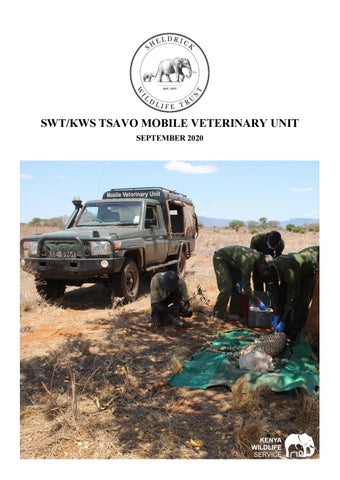
SWT/KWS TSAVO MOBILE VETERINARY UNIT SEPTEMBER 2020
Introduction
10 Cases in September
1 HWC Case
2 Elephant Cases
September Report by Dr. Jeremiah Poghon
The month of September saw a slight increase in cases of unknown deaths in zebras in Dakota and Mgeno areas of Tsavo due to suspected dehydration because of water scarcity. In Tsavo East, a male cheetah and an eland were treated for lameness of the hind legs while autopsies were performed on an adult elephant and a young elephant calf. Finally, a stray zebra that left the park and stayed in a village near Ikutha was translocated to Chyulu hills National Park and a young lion was treated for puncture and laceration wounds near Voi River, Tsavo East. Acknowledgement The unit acknowledges the support of its sponsors ViER PFOTEN through the Sheldrick Wildlife Trust (SWT) for their huge financial support to the unit. We also thank Kenya Wildlife Service through the Assistant Director of the Tsavo Conservation Area and the Head of the Veterinary Services Department.
Case Details Date
Species
Area Found
Reason for Intervention
Outcome
02-Sep-20
Eland
Maungu, Taita
Natural Causes
Had a complete fracture of the right hind limb with an extremely poor prognosis
Died
06-Sep-20
Zebra
Tsavo East NP
Postmortem
There was an increase of zebra deaths in Sept attributed to the prolonged drought
Died
08-Sep-20
Lesser Kudu
Kaluku, Tsavo
Natural Causes
She was reported to show signs of diarrhoea, inappetence and an eye problem.
Successfully Treated
Translocation of an adult female zebra that had strayed into one of the homesteads
08-Sep-20
Zebra
Ikutha, Tsavo
Human Wildlife Conflict
10-Sep-20
Zebra
Mgeno, Taita Ranches
Postmortem
Examination revealed death due to impactation and drought in 2 zebras
Died
10-Sep-20
Zebra
Mgeno, Taita Ranches
Natural Causes
He had a complete fracture of the carpal joint of the right fore limb
Died
12-Sep-20
Cheetah
Tsavo East NP
Natural Causes
A cheetah had an injury to the left hind limb
Successfully Treated
16-Sep-20
Elephant
Tsavo East NP
Postmortem
The cause of death couldn’t be ascertained but suspected to be due to natural causes
Died
19-Sep-20
Lion
Tsavo East NP
Natural Causes
A male sub-adult in a pride of lions had bite wounds caused by other lions
Successfully Treated
21-Sep-20
Elephant
Tsavo East NP
Postmortem
An elephant calf carcass: there were faeces with forage material around the carcass
Died
Task Successful
SWT/KWS Tsavo Mobile Vet Unit Treatment Locations September 2020
. Case
1 – 2nd September 2020
Eland
Natural Causes
Maungu, Taita Ranches
The report of a lame eland was made by the Wildlife Works Rangers, on a Conservancy that borders the park. They stated the eland could barely walk and was in great pain. The Tsavo Vet Unit responded and after a brief search near human settlements, the eland was seen nearby struggling to move. Immobilisation, examination and treatment After being sighted, the immobilization drugs were prepared and the eland was darted with a mixture of 8mgs Etorphine and 80mgs Azaperone. The eland went down after 6 minutes. The injury was examined which revealed a complete fracture of the right hind limb with an extremely poor prognosis. The animal was put down due to animal welfare concerns. Cause of Death Cause of the fracture is unknown but suspected to be natural.
Case 2 – 6th September 2020 Zebra
Post-mortem
Tsavo East National Park
There was an increase in death of zebras during the month of September. This observation was attributed to the prolonged drought in Tsavo East National Park that led to scarcity of water and pasture. A report of two zebra carcasses around the Dakota area in Tsavo East National Park was received by the SWT/KWS Tsavo Mobile Vet unit. Post-mortem examination The team visited the area to ascertain the cause of death. However, on arrival the Unit found the two zebra carcasses in advanced autolysis and both had been scavenged upon making a feasible post-mortem impossible. Cause of Death The cause of death could not be ascertained but was suspected to be due to natural causes.
Case 3 – 8th September 2020 Lesser Kudu
Natural Causes
Kaluku HQ, Tsavo
The SWT/KWS Mobile Vet team visited the SWT base in Kaluku to attend to a sick Lesser kudu. She was reported to show signs of diarrhea, inappetence and had an eye problem. From the general/ physical examination; she was active, alert and in a good body condition. She is a previous orphan that was hand raised but has since gone wild and remains at the SWT base of her own accord.
Immobilisation, examination and treatment A dart was prepared and filled with 4mg of Etorphine and 50mgs Xylazine. The kudu was approached on foot and darted in the rump. She went down after 7 minutes, then was quickly secured, placed on a lateral position and a blindfold put over the eyes. The kudu was administered with long acting Antibiotics and Ivermectin (for gastrointestinal parasite control), then Opticlox eye ointment was applied to both eyes. Prognosis The anaesthesia was reversed with Diprenorphine at 3 times the Etorphine dose and 1ml Atipemazole Hcl. Prognosis is good and she has since made a full recovery.
Case 4 – 8th September 2020 Zebra
Human-wildlife conflict
Ikutha, Tsavo
The proximity of human settlements to the Tsavo East National Park increases the probability of occurrence of conflict between humans and wildlife due to animals traversing the park borders into the settlements in search of pasture and water. In an effort to reduce HWC, the Tsavo mobile Veterinary Unit was involved in the translocation of an adult female zebra that had strayed into one of the homesteads in Ikutha, Kitui County. Immobilisation A dart was prepared and filled with 7mgs of Etorphine and 60mg Azaperone. The zebra was approached on foot and darted in the rump. She ran for a few metres and went down after 8 minutes in a sternal position. She was quickly secured, placed on her side and a blindfold put over the eyes. Water was poured on her to aid in thermoregulation before she was lifted into the land cruiser for transport. Mid-way of transport, she developed breathing complications and Doxapram was administered to manage the respiratory depression. Release She was transported to Chyulu National Park and the anaesthesia reversed with Diprenorphine at 2 times the Etorphine dose before being released into the wild.
Case 5 & 6– 10th September 2020 Zebra
Post-mortem/Natural Causes
Mgeno, Taita Ranches
The Veterinary Unit was made aware of a zebra carcass which was located near Panda- 2 dam in Mgeno Ranch, by Wildlife Works Rangers. The team visited the area to undertake the post-mortem examination. Post-mortem examination and cause of death of 2 zebras The carcass was lying on the left side with no injuries to the skin. Examination of the internal organs revealed injected mesenteric blood vessels, gas-filled intestines, an empty stomach, and presence of dry mucuscovered feed in the colon. These findings pointed to impaction arising from dehydration as the cause of death. A second zebra carcass was found and examined which also pointed to dehydration as the cause of death though there was an old injury on the hind leg. Examination and management of an Injured zebra Whilst performing the post-mortems, the team were informed of an injured zebra that had been spotted about 100metres from the first carcass and close to the ranch’s water point. The animal was immobilized with 6mg Etorphine and 50mg Azaperone. The animal went down after 6 minutes. He had a complete fracture of the carpal joint of the right fore limb. Due to animal welfare concerns, the injured zebra was euthanized.
Case 7 – 12th September 2020 Cheetah
Natural Causes
Tsavo East National Park
Fracture and lacerations in carnivores are quite common due to territorial fights or injuries arising from hunting. The Tsavo Mobile Vet Unit was informed about two cheetahs seen around Voi River and one of them had an injury to the left hind limb. The Vet Team drove to the area but unfortunately the cheetahs had shifted location from where they had last been seen. The team carried out an extensive search, but their camouflage made it challenging. Luckily, they were spotted resting in a shady area after 3/4hrs of searching. Immobilisation, examination and treatment The cheetahs were approached with a vehicle, and the injured male darted with 60mg of Ketamine and 1mg of Medetomidine. He went down after 6 minutes. He was quickly secured, and a blind fold put in place before being shifted to a cool area under a tree. He was examined and noted to have suffered from an overriding fracture of the tibia and fibula of the left hind limb. Bone remodelling and fusion had already set in hence the fracture was estimated to have occurred about 3 months ago. Long acting antibiotics, Dexamethasone and Opticlox eye ointment were administered parenterally. Prognosis The cheetah was revived and was standing after a few minutes. Due to the fair body condition, presence of another cheetah and the healing that had set in, the prognosis is good.
Case 8 – 16th September 2020 Elephant
Post-mortem
Tsavo East National Park
A report was received by the SWT/KWS Tsavo East Mobile Vet Unit of an elephant carcass around the Ndara Plains area of Tsavo East National Park. Post-mortem examination The team visited the area and found the carcass lying on the right side. However, the carcass was in an advanced
state of autolysis and had been scavenged upon. Cause of Death The cause of death could not be ascertained but was suspected to be due to natural causes.
Case 9 – 19th September 2020 Lion
Natural Causes
Tsavo East National Park
Due to territorial fights and injuries sustained during hunting, most carnivores suffer from fractures, puncture and laceration wounds. A report was received by the Tsavo East Mobile Veterinary Unit of a male sub-adult in a pack of lions with bites wounds.
Immobilisation, examination and treatment The pride of lions were approached with a vehicle and the injured male darted with 100mg of Ketamine and 1mg of Medetomidine. The male lion went down after 6 minutes and the rest of the pride were dispersed. The wounds were cleaned and sutured using nylon suture in a simple interrupted suture pattern. Parental administration of anti-inflammatories and long acting antibiotics were also given. Alamaycin spray and Opticlox eye ointment were applied before reversing the anaesthesia with Antipamezole at twice the Medetomidine dose. Prognosis A good prognosis for recovery was given.
Case 10 – 21st September 2020 Elephant
Post-mortem
Tsavo East National Park
A report was made by a tour guide that a fresh elephant calf carcass was near the Voi River in Tsavo East National Park. The Vet Team visited the area and found a small elephant calf, less than a month old, had died. Post-mortem examination There were faeces with forage material around the carcass. An autopsy was performed by the Vet Unit to determine cause of death.
Cause of Death The cause of death was found to be starvation from separation with the mother.