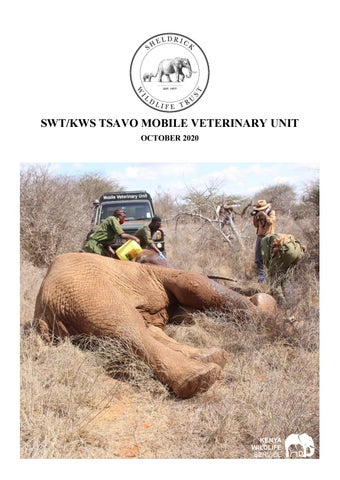
SWT/KWS TSAVO MOBILE VETERINARY UNIT OCTOBER 2020
Introduction
15 Cases in October
4 Poaching Cases
6 Elephant Cases
October Report by Dr. Jeremiah Poghon The prevailing hot and dry conditions in Tsavo East National Park continued into the month of October. During the month, the SWT/KWS Tsavo East Veterinary Team attended to an elephant bull with a spear wound in Amboseli, collared an adult lion in Kipini Conservancy, did an autopsy examination of a lion in Kambanga ranch, as well as elephant and rhino carcasses in Tsavo East. The team was also involved in the rescue of an elephant calf stuck in mud at the Aruba waterhole. Other activities included a wildlife translocation and treatment of elephants in Umani, Chyulu and Rukinga ranch. Acknowledgement The unit acknowledges the support of its sponsors ViER PFOTEN through the Sheldrick Wildlife Trust (SWT) for their huge financial support to the unit. We also thank Kenya Wildlife Service through the Assistant director Tsavo conservation area and the head, veterinary services department.
SWT/KWS Tsavo Mobile Vet Unit Treatment Locations October 2020
Case Details Date
Species
Area Found
01-Oct-20
Elephant
Kimana Sanctuary
Spear
A penetrating wound on the rump on the left side, likely caused by a spear
Successfully Treated
03-Oct-20
Lion
Kipini, North Coast
Collared
A GPS collar was fitted to mitigate humanwildlife conflict
Task Successful
04-Oct-20
Zebra
Kipini, North Coast
Snared
A wire snare had burrowed into the carpal joint of the right forelimb
Successfully Treated
06-Oct-20
Elephant
Tsavo East NP
Postmortem
The carcass was found but due to advanced decomposition, autopsy was inconclusive
Died
06-Oct-20
Lion
Kambanga, Taita
HWC
The carcass had bloody discharge. Cause of death was suspected poisoning
HWC Death
07-Oct-20
Elephant
Tsavo East NP
Rescue
A calf was stuck in the mud of a waterhole. The mother had failed to free it
Task Successful
18-Oct-20
Antelope
Haller Park, Mombasa
Relocation
4 Impalas, 4 Elands, 5 Waterbucks and 6 Oryxes were translocated to Vipingo Ridge
Task Successful
23-Oct-20
Rhino Black
Tsavo East NP
Postmortem
The rhino had just been left alone as the mother after she gave birth to a new calf
Died
24-Oct-20
Zebra
Kipini, North Coast
Snared
There was a wire snare that had burrowed into the left hind limb
Successfully Treated
25-Oct-20
Other
Tsavo East NP
Rescue
A pangolin was seized from a poacher. The team assessed then released it into the wild
Task Successful
26-Oct-20
Elephant
Umani, Chyulu Hills
Natural Causes
Lameness noted to be originating from rupture of ligaments at the carpal joint
Prognosis Poor
27-Oct-20
Elephant
Rukinga, Taita
Arrow
A contaminated arrow wound in the elbow of the right forelimb
Prognosis Poor
30-Oct-20
Rhino Black
IPZ, Tsavo West NP
Postmortem
The carcass was heavily scavenged and only the skeletal anatomy was present
Died
30-Oct-20
Elephant
Lualenyi, Taita
Rescue
The calf was found weak and couldn’t stand up prompting an emergency rescue
Taken to Orphanage
30-Oct-20
Buffalo
Tsavo East NP
Rescue
The tiny calf was found alone near a water point with no herd nearby
Taken to Orphanage
Reason for Intervention
Outcome
Case 1 – 1st October 2020 Elephant
Spear
Kimana Sanctuary
Rangers in Amboseli and Big Life Rangers reported an elephant that was in pain with a wound to the rump. In order to ease accessibility and save time, the Tsavo vet unit was airlifted to the area. The elephant bull was seen nearby in the company of two other bulls.
Immobilisation, examination and treatment Once the elephant was found, the vet prepared the dart and immobilised the elephant with 18 mgs of Etorphine Hcl. The Elephant went down after 6 minutes. Examination revealed a penetrating wound on the left side of the rump likely caused by a spear. The wound was probed incase there was an embedded spear but nothing was found. The wound was cleaned with Iodine, packed with green clay and sprayed with Alamycin. To manage bacterial infections and pain, 15000mg of Amoxicillin and 100mg of Dexamethasone were administered parenterally. Relocation, revival and prognosis The anaesthesia was reversed with 36mg of Diprenorphine and 20mg of Naltrexone intravenously. The bull was up in 7 minutes and walked away. The prognosis for recovery is favourable.
.
Case 2 – 3rd October 2020 Lion
Collared
Kipini Conservancy
Human-wildlife conflict cases have disastrous effects on both wildlife and human populations. To mitigate such problems, the Tsavo East Vet Team was involved in the collaring of an adult lion for monitoring. The team drove to the Kipini Conservancy to undertake the exercise. Voice callbacks were used to help locate the target lion. The team made an attempt to locate the lion on the evening of the 2nd October which failed. A decision was made to make a second attempt early in the morning and it was a success. Immobilisation, examination and treatment The target lion was spotted after making voice call backs and darted in the flank with 300mg of Ketamine and 4mg Medetomidine. The lion went down after 10 minutes. He was quickly secured and a blind fold put in place. A GPS collar was fitted around the neck and frontline spray applied to manage ectoparasites. Revival and prognosis The anaesthesia was reversed with 10mg of Atipamezole and 6.25mg of Yohimbine. The lion stood up after 15 minutes and walked away. .
Case 3 – 4th October 2020 Zebra
Snared
Kipini Conservancy
Snare poaching is widespread in Africa and the impacts on target/non-target animals are very severe. The snaring mortality rate has increased over time due to the severity of injuries sustained by the trapped animals. This results in a decline in wildlife populations especially among the endangered species. The Tsavo Mobile Vet Unit was involved in the de-snaring and treatment of a zebra in Kipini Wildlife Conservancy, Lamu.
Immobilisation, examination and treatment The zebra was darted from a vehicle with 5mg of Etorphine and 60mg of Azaperone. He went down after 10 minutes and was quickly secured and a blindfold put in place. There was a wire snare that had burrowed into the carpal joint of the right forelimb. The wire was cut and removed from the wound. The wound was cleaned with Hydrogen peroxide and Iodine before being sprayed with Alamycin spray. The zebra was also administered with Intramuscular injections of long acting antibiotics and anti-inflammatories. Reversal and prognosis The anaesthesia was reversed with Diprenorphine at twice the Etorphine dose. Prognosis for recovery is fair.
.
Case 4 – 6th October 2020 Elephant
Post-mortem
Tsavo East National Park
A report was made to the Tsavo Mobile Vet Unit regarding an elephant carcass in the Satao area of Tsavo East National Park. The vet team visited the area to ascertain the cause of death. Post-mortem examination The carcass was found lying on the left side and was in an advanced state of autolysis. Examination of the skin was negative for injuries and wounds. There were dry faecal materials next to the carcass. Unfortunately, due to advanced autolysis, meaningful autopsy examination wouldn’t be carried out thus adding to the number of deaths recently with unknown causes. Cause of death Unknown.
Case 5 – 6th October 2020 Lion
Human-wildlife conflict
Kambanga Ranch, Taita
A report was made t0 the Tsavo East Vet Unit regarding a lion carcass that was seen at a watering hole in Kambanga Ranch, Tsavo East. The team drove to the area to ascertain the cause of death. Post-mortem examination The carcass was lying on the left side with bloody discharges from the oral and anal openings. Internal examination revealed presence of blood-tinged fluid in both the peritoneal and thoracic cavities. The lungs and kidneys were congested. The liver was inflamed with a greenish coloration. The intestines were gas-filled and the colon had dry feed material. The intestines were noted to break apart when removed. Cause of death The cause of death was suspected to be poisoning. Samples of the liver, kidney and stomach contents were collected for laboratory examination. After undertaking the autopsy examination, the carcass was disposed of by burying.
Case 6 – 7th October 2020 Elephant
Rescue
Tsavo East National Park
The prolonged drought has seen a drop in water levels at different water holes in the vast Tsavo East National Park. The behavioural natures of elephants to cover their bodies with mud resulted in an elephant calf becoming stuck in mud at the Aruba water hole.
Rescue The Aruba Lodge Manager reported that the mother attempted to retrieve the calf from the mud but she was unsuccessful, so they called the Tsavo Vet Unit for assistance. The mother and a group of other elephants were driven away then the team got into the mudhole, tied the calf with ropes and pulled him out of the mud with the help of a land cruiser. Water was poured on the elephant calf to clear any mud around the eyes before being guided by rangers for a reunion with the rest of the family. Prognosis The calf was successfully reunited with his mother and family so has a good prognosis following the ordeal.
.
Case 7 – 18th October 2020 Antelope
Relocation
Haller Park, Mombasa
Vipingo Ridge Limited is a 2,500-acre estate located 36km North of Mombasa city at Kilifi-South sub-county in Kilifi County. The estate is primarily designed as a high end Residential Gated Community with a golf club and a lot of green spaces within the housing development. It is secured by a concrete perimeter wall with various manned gates and zoned into sections for various uses. The proposed Wildlife Sanctuary has been incorporated as one of the land-use zones and allocated an acreage of about 600acres. The Estate submitted a request to Kenya Wildlife Service for introduction of various wildlife species in their property in 2018. KWS commissioned an ecological assessment in February – March 2019 to determine the feasibility of the request. The Ecological assessment report recommended re-introduction of 20 zebras, 20 impalas, 6 bushbucks, 6 oryx, 3 elands, and 6 waterbucks in phases with a management system of a semi free-range system. The report recommendations were deliberated by the KWS Species Introduction and Re-introduction Committee in June 2019 and the establishment of the Vipingo Ridge Wildlife Sanctuary (VRWS) proposal was approved. The Committee further recommended that the project be subjected to an Environmental and Social Impact Assessment (ESIA) which was carried out between 30th June and 5th July and a license issued on 28th August 2020. Relocation The Unit assisted in the relocation of a total of 4 impalas, 4 elands, 5 waterbucks and 6 oryxes from Nairobi, Haller Park and Tsavo East to Vipingo Ridge. The animals were all darted successfully and the relocation was a success. All the animals have settled in well.
.
Case 8 – 23rd October 2020 Black Rhino
Post-mortem
Tsavo East National Park
The young rhino was observed on the 19th October 2020 during an aerial recce and on a camera trap. The rhino was alone as it had just been left the mother after she gave birth to a new calf, however the rhino seemed to be in good health. On the evening of 22nd October 2020, the carcass was spotted by a tourist along the Galana River when they were driving along a nearby road and alerted the warden. The Rangers were informed to secure the carcass and deliver it to the Voi vet clinic for an autopsy. Post-mortem examination The body condition was fair and the carcass was still fresh. Both horns were present. There was a deep penetrating wound to the right thoracic area that was oozing foul smelling dark fluid. There were superficial scratch wounds on the perineum. The penetrating chest wound was opened; it went through the rib cage shattering a thoracic vertebrae and entered the peritoneal cavity near the diaphragm. It also punctured the colon, releasing intestinal contents into the peritoneal cavity causing peritonitis. The colon was almost empty, an indication the animal wasn’t feeding. The wound were inflicted by a bigger rhino in a territorial fight. Cause of death A penetrating wound to the body led to ingester flowing into the peritoneal cavity causing serious peritonitis and internal bleeding that is always fatal. Both horns were recovered and handed to KWS.
Case 9 – 24th October 2020 Zebra
Snared
Kipini Conservancy, Lamu County
Wire snare poaching is widespread in Africa and the impacts on target/ non-target animals are very severe. The percentage of snaring mortality rate has increased over time due to the severity of injuries sustained by the trapped animals. This results in a decline in wildlife populations especially among the endangered species. The Tsavo East Vet Unit was involved in de-snaring and treatment of a zebra in Kipini Conservancy. Immobilisation, examination and treatment The zebra was darted from a vehicle with 6mg of Etorphine and 60mg of Xylazine. He went down after 6 minutes, was quickly secured and a blindfold put in place. There was a wire snare that had burrowed into the left hind limb. The wire was cut out and the wound cleaned with Hydrogen peroxide and Iodine before being sprayed with Alamycin spray. The zebra was also given intramuscular injections of long acting antibiotics and anti-inflammatories. Reversal and prognosis The anaesthesia was reversed with Diprenorphine at twice the Etorphine dose and 10mgs of Atipemazole Hcl. Prognosis for recovery is good.
Case 10 – 25th October 2020 Pangolin
Rescue
Tsavo East National Park
International demand for Africa’s iconic wildlife is causing hundreds of thousands of animals immense suffering and putting their survival in jeopardy. Pangolin poaching for traditional medicine has seen them endure unimaginable suffering. This coupled with their low reproduction is pushing them to the brink of extinction.
Rescue and Release In the spirit of saving the wildlife, the SWT/KWS Tsavo Mobile Vet Unit received a report of a pangolin that had been seized by the police from a poacher. The team received the pangolin, did a physical examination to ensure there were no injuries or wounds afflicted to the body before releasing him back into the wild inside Tsavo East National Park. Prognosis Prognosis is good as the animal was not injured and was released successfully.
.
Case 11 – 26th October 2020 Elephant
Natural Causes
Umani Springs, Chyulu Hills
A report was received by the SWT/KWS Tsavo East Mobile Vet Unit regarding a lone elephant bull by a watering point with marked lameness of the right forelimb. The Vet Team was airlifted to the area to carry out the treatment. Immobilisation, examination and treatment The elephant bull was darted from a helicopter with 18mgs of Etorphine. In spite of chemical immobilization, the elephant bull was reluctant to go down and had to be manually assisted to the ground. Rangers and a landcruiser were incorporated to help pull him down. The bull finally went down after 15 minutes. Examination of the affected forelimb was done and lameness noted to be originating from the rupture of ligaments at the carpal joint. To manage pain and bacterial infections, the elephant was given parenteral administration of Flunixin meglumine, Clindamycin and 20,000mg of Excede. Alamycin spray was applied over the skin bruises and Frontline spray was used to manage the heavy infestation of ectoparasites. Prognosis The anaesthesia was reversed with a combination of 24mg of Diprenorphine and 20mg of Naltrexone. The bull stood up after 5 minutes. The prognosis for recovery is guarded.
Case 12 – 27th October 2020 Elephant
Arrow
Rukinga Ranch, Taita
Cases of elephants with arrow wounds took an upward trend during the months of September and October 2020. A report was received from Wildlife Works rangers regarding an elephant bull with marked lameness in Maungu area. The Tsavo Vet Unit visited the area to carry out the treatment. Immobilisation, examination and treatment The target elephant bull was darted with 18mgs of Etorphine from a helicopter and went down after 6 minutes. Copious amounts of water was poured on him to aid in thermoregulation. Physical examination revealed a contaminated arrow wound in the elbow of the right forelimb. The wound was probed but no arrow head was found. The wound was cleaned with Hydrogen peroxide and Iodine before being infused with Opticlox ointment and packed with green clay for its healing properties. The elephant bull was administered with 4,000mg of Butasal and 5,000mg of Enrofloxacin intramuscularly. Clindamycin was administered into the affected elbow to cover for any bacterial infections. Prognosis The prognosis for recovery is guarded due to a suspected joint infection.
Case 13 – 30th October 2020 Black Rhino
Post-mortem
IPZ, Tsavo West National Park
The male rhino was observed on 20th October 2020 during an aerial recce and foot patrol. It was alone but appeared in good health. On 30th October 2020, Rhino Security Rangers patrolling the area where the Rhino signal emanated from discovered a heavily scavenged rhino carcass with both horns present. The reading from the horns indicated it was Ekirapa, a seven-year-old male rhino. Post-mortem examination The carcass was heavily scavenged and only the skeletal anatomy was present. All the soft tissues and the skin had been eaten by scavengers. The skull, the lower jaw, vertebral column, bones of the front right limb, bones of the left hind limb and the pelvic bones were all that was left plus the 2 horns. The ingester remains left at the scene appeared normal. Cause of death Autopsy could not determine the cause of death due to heavy scavenging that left only the bones. Estimated age of carcass from death was estimated at 5 days.
Case 14 – 30th October 2020 Elephant
Rescue
Lualenyi Ranch, Taita
The report was received from the manager of Lualenyi Ranch regarding an elephant calf that has been spotted for several days alone.
Rescue There were concerned that he would be attacked by hyenas if not rescued. The Vet team sent a nearby SWT de-snaring team to check out the calf’s condition. The calf was found weak and couldn’t stand up, prompting an emergency rescue operation to be initiated. Prognosis The calf was rescued and taken to the SWT Voi Stockade and stabilized and placed in a boma to be handraised and eventually returned to the wild. .
Case 15 – 30th October 2020 Buffalo
Rescue
Tsavo East National Park
A report was made by KWS rangers regarding one buffalo calf that was observed alone near Dakota, Tsavo East and seemed to have been abandoned by the mother. Rescue The vet team rushed to the area to find the tiny calf alone near a water point with no herd nearby. Examination revealed he was weak and must have gone without feeding for some time. Prognosis The calf was rescued and taken to the SWT Voi elephant stockade where it will be cared for.