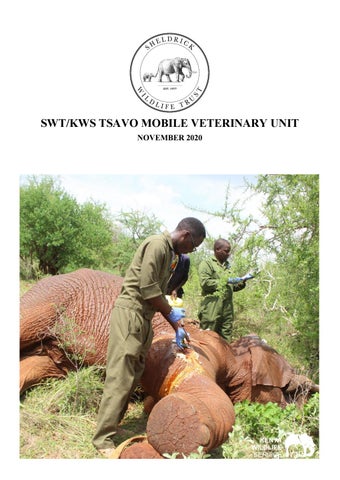
SWT/KWS TSAVO MOBILE VETERINARY UNIT NOVEMBER 2020
Introduction
4 Cases in November
3 Poaching Cases
4 Elephant Cases
November Report by Dr. Jeremiah Poghon
The long-awaited rains arrived in the month of November. The wildlife were grateful and the Tsavo ecosystem slowly filled with life as diverse new-borns were sighted across the vast Savannah grassland. With the first rains, leaves were sprouting on the trees and the bushes and savannah grass grew substantially. Due to the availability of sufficient food and water for the wildlife, there was a considerable drop in cases attended to by the Tsavo Mobile Vet unit during the month. In November, an elephant bull was treated for spear wounds in Amboseli and another for arrow wounds in Rukinga Ranch. There were also two post-mortems, one of which was caused by a snare and another where the cause of death could not be ascertained. Acknowledgement
The unit acknowledges the support of its sponsors ViER PFOTEN through the Sheldrick Wildlife Trust (SWT) for their huge financial support to the unit. We also thank Kenya Wildlife Service through the Assistant director Tsavo conservation area and the Head, Veterinary Services Department.
Case Details Species
Area Found
Elephant
Kimana, Amboseli
Spear
08-Nov-20
Elephant
Kasigau, Taita Ranches
Snared
19-Nov-20
Elephant
Rukinga, Taita Ranches
Arrow
Elephant
Galana Ranch, Tsavo
Postmortem
Date 06-Nov-20
23-Nov-20
Reason for Intervention Physical examination revealed spear wounds near the head region and on the left hind leg. The carcass was in a poor body condition with a wire snare on the tarsal joint of the left hind leg. The cause of death was pointed to starvation as a result of impaired mobility that limited proper feeding. The arrow wound on the elbow area of the right forelimb was probed in search for any foreign objects with a negative result being obtained The carcass was in advanced stage of autolysis with the time of death being estimated to be about 10 days
Outcome Successfully Treated
Poaching Death
Prognosis Poor
Died
SWT/KWS Tsavo Mobile Vet Unit Treatment Locations November 2020
Case 1 – 6th November 2020 Elephant
Speared
Kimana, Amboseli
The Tsavo Mobile Vet Unit received a report of an injured elephant bull sighted in the Kimana area, Amboseli. The team was airlifted to the area to perform the treatment. The elephant was searched for and monitored from the air and when found was darted from a helicopter.
Immobilisation, examination and treatment The elephant bull was immobilized with 18mg of Etorphine. The helicopter prevented the bull from moving into thick bush before the drugs took affect which took 10 minutes. Copious amount of water was poured on the elephant to aid in thermoregulation before commencing examination. Physical examination revealed spear wounds near the head and on the left hind leg. The wounds were cleaned with Hydrogen Peroxide and Iodine, infused with Opticlox ointment and packed with green clay for its healing properties. The elephant was also administered with long acting antibiotics and anti-inflammatories. Reversal and prognosis The anaesthesia was reversed with a combination of Diprenorphine and Naltrexone. Prognosis is good.
.
Case 2 – 8th November 2020 Elephant
Snared
Kasigau, Taita Ranches
Wildlife Works Rangers reported an elephant cow with an injured calf in Kasigau area. Due to aggressiveness, the elephant cow was driven away from the calf to allow for close examination of the injury but unfortunately the calf had already succumbed. The Tsavo Mobile Vet Unit visited the area to perform a post-mortem and ascertain the cause of death. Post-mortem examination The carcass was in a poor body condition with a wire snare on the tarsal joint of the left hind leg. Cause of death The cause of death was most likely starvation as a result of impaired mobility that limited proper feeding. The lameness was caused by a deep snare.
Case 3 – 19th November 2020 Elephant
Arrow
Rukinga, Taita Ranches
The SWT/KWS Tsavo Mobile Vet Unit was made aware of a lame elephant bull which was seen by Wildlife Works Rangers during their normal patrols. The vet team visited the area to carry out treatment. Due to the thick bush, aerial surveillance was employed to aid in tracing the lame elephant. Immobilisation, examination and treatment Once found, the elephant was darted from a helicopter with 18mg of Etorphine and he went down after 7 minutes. He was noted to have been treated before for the same arrow wound but had not fully recovered. The arrow wound on the elbow area of the right forelimb was probed for foreign objects but none were found. The wound was cleaned with Iodine and Hydrogen peroxide, then infused with Opticlox ointment and Tetracycline pessaries before being packed with green clay for its healing properties. The lame bull was also administered with 5,000mg of Flunixin meglumine and antibiotics both locally and systematically. Prognosis The anaesthesia was reversed with 36mg of Diprenorphine and 20mg Naltrexone. The bull stood up after 8 minutes but prognosis for recovery is guarded/poor due to suspected elbow joint infection.
Case 4 – 23rd November 2020 Elephant
Post-mortem
Galana Ranch, Tsavo
A report was received by the TMVU regarding an elephant carcass found in Kulalu/Galana Ranch. The team visited the location to undertake an autopsy examination and ascertain the cause of death. Post-mortem examination The carcass was in an advanced stage of autolysis with the time of death estimated to be about 10 days. Cause of death Due to predation and the advanced autolysis, the cause of death could not be ascertained.
Other Activities The unit, in conjunction with the KWS headquarter capture team, translocated several species including Grants gazelle (from Galana irrigation scheme), zebra (from Kwale area) to Vipingo Ridge Conservancy. The unit analysed 15 pieces of Ivory, pangolin scales, python skin and tens of Dikdik, Impala and Lesser Kudu carcasses brought in from Voi, Taveta, Makindu, Mombasa and Malindi KWS investigation stations and produced 15 expert reports for prosecution purposes.