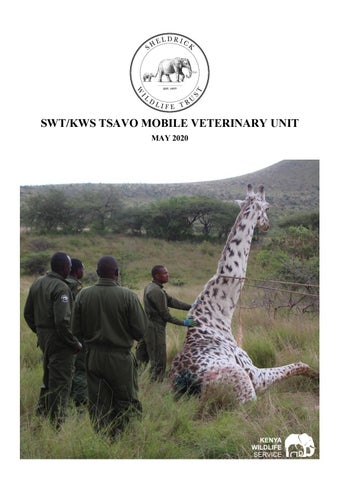
SWT/KWS TSAVO MOBILE VETERINARY UNIT MAY 2020
Introduction
15 Cases in May
5 HWC Cases
7 Elephant Cases
May Report by Dr. Jeremiah Poghon During May there was virtually no rain and very little showers across the Tsavo/coast ecosystem. The vegetation is drying up and the water that collected during the rainy season is also disappearing. However, there is still plenty of forage for grazers and browsers due to the long rains between October 2019 to April 2020. Cases attended include autopsy of 2 elephant carcasses and treatment of another 2 bulls that were injured during a territorial fight. There was a post-mortem on a lion killed by the Standard Gauge railway and another on a young lion killed through humanwildlife conflict while the mother was translocated to Tsavo West. An elephant was treated for a penetrating wound of the limb and an orphan elephant was treated for a sole injury. Finally, a giraffe was treated for a lion attack injury. Acknowledgement The unit acknowledges the support of its sponsors ViER PFOTEN through the Sheldrick Wildlife Trust (SWT) for their huge financial support to the unit. We also thank Kenya Wildlife Service through the Assistant director Tsavo conservation area and the head, veterinary and capture services department for their support.
SWT/KWS Tsavo Mobile Vet Unit Treatment Locations May 2020
Case Details Date
Species
Area Found
Reason for Intervention
Outcome
05-May-20
Eland
Tsavo East NP
HWC
Handraised and needed to be released after reaching maturity and becoming aggressive
Task Successful
08-May-20
Elephant
Tsavo East NP
Postmortem
All the soft tissues were rotting away with marked scavenger activity
Died
08-May-20
Elephant
Tsavo East NP
Postmortem
There were numerous puncture wounds on the body
Died
10-May-20
Giraffe
Chyulu NP
Natural Causes
Injuries caused by suspected lion attack
Died
11-May-20
Lion
Tsavo West NP
HWC
There were no penetrating or surface wounds observed
HWC Death
15-May-20
Elephant
Tsavo East NP
Natural Causes
The wound was probed and a sharp wooden piece removed
Prognosis Poor
16-May-20
Lion
Tsavo West NP
HWC
After predation of livestock, one lion was killed so the other was relocated
Task Successful
17-May-20
Hyena
Taita Ranches
HWC
A hyena killed an old lady and was then killed in retaliation
HWC Death
20-May-20
Elephant
Tsavo East NP
Natural Causes
There was a penetrating wound on the sole of the right front limb
Prognosis Poor
22-May-20
Elephant
Tsavo West NP
Postmortem
The carcass was in an advanced stage of decomposition
Died
26-May-20
Elephant
Chyulu Hills
Natural Causes
There were laceration wounds likely caused by a territorial fight
Prognosis Poor
26-May-20
Elephant
Tsavo East NP
Natural Causes
There were penetrating wounds likely caused by natural causes
Successfully Treated
26-May-20
Giraffe
Rombo, Tsavo
Postmortem
The young giraffe died of an open complete fracture possibly caused when fleeing from predators
Died
28-May-20
Lion
Tsavo East NP
HWC
Hit and killed by the Nairobi-Mombasa standard guage railway (SGR)
HWC Death
28-May-20
Buffalo
Tsavo East NP
Rescue
A buffalo calf was abandoned and followed local herdsmen cows to their boma
Taken to Orphanage
Case 1 – 5th May 2020 Eland
Human-wildlife Conflict
Tsavo East National Park
The eland was rescued while it was a calf and brought to the Sheldricks Voi stockade to be raised and released once it matures. After attaining maturity, the eland became aggressive to its keepers and at times head butted them several times. A request was made to the Tsavo Vet unit for it to be translocated to the park.
Immobilisation and relocation A dart was prepared and filled with 15 mgs of M99 and 20 mgs of Domosedan. The eland was approached and darted in the rump. He moved about several meters before going down on lateral recumbency. He was secured and water poured on the body to cool down. A truck was brought nearby, then the eland was loaded and transported towards Aruba but midway it developed regurgitation complications and had to be revived. He stood up and with the aid of a blind fold he was calm enough to be transported 30 KMs deep into Tsavo East National Park where he was safely released.
Case 2 – 8th May 2020 Elephant
Post-mortem
Tsavo East National Park
The report was received from the SWT field office that an elephant bull treated in April for an injury to the anal area caused by a fight with another bull in Malka Faya area of Tsavo East. The vet team visited the area to ascertain the cause of death. Examination The carcass was lying on the right flank in an advanced level of decomposition. All the soft tissues were rotting away with marked scavenger activity on the carcass. Cause of Death Autopsy could not reveal the cause of death due to the advanced autolysis but previous diagnosis of a fight wound with another bull was done earlier during treatment. Time from death placed at 3 days. The tusks were recovered and handed over to Tsavo East armoury for safe keeping.
Case 3 – 8th May 2020 Elephant
Post-mortem
Tsavo East National Park
The report was received from KWS rangers that a fresh elephant bull carcass has been found near Maungu area of Tsavo East. The vet team visited the area to ascertain the cause of death. Examination The carcass was lying on the left flank and still fresh (less than 12 hours since death). The right tibia bone had a complete open fracture and massive muscle laceration and haemorrhage. There were also numerous puncture wounds on the body the biggest being of the left triceps muscles. Several struggle marks were also seen on the ground. Cause of Death The injuries are consistent with fight with another elephant bull. The tusks were removed and handed over to the Tsavo East armoury.
. Case
4 – 10th May 2020
Giraffe
Natural Causes
Chyulu Hills National Park
The report of an injured Giraffe near Mukururo Rhino base was received by Big life foundation. The Veterinary team travelled by road to the area which is about 200 Kms away to undertake the treatment. The Giraffe was easily spotted as it was being guarded by rangers.
Immobilisation and relocation A dart was prepared and filled with 14 mgs of M99 and 30 mgs of Xylazine. The giraffe was approached and darted from a vehicle; it ran a short distance with the other giraffes then went down after 10 minutes. The anaesthesia was reversed immediately by use of Diprenorphine and Atipemazole Hcl. The giraffe was held physically on the ground as wounds caused by suspected lion attack were treated. After treatment with antibiotics and Dexamethasone both IM plus local wound treatment, the Giraffe was pushed to sterna recumbency to wake it up. After several attempts, the giraffe could not stand due to the injury, advanced age and the normal delicate nature of the species. The giraffe succumbed 2 hours later. The teams did their best but couldn’t save him.
Case 5 – 11th May 2020 Lion
Human-Wildlife Conflict
Tsavo West National Park
A report was made by the investigation officer based at Tsavo West National Park that a lion has been found dead near Mtito Andei area bordering the park on 11/05/2020 with a request for autopsy to be undertaken to ascertain the cause of death. The vet unit drove to the area to undertake autopsy. Examination The carcass was at mid-level decomposition and was examined externally. There were no penetrating or surface wounds observed. The carcass was swollen and the hairs were peeling off due to autolysis. There were diffuse haemorrhages about 15cm in diameter to the left rib area from the thoracic to lumbar vertebral region suspected caused by blunt object. The stomach was empty with very little food material which was collected Other organs – too decomposed for meaningful post mortem changes to be observed, Liver and kidney samples (collected). Cause of Death Autopsy was consistent with poisoning and blunt force trauma.
Case 6 – 15th May 2020 Elephant
Natural Causes
Tsavo East National Park
The report of an injured elephant cow was received from the SWT field operations office in Kaluku after an aerial recce had spotted the elephant in Kiasa, northern Tsavo East. The Vet travelled by road to Kaluku then airlifted by SWT Helicopter to Kiasa. The helicopter searched for the elephant and was easily spotted nearby. Immobilisation, examination and treatment A dart was prepared and filled with 16mgs of M99. The helicopter approached the elephant, that had an obvious injury to the left front limb, separated her from the herd and pushed her to a clearing where she was darted. She went down after 6 minutes and the ground teams were called in to secure the elephant whilst the helicopter landed so the vet could join them a few minutes later. There was a penetrating wound to the lower area pf the left front limb with pus oozing out. The wound was probed and a sharp wooden piece of stick removed. The wound was cleaned with dilute Hydrogen peroxide then splashed with Iodine and finally covered with green clay. The elephant was administered with long acting antibiotics and anti-inflammatory drugs intramuscularly and intravenously respectively. Prognosis After treatment the cow stood up and walked away calmly. Prognosis is guarded due to joint infection
Case 7 – 16th May 2020 Lion
Human-Wildlife Conflict
Tsavo West National Park
After the killing of a young lion near Mtito Andei, the mother was also reported to be predating on livestock in a nearby community village. After several attempts to by KWS rangers to try and solve the problem in vain, a decision was made to capture and translocate the lioness to southern Tsavo West. Due to the thick bush which was inaccessible to vehicles, assistance was sought from the SWT helicopter to aid in darting.
Relocation The lioness was immobilized with 300mgs of Ketamine mixed with 3mgs of Meditomidine Hcl in a 3cc Daninject dart. The lioness was darted from a helicopter and was finally immobilised after 2 failed attempts. She was loaded into a cage trap and the anaesthesia reversed with Atipemazole Hcl. She was then transported 150 kms away to southern Tsavo West National Park and released. The lioness is collared hence its movements will be monitored.
Case 8 – 17th May 2020 Hyena
Human-Wildlife Conflict
Taita Ranches
A report was made that a hyena had attacked an old lady in Kajire area of Taita Taveta County on the afternoon of the 16/05/2020 fatally injuring her. The hyena was then killed by community members in retaliation. KWS and KPS teams rushed to the area and collected both the body and hyena carcass. Examination The carcass was brought to the Tsavo Vet unit for autopsy. Clinical history points to a CNS problem of which the common one is rabies in carnivores. The hyena head was preserved in a freezer and submitted to Mariakani regional investigation laboratory the next day for Rabies test. The results are still being awaited on the day this report was made.
Case 9 – 20th May 2020 Elephant
Natural Causes
Tsavo East National Park
The report of a young injured elephant orphan was received from the SWT field operations office in Kaluku, the elephant had previously been treated for a penetrating wound of the sole. The Vet travelled by road to Ithumba to attend to the Elephant who had been retained near the stockade to await the intervention. Immobilisation, examination and treatment A dart was prepared and filled with 10mgs of M99. The elephant orphan was approached on foot and darted easily in the rump. He was retained by the keepers within the area until he went down. There was a penetrating wound to the sole of the right front limb with pus oozing out. The wound was probed and foreign objects and pus removed. The wound was cleaned by use of dilute Hydrogen peroxide then splashed with tincture of Iodine and finally covered with green clay. The elephant was administered with long acting antibiotics and anti-inflammatory drugs intramuscularly and intravenously respectively. All this time copious amounts of water was poured on the ears to cool the elephant down. Prognosis After the treatment, the anaesthesia was reversed and the elephant stood up and walked away calmly. Prognosis is guarded to good due to sole infection.
Case 10 – 22nd May 2020 Elephant
Post-mortem
Tsavo West National Park
A report was made by the company commander F coy of an Elephant carcass seen inside Ngulia sanctuary with tusks still intact. The Tsavo veterinary team was requested to undertake autopsy to ascertain the cause of death.. Examination The carcass was lying on the right flank and in an advanced stage of decomposition. All the soft tissues were already rotten or eaten away with some muscle, skeletal and the skin tissues left. Cause of Death The autopsy could not reveal the cause of death due to the advanced autolysis and scavenger activity. Time from death placed at 4 days. Tusks were recovered and handed over to Tsavo West for safe keeping.
Case 11 – 26th May 2020 Elephant
Natural Causes
Chyulu Hills National Park
There was a report of an injured elephant bull at Umani springs, Chyulu. The Vet team rushed to the area and found the big bull near a waterpoint. Drugs and equipment were prepared and the elephant approached. Immobilisation, examination and treatment There was a laceration wound to the right ear piercing the ear and entering the right shoulder deep into the scapula suspected to be caused by a territorial fight with another male. There was also another injury to the upper arm area that entered from above and exited the skin ventrally near the left elbow joint. From the lameness exhibited by the elephant the injuries seem to be serious. The wounds were topically flushed with dilute hydrogen peroxide then doused with tincture of Iodine before a final cover of green clay was applied. The elephant was administered with long acting antibiotics and antiinflammatory drugs intramuscularly and intravenously respectively. During treatment, copious amounts of water was poured on the ears to keep the elephant cool. Prognosis Having administered treatment, the bull was given a clean bill of health and anaesthesia was reversed with M5050 at three times the Etorphine done. The bull was assisted to stand. Prognosis is guarded.
Case 12– 26th May 2020 Elephant
Natural Causes
Tsavo East National Park
While the team was treating the Umani bull another call was received from KWS rangers based in the Emusaya area on the eastern border of Tsavo East near Sala gate regarding another bull that had been seen with pus oozing from the right front limb. The Vet team was airlifted by the SWT Helicopter to the area which was about 200kms away. On arrival the bull was quickly located as the rangers were observing him. Immobilisation, examination and treatment The elephant was in the company of 2 other bulls. A dart was prepared and filled with 18 mgs of M99. The elephant was approached with the helicopter and darted in the rump. He moved away with the other bulls but was controlled by the helicopter and fell on the road. This bull was naturally a tusk-less bull. There was a penetrating wound on the upper side of the right arm and another on the perineal area below the anal opening with pus oozing out from both wounds. The wounds were flushed with dilute Hydrogen peroxide and tincture of Iodine to remove pus and necrotic tissue debris before a final cover of green clay was applied. The elephant was administered with long acting antibiotics and anti-inflammatory drugs. Prognosis The injury was likely caused by a territorial fight. The bull stood up and joined the others. Prognosis is good.
Case 13 – 26th May 2020 Giraffe
Post-mortem
Rombo Group Ranch
A report was received from Big Life Foundation operations office that a giraffe calf had been spotted by their rangers with lameness and alone within Rombo Group Ranch that borders Tsavo West National Park. Examination The Tsavo veterinary team drove to the area which was about 150kms away. Unfortunately, the team found the young giraffe already dead from of an open complete fracture of the lower left hind limb. Cause of Death The cause of the fracture could not be determined but is suspected to be from a flight from either predators or bush meat poachers. The carcass was disposed of.
Case 14 – 28th May 2020 Lion
Human-Wildlife Conflict
Tsavo East National Park
A report was made by the KWS Community Warden of a lion that was hit and killed by the Nairobi-Mombasa Standard Gauge Railway (SGR) near Miasenyi area of Tsavo East National Park. Examination The Tsavo Vet Unit visited the area and collected the carcass and confirmed the cause of death as being an accident. The SGR lines are usually fenced off with electric fences in areas passing through the park but the fence isn’t carnivore proof. Lions and other predators use the raised railway line as an observation point for hunting. Cause of Death Confirmed to have been hit by a train on the Standard Gauge Railway.
Case 15 – 28th May 2020 Buffalo
Rescue
Tsavo East National Park
A report was made by the KWS Community Warden of a lion that was hit and killed by the Nairobi-Mombasa Standard Gauge Railway (SGR) near Miasenyi area of Tsavo East National Park. Rescue The buffalo calf was abandoned and had followed local herdsmen cows to their Boma. The herders reported to the KWS teams in the area. The vet team travelled to the area and collected the few weeks old calf and brought it to the Voi Vet clinic for examination. He was certified as being healthy and taken to the Kaluku SWT stockade for care and eventual release back to the wild.
Other Activities In the month of May, the vet team also: 1. The Vet examined 5 pieces of ivory and one giraffe, 6 dikdik, 2 zebra and 2 bustard carcasses brought in from Malindi and Voi KWS stations and produced 4 expert reports to aid in prosecution of offenders. 2. The Vet testified at Voi law courts in cases where accused are charged with being found in possession of wildlife trophies.