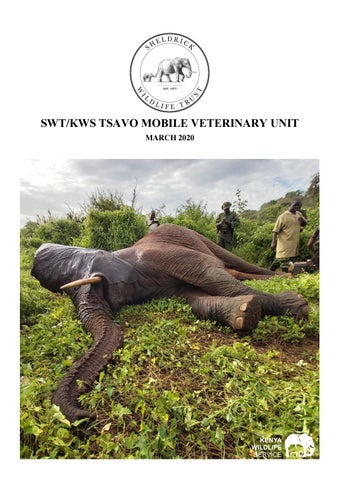
SWT/KWS TSAVO MOBILE VETERINARY UNIT MARCH 2020
Introduction
5 Cases in March
1 Poaching Case
3 Elephant Cases
March Report by Dr. Jeremiah Poghon The rains started again in Tsavo after a short break in early March; something never seen before as its usually the dry season for the Tsavo Ecosystem. These rains have been a blessing to the wildlife giving them plenty of forage and water inside the park hence reducing human-wildlife conflict. With all the blessings, cases cannot be missed though on a smaller scale. Cases attended in the month of March include autopsy of a giraffe carcass in Borabora Conservancy, Mombasa, treatment of a speared elephant bull in Ithumba, Tsavo East, examination of an elephant calf carcass and a hippo carcass in Tsavo East and finally treatment of an elephant bull with a preputial growth in Chyulu National Park. Acknowledgement The unit acknowledges the support of its sponsors ViER PFOTEN through the David Sheldrick Wildlife Trust (DSWT) for their huge financial support to the unit. We also thank Kenya Wildlife Service through the Assistant director Tsavo conservation area and the head, veterinary and capture services department for their support.
Case Details Date
Species
Area Found
04-Mar-20
Giraffe
Mombasa
Postmortem
All the soft tissues were rotten; only the skeletal and the skin tissues were left
Died
11-Mar-20
Elephant
Tsavo East NP
Spear
There was a deep spear wound on the left rump going deep in a caudal direction
Successfully Treated
15-Mar-20
Elephant
Tsavo East NP
Postmortem
The wound, possibly from a lion, had entered the peritoneal cavity causing severe peritonitis from bacterial infection
Died
25-Mar-20
Hippo
Tsavo East NP
Postmortem
Numerous bite marks from a fight with another dominant male
Died
Elephant
Chyulu National Park
Natural Causes
Examination revealed lesion around at the prepuce and the base of the penis
Successfully Treated
28-Mar-20
Reason for Intervention
Outcome
SWT/KWS Tsavo Mobile Vet Unit Treatment Locations March 2020
. Case
1 – 4th March 2020
Giraffe
Post-mortem
Bora Bora Wildlife Sanctuary, Mombasa
Borabora Wildlife Sanctuary is a new Conservancy started few years ago for conservation and tourism purposes in Ukunda area of Kwale county. The private Conservancy is located on a 20acre plot of land in the Ukunda area of the south coast. After being licensed by KWS, some giraffes, zebras and impalas were translocated to the facility. On 3rd March 2020, a female giraffe that had disappeared was later found dead. The facility requested the assistance of the unit to undertake autopsy. The case was attended on 4th March. General examination The carcass was lying on the right flank at and advanced level of decomposition. All the soft tissues were already rotten away and only the skeletal and the skin tissues were left. Autopsy could not reveal the cause of death due to the advanced autolysis. Time of death was placed at 7-10 days. The remaining giraffes and zebras appeared healthy. Cause of Death Could not be determined due to the level of decomposition.
Case 2 – 11th March 2020 Elephant
Spear
Ithumba, Tsavo East
The report of an injured elephant bull was received from the SWT HQ of an injured elephant bull that is a former orphan near the Ithumba area of Tsavo East. The vet travelled by road to Kaluku then was airlifted by the SWT helicopter to Ithumba for the operation. The elephant was searched for using the helicopter and fixed wing plane for nearly one hour before finally being located. Immobilisation, examination and treatment A dart was prepared and filled with 18 mgs of M99 and 40 mgs of Azaperone. The ground teams were directed to an area near where the animal was sited. The helicopter approached the bull, that had an obvious injury, and pushed him to a clearing where he was darted. There was a deep spear wound to the left rump going in a caudal direction. The wound was fresh and must have been inflicted less than 2 days before. The wound was cleaned with Hydrogen peroxide and tincture of Iodine, then finally covered with green clay. The elephant was administered with long acting antibiotics and anti-inflammatory drugs intramuscularly and intravenously respectively. Throughout the treatment, the elephant was kept cool with copious amounts of water poured on the ears to cool the elephant. Prognosis Having administered the treatments, the bull was given a clean bill of health and the anaesthesia was reversed. The bull stood up and walked away calmly. Prognosis is good.
Case 3 – 15th March 2020 Elephant
Post-mortem
Tsavo East National Park
A dead elephant calf was spotted along Voi- luggards road area within Tsavo East National Park by tour drivers who reported to the Tsavo Vet unit. An autopsy of the carcass was requested to ascertain the cause of death. General examination The carcass was lying on sternal recumbency with a penetrating wound to the left abdominal area. T he wound was opened and entered the peritoneal cavity causing severe peritonitis from bacterial infection. The cause of death was from septicaemia shock. The wound was likely caused by a lion or other predator. Cause of Death Septicaemia shock from bacterial peritonitis.
Case 4 – 25th March 2020 Hippo
Post-mortem
Tsavo East National Park
The report was received from the Tsavo Trust who observed a dead hippo carcass along Galana River during an aerial recce. The Tsavo vet team was alerted to ascertain the cause of death. The team drove to the area which is about 50 Kms away and easily located the carcass on bank of Galana River. General examination The carcass was lying on sternal recumbency on the river banks appearing fresh and slightly bloated. External examination revealed numerous superficial and deep bite marks from a fight with another dominant male for territory. There were more prominent bite marks on the right flank cutting deep into the muscles and causing profuse bleeding and bacterial infection. The peritoneal cavity had some reddish bloody fluid with infection. Cause of Death Haemorrhage and peritonitis.
Case 5 – 28th March 2020 Elephant
Natural Causes
Chyulu Hills
The elephant was spotted by SWT teams based at Kenze, Chyulu hills who conveyed the information to the Kaluku field office. The Tsavo Veterinary Team drove to the area which is about 140Kms away from their station. On the ground we were met with a team of SWT teams and shortly after the SWT helicopter arrived. Darting accessories were prepared and the vet boarded the helicopter to dart the elephant. Immobilisation, examination and treatment A dart was prepared with 18mgs of Etorphine and 60mgs of Azaperone. The elephant was searched for briefly and easily found and darted from the air and went down in 9 minutes. Once immobilized, the elephant was pushed to lateral recumbency. Examination revealed a lesion around the prepuce and the base of the penis with pus and tissue debris covering it. This elephant bull had been treated 3 times previously near Oldonyo Wuas lodge in Chyulu and the injury now showed signs of healing. The condition was diagnosed as squamous cell carcinoma of the prepuce. The wound was cleaned with Hydrogen peroxide and Iodine. Oxytetracycline spray was applied and then covered with green clay. The elephant was further administered with long acting antibiotics and antiinflammatory drugs intramuscularly and intravenously respectively. Prognosis Having administered all the treatments, the bull was given clean bill of health the anaesthesia was reversed.