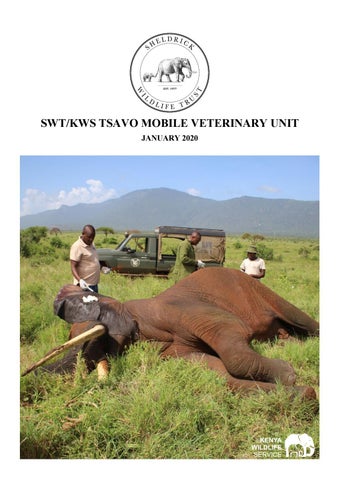
SWT/KWS TSAVO MOBILE VETERINARY UNIT JANUARY 2020
Introduction
3 Cases in Janaury
1 Poaching Case
2 Elephant Cases
January Report by Dr. Jeremiah Poghon The rains have been pounding the Tsavo Ecosystem for several months now and the habitat is lush green with plenty of surface water for wildlife. This has seen drastic reduction in cases handled by the unit. The rains are a real blessing to the semi-arid ecosystem. The unit treated an elephant bull with a front limb sprain injury and an autopsy was undertaken on an elephant bull carcass all in Tsavo East. The Unit also attended to the KWS and SWT security dogs which were administered with Trypanosomiasis prophylactic medication to control the endemic killer canine trypanosomiasis. Acknowledgement The unit acknowledges the support of its sponsors ViER PFOTEN through the Sheldrick Wildlife Trust (SWT) for their huge financial support to the unit. The Unit also thank Kenya Wildlife Service (KWS) through the Assistant director Tsavo Conservation Area and the head, veterinary and capture services department for their support.
Case Details Date 24-Jan-20
30-Jan-20
31-Jan-20
Species
Area Found
Tsavo East Elephant National Arrow Park Tsavo West Security Technical National Dog Case Park Tsavo East Natural Elephant National Causes Park
Reason for Intervention
Outcome
Examination of the carcass revealed an entry wound on the right forelimb
Poaching Death
A total of 5 security dogs were vaccinated agains Trysamiosis
Successfully Treated
The bull had a left front right limb lameness from a possible sprain
Successfully Treated
SWT/KWS Tsavo Mobile Vet Unit Treatment Locations January 2020
. Case
1 – 24th January 2020
Elephant
Arrow
RKiasa, Tsavo East National Park
A report was made of a dead elephant bull spotted near Kiasa area of northern Tsavo East. An autopsy was requested to be undertaken to ascertain the cause of death. The vet unit travelled to the area by road. General Examination The carcass was lying on its left side. The tusks had already been removed by KWS Rangers. Scavenging signs were present on the right ear as well as the perineal region and the large intestines were eaten. External examination of the carcass revealed an entry wound to the right forelimb at the level of the humerus. The entry wound was fresh, hence occurred after death. The skin of the right forelimb as well as the skin of the right thoracic and abdominal regions was removed to assess for more signs of injury. No other injury was observed until the chest area just behind the right elbow was reached where a penetrating arrow wound laced with dark substance was seen. It penetrated the abdominal wall and entered the abdominal cavity causing massive bleeding and peritonitis. A large volume of serosanguinous (red) fluid was observed in the thoracic and abdominal cavity indicating severe internal bleeding. A search for the arrowhead was not successful as the hyenas had eaten away the large intestines. Cause of Death A penetrating wound caused by a projectile suspected to be an arrow, caused massive blood loss due to internal bleeding and accompanied peritonitis. The bleeding led to hypovolaemic shock and death.
Case 2 – 30th January 2020 Security Dogs
Natural Causes
Tsavo West and Tsavo East National Park
Dogs are an important component of security in National Parks and other Conservancies. After several deaths of dogs especially within Ngulia Rhino sanctuary caused by Trypanosomiasis infection after bites by Tsetse flys, a quarterly prophylactic treatment of all dogs within the area was started. Immobilisation, examination and treatment Vaccination against Trypanosomiasis involves administration of trypanocide medication to the dogs for preventive purposes. A total of 5 dogs, one within Ngulia Rhino sanctuary and 4 others at SWT Kaluku K9 kennels were vaccinated. Prognosis Since the start of the regime, 3 years ago, no dogs have been lost or treated for Trypanasomosis. The next treatment will take place in April 2020.
Case 3 – 31st January 2020 Elephant
Natural Causes
Irima, Tsavo East National Park
The bull was seen to be limping with lameness of a front limb. Once notified of the problem, the vet team rushed to the area and found the visibly lame elephant at a water point drinking and enjoying a swim. The bull was chased out of the water and driven to a clear area where it was darted. Immobilisation, examination and treatment The elephant was approached with a vehicle and darted with 18mg of Etorphine; taking about 7 minutes to go down. Once anesthetised, the elephant was pushed to lateral recumbency. The trunk was positioned correctly to aid in breathing and a large volume of water used to cool him down throughout the treatment. Examination of the limbs found that the bull had a left front right limb lameness from a possible sprain. There was no external injury observed. The bull received a dose of supportive antibiotics and Dexamethasone HCl. Prognosis The anaesthesia was reversed with 75mgs of Naltrexone HCl. He was standing within two minutes and slowly walked away. A good prognosis was given.