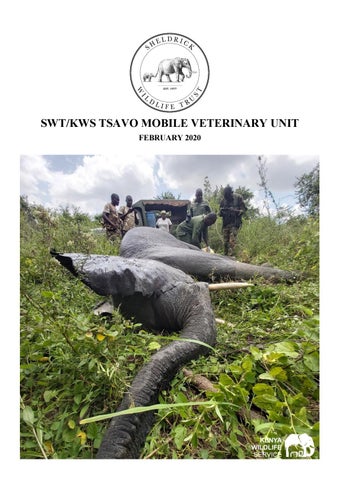
SWT/KWS TSAVO MOBILE VETERINARY UNIT FEBRUARY 2020
Introduction
6 Cases in February
2 Poaching Cases
5 Elephant Cases
February Report by Dr. Jeremiah Poghon The rains continued throughout the month of February which filled temporary water holes and kept the habitat green with plenty of forage. There were very few active cases throughout the month. Cases included the death and post-mortem of the iconic elephant bull named Tim in Amboseli National Park, treatment of a snared elephant bull in Mwaluganje Sanctuary, Shimba Hills, rescue of a hyena cub, treatment of a snared elephant near Sala gate, Tsavo East, translocation of a problem elephant bull near Kibwezi town to Chyulu Hills National Park and the autopsy of an Elephant in Tsavo West National Park. Acknowledgement The unit acknowledges the support of its sponsors ViER PFOTEN through the Sheldrick Wildlife Trust (SWT) for their huge financial support to the unit. We also thank Kenya Wildlife Service through the Assistant director Tsavo conservation area and the head, veterinary and capture services department for their support.
Case Details Date
Species
Area Found
04-Feb-20
Elephant
Shimba Hills
Snared
05-Feb-20
Elephant
Amboseli National Park
Postmortem
06-Feb-20
Hyena
Voi, Tsavo
Rescue
22-Feb-20
Elephant
Tsavo East National Park
Snared
24-Feb-20
Elephant
Kibwezi Town, Tsavo
Human Wildlife Conflict
28-Feb-20
Elephant
Tsavo West PostNational mortem Park
Reason for Intervention The wire snare around the limb had cut through tissues causing a deep wound around the lower leg The report was received from the Big Life foundation about the death of the iconic elephant bull named Tim The hyena cub was rescued by members of the public after being found wandering alone near Voi town The wire snare around the neck had cut through tissues causing a deep wound around the upper neck, ear and lower neck 2 elephants broke out of Chyulu hills National Park and entered a small forest near Kibwezi town causing human wildlife conflict with the local community
Cause of death was not determined due to advanced decomposition
Outcome Successfully Treated Died Taken to Orphanage Successfully Treated Task Successful
Died
SWT/KWS Tsavo Mobile Vet Unit Treatment Locations February 2020
. Case
1 – 4th February 2020
Elephant
Snared
Shimba Hills
A report was made of a seriously lame elephant bull in the Mwaluganje Wildlife Sanctuary, Shimba Hills National Reserve by the warden in charge. Due to the long distance and the difficult terrain in the reserve, the team was airlifted by the SWT helicopter to the area. After more than 30 minutes of searching the young bull was located alone and limping badly. Immobilisation, examination and treatment The ground teams were directed to an area near where the animal was sited. The helicopter approached the bull and pushed him to a clearing where he was darted in the rump. There was a deep cutting wire snare around the hind right limb which was bleeding and infected. The snare had cut through the tissues causing a deep wound around the lower leg. The snare was a high tensile wire with multiple strands, commonly used to lift heavy loads on cranes or in pulleys in vehicle winches. Attempts to cut loose the wire using a wire cutter were unsuccessful and a leatherman was used instead to loosen the woven wires strand by strand. The wound caused by the snare was cleaned with Hydrogen peroxide and tincture of Iodine then covered with green clay. The elephant was administered with long acting antibiotics and anti-inflammatory drugs. Prognosis Having administered the treatment, the bull was given a clean bill of health and a good prognosis.
Case 2 – 5th February 2020 Elephant
Post-mortem
Amboseli National Park
Big Life Foundation reported the death of the iconic elephant bull named Tim who was seen by a community member near Kimana town – Amboseli National Park road. Tim was one of the favourite big tuskers loved around the world. As the Amboseli Vet Unit were away, Tsavo Vet Unit responded to the case. General examination The carcass was lying on the right flank beside the road, fresh and slightly bloated. There were scavenger bite marks on the trunk, ears, anus and left chest area. Due to a request for taxidermy, autopsy was carried out with minimum damage to the skin. Both tusks were removed carefully and handed over to KWS; the right tusk weighed 61 kgs and the left 73kgs. The carcass was opened by a midline abdominal dissection from the perineal area to the chest to access the main organs. The organs were all normal apart from the intestines which were filled with frothy ingester instead of firm ingester. The stomach was filled with hardened ingester, an indication of impaction. There was torsion at the small intestine/colon area hence little ingester in the large colon. The carcass was loaded into a truck and transported to Nairobi National Museums of Kenya to undergo taxidermy. Cause of Death Intestinal torsion due to ingestion of highly fermentable green forage
Case 3 – 6th February 2020 Hyena
Rescue
Voi, Tsavo
The Hyena cub was rescued by members of the public after being found wandering alone near Voi town. Rescue The community members contacted the KWS Community Service Rangers who called the Tsavo Vet unit. The tiny Hyena was rescued, fed for 2 days and later transported to Nairobi orphanage for further care. Prognosis Hopefully the hyena will do well at the orphanage.
. Case
4 – 22nd February 2020
Elephant
Snared
Sala, Tsavo East National Park
The elephant was seen with a snare along the Galana River by tour drivers who reported to the honorary warden who conveyed the same to the SWT pilot. Due to the distance and time, the SWT helicopter was dispatched to collect the vet from Voi and fly to the area, approximately 100kms away. The elephant was located leaving the river and she tried to run back but the helicopter pushed her onto open ground. Immobilisation, examination and treatment The wire snare around the neck had cut through the tissues causing a deep wound around the upper neck, ear and lower neck. The snare was a high tensile wire commonly used to lift heavy loads and in pulleys in vehicle winches. Attempts to cut the wire with a wire cutter was unsuccessful and a knife had to be used to cut loose the wires strand by strand. The wound caused by the snare was cleaned with Hydrogen peroxide and Iodine, then sprayed with Oxytetracycline spray and finally covered with green clay. The elephant was administered with long acting antibiotics and anti-inflammatory drugs both intramuscularly and intravenously respectively. Prognosis After treatment the bull was given a clean bill of health and the anaesthesia was reversed. The cow stood up and walked away calmly. Prognosis is good.
Case 5 – 24th February 2020 Elephant
Human-wildlife conflict
Kibwezi Town, Tsavo
It was reported that two elephants broke out of Chyulu Hills National Park and entered a small forest near Kibwezi town causing human-wildlife conflict within the local community. There were several failed attempts to push the animals back into Chyulu National Park and authorization was sought to immobilise and translocate the animals back to the Park. The Tsavo veterinary unit teamed up with the SWT Aerial Unit and translocation team for the exercise. Relocation The SWT helicopter searched for and easily located the elephants in thick bush within the forest. Several attempts to drive the two bulls into an open area failed. Eventually, the helicopter drove the bigger tusked bull was into an open area near the edge of the forest where it was darted with 18 mgs of Etorphine and 50 mgs of Azaperone. The helicopter kept the bull in the open area until the drugs took effect. Water was poured onto the elephant whilst the self-loading lorry was moved into place. The elephant’s feet were secured by straps and it was lifted by a crane into a flat-bed trailer. The elephant was transported into Chyulu Hills National Park and released in good health. The second bull vanished deep into the forest and could not be located.
Case 6 – 28th February 2020 Elephant
Post-mortem
Tsavo West National Park
A dead elephant was spotted by KWS security teams in the IPZ area within Tsavo West National Park. An assessment of the carcass was requested to ascertain the cause of death. General examination The carcass was in late stage decomposition which made post-mortem assessment difficult. The tusks were removed by KWS Tsavo West teams. Cause of Death A diagnosis of the cause of death was impossible due to advanced level of carcass decomposition as observed by the vet team.
Other Activities In the month of February; •
The Vet testified at Mombasa law courts in 2 cases where offenders were charged with being in poseesion of wildlife trophies.