SWT/KWS TSAVO MOBILE VETERINARY UNIT APRIL 2020
Introduction
5 Cases in April
2 Elephant Cases
2 HWC Cases
April Report by Dr. Jeremiah Poghon The rains continued in April but with reduced intensity and spread. Cases within the ecosystem remained low with only 5 cases handled. There was an autopsy of an elephant bull carcass, treatment of an Injured elephant bull and autopsy of a lioness that attacked rangers in Tsavo East. There was also the treatment of a zebra with an arrow stuck in its neck near Kaluku SWT field headquarters and finally a retaliatory wildlife poisoning in Kuku Group Ranch within Chyulu Hills after predation of livestock. The case load is still low and is expected to remain so in the near future as forage and water availability is still plenty. Acknowledgement The unit acknowledges the support of its sponsors ViER PFOTEN through the Sheldrick Wildlife Trust (SWT) for their huge financial support to the unit. We also thank the Kenya Wildlife Service (KWS) through the Assistant Director of the Tsavo Conservation Area and the head, veterinary and capture services department for their support.
Case Details Date
Species
Area Found
14-Apr-20
Elephant
Sobo, Tsavo East NP
Postmortem
The carcass was lying on the left flank at and advanced level of decomposition. All the soft tissues were already rotten away
Died
Zebra
Kaluku, Tsavo East NP
Arrow
Zebra was spotted near their airstrip with an arrow stuck on its neck near Jugular vein
Successfully Treated
14-Apr-20
Lion
Triangle, Tsavo East NP
Human Wildlife Conflict
21-Apr-20
Elephant
Tsavo East NP
Natural Causes
Predators
Kuku Group Ranch
Human Wildlife Conflict
14-Apr-20
26-Apr-20
Reason for Intervention
The Lioness resorted to attacking the rangers because it was starving and due to inability to hunt wild game - killed by Rangers There was a deep wound on the prerineal area lateral to the anal opening with pus oozing out. The wound was enlarged and pus and bone fragments cleaned out - due to territorial fight They located Lion, Leopard and Jackal carcasses with a cow carcass suspected to have been laced with poison nearby
Outcome
HWC Death
Prognosis Poor
HWC Death
SWT/KWS Tsavo Mobile Vet Unit Treatment Locations April 2020
. Case
1 – 14th April 2020
Elephant
Post-mortem
Sobo, Tsavo East National Park
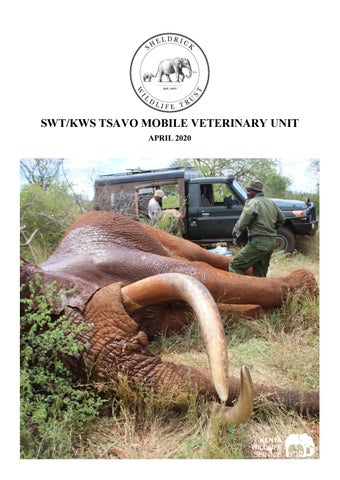
During the normal patrols by the Veterinary Team to assess the general health of wildlife populations, several vultures were seen circling in the air near the Sobo area of Tsavo East National Park. The team approached the site and found an elephant carcass on the ground. Examination The carcass was lying on its left side in an advanced state of decomposition. All the soft tissues were already rotten away and only the skeletal and the skin tissues were left. Cause of Death Autopsy could not reveal the cause of death due to the advanced autolysis. Time of death was placed at approximately 7-10 days. The tusks were recovered and handed over to the Tsavo East armoury for safe keeping.
Case 2 – 14th April 2020 Zebra
Arrow
Kaluku, Tsavo East
The SWT field office reported a zebra that had been spotted near their airstrip with an arrow in its neck. The Vet was airlifted to the location by KWS aircraft and easily found the zebra nearby.
Immobilisation, examination and treatment The zebra was immobilized from foot with a dart containing 8mgs of Etorphine mixed with 60mgs of Azaperone and it went down shortly after. The arrow was carefully removed as it was right next to the jugular vein. The wound was then cleaned with tincture of Iodine, sprayed with Oxytetracycline spray and covered with wetted green clay. 40cc of long acting antibiotics and 20cc of Dexamethasone Sodium were also administered intramuscularly. Prognosis The anaesthesia was reversed with 18mgs of Diprenorphine given intravenously through the jugular vein. Prognosis for a full recovery is good.
Case 3 – 14th April 2020 Lion
Human-wildlife Conflict
Triangle, Tsavo East National Park
A report was made of a lioness that attacked KWS rangers within the triangle area of Tsavo East National Park and was killed by the rangers in the struggle. The carcass was brought to the Veterinary Unit for examination. An autopsy was requested to be undertaken to ascertain why the lioness resorted to attacking humans. Examination The lioness carcass was in poor body condition hence there was a chance that it hadn’t been feeding for some time. The poor body condition makes it impossible for the lioness to hunt. The canines were checked and they were broken which is a sign of old age. Cause of Death The lioness resorted to attacking the rangers because it was starving due to the inability to hunt wild game. Lions lose their canines (weapons used for predation) during old age and sadly the lion was killed due to human-wildlife conflict.
Case 4 – 21st April 2020 Elephant
Natural Causes
Tsavo East National Park
The report of an injured elephant bull was received from the Rhino Security Team in Malka Faya area of Tsavo East. The Vet team rushed to the area and found the big elephant bull near a water point. Immobilisation, examination and treatment The elephant was approached and darted in the rump with 18mg of Etorphine and 40mg of Azaperone. He moved about 100 meters before going down on lateral recumbency. The elephant was secured and water poured on the ears to keep him cool. There was a deep wound to the perineal area, lateral to the anal opening with pus oozing out. The wound was enlarged and pus and bone fragments cleaned out. The wound was flushed with Hydrogen peroxide then doused with tincture of Iodine before being covered with green clay. The elephant was administered with long acting antibiotics and anti-inflammatory drugs intramuscularly and intravenously respectively. Prognosis Having administered treatment, the bull was given a clean bill of health and the anaesthesia was reversed by use of M5050 at three times the Etorphine dose and the bull was assisted to stand. The wound was most likely caused during a territorial fight with another bull. Prognosis is guarded.
Case 5 – 14th April 2020 Predators
Human-wildlife Conflict
Kuku Group Ranch
A report was made by rangers of the Kuku Community Conservancy that there were deaths of wildlife within the conservancy from suspected poisoning. The rangers went to the remote area to confirm the details of the deaths. Examination The Rangers located a lion, a leopard and a jackal carcass close to a cow carcass suspected to have been laced with poison. Due to the remoteness of the area the community rangers burnt the carcasses to prevent further poisoning of other species. They were advised to contact KWS Vets for sampling in the future for poison identification.
Other Activities In the month of April, the vet team also examined 14 pieces of ivory and one Warthog carcass brought in from Voi and a Python skin from Makindu recovered from suspects and produced 6 expert reports to aid in prosecution of offenders.