SWT/KWS TSAVO MOBILE VETERINARY UNIT JANUARY 2021
Introduction
3 Cases in January
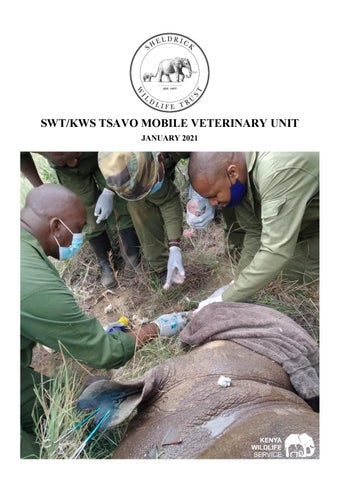
6 Rhinos Ear-notched
2 Elephant Cases
January Report by Dr. Jeremiah Poghon The start of 2021 was a fairly quiet month as there were only 3 cases. One case involved the ear-notching of 6 black rhinos in Tsavo East National Park. The other two cases were elephant post-mortems, but due to the advanced decompensation, a definite cause of death was not determined for either of the elephants. However as the tusks were intact and there was no sign of human activity, or weapons such as arrows or spears present in or around the carcasses, the deaths were assumed to be natural. Acknowledgement The unit acknowledges the support of its sponsors ViER PFOTEN through the Sheldrick Wildlife Trust (SWT) for their huge financial support to the unit. We also thank Kenya Wildlife Service through the Assistant director Tsavo conservation area and the Head, Veterinary Services Department.
Case Details Date
Species
Area Found
28-Jan-21
Black Rhino
Sobo, Tsavo East
30-Jan-21
31-Jan-21
Reason for Intervention Technical Cases
Elephant
Sagalla, Taita Ranches
Postmortem
Elephant
Tsavo East National Park
Postmortem
A total of 6 rhinos were ear notched and fitted with transmitters An elephant bull carcass was found with the tusks intact. An autopsy was inconclusive as no specific pathological change was observed indicating the cause of death The carcass was in an advanced stage of decomposition with all soft tissues rotten away so the autopsy was inconclusive
Outcome Task Successful
Died
Died
SWT/KWS Tsavo Mobile Vet Unit Treatment Locations January 2021
. Case
1 – 28th January 2021
Black Rhino
Technical Case
Sobo, Tsavo East National Park
The exercise was planned to begin at first light to take advantage of cool temperatures. 3 fixed wing aircrafts and 1 helicopter assisted the exercise. Immobilisation and ear-notching After the target was positively identified, it was first driven to open ground and darted from a helicopter. The adults were darted with 80mgs Azaperone and 4.5 Etorphine and the sub-adults with 3.0-3.5mgs Etorphine and 60 mgs Azaperone. Induction time ranged from 3.5 to 9 minutes. After being immobilized, a butterfly catheter was fixed onto one of the ear veins to monitor the oxygenation levels and administer respiration enhancing drugs such as Doxopram and Butorphanol tartrate. Vital parameters including respiration rate, pulse, heart rate, temperature, carbon dioxide levels and arterial blood pressure were monitored. Immobilised animals were doused with water to keep them cool and a blindfold and ear plugs were used to prevent damage to the cornea and to minimize visual and noise stimulation. The ears were notched with a predetermined pattern. Forceps were used to control bleeding and an antibiotic spray applied on the wounds. Six transponders (microchips) were fitted; one in each horn, two in the neck and two at the base of the tail. Blood, tissue and horn samples were collected before the anaesthetic was reversed. The team observed each rhino until it was fully awake before moving on to the next.
Case 2 – 30th January 2021 Elephant
Post-mortem
Sagalla, Tsavo East National Park
The Tsavo Mobile Vet Unit were informed of an elephant carcass found in Tsavo East National Park. Post-mortem The vet team visited the area and found the elephant bull carcass with the tusks intact. The carcass was approximately 5 days old. An autopsy was performed, and no specific pathological change was observed indicating the cause of death. The carcass was at a mid-advanced level of decomposition and the autolytic changes masked the indicators. Due to serious human-wildlife conflict reported in the area recently, ingester and other internal organs were collected for laboratory diagnosis of possible poisoning. Cause of death Unknown, but presumed to be natural unless laboratory results are positive for poisoning.
Case 3 – 31st January 2021 Elephant
Post-mortem
Kirumbi, Tsavo East National Park
A report was made by the Community Warden based at Tsavo East National Park that an elephant carcass had been spotted near Kirumbi area bordering Sagalla community area of Tsavo East. Post-mortem The vet team visited the area and found the elephant bull carcass with one tusk intact. The carcass was in an advanced stage of decomposition with all soft tissues rotten away. Cause of death Cause of death could not be determined due to advanced autolysis.