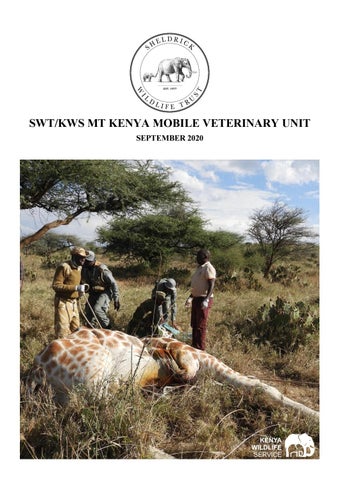
SWT/KWS MT KENYA MOBILE VETERINARY UNIT SEPTEMBER 2020
Introduction
4 Cases in September
1 Lion Case
75% Success
September Report by Dr. Domnic Mijele During the month of September 2020, the Mt Kenya Wildlife Veterinary unit attended to 4 wildlife cases that required veterinary intervention in the Laikipia ecosystem and Mt. Kenya region. Some of the wildlife veterinary cases attended to included chemical immobilization, relocation and treatment of an adult mountain bongo (Riziki) at Mt Kenya Wildlife Conservancy, treatment of an adult male giraffe with an abscess in Loisaba Wildlife Conservancy, examination and euthanasia of a Grevy’s zebra with a fracture of the metatarsal bone at Ol Pejeta Conservancy and treatment of a lion with several bite wounds to the left front leg at Mpala Conservancy as highlighted in the report below; Acknowledgement We greatly acknowledge the Sheldrick Wildlife Trust (SWT) for their continued support that has enabled the Mt Kenya veterinary unit team to respond promptly and offer medication to all wildlife cases that required veterinary intervention during the month.
Case Details Date
Species
Area Found
Bongo
Mount Kenya Natural Wildlife Causes Conservancy
17-Sep-20
Giraffe
Loisaba Natural Wildlife Causes Conservancy
23-Sep-20
Zebra
Ol Pejeta Natural Conservancy Causes
Lion
Mpala Natural Wildlife Causes Conservancy
11-Sep-20
29-Sep-20
Reason for Intervention The animal was suspected to be suffering from helminthosis Had a huge swelling on its right shoulder below the armpit, the swelling looked like an abscess that was painful and the giraffe was unable to move freely This was an adult male Grevy zebra that had a complete compound fracture of the left metatarsal bone of the left hind leg The lion was in good body condition, but it had two deep wounds on the dorsal side of the pad of the left front leg. These were bite wounds inflicted by another male lion
Outcome Successfully Treated
Successfully Treated
Died
Successfully Treated
SWT/KWS Mount Kenya Mobile Vet Unit Treatment Locations September 2020
. Case
1 – 11th September 2020
Bongo
Natural Causes
Mt Kenya Wildlife Conservancy
This was an adult male bongo named (Riziki) that was reported to have signs of helminthosis in Mt Kenya Wildlife Conservancy. This required treatmwnt and an opportunity to collect samples for laboratory analysis.
Immobilisation, examination and treatment The animal was darting from foot with 6mgs Etorphine Hcl combined with 50mgsAzaperone. It took about 5 minutes for the drugs to take effect and the animal went recumbent. The animal was suspected to be suffering from helminthosis; specifically a trichuris infection. It was treated with Ivermectin subcutaneous injection, oral Fenbendazole, then Amoxicillin and multivitamin injections intramuscularly. Feacal samples were collected for parasites egg count and identification, blood samples were collected for haematology tests. Relocation, revival and prognosis The animal was put on a stretcher and then loaded onto a pick-up and transported to another paddock about 2 kilometers away to help avoid any parasite contaminated paddocks. After treatment and relocation, the animal was revived from anaesthesia. It was monitored for a few days and recovered fully.
Case 2 – 17th September 2020 Giraffe
Natural Causes
Loisaba Wildlife Conservancy
This was an adult male giraffe which was found with a huge swelling on its right shoulder below the armpit; the swelling looked like an abscess that was quite painful and the giraffe was unable to move freely. Immobilisation, examination and treatment The giraffe was darted from a vehicle with 15mgs Etorphine combined with 50mgs of Azaperone. It took 7 minutes for the drugs to take effect and the giraffe went recumbent without being roped to the ground. The swelling was shaved clean with a scalpel blade and disinfected with 70% Ethanol and Surgical spirit. It was then cut open on the ventral side and pushed to remove all the whitish exudates and pus. It had accumulated more than 15 litres of pus and the giraffe felt relieved. After the exudates were completely removed, the wound was cleaned with forceps and swabs, then 10% Hydrogen peroxide and Iodine. The wound was then infused with Opticlox ointment and sprayed with Oxytetracycline spray. The animal was also given Amoxycillin and Flunixine intramuscularly as well as a Multivitamin injection intramuscularly. Prognosis After treatment, the giraffe was revived from the anaesthesia with 36mgs Diprenorphine combined with 50mgs Naltrexone and helped to his feet after 2 minutes feeling relieved. Prognosis was fair after treatment.
Case 3 – 23rd September 2020 Zebra
Natural Causes
Ol Pejeta Wildlife Conservancy
This was an adult male Grevy zebra that had a complete compound fracture of the left metatarsal bone of the left hind leg. The bone was completely broken mid-shaft and bone flakes were protruding from the injury. The zebra was in a lot of pain and was not able to walk or put weight on the leg Immobilisation, examination and management The injured Grevy zebra could not move and remained in one location for a long time. It was darted from a vehicle with 5mgs of Etorphine Hcl combined with 80mgs of Azaperone delivered by the Dan-inject remote delivery system. The fractured leg was examined and found to have no chances of recovery. A decision was made to euthanize the zebra to relieve it from pain and suffering, as well as to do the post-mortem examination. Postmortem Findings/Cause of death The metatarsal bone was broken mid-shaft in a way that could not recover; it was reported to have been fractured while running during a fight with another dominant male and falling into a deep burrow in the field.
Case 4 – 29th September 2020 Lion
Natural Causes
Mpala Wildlife Conservancy
This was a case of an adult lion that was seen limping and lying down most of the time in Mpala Conservancy. Immobilisation, examination and treatment The lion was found lying in a thick and dense bushy area, it was shy and kept running in the bushes making it difficult to dart it. After tracking it with vehicles for about one hour, the vet was able to dart it with 300mgs Ketamine and 6mgs Medetomidine. The anaesthesia took effect after 10 minutes and the lion became recumbent. The lion was in good body condition but had two deep wounds on the dorsal side of the pad of the left front leg. These were bite wounds inflicted by another male lion while they were fighting over a kill. The two wounds were disinfected with surgical spirit then shaved clean with a surgical blade. The wounds were then treated with dilute Hydrogen peroxide followed with an Iodine solution and Opticlox ointment. Finally, the wounds were sutured using Chromic cat-gut simple interrupted sutures. Other superficial scratch wounds were sprayed with Oxytetracycline spray. The lion was also given Dexamethasone to reduce pain and Amoxicillin (Betamox) was administered intramuscularly to treat bacterial infections. Prognosis Prognosis was good and the lion was in a pide that would assist in hunting. It has since recovered fully.