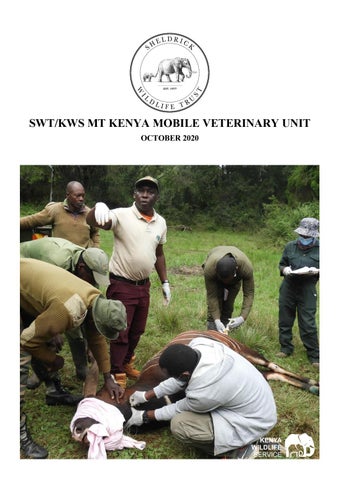
SWT/KWS MT KENYA MOBILE VETERINARY UNIT OCTOBER 2020
Introduction
8 Cases in October
3 Rhino Cases
62% Success
October Report by Dr. Domnic Mijele During the month of October 2020, the Mt Kenya Wildlife Veterinary unit attended to eight wildlife cases that required urgent veterinary intervention in the Laikipia ecosystem and Mt. Kenya region. Some of the wildlife cases attended to include the post-mortem examination of an adult female white rhino in Ol Jogi Wildlife Conservancy, immobilization, examination and euthanasia of a black rhino in Borana Wildlife Conservancy, capture and hoof trimming of an eland in Mt Kenya game ranch as well as treatment of an adult female bongo with a hoof injury and two separate treatments and relocations of an adult female bongo and her calf at Mt Kenya Wildlife Conservancy. Acknowledgement We greatly acknowledge Sheldrick Wildlife Trust (SWT) for their continued support that has enabled the Mt Kenya Veterinary Unit to respond promptly and offer treatment to all wildlife cases that required veterinary intervention during the month. This support has made it possible for the team to respond and save many wildlife lives that required veterinary attention.
Case Details Date
Species
Area Found
02-Oct-20
Rhino White
Ol Jogi Ranch
Postmortem
The rhino carcass was found and there were signs of struggle at the scene of death
Died
02-Oct-20
Rhino White
Ol Jogi Ranch
Rescue
The mother had died, and the calf required rescuing
Taken to Orphanage
05-Oct-20
Bongo
Mt Kenya NP
Natural Causes
A puncture wound was noticed at the bottom of the hoof
Successfully Treated
06-Oct-20
Rhino Black
Borana Ranch
Natural Causes
Had a discharging wound most likely caused by a territorial fight
Died
07-Oct-20
Eland
Mt Kenya NP
Technical Case
A semi-captive eland had overgrown hind leg hooves that made it difficult to move
Task Successful
07-Oct-20
Bongo
Mt Kenya NP
Natural Causes
De-worming and antibiotics given
Successfully Treated
27-Oct-20
Bongo
Mt Kenya NP
Natural Causes
Repeat de-worming and antibiotics
Successfully Treated
29-Oct-20
Bongo
Mt Kenya NP
Technical Case
There was need to transfer two breeding females and one male for breeding
Task Successful
Reason for Intervention
Outcome
SWT/KWS Mount Kenya Mobile Vet Unit Treatment Locations October 2020
. Case
1 & 2 – 2nd October 2020
White Rhino
Post-mortem/Rescue
Ol Jogi Ranch, Laikipia
This report describes a post-mortem examination of an adult female white rhino and the rescue of its calf.
Post-mortem Examination The carcass was at least 3 days old and there were signs of struggle at the scene. The rhino had a 13-monthold calf that was darted and moved to an existing rhino boma for its safety and care as it was too young to survive without the mother’s milk and protection. The carcass was already decomposing, but the animal was in good body condition at the time of death. There were thick mucoid slimy discharges from the vulvar, a sign of being “in heat”. Both the horns were present. The right ear was missing, as well as the lower lip and the mammary glands which were scavenged by carnivores. There were abrasive skin lesions on the base of the neck, the right auxiliary region, the shoulders and the flank. There were lacerating wounds, including multiple areas of haemorrhages, blood clots and bruising to the musculature of the right thorax, shoulder and neck. The lesion on the auxiliary region was a 1-inch deep puncture wound. There were maggots on various parts of the carcass. There were internal injuries to the aorta, lungs and liver and traumatic injuries to the rib cage. The stomach and intestines were full of ingesta indicating the rhino was well fed and active before death. Cause of Death The animal died of abrupt and excessive internal haemorrhage from the ruptured aorta and lungs that led to hypovolemic shock and sudden death. The injuries to the internal organs were caused by blunt trauma from another rhino most likely during mating as seen by signs of struggle in the nearby bushes. Rescue The 13-month-old, orphaned rhino calf (female) was captured by chemical immobilization and moved to an existing rhino enclosure within Ol jogi Conservancy to protect it from predation. The calf will stay under protection until it becomes 2 years of age and able to defend itself from predators. It will then be released back to the wild within the Ol jogi Pyramid sanctuary.
Case 3 – 5th October 2020 Bongo
Natural Causes
Mount Kenya Wildlife Conservancy
An adult female mountain bongo named “Kipenzi” was reported to be limping on its left forelimb since 3rd October and rangers reported it could not put weight on the affected leg and it was in a lot of pain.
Immobilisation, examination and treatment The bongo was darted from the ground with 4mgs Etrophine hydrochloride combined with 40mgs Azaperone tartate. The drug took effect after about 7 minutes and the animal was recumbent. The leg was examined and a puncture wound was found at the bottom of the hoof. It was flushed with Hydrogen peroxide and Iodine to remove debris and then given topical antibiotic cover. Green clay was applied to improve the healing process. All the hooves were overgrown and that this was causing discomfort and increased the likelihood of injury. Therefore, hoof cutters were used to trim the hooves. The animal was also injected with 165mg of Flunixin meglumine, to relieve pain and inflammation, and 3000mg of Amoxicillin, for systemic antibiotic cover. 8mls of multivitamins were also administered. Serum and whole blood samples were taken for future investigation Prognosis Prognosis is good after treatment and the trimming of the hooves improved the animal’s movement.
.
Case 4 – 6th October 2020 Black Rhino
Natural Causes
Borana Ranch
Rocky has no previous history of veterinary treatment since he was translocated from Lewa Conservancy to Borana in 2013. He is well known for his agility and temperament, charging at vehicles and people. Rangers on patrol noticed he was lame, struggling to feed, with a discharging wound on the carpal area. There were two sympatric males nearby, so it was possible there had been a territorial fight. It was not possible to treat the rhino the day the injury was noticed due to poor terrain and proximity to a large dam which could lead to complications after darting. Intervention was scheduled for the 6th October. Immobilisation, examination and treatment The rhino was darted from foot with 3.5mg Etorphine and 50mg Azaperone. The rhino was very agitated and charged around but was kept in safe terrain by a helicopter. He was fully immobilized after 10 minutes. The rhino was blindfolded and stabilized with 20mg of Butorphanol. Examination revealed he was in good body condition, but he had a laceration on the right ear and abdomen and the left forelimb was clearly swollen with a discharging wound. Manipulation of the limb elicited crepitation of bones and exposed bones. X-ray findings showed a complete fracture of the metacarpal bones with multiple fragments. Prognosis After many consultations, a decision was made to euthanize the rhino to relieve pain and suffering.
Case 5 – 7th October 2020 Eland
Technical Case
Mount Kenya Wildlife Conservancy
This was a case of an adult female semi-captive eland at Mt. Kenya game ranch which had overgrown hind leg hooves that made it difficult to move and it could be seen walking with a poor gait.
Immobilisation, examination and treatment The eland was darted using 9mgs of Etorphine Hcl combined with 50mgs of Azaperone within the paddock. It became immobilized and recumbent after about 5 minutes. On physical examination, the hooves had excessively overgrown and curved upwards affecting the gait of the animal. Both the hooves were trimmed using a hoof trimmer and sprayed with Oxytetracycline antibiotic spray. The animal was then administered antibiotics and anti-inflammatories intramuscularly to prevent secondary bacterial infection and reduce pain. Prognosis The anaesthesia was reversed with 24mg of Diprenorphine combined with 50mgs of Naltrexone, the eland got up after 2 minutes feeling much relieved and resumed normal gait.
.
Case 6 – 7th October 2020 Bongo
Natural Causes
Mount Kenya Wildlife Conservancy
Feacal samples taken from a 7 months old calf’s (Eldama) boma revealed a high number of helminthic eggs. The calf’s feaces presented with a large number of adult tape worms and segments. Therefore it was determined that the calf and the dam be captured, treated and moved to a different holding area where they can be easily dewormed regularly until the calf recovers.
Immobilisation, examination and treatment The calf was darted with 1.5 mgs of Etorphine combined with 20mgs of Azaperone, it took about 5 minutes for the drugs to take effect. The mother was darted with 5mgs of Etorphine Hcl combined with 50mgs of Azaperone and it took about 6 minutes for the drugs. Both the calf and the mother were treated with Ivermectin subcutaneous injection, oral Fenbendazole and Amoxicillin and multivitamin injections intramuscularly. Faecal samples were collected for parasite egg count and identification, blood samples collected for haematology tests. Prognosis The calf and mother were loaded onto a pick-up and transported to the nursery boma for regular deworming and treatment. Prognosis for both mother and calf is good.
.
Case 7 – 27th October 2020 Bongo
Natural Causes
Mount Kenya Wildlife Conservancy
After successful repeated de-worming and treatment for 3 weeks, the calf (Eldama) and mother (Eburu) were again captured and released to a larger paddock with adequate space and natural browse.
Immobilisation, examination and treatment The calf was captured by physical restraint while the mother was captured by darting from foot with 5mgs of Etorphine Hcl combined with 50mgs of Azaperone. Both the calf and the mother were treated using Ivermectin subcutaneous injection, oral Fenbendazole, Amoxicillin antibiotics and multivitamin injections intramuscularly. Faecal samples were collected for parasites egg count and identification, blood samples collected for haematology tests. Prognosis The calf and the mother were then loaded onto a pick-up and transported to the Middle forest paddock where they can access natural browse and for breeding purposes.
.
Case 8 – 29th October 2020 Bongo
Technical Case
Mount Kenya Wildlife Conservancy
Two potential breeding females needed to be transferred from the Mackeand paddock to the newly
partitioned Top Forest paddock just within Mt Kenya Wildlife Conservancy; the objective was to decongest the overcrowded Mackeand paddock and create a new breeding herd at the Top forest paddock. One adult and mature male was also captured and moved with the females for breeding purposes..
Immobilisation and relocation The three animals were captured one at a time by darting from foot with 5mgs of Etorphine Hcl combined with 50mgs of Azaperone. They were then loaded onto a pickup truck using a stretcher and driven across to the new paddock about 2 kilometres away. The animals were also given Ivermectin subcutaneous injection as well as Amoxicillin and multivitamin injections intramuscularly. Faecal samples were collected for parasites egg count and identification, blood samples collected for haematology tests. Prognosis This will help decongest small paddocks and start a breeding herd in new paddocks with adequate browse. .