SWT/KWS MT KENYA MOBILE VETERINARY UNIT NOVEMBER 2020
Introduction
13 Cases in November
3 Rhino Cases
1 Elephant Case
November Report by Dr. Domnic Mijele During November, the Mt Kenya Veterinary Unit attended to many wildlife cases that required urgent intervention in the Laikipia ecosystem and Mt. Kenya region. These cases included the treatment of an adult male white rhino with a forelimb injury in Ol Pejeta Conservancy and a female rhino in Ol jogi Conservancy as well as translocation of a rhino from Lewa Conservancy to Ol Pejeta. A female bongo was treated for a prolapsed vagina, three bongos were relocated to a new enclosure and a post-mortem was conducted on a male bongo within the Mt. Kenya Wildlife Conservancy. A spear was removed from an elephant in Ol Malo, a lion was collared in Loisaba and an investigation into the deaths of vultures was conducted. Acknowledgement We greatly acknowledge Sheldrick Wildlife Trust (SWT) for their continued support that has enabled the Mt Kenya veterinary unit team to respond promptly and offer treatment to all wildlife cases that required veterinary intervention.
SWT/KWS Mt Kenya Mobile Vet Unit Treatment Locations November 2020
Case Details Date
Species
Area Found
02-Nov-20
Vultures
Mutara Ranch
Human Wildlife Conflict
Post-mortem revealed congestion haemorrhages indicating poisoning
HWC Death
05-Nov-20
Rhino White
Ol Pejeta Conservancy
Natural Causes
The injured leg had a deep puncture wound caused during a territorial fight
Successfully Treated
06-Nov-20
Bongo
Mount Kenya NR
Natural Causes
Had a vaginal prolapse shortly after mating on the 5th November 2020
Successfully Treated
10-Nov-20
Bongo
Mount Kenya NR
Natural Causes
Poor body condition with protruding ribs and bony prominences of the hind limb
Prognosis Poor
Spear
A spear was retrieved from the flank, which caused a deep puncture wound (approx. 6 inches)
Successfully Treated
10-Nov-20
.
Ol Malo Elephant Conservancy
Reason for Intervention
Outcome
17-Nov-20
Bongo
Mount Kenya NR
Postmortem
The animal was found entangled in vines and bushes, with its head kinked
Died
19-Nov-20
Bongo
Mount Kenya NR
Relocation
An adult mountain bongo was moved from the orphanage to a new boma following improvement of condition after treatment
Task Successful
19-Nov-20
Bongo
Mount Kenya NR
Relocation
Two females were relocated to become part of a breeding herd
Task Successful
20-Nov-20
Rhino Black
Ol Jogi Ranch
Natural Causes
20-Nov-20
Elephant
Mpala Ranch
Natural Causes
21-Nov-20
Lion
Loisaba Ranch
Collared
24-Nov-20
Rhino White
Lewa Conservancy
Relocation
26-Nov-20
Zebra
Ol Pejeta Conservancy
Postmortem
X-rays revealed no broken bones but rotation of the limb suggested possible dislocation of the hip joint Manipulation of the leg did not reveal any broken bones, but a deep puncture wound and significant swelling was seen An adult male lion at Loisaba Conservancy needed to have its GPS collar changed An adult male, southern white rhino was translocated from Lewa to Ol Pejeta for breeding purposes Cause of death was anaemia caused by infestation of round worms and secondary pneumonia due to bacterial infection and reduced immunity
Prognosis Poor Prognosis Poor Task Successful Task Successful
Died
Case 1 – 2nd November 2020 Vultures
Human-wildlife conflict
Mutata Ranch
This report describes a post-mortem examination of 4 African vultures that died in the Mutara area in Laikipia after consuming a poisoned camel carcass. Four vultures died shortly after consuming the carcass.
Post-mortem examination Post-mortem revealed congestion haemorrhages within the gastro-intestinal tract, intestines and crop. The crop and proventriculus was full of camel meat ingesta and a lot of vomitus from the mouth. The birds dropped dead suddenly after consuming the poisoned carcass. The following samples were collected and submitted to the government chemist lab for toxicology tests • • • • •
Vomitus Crop contents & crop tissues Sample of the poisonous chemical Liver samples Poisoned camel meat
The samples were submitted to the government chemist lab for toxicology analysis to identify the poisonous chemical used to kill the vultures.
Case 2 – 5th November 2020 White Rhino
Natural Causes
Ol Pejeta Conservancy
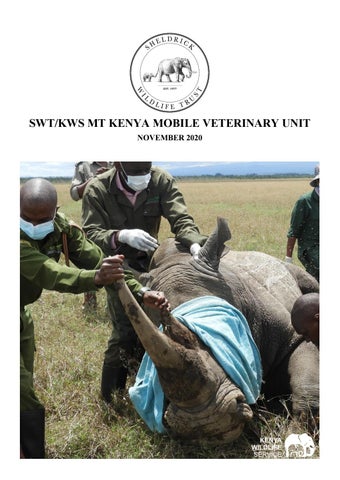
The management of Ol Pejeta and their security teams reported an adult male white rhino that was limping on the left forelimb and not bearing weight properly with an open bleeding wound. Immobilisation, examination and treatment The rhino was darted from a vehicle with 5mg Etorphine hydrochloride and 80mg Azaperone tartrate. The rhino fell on his left side about 6 minutes after darting. A blindfold and ear-plug were applied to prevent light and noise stimulation. 10mg of Butorphanol was administered intravenously through the superficial ear vein and oxygen insufflations was initiated to improve cardio-respiratory function. The injured leg had a deep puncture wound (approx. 10cm deep) on the left forelimb at the level of the metacarpals. The wound was first debrided with Hydrogen peroxide and disinfected with Iodine then Opticlox ointment and Chlortetracycline pessaries were inserted into the woundA layer of healing green clay and topical Oxytetracycline spray were also applied. The elephant was also administered Penicillin (100mls) for systemic antibiotic cover and Dexamethasone (40mls) for anti-inflammatory and analgesic action. Prognosis The rhino should make a full recovery as it is in good condition and subsequent reports have been positive.
Case 3 – 6th November 2020 Bongo
Natural Causes
Mount Kenya Wildlife Conservancy
An adult mountain bongo was reported to have a vaginal prolapse shortly after mating on 5th November 2020. The prolapsed vagina was popping out and was susceptible to bacterial infection. Immobilisation, examination and treatment The bongo was darted in the left thigh 4mgs Etorphine hydrochloride and 40mgs Azaperone tartrate. The drug took effect after 7 minutes and the animal became recumbent. Local anaesthesia of 2% Lignocaine (5mls) was used to desensitize the perineum and vulvar lips prior to suturing. The protruding tissue was lavaged with sterile normal saline and carefully repositioned and manipulated back to normal position. Once the tissue was in place, reduction and retention was done with a purse string suture using absorbable 2-0 polyglyconate suture. 40mls of Dexamethasone was injected to relieve pain and decrease inflammation, as well as 60mls of Penicillin for systemic antibiotic cover. The animal was also given 3mls of 1% Ivermectin subcutaneously for control of internal and external parasites. Prognosis The anaesthetic was reversed and the bongo was standing within 2 minutes. The prognosis is good as the tissue had minimal trauma and contamination. The animal is expected to heal well
Case 4 – 10th November 2020 Bongo
Natural Causes
Mount Kenya Wildlife Conservancy
An adult male mountain bongo was reported to be having a loss of body condition and it was decided to move the animal to the orphanage section for treatment and closer monitoring. Immobilisation, examination and treatment The bongo was darted with 5mgs Etorphine hydrochloride and 40mgs Azaperone tartate. The drug took effect after 7 minutes and the animal became recumbent. A blindfold was placed on the animal’s head to prevent light stimulation. Oxygen was supplemented throughout the procedure. The bongo was dewormed with 10ml of Fenbendazole (given orally), and 5ml 1% Ivermectin, which was given subcutaneously. The animal was also given 60ml Procaine penicillin administered intra-muscularly for systemic antibiotic cover and Vitamin B12 intramuscularly. Blood samples (EDTA blood and serum) were also taken from the jugular vein for further investigation. Relocation, revival and prognosis The prognosis is guarded as the cause of the loss of body condition is yet to be fully determined. However, the animal is expected to improve as closer monitoring and supplementary feeding will be useful.
.
Case 5 – 10th November 2020 Elephant
Spear
Ol Malo Conservancy
An adult male elephant was noted to have a spear embedded in its right flank. On assessment the animal was clearly in pain and discomfort. There were also some exudates noted to be discharging from the wound. Immobilisation, examination and treatment The elephant was darted with 18mg Etorphine hydrochloride from a vehicle. The elephant fell on sternal recumbency and was quickly roped and pulled onto his left side to facilitate better breathing and treatment. A spear was removed from the flank which caused a deep puncture wound (approx. 6 inches). There was no evidence of penetration into the peritoneal cavity. The spear was bent, and this probably happened as the animal rubbed itself on a tree in an attempt to remove the spear. The wound flushed with Hydrogen peroxide and irrigated with Iodine for topical disinfection. After thorough cleaning, Opticlox ointment and Chlortetracycline pessaries were inserted into the wound, then a layer of healing green clay and topical Oxytetracycline spray applied. The elephant was also administered with an intramuscular injection of Oxytetracycline (200mls) as an antibiotic and Dexamethasone (40mls) as an anti-inflammatory. Prognosis Prognosis for a full recovery was good as there was no penetration of the peritoneal cavity or internal organs.
Case 6 – 17th November 2020 Bongo
Post-mortem
Mount Kenya Wildlife Conservancy
The bongo was seen on the 16th November 2020, feeding well and in good condition. Sadly the animal was found dead a day later and there were signs of struggle around the carcass. The animal was found entangled in vines and
bushes, on sternal recumbency with its head kinked slightly ventrally. With some effort from the team, the animal was removed from the bushes and placed on its side. Post-mortem examination The carcass was fresh; possibly less than 24 hours old. The animal was still warm indicating that rigor mortis had not set in and all orifices were absent of discharge apart from thin bloody discharge from the left nostril. There were various abrasions on the skin, as well as multiple areas of haemorrhage blood clots and congestion to the neck muscles, and thorax. The trachea was opened and examined which revealed clear frothy discharge. The lungs were soft and congested. The stomach and intestines were full of normal ingesta. The liver was slightly enlarged and congested with petechial haemorrhages. There was a white, fat-like plaque removed from the bile ducts that may have caused an obstruction. Petechial haemorrhage was also seen on the spleen. The messenteric blood vessels were congested and the messenteric lymph nodes were very enlarged. There were marked areas of petechial haemorrhages on the kidney surface. Investigation of the environment revealed that the animal struggled prior to death and multiple lesions were found on the skin. The nasal discharge may have occurred due to trauma to the mucosal tissue prior to death. Cause of death Tracheal froth accompanied by the presence of pulmonary congestion, oedema and haemorrhage on thoracic musculature are indicative of respiratory distress possibly caused by mechanical asphyxia. The petechial haemorrhages and enlarged lymph nodes could be indicative of an infection. .
Case 7 & 8 – 19th November 2020 Bongo
Relocation
Mount Kenya Wildlife Conservancy
An adult mountain bongo was to be moved from the orphanage to a new boma following improvement of condition after treatment. On the same day, two females needed to be moved to a breeding herd in the Mzalendo boma with a male mountain bongo that was fit for breeding. Immobilisation, examination and relocation The male bongo was darted from foot with 4mgs Etorphine and 40mgs Azaperone. The animal was recumbent within 6 minutes. The bongo was moved into the new boma and the anaesthetic was reversed. The female bongos were darted with 6mgs and 4mgs Etorphine hydrochloride combined with 40mgs and 30mgs Azaperone tartate respectively. Throughout the exercise, respiration was monitored and blood samples were collected for future examination. The second female also received 10mls of Multivitamins were injected intra-muscularly. Prognosis It is important to establish successful breeding herds to increase captive populations of the mountain bongo. The group will be closely monitored for the next few months to assess success of mating and breeding.
Case 9 – 20th November 2020 Black Rhino
Natural Causes
Ol Jogi Ranch
An adult female black rhino was reported to be limping by Ol Jogi Conservancy Rangers. Immobilisation, examination and treatment The rhino was with 4mgs Etorphine and 60mgs Azaperone tartrate, from a helicopter. The drugs took effect and the rhino fell on sternal recumbency. She was then rolled onto her right side to facilitate examination of the limbs. 5mg of Butorphanol tartrate and oxygen were administered to improve cardio-respiratory function The limb was examined and to see if there were any noticeable injuries or damage. There were minor external injuries to the hind quarters which were treated with Oxytetracycline spray. Manipulation did not reveal any broken bones, which was confirmed with X-rays. However, rotation of the limb suggested dislocation of the hip joint. It was also suspected that the animal had a muscle or tendon tear. For pain management and inflammation, 2000mg of Flunixine meglumine and 100mg of Dexamethasone were administered as well as 100mls of Oxytetracycline as an antibiotic. Incidental filariasis lesions were noted on the neck, flank, and inner limb region as well as minor injuries on the vulvar which were all treated with topical antibiotic spray. Prognosis The prognosis is guarded because, despite no fracture or major trauma to the bones, it is difficult to keep a freeranging animal in confinement to heal. The rhino is heavily pregnant and after birth, she will be relieved of pressure on her hind quarters which will also aid in healing. The rhino will be monitored closely.
Case 10 – 20th November 2020 Elephant
Natural Causes
Mpala Ranch
A sub-adult female elephant was reported to be limping (leg-lifting lameness) and was notably in pain and distress. Immobilisation, examination and treatment The elephant was darted from foot with 14mgs Etorphine hydrochloride in the left thigh muscles. The elephant fell on sternal recumbency after five minutes and was immediately rolled onto the right side. Ointment was applied to the eyes and the ear placed over the eye to prevented drying out. Respiratory rate was monitored every few minutes to ascertain the animal was breathing well. Water was poured over the animal to prevent hyperthermia. Manipulation of the limb did not reveal any broken bones, but a deep puncture wound and significant swelling was seen on the medial aspect of the left hind leg. The animal was turned onto its left side to enable wound treatment. No foreign object was found when probed with forceps so the wound was flushed with Hydrogen peroxide and Iodine to remove any debris then Opticlox was applied as an antibiotic. Green clay and topical Alamycin spray were also applied for antibiotic cover and to act as fly repellent. The elephant was then administered with 200mls of Oxytetracycline as an antibiotic and 200mg of Dexamethasone for management of pain and inflammation. Prognosis The prognosis is guarded because although there was no notable fracture, the wound was deep and severely affected movement of the animal. The Mpala Ranch Rangers and Vet Team will monitor the elephants progress closely.
Case 11 – 21st November 2020 Lion
Collaring
Loisaba Ranch
An adult male lion at Loisaba Conservancy needed to have its GPS collar changed. The lion was in a group with 5 other adult males and 2 females. On the 21st November 2020, the Loisaba Conservancy Rangers identified the lion’s location and with a Lion Landscapes team and the support of the Mobile Vet Unit, bait was set up to capture the lion. However, after a few hours of waiting and moving the bait to a different location where the group were last seen, the lions did not appear. Early morning on 22nd November, the rangers moved the bait to another area, the pride responded and the veterinary team quickly moved to immobilize the targeted lion. Immobilisation, examination and collaring The lion was darted with 8mg Medetomidine and 350mg Ketamine and he went down 13 minutes later. On approach, a blindfold was put in place and the neck extended to facilitate better respiration. Physiological parameters were recorded every 5 minutes. The lion was in good body condition, the mucus membranes were moist and pink and there were no external injuries except for a few, minor wounds that had scabbed over. These were treated with topical Alamycin spray. All of the lion’s teeth were present and in good condition. Measurements of the lion and blood samples were taken and recorded by the Lion landscapes team. These included head to rump length, chest and hip width, testicle length, etc. Notable markings were also recorded to make future identification easier. Prognosis The exercise was successful. Collaring will give valuable data on the behaviour and the movement of the lion.
Case 12 – 24th November 2020 White Rhino
Relocation
Lewa Conservancy
An adult male, Southern white rhino needed to be relocated from Lewa Conservancy to Ol Pejeta Conservancy to serve as a teaser bull for five female Southern white rhinos that would be surrogate to embryos of Northern white rhinos. This exercise was facilitated by the Kenya wildlife Service as part of effort to save the Northern white rhino species. Immobilisation The rhino was darted from a vehicle with 5mgs Etorphine combined with 80mgs Azaperone. The dart landed in the right shoulder and 23 minutes later the rhino went down. Ropes were used to help the animal lie on the left side. 10mgs Butorphanol was administered to counter respiratory depression caused by opioid use. The rhino was then rolled onto its chest and loaded into a crate with strong non-abrasive ropes tied behind the posterior horn and round the rump of the animal. Vehicles and a team of personnel helped pull the rhino into the crate Relocation The crate had a rubber floor to prevent slippage and the rhino was able to stand and lie down comfortably. During transportation, the Vet Unit monitored the animal to ensure its welfare and safety. When the animal arrived at the site, a though inspection of the holding boma and an assessment of the rhino was conducted to ensure all was in order. Prognosis The animal was expectedly apprehensive and took time to assess his new environment, but he has since adapted well.
Case 13 – 26th November 2020 Zebra
Post-mortem
Ol Pejeta Conservancy
A sub-adult female Grevy zebra was found dead in Ol Pejeta Conservancy that required an urgent postmortem to establish the cause of death. Post-mortem examination The carcass was quite fresh, in good body condition but there was white mucous from the nostrils. A lot of round worms were found in the stomach and intestines. Pale mucous membranes, anaemia and red hepatisation of lung tissues are a sign of pneumonia. Cause of death Cause of death is likely due to anaemia caused by massive infestation of round worms in the gastrointestinal tract and secondary pneumonia caused by opportunistic bacterial infection due to reduced immunity. Management are advised to expand the Grevy zebra sanctuary to allow for dispersal of the animals to help evade the parasites.