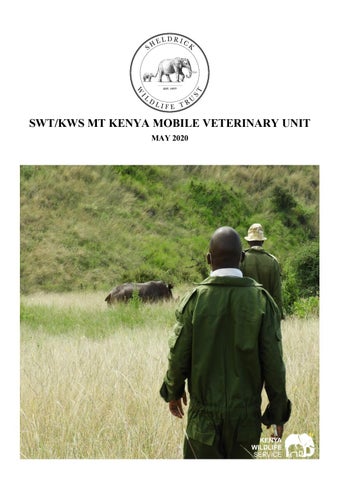
SWT/KWS MT KENYA MOBILE VETERINARY UNIT MAY 2020
Introduction
9 Cases in May
26 Zebras Relocated
5 Bongo Cases
May Report by Dr. Domnic Mijele During the month of May, 2020, the Mt Kenya Wildlife Veterinary unit attended to many wildlife cases that required veterinary intervention and investigations in Laikipia ecosystem and Mt. Kenya region. Some of the wildlife emergency veterinary cases attended to include three treatments and one post-mortem of Mountain Bongos in Mt. Kenya Wildlife Conservancy, treatment of a common zebra with a retained placenta (after birth) in Solio Wildlife Conservancy, translocation of 26 Grevy’s zebra from Lewa Wildlife Conservancy to Sera Wildlife Conservancy, post-mortem of a reticulated giraffe that died of dystocia (difficult calving) in Mpala Wildlife Conservancy and ear-notching of a male White Rhino in Lewa Wildlife Conservancy. Acknowledgement We acknowledge continued and long-term support from Sheldrick Wildlife Trust (SWT), KWS and Wildlife Conservancies that has enabled the Mt Kenya Veterinary Unit to respond promptly to all wildlife cases that required veterinary intervention during the month. This support has made it possible for the team to attend and treat many wildlife cases that required urgent veterinary attention.
Case Details Date
Species
Area Found
06-May-20
Bongo
Mt Kenya NP
Natural Causes
Bongo showed signs of weakness, lethargic, diarrhoea and poor body condition
Prognosis Poor
11-May-20
Zebra
Solio Ranch
Natural Causes
Had a large piece of placenta hanging from the vulvar
Successfully Treated
12-May-20
Zebra
Lewa Relocation Conservancy
To start a new grevy’s zebras population as part of species conservation programme
Task Successful
14-May-20
Giraffe
Mpala Ranch
Postmortem
A calf was stuck and died in the pelvic cavity
Died
18-May-20
Bongo
Mt Kenya NP
Natural Causes
Bongo showed signs of weakness, lethargic, diarrhoea and poor body condition
Prognosis Poor
18-May-20
Bongo
Mt Kenya NP
Natural Causes
Bongo showed signs of weakness, lethargic, diarrhoea and poor body condition
Prognosis Poor
23-May-20
Rhino White
Lewa Conservancy
Technical Cases
Ear notching enables individual identification of rhinos
Task Successful
24-May-20
Bongo
Mt Kenya NP
Postmortem
Bongo died after showed signs of weakness, lethargic, diarrhoea and poor body condition
Died
Bongo
Mt Kenya NP
Natural Causes
Bloat and dehydration caused by profuse watery diarrhoea, hypoglyceamia and nutritional deficiency
Prognosis Poor
24-May-20
Reason for Intervention
Outcome
SWT/KWS Mt Kenya Mobile Vet Unit Treatment Locations May 2020
. Case
1 – 6th May 2020
Bongo
Natural Causes
Mt Kenya Wildlife Conservancy
One of the adult male bongo antelopes was reported to have signs of weakness, lethargic, profuse watery diarrhoea, poor body condition, rough hairs, and sub-mandibular swelling. This required urgent veterinary intervention to treat the animal. It was suspected to have prolonged indigestion and diarrhoea caused by imbalanced feeds formular and gastrointestinal parasites. Immobilisation, examination and treatment The bongo was quite weak and lethargic so it was physically restrained by hands. The animal was then treated using oral trimethoprim sulfonamides, then Procaine penicillin intramuscular injection, Vitamin B12 (Cyanocobalamine) administered intramuscularly and ivermectin subcutaneous injection. The skin was sprayed using FrontlineÂŽ to eradicate all ectoparasites. Blood, tick and faecal samples were also collected for further laboratory analysis. Prognosis This is an ongoing problem with the bongos in the Conservancy.
Case 2 – 11th May 2020 Zebra
Natural Causes
Solio Ranch
This was an adult female common zebra at Solio Wildlife Conservancy that had a large piece of placenta hanging on the vulvar. It had haemorrhages from the vulvar caused by the peeling off of the placenta. This was an emergency case that required urgent intervention from the veterinary team.
Immobilisation, examination and treatment The zebra was darted using 5mgs of etorphine Hcl combined with 50mgs of azaperone delivered by Daninject remote delivery system. It took about 6 minutes for the drug to take effect and the zebra became fully anaesthetised for the operation. The loose placenta was gently pulled out with moderate force and the uterus flushed using very dilute mild iodine and chlortetracycline pessaries inserted. The zebra was further treated using antibiotics and antinflammatory drugs. Prognosis After the exercise, anaesthesia was reversed. The zebra rose up after 2 minutes and joined the others. Prognosis was good after the removal of the placenta although it had a lot of haemorrhage and pain.
Case 3 – 12th May 2020 Zebra
Relocation
Lewa Wildlife Conservancy
The Mt Kenya vet unit worked together with the Lewa veterinary unit and Northern Rangelands Trust (NRT) team to undertake translocation of 26 Grevy’s zebras from Lewa Wildlife conservancy to Sera Conservancy. The main objective is to start a new Grevy zebras population in Sera conservancy as part of species conservation programme
Relocation All the grevy’s zebras were successfully darted from a vehicle. After darting the animals were placed on a specially designed animal stretcher successively and loaded onto pick-up and to the lorry truck. Inside the truck, tissue, ticks and blood samples were collected then the animal revived from anaesthesia and later driven to Sera Wildlife conservancy; a distance of about 150 kilometres. Prognosis The relocation went well.
Case 4 – 14th May 2020 Giraffe
Post-mortem
Mpala Ranch
This was a case of a female reticulated giraffe that had a dystocia (difficult calving) and the calf got stuck and died in the pelvic cavity in Mpala Wildlife Conservancy, unfortunately it was sighted late and it died shortly before intervention. Examination Post-mortem examination revealed that the foetus was in anterior presentation with one left leg out but the head and the other right leg was still stuck in the pelvic cavity. Cause of death The foetus was dead in the pelvic cavity, swollen and decomposed with maggots, pus and necrotic debris that introduced infections in the uterus leading to septicaemia and death of the mother.
Case 5 – 18th May 2020 Bongo
Natural Causes
Mt Kenya Wildlife Conservancy
This was another sub-adult female bongo that was also reported to have signs of weakness, lethargic, poor body condition, and sub-mandibular oedema. This required urgent veterinary intervention to treat the animal. It was suspected to have prolonged indigestion and diarrhea caused by imbalanced feeds formular and gastrointestinal parasites. Immobilisation, examination and treatment The bongo was quite weak and lethargic so it was physically restrained by hands. The animal was then treated using oral Amprolium and Trimethoprim sulfonamides, then Betamox, Vitamin B12 (Cyanocobalamine) administered intramuscularly and Ivermectin subcutaneous injection. The skin was sprayed using Frontline to eradicate all ectoparasites. Blood, tick and faecal samples were also collected for further laboratory analysis. Prognosis This is an ongoing problem within the Conservancy.
Case 6 – 18th May 2020 Bongo
Natural Causes
Mt Kenya Wildlife Conservancy
This was another sub-adult female bongo antelope that was also reported to have signs of weakness, lethargic, profuse watery diarrhoea, poor body condition, rough hairs, and sub-mandibular swelling. This required urgent veterinary intervention to treat the animal. It was suspected to have prolonged indigestion and diarrhea caused by imbalanced feeds formula and gastrointestinal parasites. Immobilisation, examination and treatment The bongo was quite weak and lethargic so it was physically restrained by hands. The animal was then treated using oral Amprolium and Trimethoprim sulfonamides, then Procaine penicillin, and Vitamin B12 (Cyanocobalamine) administered intramuscularly as well as Ivermectin subcutaneous injection. The skin was sprayed using Frontline to eradicate all ectoparasites. Blood, tick and faecal samples were also collected for further laboratory analysis. Prognosis This is an ongoing problem within the Conservancy.
Case 7 – 23rd May 2020 White Rhino
Technical Case (Ear Notching)
Lewa Wildlife Conservancy
Ear notching of an adult male Southern white rhino (Ceratotherium simum) was carried out in Lewa Wildlife Conservancy as part of the rhino identification and monitoring process. Ear notching enables individual identification of rhinos for purposes of enhancing monitoring in the wild. Ear-notching of rhinos is a very important management tool for rhino conservation as the security rangers are able to use the ear-notch to accurately identify specific individuals and report their status on daily basis. Only one rhino was identified for ear-notching during this exercise.
Ear-Notching Exercise The rhino was darted from a helicopter using 5mgs of Etorphine Hcl combined with 80mgs of Azaperone tartrate. Induction time was about 10 minutes and the animal became immobilized and recumbent. To improve the plane of anaesthesia and respiration 10 mg of Butorphanol was administered through the superficial ear veins soon after the rhino was immobilized. Once the anaesthesia was stable the rhino was then ear-notched successfully then revived from anaesthesia and released back into the wild.
Case 8 – 24th May 2020 Bongo
Post-mortem
Mt Kenya Wildlife Conservancy
An adult female bongo died after showing signs of losing body weight, profuse watery diarrhea and lethargy. It made little improvement and the condition kept on recurring until it got worse and the animal succumbed. More than 10 bongos died in May 2020 with similar signs and post-mortem findings were as below. Examination All the organs and the intestines were healthy. There was excess accumulation of semi-digested food and water in all the four stomach chambers and small intestines but there was bloat and gaseous/frothy accumulation. There was no inflammation or gastroenteritis in any part of the gastrointestinal system. All internal organs tissue samples, stomach contents and blood collected for further laboratory investigations. Cause of death Bloat, dehydration caused by profuse watery diarrhoea, hypoglycaemia and nutritional deficiency. Several mountain bongos have had the same condition since 2017 and many of them have died while others barely survived. A number of post-mortem have been conducted but there were no significant finding other than profuse diarrhoea, poor body condition and anorexia. Currently a number of the animals in the facility have diarrhoea and on the verge of succumbing to the same if immediate action is not taken. The following recommendations should be implemented with immediate effect to avert the situation; • •
We recommend that the current feeding of pellets supplied from Unga feeds be stopped and those pellets be subjected to nutritional analysis before being approved for bongo consumption The animals should feed more on natural browse and less of the commercial concentrates.
Case 9 – 24th May 2020 Bongo
Natural Causes
Mt Kenya Wildlife Conservancy
This was another adult male bongo that was also reported to have signs of weakness, lethargic, profuse watery diarrhea, poor body condition, rough hairs, and sub-mandibular swelling. This required urgent veterinary intervention to treat the animal. It was suspected to have prolonged indigestion and diarrhea caused by imbalanced feeds formular and gastrointestinal infections. Immobilisation, examination and treatment The bongo was quite weak and lethargic so it was physically restrained by hands. The animal was then treated using oral Amprolium and Trimethoprim sulphonamides. Then Procaine penicillin and Vitamin B12 (Cyanocobalamine) were administered intramuscularly as well as an Ivermectin subcutaneous injection. The skin was sprayed with Frontline to eradicate all ectoparasites. Blood, tick and faecal samples were also collected for further laboratory analysis. Prognosis The prognosis was not good as the bongo was very dehydrated and hypoglycaemic. Sadly, it died afterwards despite treatments.