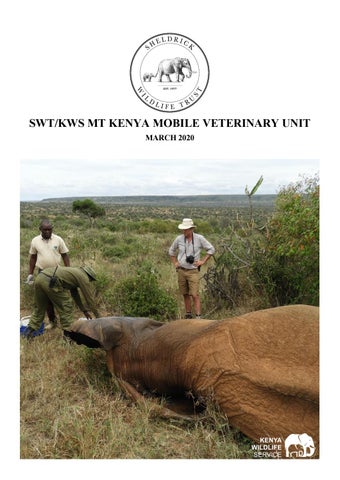
SWT/KWS MT KENYA MOBILE VETERINARY UNIT MARCH 2020
Introduction
9 Cases in March
5 Bongo Cases
78% Success
March Report by Dr. Domnic Mijele During March 2020, the Mt Kenya Wildlife Veterinary unit attended to many wildlife cases that required urgent veterinary intervention in the Laikipia ecosystem and Mt. Kenya region. Some of the wildlife cases attended to include relocation of two sub-adult male white rhinos, treatment of a bongo with chronic emaciation, translocation of “Kiko� the orphaned reticulated giraffe from the Sheldrick Wildlife Trust orphanage to Sirikoi Conservancy, treatment of a sub-adult male bongo with a traumatic injury, post-mortem examination of a bongo, treatment of an adult female bongo with brisket and submandibular oedema, treatment of a giraffe injured in Meru National Park, treatment of an elephant bull with a leg dislocation in Mpala Wildlife Conservancy and the relocation of 3 previously treated bongos. Acknowledgement We acknowledge Sheldrick Wildlife Trust (SWT), KWS and other partners for their support that has enabled the Mt Kenya Veterinary Unit Team to respond promptly to all wildlife emergency cases that required veterinary intervention during the month. This support has made it possible for the team to respond and treat wildlife cases that required urgent veterinary attention without which they would not have survived.
Case Details Date
Species
Area Found
05-Mar-20
Rhino White
Ol Pejeta Conservancy
07-Mar-20
Bongo
17-Mar-20
Reason for Intervention
Outcome
Relocation
Two male Southern white rhinos were moved from the Northern white rhino enclosure
Task Successful
Mount Kenya NR
Natural Causes
One of the bongos was reported to have poor body condition and to be lethargic
Successfully Treated
Giraffe
Nairobi
Relocation
Kiko, the hand raised giraffe was translocated to Sirikoi
Task Successful
18-Mar-20
Bongo
Mount Kenya NR
Natural Causes
A male bongo was attacked by another male bongo and was pierced through the rib-cage
Prognosis Poor
21-Mar-20
Bongo
Mount Kenya NR
Postmortem
The bongo that was treated for a puncture wound died
Died
24-Mar-20
Bongo
Mount Kenya NR
Natural Causes
Bongo had poor body condition, oedema and sub-mandibular swelling
Successfully Treated
28-Mar-20
Giraffe
Meru National Park
Snared
A wire snare had cut through the muscles of the hock joint creating a septic wound
Successfully Treated
29-Mar-20
Elephant
Mpala Ranch
Natural Causes
The elephant was limping and dragging the affected leg which was dislocated
Successfully Treated
Bongo
Mount Kenya NR
Relocation
2 males and 1 female bongo were relocated from their treatment enclosures after recovery
Task Successful
31-Mar-20
SWT/KWS Mt Kenya Mobile Vet Unit Treatment Locations March 2020
. Case
1 – 5th March 2020
Rhino
Relocation
Ol Pejeta Conservancy
KWS in collaboration with the Ol Pejeta Wildlife Conservancy and other partners are working together to recover the endangered Northern White rhino population that is almost getting extinct. The two male southern white rhinos were captured and removed from the Northern white rhino enclosure in order to create space for in-vitro fertilization and breeding of the few remaining Northern white rhinos.
Relocation KWS in collaboration with the Ol Pejeta Wildlife Conservancy and other partners are working together to recover the endangered Northern White rhino population that is almost extinct. The two male Southern white rhinos were captured and removed from the Northern white rhino enclosure in order to create space for in-vitro fertilization and breeding of the few remaining Northern white rhinos. Reversal The rhinos were darted, loaded into a wooden crate and lifted into a lorry using a crane. They were then revived from the anaesthesia and moved to the main wildlife sanctuary just about 5 kilometres away.
Case 2 – 7th March 2020 Bongo
Natural Causes
Mt Kenya Wildlife Conservancy
One of the male bongos was reported to have poor body condition, rough hairs and was very lethargic. This required veterinary attention to save the animal and collect samples for further laboratory analysis. Immobilisation, examination and treatment The bongo was in an enclosure where it was darted with 7mgs of Etorphine combined with 50mgs of Azaperone. It became immobilized and recumbent after about 8 minutes. Before treatment, blood samples were collected from the jugular vein in EDTA coated tubes and plain tubes. Blood smears were also prepared for microscopy, these will be analysed to establish the cause of infection. The animal was then treated with Procaine penicillin, Vitamin B12 administered intramuscularly and Ivermectin subcutaneous injection. The skin was sprayed using Frontline to eradicate all ectoparasites. Prognosis The bongo was revived from the anaesthesia and rose up after 2 minutes. Prognosis was good after treatment and it recovered well.
Case 3 – 17th March 2020 Giraffe
Relocation
Nairobi/Sirikoi
Kiko is an adult male giraffe that was rescued from Meru National Park in 2015 after his mother died when he was just a week old. He was taken to the Sheldrick Wildlife Trust (SWT) orphanage where he has been cared for until he was ready for release. SWT requested KWS to allow Kiko to be released back into the wild since he is fully grown. Relocation The most appropriate release site was Sirikoi Wildlife Conservancy within Lewa. Sirikoi has adequate habitat and water for giraffes and another hand reared female reticulated giraffe named “Nditu” who will be a companion to Kiko. Sirikoi and SWT built predator proof stables where Kiko and Nditu will stay at night to safeguard them from lions or hyenas whilst they are acclimatising to the wild. The keepers at Sirikoi already have a lot of experience with giraffes. Kiko was lured into a giraffe translocation crate mounted on a canter lorry; prior to the translocation Kiko had be familiarised with the crate, so he walked in of his own accord and was provided with food. The translocation crate’s floor was well padded with sawdust and rubber so Kiko’s trip was comfortable. Kiko was then transported the 350 kilometres, which took 6 hours, to Sirikoi Conservancy. The relocation was successful and he is doing well at the Conservancy.
Case 4 – 18th March 2020 Bongo
Natural Causes
Mt Kenya Wildlife Conservancy
One of the male bongos was attacked by another dominant male bongo and pierced through the rib-cage by a horn, it sustained a severe injury and had a lot of internal bleeding. It then became weak and recumbent and could not eat or walk normally. Immobilisation, examination and treatment The bongo was physically restrained using ropes. The wound was examined and found to have pierced through the skin, abdominal muscles and pierced into the rumen and causing spillage of ruminal content into the peritoneum. It had serious peritonitis and pus accumulation in the peritoneum. It had stayed with the injury for long and had developed muscular necrosis of the affected abdominal muscles. The wound was cleaned and lavaged then infiltrated with local anaesthesia 2% lignocaine and sutured using catgut N0. 3 suture on a swaged needle. The wound was well sutured and topically treated using OpticloxÂŽ ointment and oxytetracycline spray. It was also treated using Betamox antibiotic and dexamethasone, then given oral rehydration and molasses to help restore the lost energy. Prognosis Prognosis was poor due to peritonitis and risk of developing septicaemia.
Case 5 – 21st March 2020 Bongo
Post-mortem
Mt Kenya Wildlife Conservancy
Unfortunately, the bongo that was previously treated for an injury to the rib cage after a fight with another male didn’t survive and a post-mortem was required. General Examination The bongo suffered an abdominal puncture wound and died of septicaemia and peritonitis. Post-mortem examination revealed massive spillage of ruminal content into the peritoneal cavity, pus accumulation and muscle necrosis of the abdominal wall.
Case 6 – 24th March 2020 Bongo
Natural Causes
Mt Kenya Wildlife Conservancy
One of the adult female bongos was reported to have poor body condition, rough hairs, brisket edema and sub-mandibular swelling. This required veterinary intervention to treat the animal. Immobilisation, examination and treatment The bongo was quite weak and lethargic so it was physically restrained by hand. The brisket oedema was aspirated and found to have clear fluids caused by oedema; the submandibular swelling was a consolidated mass formed by interstitial fluids; all the oedema was caused by coccidiosis infection. The brisket oedema was aseptically cut open and about half litre of fluid was drained out. Faecal and blood samples were collected for further laboratory analysis. The bongo was then treated using oral Amprolium and Suxamethoxasole, followed by Procaine penicillin and Vitamin B12 (Cyanocobalamine) administered intramuscularly as well as Ivermectin subcutaneous injection. The skin was sprayed with Frontline to eradicate all ectoparasites. Prognosis Prognosis was good after treatment and the animal has since recovered.
Case 7 – 28th March 2020 Giraffe
Snared
Meru National Park
An adult female giraffe was reported to be limping and had a deep cut injury on the left hock joint in Meru National Park. The injury was swollen/painful and required immediate veterinary attention. The veterinary team therefore responded quickly to save the giraffe from the pain and suffering caused by a wire snare. Immobilisation, examination and treatment The injured giraffe was found with other giraffes in a bushy terrain and it was quickly darted from a vehicle with 17mgs of Etorphine combined with 50mgs of Azaperone. It took about 10 minutes for the drugs to take effect after which the giraffe was roped down by the veterinary team assisted by the Park Rangers. The wire snare had cut through the muscles of the hock joint creating a septic wound around the joint. The wire had fallen off and was not found. The wound was cleaned with water, cauterized and debrided with Hydrogen peroxide, disinfected with Povidone iodine then sprayed with Oxytetracycline spray. Amoxycillin (BetamoxÂŽ) and Dexamethasone anti-inflammatory drug were administered intramuscularly to enhance the wound healing process. Prognosis The anaesthetic was reversed and the giraffe rose up after 1 minute and joined the rest of the herd. The prognosis was good after the wound was adequately treated.
Case 8 – 29th March 2020 Elephant
Natural Causes
Mpala Conservancy
This was a case of an adult male elephant in Mpala Conservancy that had sustained a dislocation of the right elbow (Cubital) joint. The elephant could be seen limping and dragging the affected leg as it walked with a lot of pain. Immobilisation, examination and treatment The injured elephant was immobilized by darting from a vehicle with 18mgs of Etorphine and was immobilized after about 5 minutes, going down on lateral recumbency. The affected leg was swollen with no visible wound or any external injury. The leg was examined all round, palpated and flexed severally to ascertain the cause of the limping. It was found to be a dislocation of the elbow joint probably caused when the elephant got stuck in a pit hole or rocky terrain or a hit by another elephant. The elephant was treated with an adequate dose of Calcium (CalcijectÂŽ) followed by Dexamethasone injection and multivitamin administered intramuscularly to reduce pain and enhance the recovery process. Prognosis Prognosis was good after medication but the recovery will take time due to the heavy weight of the elephant.
Case 9 – 31st March 2020 Bongo
Relocation
Mt Kenya Wildlife Conservancy
Three mountain bongos were confined in enclosed pens for treatment and care whilst recovering from various ailments. Once fully recovered they needed to be released into the field to be free ranging. They could only be captured by chemical immobilization so they could be loaded onto a crate and transported into the open paddocks. The management of Mt Kenya Wildlife Conservancy requested the veterinary unit to help immobilize the bongos and relocate them.
Relocation The bongos were darted one at a time using 5mgs of Etorphine Hcl combined with 50mgs of Azaperone. It became immobilized and recumbent after 10 minutes. They were put onto a stretcher and loaded onto a pick-up truck and taken to a release site about 3 kilometers away. Reversal The bongos were each revived from anaesthesia using 12mgs of Diprenorphine Hcl and 50mgs of Naltrexone administered through the jugular vein and released into the open paddocks.