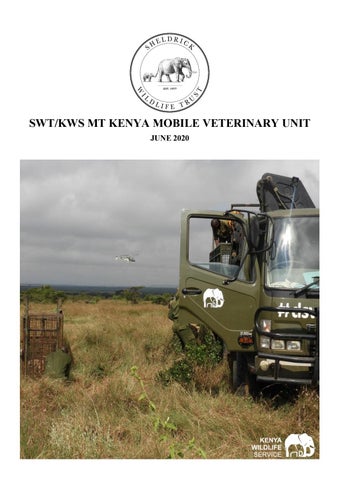
SWT/KWS MT KENYA MOBILE VETERINARY UNIT JUNE 2020
Introduction
14 Cases in June
3 Poaching Cases
4 Elephant Cases
June Report by Dr. Domnic Mijele During June, 2020, the Mt Kenya Wildlife Veterinary unit attended to wildlife cases that required urgent veterinary intervention in the Laikipia ecosystem and Mt. Kenya region. The wildlife cases attended to included the capture and relocation of a leopard, de-snaring of an eland, post-mortem examination of an elephant that died of electrocution, rescue of a female elephant stuck at Ontulili forest, treatment of bongos with diarrhoea, emaciation and submandibular oedema and two post-mortems of bongo at Mt Kenya Wildlife Conservancy, capture and translocation of a rogue lion from Nanyuki game ranch to Meru, capture and translocation of problem lions from Solio Conservancy, post-mortem of a baby white rhino, treatment of a female reticulated giraffe and treatment of two elephants. Acknowledgement We acknowledge continued and long-term support from Sheldrick Wildlife Trust (SWT), KWS and wildlife Conservancies for their support that has enabled the Mt Kenya veterinary unit team to respond promptly to reported wildlife cases that required intervention.
SWT/KWS Mt Kenya Mobile Vet Unit Treatment Locations June 2020
Case Details Date
Species
Area Found
Reason for Intervention
05-Jun-20
Leopard
Mount Kenya NR
Relocation
07-Jun-20
Eland
Sangare Ranch
Snared
07-Jun-20 Elephant
Meru Environs
HWC
09-Jun-20 Elephant
Ontulili Forest
Outcome
A leopard was predating on bongo calves
Task Successful
Had a tight long wire snare around the left hind leg An elephant was accidentally electrocuted on an electric fence
Successfully Treated
Rescue
Found stuck in a muddy area
Task Successful
HWC Death
10-Jun-20
Bongo
Mount Kenya NR
Natural Causes
Signs of weakness, diarrhoea, poor body condition, rough hairs, and oedema
Successfully Treated
11-Jun-20
Bongo
Mount Kenya NR
Postmortem
Signs of weakness, diarrhoea, poor body condition, rough hairs, and oedema
Died
12-Jun-20
Lion
Nanyuki Game Ranch
HWC
A lion had been involved in livestock predations and was a threat to humans
Task Successful
14-Jun-20
Bongo
Mount Kenya NR
Natural Causes
The animal had a swelling caused by a fight with other bongo
Successfully Treated
14-Jun-20
Bongo
Mount Kenya NR
Postmortem
This animal had difficultly calving
Died
15-Jun-20
Lion
Solio Ranch
HWC
The lion population were preying on livestock
Task Successful
15-Jun-20
Rhino White
Solio Ranch
Postmortem
A one-week old white rhino calf was killed by hyenas and jackals
Died
25-Jun-20
Giraffe
Loisaba Ranch
Natural Causes
An adult female giraffe was limping and had an open wound on the right front leg
Successfully Treated
25-Jun-20 Elephant
Loisaba Ranch
Bullet
Had a deep penetrating bullet wound
Prognosis Poor
27-Jun-20 Elephant
Ol Pejeta Conservancy
Bullet
The elephant had had a deep penetrating wound that extended into the knee joint
Prognosis Poor
.
Case 1 – 5th June 2020 Leopard
Relocation
Mount Kenya National Reserve
This was an adult male leopard that was trapped in the Mt Kenya Wildlife Conservancy Bongo sanctuary forest
Immobilisation and relocation This leopard was found to be preying on mountain bongo calves which are an endangered species. It was decided to bait and trap the leopard in a cage then it translocate and release it in the Noromoru side of the same Mt Kenya forest ecosystem. It was examined in the cage and found to be in good health and good body condition hence did not require immobilization. Prognosis The leopard was successfully released and should do well in its new habitat.
Case 2 – 7th June 2020 Eland
Snared
Sangare Ranch
This was a case of an adult female eland at Sangare ranch which had a tight wire snare around the left hind leg, the wire was quite long and the animal was irritated as it was dragging along as it walked in the thick vegetation. This required urgent veterinary intervention to save the eland from pulling the long wire.
Immobilisation and relocation The eland was darted using 7mgs of etorphine Hcl combined with 50mgs of azaperone and it became immobilized and recumbent after about 6 minutes. The wire had not inflicted any injury and it was gently removed and the animal quickly revived from anaesthesia. Prognosis As the snare hadn’t caused any injury the prognosis is good and the eland should return to a normal life in the wild.
Case 3 – 7th June 2020 Elephant
Human-wildlife Conflict
Meru Environs
This was an adult male elephant that strayed out of the Imenti forest into the villages and was accidentally electrocuted on an electric fence in one of the homesteads. Post-mortem examination Both the tusks were intact and were recovered by the KWS security teams in the area. The case is under investigation by KWS and the Kenya Power and Lightning Company on use of high voltage fence lines near a wildlife conservation area Cause of Death Electrocution due to human-wildlife conflict.
Case 4 – 9th June 2020 Elephant
Rescue
Ontulili Forest
This was a case of a sub-adult female elephant found stuck in a slippery muddy area in Ontulili forest, Mt Kenya. It had struggled to rise up for 6 hours unsuccessfully. Rescue Through a combined effort of the Sheldrick Wildlife Trust and KWS Veterinary Teams and Rangers, teams from Mt Kenya Forest and Community Members, the elephant was pulled out of the mud gently using strong straps anchored to the tusks and pulled by a 4-wheel drive land-cruiser. Prognosis The elephant lifted up its head straightened its front legs and slowly stood up from the mud, but it was too weak to walk away and the rear legs were numb. It was put on an intravenous drip of 50% Dextrose solution and after a few minutes it was able to rise up and walked away successfully, feeling relieved but still weak. It is hoped it will make a full recovery.
Case 5 – 10th June 2020 Bongo
Natural Causes
Mount Kenya National Reserve
One of the sub-adult male bongo antelopes was reported to have signs of weakness, lethargy, profuse watery diarrhoea, poor body condition, rough hairs, and sub-mandibular oedema. This required urgent veterinary intervention to treat the animal. It was suspected to have prolonged indigestion and diarrhea caused by malnutrition due to imbalanced feed formula and gastrointestinal parasites. Immobilisation, examination and treatment The bongo was quite weak and lethargic so it was physically restrained by hands. The animal was then treated using oral Trimethoprim sulfonamides, then Procaine penicillin intramuscular injection, Vitamin B12 (Cyanocobalamine) administered intramuscularly, and ivermectin subcutaneous injection. The skin was sprayed with Frontline to eradicate all ectoparasites. Blood, tick and faecal samples were also collected for further laboratory analysis. Prognosis This is an ongoing problem within the Reserve and requires additional management and intervention.
Case 6 – 11th June 2020 Bongo
Post-mortem
Mount Kenya National Reserve
This animal was reported to have signs of weakness, lethargy, profuse watery diarrhoea, poor body condition, rough hairs, and sub-mandibular oedema. It was a young bongo of about 6 months old and had just been weaned. It later collapsed and died while being examined for treatment. Post-mortem examination All the internal organs were healthy and of normal consistency. There was an excessive accumulation of indigested green feeds in all the 4 chambers of the stomach, there were some whitish fatty stuff suspected to be unpalatable browse in the abomasums that could not exit into the intestines and could not be absorbed. It also had Ostertagia ostertagi round worms in the abomasums likely acquired after weaning. Cause of Death This animal died due to prolonged hypoglycaemia that led to unconsciousness and death. The management has since been advised to supplement these animals on quality concentrates and monitor them closely how they feed.
Case 7 – 12th June 2020 Lion
Human-wildlife Conflict
Nanyuki Game Ranch
This was an adult male lion that had been involved in several livestock predation in Nanyuki area and was a threat to human lives as it was staying permanently outside the conservation area. Relocation There was a need to capture the lion and translocate it to a safer area where it would not cause conflict. Several attempts to bait and trap it had failed as it had already learned to evade the traps so it required darting. The lion was darted from a vehicle at night using 350mg of Ketamine combined with 8 mg of Medetomidine and loaded onto a lion cage. The next day it was fitted with a GPS tracking collar and released at Meru National park
Case 8– 14th June 2020 Bongo
Natural Causes
Mount Kenya National Reserve
This was an adult female mountain bongo with a traumatic swelling on the left abdomen that required veterinary intervention. Immobilisation, examination and treatment The bongo was in an enclosure where it was darted with 7mgs of Etorphine Hcl combined with 50mgs of Azaperone. It became immobilized and recumbent after about 6 minutes. The animal had a dried swelling caused by a fight with other bongos which had already started healing. It was treated with Procaine penicillin and Dexamethasone intramuscularly to enhance the healing process. Revival and Prognosis The bongo was revived from the anaesthesia with 12mgs of Diprenorphine and 50mgs of Naltrexone administered through the jugular vein and it rose up after 2 minutes. Prognosis was good and it recovered quite soon after treatment.
Case 9 – 14th June 2020 Bongo
Post-mortem
Mount Kenya National Reserve
This animal had difficult calving at night and it was not sighted until morning when it was found lying dead with a dead foetus stuck on its vulvar. Post-mortem examination Post-mortem examination revealed a dead foetus stuck in the pelvic cavity, it was presenting itself with a wrong posture with head first but both the front legs stuck inside. The shoulder was quite big and could not pass through the vulva. The mother strained for hours to push the foetus out unsuccessfully until it became exhausted and died. Cause of Death This animal died due to difficulty giving birth.
Case 10 – 15th June 2020 Lion
Human-wildlife Conflict
Solio Ranch
The management of Solio Conservancy has complained about the rising lion population and predation of their livestock as well as lions invading the surrounding community areas causing human-wildlife conflict. Several previous attempts to take the lions back into the conservation area has faced challenges as the lions return to the livestock area where they have easy livestock prey. In March 2020, Solio Ranch management officially requested KWS to take action to minimize the crisis. KWS decided to translocate 30 lions out of Solio and take them to Tsavo ecosystem and Meru National parks to ease the lion carrying capacity. The Solio lion translocation was conducted jointly in collaboration by KWS, Sheldrick Wildlife Trust, and Solio Conservancy to resolve the rampant human-lion conflicts in the area. Immobilisation and relocation Prior to the capture operation an aerial recce of the ranch using a helicopter and fixed wing aircraft was conducted to locate and identify the lion prides outside the Solio Conservation Area. The lions were darted both from the helicopter and from the ground depending on the terrain and the nature of the pride. The two methods were combined in order to maximize the number of lions captured daily with minimum disruption of the pride structures. The lions were chemically immobilized using Ketamine at 420 - 450mgs and Medetomidine 6-8mgs for all the adult individuals while a dose of 350mgs Ketamine and 6mgs Medetomidine was used for the sub-adult lions and finally 200mg Ketamine and 4mgs Medetomidine was used for the less than 1 year cubs. Some very young cubs were captured by hand blindfolded and transferred into a cage immediately. Anaesthesia was closely monitored using key vital physiological parameters such as respiration rate, heart rate, temperature and oxygen saturation levels and recorded over the duration of the anaesthesia. The lions were also supplied with oxygen to improve tissue perfusion whilst immobilized. Blood, tissue, hair, tick and faecal samples were collected from all the lions, processed and preserved for disease surveillance and population genetics studies.
The immobilized lions were carefully placed on a canvas stretcher and transferred into the lion cages which were padded with hay on the bottom. They were positioned on lateral recumbency and the patency of the airway maintained by extending the neck and ensuring that the nostrils remained patent. Once safely in the cage, the individuals were then allowed to gradually wake up as the immobilization drugs wore off within about 1 hour to ensure smooth recovery and they were later loaded on to the transport lorry using a crane. The lions were all placed inside the lion cages which were well locked and secured and covered by a canvas to minimize external irritations during the transportation. They were loaded onto a lorry crane and canter then transported during the night, which is cooler, to various destinations. At least one or two lions from every pride that was translocated was fitted with a GPS/GSM collar that will help the area scientists to monitor the lions in their new territories. A post-release monitoring report will be shared once the lions settle down in their new territories. Prognosis The translocation exercise was quite successful and all the targeted 30 lions of various ages and sexes were safely immobilized by helicopter and ground vehicles despite thick bushes, poor terrain and elusive lions. Following this translocation, the lion’s population in Solio has now significantly been reduced from the estimated 70 individuals to 40 individuals and reduced livestock losses due to predation. This exercise mainly targeted lions residing outside the Solio conservation area that are frequently involved in human-wildlife conflict. This population included a large pride on the Western side of Solio and another pride on the Eastern side of Solio. Those two prides were all captured and translocated hence we expect the lions livestock predation cases to decrease to a manageable level.
Case 11– 15th June 2020 White Rhino
Post-mortem
Solio Ranch
A white rhino calf carcass was found and reported to the Unit. Solio Ranch requested a post-mortem to determine the cause of death. Post-mortem Examination Post-mortem revealed a one-week old white rhino calf that was predated on by hyenas and jackals in Solio Conservancy. .
Case 12 – 25th June 2020 Giraffe
Natural Causes
Loisaba Ranch
An adult female giraffe was reported to be limping and had an open wound around the corium on the distal end of the left front leg. The animal was weak and was walking with difficulty. The affected leg was swollen and necrotic and the animal could not put weight on the affected leg. The cause of the injury could not be ascertained but looked like it was caused by a sharp stone on the cliff. Immobilisation, examination and treatment The giraffe was darted from a vehicle using 15mgs Etorphine combined with 50mgs of Azaperone. It took about 10 minutes for the drugs to take effect and the giraffe was roped to the ground by the vet team and the Loisaba team. The giraffe had a wound on the distal end of the left front leg, the leg was heavily swollen and inflamed. The wound was cleaned with water, cauterized and debrided with Hydrogen peroxide and covered with Iodine. Further treatments included application of Opticlox ointment then Oxytetracycline spray. Betamox and Dexamethasone were administered intramuscularly to enhance wound healing. Prognosis The giraffe was revived from the anaesthesia and rose up after 2 minutes and ran into the nearby thicket. Prognosis was good after treatment of the wound.
Case 13 – 25th June 2020 Elephant
Bullet Wound
Loisaba Ranch
This was a case of an adult male elephant sighted within Loisaba Wildlife Conservancy by Security Rangers; it had a deep penetrating wound on the left front leg. The elephant was weak, limping and remained isolated from the rest of the elephant herds. Immobilisation, examination and treatment The injured elephant was found in a thicket forest within Loisaba Conservancy where it was darted from a vehicle with 18mgs of Etorphine. The elephant fell on its left side after about 10 minutes. The elephant had a deep penetrating wound on the distal part of the left front leg, the wound extended anterio-posteriorly into the carpal joint. Some carpal bones were broken and bone crackling sounds were heard when probing the wound with long forceps. It was suspected to be a bullet wound. The wound was cleaned with water, debrided with Hydrogen peroxide and disinfected with Iodine before application of Opticlox ointment. The elephant was also given Amoxicillin Trihydrate (Betamox) and Dexamethasone to support wound healing. The wound was finally packed with green clay and Oxytetracycline spray. Other minor injuries on the upper parts of the leg were sprayed using oxytetracycline spray Prognosis Prognosis was poor due to its inability to move and the possibility of developing arthritis which has poor prognosis in elephants. The Security Rangers will monitor the progress in case it requires repeat treatment.
Case 14 – 27th June 2020 Elephant
Bullet Wound
Ol Pejeta Conservancy
This was a case of an adult male elephant sighted within Ol-Pejeta Wildlife Conservancy in Laikipia by Security Rangers; it had a deep penetrating wound to the left front leg. The elephant was weak, limping and remained isolated from the rest of the elephant herds. Immobilisation, examination and treatment The elephant was found in an open area within the Conservancy where it was darted from a vehicle with 18mgs Etorphine. The drugs took effect in about 8 minutes with the elephant falling on the left side. The elephant had a deep penetrating wound on the distal part of the left front leg, the wound extended into the knee (stifle) joint. The wound was probed with long forceps to remove all the necrotic debris and ensure no foreign material was left inside. It was suspected to be a bullet wound. The wound was cleaned with water, debrided with Hydrogen peroxide, disinfected with iodine then Opticlox ointment was applied. The elephant was also given Amoxicillin Trihydrate (Betamox) and Dexamethasone to support wound healing. The wound was finally packed with green clay and sprayed with Oxytetracycline spray. Prognosis The elephant was revived from anaesthesia but it was unable to rise on its own and it had to be assisted with roped and a vehicle. Eventually it rose up with difficulty and walked away still in a lot of pain. Prognosis was poor due to its inability to move and the possibility of developing arthritis which has poor prognosis.