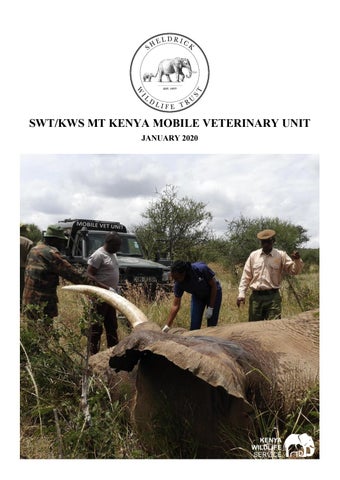
SWT/KWS MT KENYA MOBILE VETERINARY UNIT JANUARY 2020
Introduction
11 Cases in January
3 Poaching Cases
2 Elephant Cases
January Report by Dr. Domnic Mijele During the month of January 2020, the Mt Kenya Wildlife Veterinary Unit attended to cases that required intervention in the Laikipia Ecosystem and Mt. Kenya Region. Some of the wildlife cases attended to include treatment of an bull elephant in Tsavo, post-mortem examination of a black rhino in Ol Pejeta Wildlife Conservancy, treatment of an injured leopard near Nyeri, treatment of a bull elephant at Mpala Wildlife Conservancy, removal of a snare from a waterbuck in Mt Kenya National Park, treatment of a Grevy�s zebra with an injured hoof in Rumuruti and four separate bongo cases at Mt Kenya Wildlife Conservancy Acknowledgement The Unit acknowledge Sheldrick Wildlife Trust (SWT), KWS and other partners for their support that has enabled the Mt Kenya Veterinary Unit Team to respond promptly and offer medication to all wildlife cases that required veterinary intervention during the month.
Case Details Date Date
16-Jan-20 16-Jan-20 17-Jan-20 17-Jan-20 18-Jan-20 18-Jan-20 20-Jan-20 20-Jan-20 20-Jan-20 20-Jan-20 23-Jan-20 23-Jan-20 26-Jan-20
Species Species
Elephant
Area Found Area Found Kaluku,
Tsavo Kaluku, Elephant Mt Tsavo Kenya Bongo Game Ranch Mt Kenya Bongo Rhino Ol Pejeta Game Ranch Black Conservancy Rhino Ol Pejeta Sirikoi, Black Conservancy Giraffe Laikipia Sirikoi, Giraffe Nyeri, Laikipia Leopard Laikipia Nyeri, Leopard Laikipia Elephant Mpala Ranch
Mpala Ranch Mt Kenya Game Ranch Mount 26-Jan-20 Bongo Kenya Game Mt Kenya 26-Jan-20 Bongo Ranch Game Ranch MtMount Kenya 26-Jan-20 Bongo Kenya Game 27-Jan-20 Waterbuck National Ranch Park Mount Mt Kenya 28-Jan-20 Bongo 27-Jan-20 Waterbuck Kenya Game Game Ranch Ranch Rumuruti, Mount 29-Jan-20 Zebra Laikipia 28-Jan-20 Bongo Kenya Game Ranch 29-Jan-20
Elephant Bongo
Zebra
Rumuruti,
Reason for Intervention
Outcome
Reason for Intervention Two deep wounds on the left side of the abdomen caused by an arrow Two deep wounds on the left side of the Arrow Natural Reported to have poor body abdomen caused by ancondition, arrow Causes rough hairs and diarrhoea Natural Reported to have poor body condition, PostPost-mortem several lacerative Causes roughrevealed hairs and diarrhoea mortem wounds caused by a territorial fight PostPost-mortem revealed several lacerative Technical on the Sirikoi/SWT stockades built mortem Checking wounds caused by a territorial fight Case for hand raised giraffe Kiko Technical Checking on the Sirikoi/SWT stockades built Leopardfor thathand wasraised trapped in a University Cases giraffe Kiko Snared compound due to human-wildlife conflict Leopard that was trapped in a University Snared Natural The elephantdue hadtoahuman-wildlife sharp stone piercing compound conflict Causes deep through the centre of the foot pad Natural The elephant had a sharp stone piercing Natural Reported to have body condition, Causes deep through thepoor centre of the foot pad Causes rough hairs and diarrhoea Natural Reported to have poor body condition, PostAn adult male bongo antelope was found Causes rough hairs and diarrhoea mortem dead in one of the enclosures
Outcome Successfully Treated Successfully Successfully Treated Treated Successfully Treated Died
Post- A snare An adult bongo antelope was found had male cut through the foot around the Snared mortem dead in one of the enclosures coronary band just above the hoof
Successfully Died Treated
Arrow
Died Task Successful Task Taken to Successful Orphanage Taken to Successfully Orphanage Treated Successfully Successfully Treated Treated Successfully Treated Died
Natural Reported to have poor body weak A snare had cut through thecondition, foot around the Successfully Successfully Snared Causes and band havingjust diarrhoea Treated coronary above the hoof Treated Natural The animal had a splintered hoof of the right Successfully Natural hind Reported to was havebleeding poor body weak Successfully Causes leg that andcondition, quite painful Treated Causes and having diarrhoea Treated Natural
The animal had a splintered hoof of the right
Successfully
SWT/KWS Mt Kenya Mobile Vet Unit Treatment Locations January 2020
. Case
1 – 16th January 2020
Elephant
Arrow
Kaluku, Tsavo Ecosystem
An adult male elephant in Kaluku, Tsavo had two deep wounds on the left side of the abdomen suspected to have been caused by an arrow. The elephant was in pain and the wounds had become infected with lots of pus and necrotic debris. This required urgent treatment to save it from pain and suffering. Immobilisation, examination and treatment The injured elephant was found in a bushy area where it was approached by a helicopter and darted with 18mgs of Etorphine. The elephant was immobilized after 5 minutes and went down on lateral recumbency. The two wounds were probed to remove all the necrotic debri and pus, then cleaned with copious amounts of water, debrided with dilute Hydrogen peroxide, cleaned with tincture of Iodine before Chlortetracycline pessaries were inserted into the wounds. The wounds were further treated with Opticlox ointment applied topically, as well as Oxytetracycline spray, then green clay was packed into the wound. The elephant was also given an intramuscular injection of Amoxicillin Trihydrate (Betamox) and Flunixin meglumine to support the wound healing process. Prognosis Prognosis was good after treatment and the elephant was expected to make good recovery.
Case 2 – 17th January 2020 Bongo
Natural Causes
Mount Kenya Game Ranch
One of the juvenile male bongo antelopes was reported to have poor body condition, rough hairs and diarrhea in Mt Kenya Wildlife Conservancy. This required veterinary attention to save the animal and collect samples for further laboratory analysis. The juvenile animal was physically restrained by hand for treatment.
Examination and treatment Before treatment, blood samples were collected from the jugular vein in EDTA coated tubes and plain tubes. Skin scrapings were also collected and preserved in 70% Ethanol. Blood smears were prepared and taken to the lab for analysis to establish the cause of infection. The animal was treated with Procaine penicillin (Norocillin) and Vitamin B12 (Cyanocobalamine) administered intramuscularly as well as an Ivermectin subcutaneous injection. The skin was sprayed using Frontline to eradicate all ectoparasites. Prognosis Prognosis was good after treatment and it has since recovered from the infection.
Case 3 – 18th January 2020 Black Rhino
Post-mortem
Ol Pejeta Wildlife Conservancy
This report describes a post-mortem examination of a male black rhino that was engaged in a fierce territorial fight with another dominant male in Ol Pejeta Wildlife Conservancy. The rhino had been attacked frequently by the other male and had sustained several lacerative wounds all over the body. On the 17th January, 2020 this rhino was engaged in a prolonged fight over night that was fatal and it succumbed the next day, just before it was to be relocated to another area. General Examination Post-mortem revealed several lacerative wounds over most of the body including a very deep wound to the left mandible extending into the oral cavity. The entire perineum and penile shaft were severely wounded and the penis urethra was blocked due to inflammation hence the animal could not urinate leading to urine accumulation in the bladder causing urogenital infection. The animal suffered from extensive hemorrhage and loss of blood leading to anaemia and hypovolemic shock. There were several blunt injuries to the left rib cage caused by hard impact from the fight leading to physical injuries to the lungs and heart exhibited by extensive haemorrhages on the lungs and liver. It also had a deep wound on the left knee (stifle) joint causing a dislocation and subluxation of the stifle joint. The rhino was quite emaciated, dehydrated and anaemic following prolonged repeated fights in the wild. Cause of Death The rhino died of anaemia caused by acute loss of blood overnight and prolonged urine accumulation in the urinary bladder that led to urogenital infection and septiceamia caused by several other injuries on the body.
Case 4 – 20th January 2020 Giraffe
Technical Case
Sirikoi Wildlife Conservancy
Kiko is an adult male giraffe that was rescued from Laikipia in 2015 when he was just a week old. He was taken to the Sheldrick Wildlife Trust (SWT) orphanage where he was raised, but he is now ready for release back to the wild since he is fully grown. Release Site The most appropriate identified release site is Sirikoi Wildlife Conservancy within Lewa. Sirikoi has adequate habitat and water for giraffes and has another hand reared female reticulated giraffe named “Nditu” who will be a companion for Kiko. Sirikoi and SWT have built predator proof stables where Kiko and Nditu will stay at night to safeguard them from lions or hyenas before they are accustomed to the wild and are able to protect themselves. Recommendations The Vet Unit completed an assessment of Sirikoi and found the stockades more than adequate and ready for Kiko’s translocation from Nairobi. The translocation can be undertaken when the rains subside, and the roads are passable. Kiko will be translocated by KWS veterinary and capture officers, working together with SWT personnel to ensure his welfare is well taken care of throughout the process.
Case 5 – 20th January 2020 Leopard
Snared
Nyeri, Laikipia
This was an adult female leopard that was trapped in the Dedan Kimathi University compound in Nyeri. The leopard was constantly involved in human-wildlife conflict and was trapped by KWS personnel to be relocated to a safer area. Unfortunately, it had a tight snare around the carpal joint of the right front leg.
Immobilisation, examination and treatment The leopard was darted at close range in the trapping cage with 100mgs of Ketamine combined with 1.5mgs of Medetomidine. The anaesthesia took effect after about 8 minutes and the leopard became recumbent. The manilla snare was cut off using a blade and the injured leg was treated with dilute Hydrogen peroxide, Lugol’s iodine, Opticlox ointment and Oxytetracycline spray. Further treatments included intramuscular injection with Betamox and Dexamethasone injection. Reversal and Prognosis The leopard was revived from anaesthesia using 15mgs of Atipamezole Hcl intramuscularly and it got up after 10 minutes. The leopard was transferred to the Nairobi Orphanage the next day for further treatment and care. Once the injury has healed, the leopard will be released back into the wild.
Case 6 – 23rd January 2020 Elephant
Natural Causes
Mpala Wildlife Conservancy
This was a case of an adult male elephant sighted within Mpala Wildlife Conservancy by security scouts. The bull was quite weak, could be seen limping and remained isolated from the rest of the elephant herds. Immobilisation, examination and treatment The injured elephant was found in a fairly open area where it was quickly approached and darted from a vehicle with 18mgs of Etorphine. The elephant was adequately immobilized after about 9 minutes and went down on lateral recumbency. The elephant was doused with plenty of water and the eyes were covered with the ear pinna. The trunk was kept patent using a stick and the anaesthesia monitored throughout treatment. The elephant had a sharp stone piercing deep through the centre of the foot pad causing a lot of pain due to the massive weight of the elephant and the animal was unable to walk. The stone was removed using a pair of pliers and there was no bleeding, or any other injury. Prognosis Soon after treatment the elephant was revived from anaesthesia using 48mgs of Diprenorphine through the superficial ear-vein. The elephant rose up with difficulty but then walked away feeling relieved. Prognosis was good as the elephant started walking normally soon after treatment.
Case 7 – 26th January 2020 Bongo
Natural Causes
Mount Kenya Wildlife Conservancy
Another juvenile female bongo was reported to have poor body condition, rough hairs and diarrhea in Mt Kenya Wildlife Conservancy. This required veterinary attention to save the animal and collect samples for further laboratory analysis. Immobilisation, examination and treatment The juvenile animal was physically restrained by hand for treatment. The animal was administered with Procaine penicillin (Norocillin) and Vitamin B12 (Cyanocobalamine) intramuscularly. The bongo was also given Ivermectin subcutaneous injection and then the skin was sprayed using Frontline to eradicate all ectoparasites. Prognosis Prognosis is good following treatment.
Case 8 – 26th January 2020 Bongo
Post-mortem
Mount Kenya Wildlife Conservancy
An adult male bongo antelope was found dead in one of the enclosures, the carcass was still fresh, and a post-mortem examination was required to establish the cause of death. General examination The bongo had a big cyst in the liver parenchyma and several echinococcus cysts on the liver. About 90% of the liver had become necrotic and enlarged so it was no longer functional. Cause of Death Liver dysfunction and bacterial infection of the liver and lungs. Cyst samples collected and preserved in ethanol and lung tissue samples taken to Karatina veterinary laboratories for analysis.
Case 9 – 27th January 2020 Waterbuck
Snared
Mount Kenya National Park
An adult female waterbuck was reported to have a wire snare on both the left front leg and left hind leg at Mt. Kenya National park, near Naromoru gate. The waterbuck could be seen limping and very weak preferring to lie down most of the time. Immobilisation, examination and treatment The waterbuck was darted from a vehicle using 5mgs of Etorphine combined with 40mgs of Azaperone. It was fully immobilized after about 6 minutes and became recumbent for treatment. The manila snare on the front leg was quite tight and had cut through the foot around the coronary band just above the hoof. The snare was quickly extracted from the tissue using long forceps and cut off with a surgical blade. The snare on the hind leg had cut through the muscles creating a septic wound around the foot. The wire snare was cut off using a wire cutter. The resultant wound was then debrided with Hydrogen peroxide and thereafter covered with Iodine, Opticlox Ointment and Oxytetracycline spray. Betamox and Dexamethasone anti-inflammatory drug were administered intramuscularly to enhance the wound healing process. Prognosis The anaesthesia was reversed and the waterbuck rose up feeling much relieved. Prognosis was good.
Case 10 – 28th January 2020 Bongo
Natural Causes
Mount Kenya Wildlife Conservancy
Another juvenile female bongo was reported to have poor body condition, weak and having diarrhea in Mt Kenya Wildlife Conservancy. This required veterinary attention to save the animal. Immobilisation, examination and treatment The juvenile animal was physically restrained by hand for treatment. The animal was administered with Procaine penicillin (Norocillin) and Vitamin B12 (Cyanocobalamine) intramuscularly. The bongo was also given ivermectin subcutaneous injection and then the skin was sprayed using Frontline to eradicate all ectoparasites. Prognosis Prognosis was good following treatment.
Case 11 – 29th January 2020 Zebra
Natural Causes
Rumuruti, Laikipia
An adult female Grevy’s zebra in the Pingwan area near Posta town in Rumuruti was reported to be limping and unable to run or walk. It required urgent veterinary intervention. Immobilisation, examination and treatment The Grevy’s zebra was found a lone in open grassland, isolated from the other zebras, it was weak and moving quite slowly due to the intense pain from the injured leg. The animal was then successfully darted from a vehicle using 5mgs of Etorphine combined with 60mgs of Azaperone tartrate. Examination revealed the animal had a splintered hoof of the right hind leg that was bleeding and quite painful. The splintered hoof was trimmed, and the wound treated with dilute Hydrogen peroxide, Lugol’s iodine and Oxytetracycline spray. The zebra was then administered Flunixin meglumine and Betamox antibiotic as well as Ivermectin. Prognosis After treatment, the anaesthesia was reversed with 12mgs Diprenorphine and 50mgs of Naltrexone through the jugular vein. The zebra rose up after about 2 minutes and walked away feeling relieved.