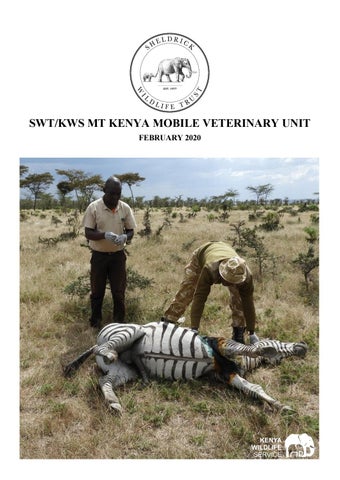
SWT/KWS MT KENYA MOBILE VETERINARY UNIT FEBRUARY 2020
Introduction
12 Cases in February
3 Poaching Cases
67% Success
February Report by Dr. Domnic Mijele During the month of February, 2020, the Mt Kenya Wildlife Veterinary unit attended to many wildlife cases that required urgent veterinary intervention in Laikipia ecosystem and Mt. Kenya region. Some of the wildlife veterinary cases attended to included treatment of several mountain bongo as well as one post-mortem at Mt Kenya Wildlife Conservancy, de-snaring of a Rothschild giraffe, a lion cub with a fractured vertebral column. treatment of an eland, rescue of an elephant stuck in a valley, treatment of an elephant bull with a dislocation of the right carpal joint, desnaring of a zebra, relocation of a hartebeest and examination and euthanasia of a snared zebra at Mawingu area, Mt Kenya forest. Acknowledgement We acknowledge Sheldrick Wildlife Trust (SWT), KWS and other partners for their support that enabled the Mt Kenya veterinary unit team to respond promptly and offer medication to many wildlife cases that required veterinary intervention during the month. This made it possible for the team to respond and save many wildlife cases that required urgent veterinary intervention without which they would not have survived.
SWT/KWS Mt Kenya Mobile Vet Unit Treatment Locations February 2020
Case Details Date
Species
Area Found
Reason for Intervention
Outcome
03-Feb-20
Bongo
Mout Kenya Game Reserve
Natural Causes
One of the bongos had poor body condition, anorexia and watery diarrhoea
Successfully Treated
03-Feb-20
Giraffe
Mwea National Park
Snared
An adult female giraffe had a tight wire snare around the left hind leg
Successfully Treated
05-Feb-20
Lion
Mpala Ranch
Natural Causes
A lion cub was found moribund unable to walk and just crawling on the belly
Died
06-Feb-20
Eland
Maralal Conservancy
Natural Causes
An eland with loss of body condition and heavily infested with ticks
Successfully Treated
08-Feb-20
Elephant
Timau, Mount Kenya
Rescue
An elephant was found stuck in a deep valley in Ngishishi forest
Died
10-Feb-20
Elephant
Segera Ranch, Laikipia
Natural Causes
An adult male elephant sustained a dislocation of the right carpal joint
Successfully Treated
14-Feb-20
Bongo
Mout Kenya Game Reserve
Natural Causes
A one-week old bongo was weak, not suckling and was not in good health
Successfully Treated
19-Feb-20
Zebra
Laikipia
Snared
An adult female zebra had a wire snare cutting around the neck and shoulder
Successfully Treated
19-Feb-20
Bongo
Mount Kenya Game Reserve
Natural Causes
Another bongo was reported to have poor body condition, rough hairs and diarrhoea
Died
25-Feb-20
Hartebeest
Ol Pejeta Conservancy
Relocation
Relocation of a hartebeest from the White rhino enclosure to the main Conservancy
Task Successful
26-Feb-20
Bongo
Mout Kenya Game Reserve
Natural Causes
Another bongo was reported to have poor body condition, rough hairs and diarrhoea
Successfully Treated
29-Feb-20
Zebra
Mount Kenya NP
Snared
A juvenile common zebra had a snare that had cut of the right front leg
Poaching Death
Case 1 – 3rd February 2020 Bongo
Natural Causes
Mt Kenya Game Reserve
One of the sub-adult male bongos was reported to have poor body condition, anorexia and profuse watery diarrhoea in the Mt Kenya Wildlife Conservancy. This required urgent veterinary intervention to save the animal and collect samples for further laboratory analysis. The animal was physically restrained by hand for treatment. Immobilisation, examination and treatment Before treatment, blood samples were collected from the jugular vein in EDTA coated tubes and plain tubes, skin scrapings collected and preserved in 70% Ethanol and blood smears were also prepared. These were taken to the lab for analysis to establish the cause of infection. The animal was then treated using Procaine penicillin (Norocillin) and Vitamin B12 (Cyanocobalamine) administered intramuscularly, plus Ivermectin subcutaneous injection, oral treatment with Diseptoprim tablets and Levamisole de-wormer. The skin was sprayed using Frontline to eradicate all ectoparasites. Prognosis Prognosis was good after treatment it has since recovered from the infection.
Case 2 – 3rd February 2020 Giraffe
Snared
Mwea National Park
An adult female giraffe was reported to have a tight wire snare around the hind-leg in Mwea National Park. The animal was weak, emaciated and could not keep pace with the other giraffes. Rothschild giraffes are an endangered species in Kenya where they were being closely monitored to prevent their extinction in the wild. In Mwea National Reserve there are less than 50 individuals that were introduced some years back and the population has been growing steadily. Immobilisation, examination and treatment The snared giraffe was found with other giraffes next to the road. It was darted from a vehicle using 15mgs of Etorphine Hcl combined with 50mgs of Azaperone. It took about 8 minutes for the immobilization drug to take effect and the giraffe was roped down by the veterinary team assisted by the team at the reserve. The wire snare had cut through the muscles of the left hind leg creating a septic wound around the foot. The wire was quickly retrieved from the tissue using a wire cutter. The wound was then cleaned with water, debrided with Hydrogen peroxide, disinfected with Iodine and sprayed with Oxytetracycline spray. Amoxycillin (Betamox) and Dexamethasone anti-inflammatory drug were also administered. Prognosis Prognosis was quite good after the snare was removed and the wound was adequately treated.
Case 3 – 5th February 2020 Lion
Natural Causes
Mpala Wildlife Conservancy
This was a lion cub that was found moribund and lying next to the mother in Mpala Wildlife Conservancy. It was unable to walk and just crawling on the belly with a lot of pain. It had a complete compound fracture of the vertebral column that had caused paralysis of both the hind legs. The fracture was suspected to have been caused by a prey during hunting. Management The animal was in a lot of pain and had no chances of recovery from the fracture, the veterinary team made a decision to euthanize the cub to help alleviate pain and suffering. It was euthanized using pentobarbitone Hcl (EuthatalÂŽ) administered through the jugular vein and the animal died instantly without struggling.
Case 4 – 6th February 2020 Eland
Natural Causes
Maralal Wildlife Sanctuary
This was a case of an adult female eland with loss of body condition and was heavily infested with ticks in Maralal Wildlife Sanctuary. It required veterinary intervention to examine and treat the animal. Immobilisation, examination and treatment The eland was successfully darted from a vehicle using 7mgs of Etorphine Hcl combined with 50mgs of Azaperone. It took about 5 minutes for the drug to take effect and for the animal to become anaesthetised. The animal was treated using Oxytetracycline and Vitamin B12 (Cyanocobalamine), both administered intramuscularly. The eland was also given an Ivermectin subcutaneous injection. The skin was then sprayed using Frontline to eradicate all ectoparasites. Blood and tick samples were also collected for further laboratory analysis. Prognosis The anaesthesia was revived using 36mgs of Diprenorphine Hcl administered through the jugular vein. The eland rose up after 2 minutes and ran away feeling relieved. Prognosis was good after treatment and the animal has since improved.
. Case
5 – 8th February 2020
Elephant
Rescue
Timau Forest, Mt Kenya
Community Scouts found this adult female elephant found stuck in a deep valley in Ngishishi forest in Timau area. The vet team responded quite fast to rescue it from the valley. Rescue Through a combined effort of Sheldrick Wildlife Trust and KWS veterinary teams as well as rangers from Laikipia and Mt Kenya National Parks the elephant was pulled out of the mud gently using strong straps anchored onto the tusks and pulled by a tractor. Prognosis and Management Unfortunately, it was not able to rise up after several attempts, it was administered with 50% Dextrose i.v but was still not able to rise. Several attempts to help it rise up failed and finally a complete fracture of the left femur was discovered. Due to a grave prognosis, the decision was made to euthanize the elephant and recover the tusks.
Case 6 – 10th February 2020 Elephant
Natural Causes
Segera Ranch, Laikipia
This was a case of an adult male elephant in Segera Ranch that had sustained a dislocation of the right carpal joint. The elephant could be seen limping and dragging the affected leg as it walked with a lot of pain. Immobilisation, examination and treatment The injured elephant was darted from a vehicle using 18mgs of Etorphine Hcl. It was darted in the right thigh muscle and was immobilized after about 7 minutes and going down on lateral recumbency. The affected leg was heavily swollen with no visible wound or any external injury. The leg was examined all round, palpated and flexed to ascertain the cause of limping. It was found to be a dislocation of the carpal joint probably caused when the elephant got stuck in a pit hole or rocky terrain. The elephant was then treated with Vitamin B12 and Calcium (Calciject) followed by Dexamethasone injection and a multivitamin, administered intramuscularly to reduce pain and enhance the recovery process. Prognosis Prognosis was good after medication but the recovery will take time due to heavy weight of the elephant.
Case 7 – 14th February 2020 Bongo
Natural Causes
Mount Kenya Game Reserve
A one-week old infant female bongo was reported to be weak and not suckling as expected. It had not suckled colostrum since birth and was not in good health. Immobilisation, examination and treatment The infant animal was physically restrained by hand for treatment. It was then treated with milk replacers orally until it recovered. Prognosis Prognosis good.
Case 8 – 19th February 2020 Zebra
Snared
Endana, Laikipia
An adult female zebra had a wire snare cutting around the neck and shoulder in the Endana area in Laikipia. Immobilisation, examination and treatment The snared zebra was found alone in an open field but it was quite agitated and quickly ran away when it was approached for darting. The team was able to track it with a vehicle and eventually it was successfully darted from the vehicle with 6mgs Etorphine Hcl combined with 80mgs of Azaperone. The wire had cut through the neck, brisket muscles and through the arm pit causing very deep septic wounds. The wire was immediately cut off using a wire cutter followed by wound treatment. The wounds were cleaned with lots of water, cauterized and debrided with Hydrogen peroxide and thereafter covered with tincture of iodine. Further treatments included application of Opticlox ointment then Oxytetracycline spray. Amoxycillin (Betamox) and Dexamethasone anti-inflammatory were administered intramuscularly to enhance the wound healing process. Prognosis Prognosis was quite good after the wire was removed and the wounds adequately treated.
Case 9 – 19th February 2020 Bongo
Natural Causes
Mount Kenya Game Reserve
Another juvenile female bongo was reported to have poor body condition, rough hairs and diarrhea in Mt Kenya Wildlife Conservancy. This required veterinary attention to save the animal and collect samples for further laboratory analysis. Immobilisation, examination and treatment The juvenile animal was physically restrained by hand for treatment. The animal was treated using Procaine penicillin (Norocillin) and Vitamin B12 (Cyanocobalamine) both administered intramuscularly. The bongo was then given ivermectin subcutaneous injection to treat for parasites. The skin was also sprayed with Frontline to eradicate all ectoparasites. Prognosis The animal later died and post-mortem and laboratory analysis revealed coccidiosis.
Case 10 – 25th February 2020 Hartebeest
Relocation
Ol Pejeta Conservancy
The management of Ol Pejeta Conservancy requested KWS to approve and help to capture and relocate one adult female hartebeest from the White rhino enclosure to the main Ol Pejeta Conservancy so that it can join other hartebeest herds and start breeding. Immobilisation, examination and treatment The hartebeest was darted from a vehicle using 10mgs of Etorphine combined with 50mgs of Azaperone and it became adequately immobilized. It was dowsed with large amounts of water to control the body temperature. The legs were well secured with ropes and it was loaded onto a pick-up van and driven for 5 minutes to the main Conservancy. Blood samples were collected from the jugular vein in EDTA coated tubes and plain tubes for disease surveillance purposes. Prognosis The hartebeest was revived from anaesthesia using 24mgs Diprenorphine combined with 50mgs Naltrexone. She rose up after 2 minutes and released to join the females immediately..
Case 11 – 26th February 2020 Bongo
Natural Causes
Mt Kenya Game Reserve
Another juvenile female bongo was reported to have poor body condition, rough hairs and diarrhea in Mt Kenya Wildlife Conservancy. This required veterinary attention to save the animal and collect samples for further laboratory analysis. Immobilisation, examination and treatment The juvenile animal was physically restrained by hand for treatment.
The animal was treated using Procaine penicillin (Norocillin) and Vitamin B12 (Cyanocobalamine) administered intramuscularly. The bongo was also given an Ivermectin subcutaneous injection to cover for internal parasites. The skin was then sprayed with Frontline to eradicate all ectoparasites. Prognosis The animal should recover well after treatment.
Case 12 – 29th February 2020 Zebra
Snared
Mawingu area, Mt Kenya NP
A juvenile common zebra was reported to have a serious snare injury to the leg. Immobilisation and management Immobilisation was not required as the zebra was already recumbendent. Examination revealed the snare had cut off the right front leg. It was not able to walk and was in severe pain and quite emaciated. It could not recover from the injury and was therefore euthanized using Pentobarbitone Hcl administered through the jugular vein and later disposed.