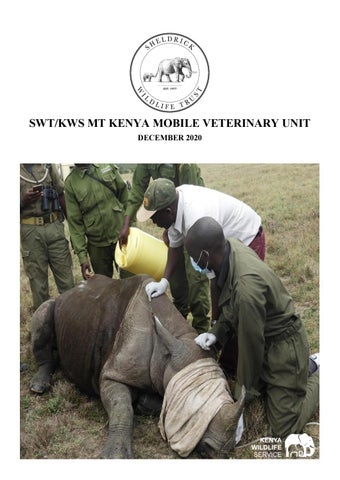
SWT/KWS MT KENYA MOBILE VETERINARY UNIT DECEMBER 2020
Introduction
13 Cases in December
3 Poaching Cases
85% Success
December Report by Dr. Domnic Mijele During December 2020, the Mt Kenya Wildlife Veterinary Unit attended to many wildlife cases that required urgent veterinary intervention in the Laikipia ecosystem and Mt. Kenya region. Some of the wildlife cases attended to included treatment of an elephant with a bullet wound and another two with snares, also snare removal from a zebra, treatment of an eland with an abdominal wound and the rescue of a giraffe stuck in a swamp. In Olpejeta, a Southern White rhino bull needed a vasectomy so it could be used as a teaser bull, oocytes were collected from two Northern White rhinos, the horn was trimmed on a Southern White rhino and a blind rhino was rescued. Other cases included treatment of a bongo with a vaginal prolapse and another with an abscess, translocation of wild animals from Gen. Karangi farm to Ngawa Ranch, Nyeri, capture and wild animals at Mt. Kenya Conservancy to Fairmont Safari Club. Acknowledgement We greatly acknowledge Sheldrick Wildlife Trust (SWT) for their continued support that has enabled the Mt Kenya Veterinary Unit to respond promptly and offer treatment to wildlife cases that required veterinary intervention.
SWT/KWS Mount Kenya Mobile Vet Unit Treatment Locations December 2020
Case Details Species
Area Found
03-Dec-20
Elephant
Mugie Ranch
Bullet Wound
The animal had multiple through and through gunshot wounds on the right fore and hind limbs
Poaching Death
06-Dec-20
Elephant
Ol Jogi Ranch
Snared
Both the elephant’s hind limbs were entangled by a snare
Successfully Treated
08-Dec-20
Eland
Mt Kenya NP
Natural Causes
A contusion and 5-inch puncture wound on the right abdominal flank
Successfully Treated
10-Dec-20
Giraffe
Sangare Ranch
Rescue
Was stuck in the mud in a swamp, up to its shoulders, and was sinking further
Task Successful
11-Dec-20
Bongo
Mt Kenya NP
Natural Causes
12-Dec-20
Rhino White
Ol Pejeta Conservancy
Technical Case
13-Dec-20
Rhino White
Ol Pejeta Conservancy
Technical Case
13-Dec-20
Rhino White
Ol Pejeta Conservancy
Technical Case
The rhinos horn needed to be trimmed
Task Successful
15-Dec-20
Bongo
Mt Kenya NP
Natural Causes
A 3-month-old mountain bongo calf, had a large swelling/abscess on its right cheek
Successfully Treated
17-Dec-20
Antelope
Karangi Farm, Abedares
Relocation
19-Dec-20
Antelope
Mt Kenya NP
Relocation
21-Dec-20
Zebra
Mt Kenya NP
Snared
There was a nylon snare tight on the leg and there was a large bleeding wound present
Successfully Treated
22-Dec-20
Rhino Black
Ol Pejeta Conservancy
Natural Causes
The rhino was born with good eyesight but it became poorer with age. The animal was also seen to have a poor body condition
Taken to Orphanage
Date
Reason for Intervention
Had a prolapsed vagina shortly after giving birth. The prolapse had been treated but the prolapse reoccurred A mature, Southern white rhino bull was to be prepared for use as a teaser bull for heat detection in a Northern white rhino female Several oocytes collection operations have been undertaken on the only two surviving female Northern White rhinos
The area had been determined to be too small. 6 impala, 2 thompson gazelles and 1 common zebra were to be moved 6 zebras, 3 elands, 5 waterbuck, 10 impala and 4 reed buck were moved to the Fairmont Hotel compound for breeding
Outcome
Successfully Treated Successfully Treated Task Successful
Task Successful Task Successful
Case 1 – 3rd December 2020 Elephant
Bullet Wound
Mugie Ranch
Rangers reported that an adult bull elephant was unable to walk and feed properly, and was noted to have had possible multiple gunshot wounds. The veterinary team was urgently called upon to assess and treat the animal. Immobilisation, examination and treatment The elephant was darted from a vehicle at 12:33pm using 17mg Etorphine hydrochloride. The drug took effect after 8 minutes and the animal went down on left lateral recumbency. The animal had multiple wounds on the right fore and hind limbs. There was also a through-and-through, subcutaneous wound at the back of the animal. All the wounds appeared as gunshot wounds and presence of necrotized tissues indicated that the wound was not fresh. The right fore and hind limbs were swollen, and the elephant was unable to move. Post-mortem The prognosis for a full recovery was grave as the animal had suffered multiple wounds and extent of internal damage could not be determined. The animal was euthanized to relieve him from pain and suffering. On opening of the right forelimb there was a deep wound on the medial areas of the limb. The wound had necrotizing myositis. It was clear that the gunshot was from a height above the animal. Unfortunately, no pictures are available for this case.
Case 2 – 6th December 2020 Elephant
Snare
Ol Jogi Conservancy
A sub-adult female elephant was reported to be having difficulty walking and was to be shuffling her feet. On closer inspection, rangers noticed that both the elephant’s hind limbs were entangled by a snare. Immobilisation, examination and treatment The elephant was darted with 16mgs Etorphine hydrochloride, delivered using a Dan-Inject CO2 rifle, fired from foot. The dart was delivered to the musculature of the left rump. The elephant fell onto sternal recumbent and was immediately rolled to right lateral recumbency. On examination it was noted that the snare had tangled around both hind limbs. The snare was removed with wire cutters and the animal assessed for any injuries and damage caused by the snare. There were no notable wounds or injuries to the musculo-skeletal system. Prognosis The prognosis is good as the snare had not caused any injuries and the elephant happily walked away without any indication of trauma. The snare was causing a lot of discomfort and obstructing the elephant’s free movement
Case 3 – 8th December 2020 Eland
Natural Causes
Mt Kenya Wildlife Conservancy
An adult female eland was reported to be limping and walking in discomfort, with an injury reportedly seen on the right abdominal flank. Immobilisation, examination and treatment The animal was darted from foot with 8mgs Etorphine hydrochloride combined with 40mgs Azaperone tartate. The animal was recumbent within 11 minutes. 100mgs of Ketamine was administered intravenously to calm the animal down and for better immobilization. On assessment, it was noted that there was a contusion and puncture wound on the right abdominal flank. The puncture was approximately 5 inches deep into subcutaneous tissue. The injury was also noted to possibly extend to the abdominal muscles. There was also severe inflammation and edema seen. The animal was noted to be pregnant and in 3rd trimester. The wound was cleaned with 10% Hydrogen peroxide, Iodine, and Oxytetracycline spray. Opticlox® ointment was also applied to the wound. For systemic antibiotic cover, 30ml of Penicillin was injected intramuscularly and meloxicam given as an anti-inflammatory Prognosis The prognosis was good after treatment. Exploratory abdominal surgery was indicated if there was no progress and improvement even after the animal had given birth.
Case 4 – 10th December 2020 Giraffe
Rescue
Sangare Conservancy
An adult female giraffe was reported to have gotten stuck in the mud in a swamp, up to its shoulders, and was sinking further due to the unstable, watery ground. The animal had attempted to free itself but failed and was lying in exhaustion.
Rescue Operation The giraffe had sunk up to its shoulders. It was decided that chemical immobilization was not warranted because the animal was already fatigued and use of immobilizing drugs would deteriorate its condition as giraffes are very sensitive to anaesthesia. Ropes were carefully positioned on the neck and body of the animal and all personnel helped to pull the animal out of the mud. The animal was dragged out of the mud and lay on sternal recumbency, recovering for 6 minutes then finally getting up and walking away. Prognosis Prognosis was good as the animal was just exhausted but had no wounds or broken bones.
.
Case 5 – 11th December 2020 Bongo
Natural Causes
Mount Kenya Wildlife Conservancy
An adult mountain bongo was reported to have a prolapsed vagina shortly after giving birth on 5th November 2020. The prolapse was earlier corrected on the 6th November, 2020. However, on 11th December, 2020 keepers noticed that the prolapse had reoccurred and it required urgent intervention. Immobilisation, examination and treatment The bongo was darted with 4mgs Etorphine hydrochloride combined with 40mgs Azaperone tartate, delivered using a Dan-Inject CO2 rifle, fired from foot. The animal was recumbent, 7 minutes after darting. Local anaesthesia of 2% Lignocaine (5mls) was used to desensitize the area prior to suturing. The protruding tissue was lavaged using sterile normal saline and carefully repositioned and manipulated back to normal position. Once the tissue was in place, reduction and retention was done with a purse string suture using absorbable 2-0 Chromic cat-gut suture. Prognosis The prognosis was good after placing the purse string suture as the vulva was not infected
Case 6 – 12th December 2020 White Rhino
Technical Case
Ol Pejeta Conservancy
A mature, free-ranging Southern white rhinoceros bull was to be prepared for use as a teaser bull for heat detection in Northern White rhino females. The animal had been captured in the wild at the Lewa Conservancy and translocated to the Ol Pejeta Conservancy, where it was housed in a boma.. Immobilisation, examination and treatment The rhino was darted with 15mg Medetomidine, 180mg Butorphanol, 25mg Midazolam and 600mg. Maintenance of the anaesthesia was done by using varying dosages of the drug mixture and plain Ketamine. The anaesthesia protocol was also used so as to prevent respiratory depression associated with opioid use as the procedure was lengthy. A novel method of sterilization known as thermal ablation was used as a non-invasive form of vasectomy to avoid post-operative complications of vasectomy. During the procedure, 15,000mg of Amoxicillin was administered intramuscularly for systemic antibiotic cover 44 mg Flunixine was administered intravenously to help decrease visceral pain. Prognosis The procedure went well as it was minimally invasive, the animal will have less discomfort and will recover.
Case 7 – 13th December 2020 White Rhino
Technical Case
Ol Pejeta Conservancy
Several oocytes collection operations have been undertaken on the only two surviving female Northern White rhinos in Olpejeta, Fatu and Najin and this was a repeat procedure. Prior to the procedure, the animals were injected with 1.5mg Histerine acetate; a follicle stimulating hormone (FSH). This was done three times every other day, to stimulate the follicles for effective oocytes collection. Immobilisation, examination and treatment A non-Etorphine immobilization protocol was used for both animals. The rhinos were darted with 35mg Detomidine, 50mg Butorphanol, 20mg Midazolam and 200mg. Maintenance was done using varying dosages of the drug mixture and plain Ketamine. Oxygen was supplemented throughout the procedure intranasally. The oocytes were harvested from the ovaries using a guided probe under ultrasound guidance. Puncture of the rectal wall and subsequent aspiration of multiple follicles resulted in the recovery of two to nine oocytes. The oocytes were transported to a laboratory in Italy for incubation and fertilization and later on used for embryo transfer to the surrogate Southern White rhinos at Olpejeta to obtain a Northern white rhino calf. Prognosis The animals responded well to anaesthesia and recovered successfully.
Case 8 – 13th December 2020 White Rhino
Technical Case
Ol Pejeta Conservancy
An adult female southern white rhino was to have its horn trimmed to prevent injury to other rhinos. The horns were intact albeit sharp and the rhino would cause injuries to other rhinos in her enclosure. Immobilisation and horn trimming The animal was immobilized using a combination of 180mgs Butorphanol, 25mg Midazolam, 15mg Medetomidine and 300mg Ketamine; a non-Etorphine combination. The rhino was darted using in the left neck muscle. The drug took effect within 2 minutes and the animal was down in sternal recumbency 17 minutes later. 2 minutes after the drugs took effect, the anaesthetic was topped up with 500mg Ketamine intravenously and an additional 10mg Butorphanol to facilitate breathing. The horn was trimmed after the animal was determined to be fully immobilized with ear plugs and a blind fold put into place to prevent stimulation. The horn was trimmed using an oscillating power saw and was thereafter blunted using a file. Reversal and prognosis The anaesthetic was reversed using 15mg Atipamazole (10mls intravenously and 10mls intramuscularly) and 360mg Naltrexone given intravenously through the superficial ear-vein. The animal was up 2 minutes later and was monitored for an hour to assess the metabolism of the Ketamine as it has no reversal. Unfortunately, there are no pictures available for this case.
Case 9 – 15th December 2020 Bongo
Natural Causes
Mount Kenya Wildlife Conservancy
Baringo, a 3-month-old female mountain bongo calf, was spotted by animal keepers with a large swelling on its right cheek. The swelling was noted to be an abscess growing larger as the days passed by and required urgent intervention to save the animal Immobilisation, examination and treatment The bongo was darted with 1mgs Etorphine hydrochloride combined with 10mgs Azaperone tartate, delivered using a Dan-Inject CO2 rifle from foot. The drug took effect 5 minutes after darting. The swelling was first examined and determined to be an abscess. It was shaved, disinfected, lanced and drained. Thereafter, the wound was debrided using Hydrogen peroxide (10%) and disinfected with Iodine for topical antibiotic cover. Dexamethasone was administered for pain relief and to decrease inflammation. It was further treated using Amoxicillin intramuscular injection. Prognosis Prognosis is favourable as the abscess was managed in time and the animal is young and healthy. The keepers were advised to ensure the animal is monitored for at least a week to assess the recovery process.
Case 10 – 17th – 18th December 2020 Antelope
Relocation
Karangi Farm
From 17th – 18th December 2020, animals were moved from the Conservancy to the Fairmont Hotel. The area they were in at Gen. Karangi farm had been previously assessed and determined to be too small for the stock of animals, and not a conducive environment. Therefore, the animals were to be moved to a larger section of Ngawa Ranch with adequate space, vegetation and water to enhance their breeding. The following animals were translocated: 1 male common zebra, 6 impalas and 2 Thompson gazelles. Immobilisation and relocation The impalas and the Thompson gazelle were captured easily using nets set up around the vegetation. They were then disentangled and loaded into the translocation truck. The zebra was darted from foot with 6mgs Etorphine hydrochloride combined with 80mgs Azaperone tartate. Prior to darting, the zebra had run into a fence and had some superficial lacerations, which were treated with Oxytetracycline spray and 10ml of Oxytetracycline given intramuscularly for systemic antibiotic cover. Release The animals were then loaded and transported to the release site. The zebra’s anaesthetic was reversed at the site and the other animals were all released from the truck and are doing well in their new environment.
Case 11 – 19th – 22nd December 2020 Antelope
Relocation
Mount Kenya Wildlife Conservancy
From 19th to 22nd December 2020, animals were moved from the Conservancy to the Fairmont Hotel compound to enhance breeding. The area had been previously assessed and determined that it was suitable for the animals. The following animals were translocated: 6 Common zebras (4 females and 2 males), 3 elands (1 male and 2 females), 5 waterbucks (3 females and 2 males), 4 reedbucks (2 females and 2 males) and 10 impalas (3 males and 7 females). Immobilisation and relocation Due to their large size, physical restraint was not possible so zebras, elands, waterbuck and reedbucks were chemically immobilized using 5mgs Etorphine/80mg Azaperone, 8mgs Etorphine/50mgs Azaperone, 6mgs Etorphine/30mgs Azaperone and 3mgs Etorphine/20mgs respectively, then the anaesthetic was immediately reversed. The impalas were captured using capture nets. Herds were carefully driven into nets where they got entangled and personnel quickly untangled them and loaded them into the moving truck. Release The animals were carefully driven in the moving truck and released at the new site with the veterinary team ensuring that all animals were not injured and were in good condition upon release. All the selected animals were healthy and in good body condition.
Case 12 – 21st December 2020 Zebra
Snare
Mount Kenya National Park
A male, adult zebra was reported to be limping with a snare noted to be tied around its leg. On assessment, the zebra was noted to be slow moving and in a great deal of pain. Immobilisation, examination and treatment The zebra was darted from a vehicle with 6mgs Etrophine hydrochloride combined with 80mgs Azaperone tartate, delivered using a Dan-Inject CO2 rifle. The zebra was recumbent 7 minutes after darting. There was a nylon snare tight on the leg and this had caused trauma as there was a large bleeding wound present. The snare was cut off and the wound cleaned with Hydrogen peroxide (10%) and Iodine for topical antibiotic cover. 20mls of Amoxicillin was administered intra-muscularly for systemic antibiotic cover and 10mls of Dexamethasone to decrease inflammation and pain relief. Opticlox® ointment and topical Oxytetracycline spray was also applied. Prognosis The prognosis is good as the wound was not deep and the animal is expected to recover fully.
Case 13 – 22nd December 2020 Black Rhino
Rescue
Ol Pejeta Conservancy
A young female black rhino was spotted alone without her mother roaming anxiously in circles. The rhino was born with good eyesight but rangers noted that it became poorer with age and could now possibly be blind. The animal was also seen to have a poor body condition. Immobilisation, examination and treatment The rhino was darted with 3.5mgs Etrophine combined with 50mgs Azaperone. Oxygen was supplemented to aid in respiration. 10mg of Butorphanol was administered intravenously to aid with respiration. A further 10mg was topped up after about 7 minutes. Blood samples were collected for immediate and future studies including CBC (Complete blood count) to assess the status of the animal. The crate was placed in front of the rhino with the head lifted slightly into the crate. The anaesthetic was reversed and ropes were then used to safely guide the rhino into the crate. The crate was then closed and loaded onto a truck for transportation to a predator free enclosure 5kms away within the Conservancy. Prognosis The rhino was safely transported to the boma and released. The site had been assessed to ensure it would be able to accommodate the animal. The animal will be monitored continuously to ensure she adapts well to the new environment and will be able to relax and eventually gain an improved body condition.