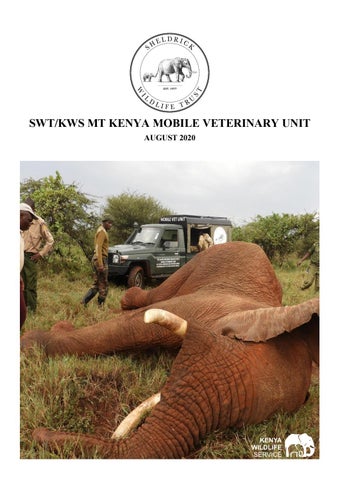
SWT/KWS MT KENYA MOBILE VETERINARY UNIT AUGUST 2020
Introduction
16 Cases in August
2 HWC Cases
4 Elephant Cases
August Report by Dr. Domnic Mijele During August 2020, the Mt Kenya Wildlife Veterinary unit attended to 16 wildlife cases that required urgent veterinary intervention in the Laikipia ecosystem and Mt. Kenya region. The Unit conducted post-mortem examinations of 2 elephants; one that died from natural causes and another from a gunshot wound likely caused during human-elephant conflict, as well as de-snaring of a common zebra, treatment of a wounded grevy zebra, rescue and relocation of a Colobus monkey and a spotted hyena in Nanyuki, treatment of three mountain bongo’s at Mt Kenya Wildlife Conservancy, treatment of two injured elephants, collection of oocytes from two endangered Northern White rhinos, euthanasia of a giraffe with a fracture, treatment of a giraffe with laminitis and the post-mortem of a white rhino in Solio Wildlife Conservancy. Acknowledgement Many thanks to Sheldrick Wildlife Trust (SWT) for their continued support that has enabled the Mt Kenya veterinary unit team to respond and offer medication to all cases that required veterinary intervention.
SWT/KWS Mt Kenya Mobile Vet Unit Treatment Locations August 2020
Case Details
.
Date
Species
Area Found
Reason for Intervention
Outcome
01-Aug-20
Elephant
Mutara Ranch
Postmortem
Cause of death was suspected to be either poisoning but most likely anthrax
Died
01-Aug-20
Zebra
Rumuruti, Laikipia
Snared
The wire snare was tight and made a deep cut and severe swelling around the neck
Successfully Treated
02-Aug-20
Colobus Monkey
Nanyuki, Laikipia
Relocation
On top of a building in Nanyuki and required relocating back to the Mt Kenya Forest
Task Successful
07-Aug-20
Elephant
Ol Donyo, Laikipia
HWC
A gunshot that broke the leg bone. Suspected human-elephant conflict
HWC Death
08-Aug-20
Bongo
Mount Kenya NR
Natural Causes
Treated many times as it was losing body weight, had diarrhoea and pneumonia
Successfully Treated
09-Aug-20
Elephant
Oldonyiro, Samburu
Natural Causes
The affected left leg was swollen and inflamed; it had no external injury
Successfully Treated
09-Aug-20
Hyena
Nanyuki, Laikipia
HWC
A hyena had preyed on livestock near Nanyuki town and needed to be relocated
Task Successful
11-Aug-20
Elephant
Naibunga Conservancy
Natural Causes
The affected right front leg was swollen and firm, it had no any external injury
Successfully Treated
16-Aug-20
Zebra
Lewa Conservancy
Natural Causes
It had been attacked by a lion and severely wounded
Successfully Treated
17-Aug-20
Rhino White
Ol Pejeta Conservancy
Technical Case
Assisted reproduction; an ovum is collected for in-vitro fertilization
Task Successful
19-Aug-20
Bongo
Mount Kenya NR
Natural Causes
Suffering from helminthosis; particularly trichuris infection
Successfully Treated
23-Aug-20
Zebra
Lewa Conservancy
Natural Causes
A dislocation of the tarsal joint; it had been treated and showed good signs of recovery
Successfully Treated
23-Aug-20
Giraffe
Loisaba Ranch
Natural Causes
A complete mid-shaft closed fracture of the right metacarpal bone
Died
28-Aug-20
Bongo
Mount Kenya NR
Postmortem
Signs of diarrhoea and emaciation caused by helminthosis
Died
29-Aug-20
Giraffe
Leparua Conservancy
Natural Causes
It was a dry swelling. There were some cracks that had caused an inflammation
Successfully Treated
31-Aug-20
Rhino White
Solio Ranch
Postmortem
The carcass was already decomposed, lying in a small dry water pool
Died
Case 1 – 1st August 2020 Elephant
Post-mortem
Mutara Ranch
KWS in Laikipia and Rangers from Rumuruti informed the veterinary team of a dead adult male elephant. Post-mortem examination The carcass was about 4 days old and the cause of death was suspected to be either poisoning or anthrax. • • •
The carcass was about 4 days old and had already started decomposing It was found lying on sternal recumbency and with no signs of struggle or injury The tusks had already been removed by the KWS rangers and taken for safe custody
• • •
Black tarry non clotting blood was seen oozing from the anus and mouth The carcass was heavily bloated and not eaten by scavengers It was immediately suspected to have died suddenly of anthrax infection or poisoning
Blood smears were collected from the anus and mouth and fixed in ethanol; the samples were immediately delivered to Karatina Veterinary investigation laboratories to confirm the anthrax diagnosis. Cause of death Unfortunately, the samples were inconclusive and cause of death could not be determined.
Case 2 – 1st August 2020 Zebra
Snared
Rumuruti, Laikipia
An adult male zebra was reported to have a wire snare hanging around the neck which was cutting through the neck muscles both on the dorsal and ventral parts of the neck. Immobilisation, examination and treatment The snared zebra was found in an open field with many other zebras, the team was able to quickly track it with a vehicle and eventually it was successfully darted with 6mgs of Etorphine and 80mgs of Azaperone. It took about 5 minutes for the drug to take effect and it became recumbent. The wire snare was quite tight and had made a deep cut and severe swelling around the neck. The zebra was in severe pain as the wire continued to cut through the neck any time the animal moved. The snare had caused a large and deep septic wound. The wire was removed and the septic wound cleaned with water, cauterized and debrided with 10% Hydrogen peroxide then covered with Iodine. Further treatments included application of Opticlox ointment and Oxytetracycline spray. The zebra was also administered with Amoxycillin and Dexamethasone anti-inflammatories to enhance wound healing process. Prognosis Prognosis was good after the wire was removed and the wound adequately treated.
Case 3 – 2nd August 2020 Colobus Monkey
Relocation
Nanyuki Town, Lakipia
An adult male Colobus monkey was seen on top of a tall building in Nanyuki town. It was not clear where the animal came from but it may have been fought by other dominant males and chased away from the nearby Mt Kenya forest. It was shy and not approachable. After along chase it entered a new building in the surbubs of Nanyuki town where it was left to spend the night due to darkness. Rescue The next day it was tracked for several hours on top of the building and finally it was darted after about 2 hours. It was darted when it entered a wardrobe in one of the bedrooms of the building. It was anaesthetised with 70mgs of Ketamine Hcl combined with 0.5mgs of Medetomidine. The drug took effect after about 5 minutes and the animal was captured and put into an animal cage. Relocation Later it was taken to Mt Kenya forest in Mawingu area and released into a very good habitat with other Colobus monkeys nearby.
Case 4 – 7th August 2020 Elephant
Human-wildlife conflict
Oldonyo Lemporo Conservancy
This was a sub-adult male elephant that was found dead in Oldonyo Lemporo Wildlife Conservancy. Post-mortem examination The carcass was already decomposed and partly scavenged by predators. All the internal organs including the liver, lungs and intestines were already decomposed. Both the tusks were intact and were retrieved and stored at KWS Rumuruti station. The left front leg was swollen and it had a gun-shot wound that broke the humerus bone of the left front leg. It was suspected to have been shot due to human-elephant conflict in the area Cause of death The elephant died of the gunshot wound that fractured the humerus bone.
Case 5 – 8th August 2020 Bongo
Natural Causes
Mount Kenya Wildlife Conservancy
This was a sub-adult male bongo called Dol dol, that had been treated many times since 2019 after losing body weight, having profuse diarrhea and anorexia. During August 2020, it was attended to and treated on the 8th, 16th and 22nd for diarrhea and emaciation caused by helminthiasis. It also had stunted growth and rough hair coat. Immobilisation, examination and treatment It developed signs of acute pneumonia/respiratory infection and became extremely weak, it was physically restrained by hands and treated with antibiotics and Dexamethasone, as well as oral Fenbendazole and Ivermectin injection subcutaneously. It was then taken to an in-house nursery with an electric heater and hay-padded floor for further treatments and health monitoring. While in the nursery it was fed with Lucerne, pellets, mineral licks and water adlibitum. Faecal and blood samples were also collected for worm eggs counts and haemotology tests. Prognosis Prognosis was good as it made remarkable improvements.
Case 6 – 9th August 2020 Elephant
Natural Causes
Oldonyiro, Samburu
This was a case of an adult male elephant in Oldonyiro Tinkai Nanapa area that had sustained a dislocation of the right elbow joint of the right front leg. The elephant could be seen limping and dragging the affected leg as it walked with a lot of pain in a bushy area.
Immobilisation, examination and treatment The injured elephant was immobilized by darting from a vehicle with 17mgs of Etorphine Hcl. It was darted in the right thigh muscle and was immobilized after about 5 minutes, going down on lateral recumbency. The affected left leg was palpated and flexed to ascertain the cause of the limping; it was swollen and inflamed, it had no wound or any external injury to the affected leg. The elephant was then treated with an adequate dose of Vitamin B12 and Calcium (CalcijectÂŽ) followed by Dexamethasone injection, long-acting Amoxycillin and Multivitamin administered intramuscularly to reduce pain and enhance the recovery process. Prognosis Prognosis was favourable after treatment but the recovery will take time due to the weight of the elephant.
Case 7 – 9th August 2020 Hyena
Human-wildlife conflicts
Nanyuki, Laikipia
This was a case of a spotted hyena that had predated on livestock in Umande location a few kilometres from Nanyuki town. Capture and examination KWS security team had taken a trap to the area and the hyena was effectively trapped. The Vet Unit examined the hyena and found it had no injury or any illness. Relocation and Release The following day it was taken and released at Ol pejeta Wildlife Conservancy in a secure place where it will not be able to return to the village.
Case 8 – 11th August 2020 Elephant
Natural Causes
Naibunga Wildlife Conservancy
This was a case of an adult male elephant in Naibunga Wildlife Conservancy that had a painful and swollen carpal joint of the right front leg, it was heavily limping and the cause of the injury was not ascertained. The elephant could be seen dragging the affected leg as it walked with a lot of pain. Immobilisation, examination and treatment The injured elephant was in densely thick bushes where it could not be accessed by a vehicle for darting, it was therefore tracked on foot for several hours and finally we were able to dart it while on foot using 18mgs of etorphine Hcl. It was immobilized after about 5 minutes and went down on lateral recumbency. The affected right front leg was lifted, palpated and flexed to ascertain the cause of the limping; it was heavily swollen and firm, it had no wound or any external injury to the affected leg other than the immense swelling of the distal end of the leg. The elephant was treated with an adequate dose of Vitamin B12 and Calcium (CalcijectÂŽ) followed by Dexamethasone injection and multivitamin administered intramuscularly to reduce pain and enhance the recovery process Prognosis Prognosis was good after medication but the recovery will take time due to heavy weight of the elephant.
Case 9 – 16th August 2020 Zebra
Natural Causes
Lewa Wildlife Conservancy
An adult female Grevy zebra was reported to have been attacked by a lion and severely wounded on the thighs, inguinal region, back and perineum regions. The wounds were quite large and becoming septic hence required urgent attention and treatment to avoid developing septicaemia and possible invasion by maggots. Immobilisation, examination and treatment Grevy’s zebras are highly endangered wildlife species and are only found in Northern Kenya and Ethiopia. Currently there are only less than 2000 individuals remaining in the world and Kenya hosts the largest population about 1,600 (80%) and Ethiopia about 400 (20%). The injured grevy’s zebra was found alone in an open field, it was weak and slow due to intense pain from the many injuries. The veterinary team was able to track it by a vehicle and it was successfully darted with 6mgs Etorphine combined with 80mgs Azaperone. The wounds were not septic but had some loose skin hanging from the wounds. All the bite wounds were cleaned with water, the loose skin trimmed off, cauterized and debrided with Hydrogen peroxide, covered with Iodine, Opticlox ointment then Oxytetracycline spray and green clay. Amoxycillin and Dexamethasone anti-inflammatory drug were administered intramuscularly to enhance wound healing process. Prognosis Prognosis was good after treatment and the zebra has already recovered.
Case 10 – 17th August 2020 White Rhino
Technical Case
Ol Pejeta Conservancy
Northern White rhinos are a highly endangered wildlife species which are currently facing extinction. There are only two females (Najin and Fatuh) left who are already aging and not able to get pregnant naturally. They require assisted reproduction where an ovum is collected using artificial means and in-vitro fertilization is done using stored semen. Then the embryo is implanted into a surrogate mother most likely a southern white rhino who will then give birth to a Northern white rhino calf. This was a joint operation between KWS, Sheldrick Wildlife Trust (SWT), Olpejeta Wildlife Conservancy, Zech republic, and vet experts from Germany. Immobilisation and oocyte collection The two female Northern White rhinos were anaesthetised with Azaperone, Butorphanol, Medetomidine, Ketamine, and Midazolam. The anaesthesia was monitored with a pulse oxymeter, capnometer and recording of respiratory rate, pulse rate, heart rate, body temperature, capillary refill time. More drugs were administered depending on the rate of the above physiological parameters. Oxygen was also supplemented throughout the oocyte collection process that took an average of one and half hours in each animal. The oocytes were collected using a one-meter long probe inserted through the rectum connected to an ultrasound machine screen used to observe the follicles and pick the oocyte. The process was quite successful with at least 10 oocytes collected from both the animals. This is the third time the oocytes have been harvested from these animals; the aim is to collect as many eggs as possible before they age and die.
Case 11 – 19th August 2020 Bongo
Natural Causes
Mount Kenya Wildlife Conservancy
This was a 2-year old sub-adult male bongo that had signs of diarrhoea in Mt Kenya Wildlife Conservancy. This required veterinary attention to save the animal and collect samples for laboratory analysis.
Immobilisation, examination and treatment The animal was captured by darting from foot using 3.5mgs of Etorphine Hcl combined with 40mgs azaperone; it took about 5 minutes for the drugs to take effect and the animal went recumbent. The animal was suspected to be suffering from helminthosis, particularly trichuris infection. It was treated with Ivermectin subcutaneous injection, oral Fenbendazole, Amoxicillin and multivitamin injections intramuscularly. Feacal samples were collected for parasites egg count and identification, blood samples collected for haematology tests. Prognosis After treatment the animal anaesthetic was reversed. It was monitored for a few days and recovered fully.
Case 12 – 23rd August 2020 Zebra
Natural Causes
Lewa Wildlife Conservancy
An adult male Grevy’s zebra was reported to have a dislocation of the tarsal joint of the left hind leg, it had been treated a month earlier and had showed good signs of recovery but then it required a repeat treatment to help speed up the healing process. Immobilisation, examination and treatment The injured zebra was found with other males in an open field; it was quite weak and slow due to intense pain from the injured leg. The team was able to track it with a vehicle and it was successfully darted from a vehicle using 5mgs of Etorphine Hcl combined with 80mgs of Azaperone. The injured leg was swollen and quite painful, it was examined physically by gentle palpations and flexing and was found to have formed a callous and was beginning to heal. It had no open wound or injury on the affected leg. The zebra was then treated using Amoxycillin (Betamox®) antibiotic, Dexamethasone, and Calciject® administered intramuscularly to enhance wound healing process. Prognosis The anaesthesia was reversed and the zebra rose up after 2 minutes and joined others nearby. The animal will be monitored closely and until it recovers from the injury. Prognosis is good.
Case 13 – 23rd August 2020 Giraffe
Natural Causes
Loisaba Ranch
This was a case of an adult male giraffe in Loisaba Wildlife Conservancy which was found limping and was not able to put weight on the affected right front leg. This required urgent veterinary intervention to save the giraffe from the pain and suffering caused by the injured leg. The cause of the injury was not well established but was suspected to be a fracture due to old age susceptibility. Immobilisation and examination The giraffe was darted from a vehicle using 15mgs of Etorphine Hcl combined with 50mgs of Azaperone delivered by a Dan-inject remote delivery system. It took about 8 minutes for the immobilization drug to take effect and the giraffe went recumbent without being roped. Management The giraffe was confirmed to have a complete mid-shaft closed fracture of the right metacarpal bone that was extremely painful and could not heal due to heavy weight of the giraffe and old age. A decision was made to euthanize it and relieve it from pain and suffering.
Case 14 – 28th August 2020 Bongo
Post-mortem
Mount Kenya Wildlife Conservancy
This is a sub-adult male bongo that had been treated many times since 2019 for loss of body weight, profuse diarrhea and anorexia. During August 2020, it was attended to and treated 3 times on 8th, 16th, 22nd for helminthosis. On the 16th August, it developed signs of acute pneumonia/respiratory infection and became extremely weak. Following treatment, it was taken to a nursery with electric heater for further treatment and health monitoring. While in the nursery it was fed on Lucerne, pellets, mineral licks and water ad-libitum. Over the two weeks it made a tremendous recovery until on the 27th August, 2020 when it accidentally slid on the floor Both the hind legs were paralysed and the animal collapsed. Attempts to resuscitate it failed and it succumbed due to severe haemorrhage, dehydration and hypoglyceamia. Post-mortem examination • • • • • • • • • • • •
The body condition was about 2.5, hair-coat was average, no ticks or other ectoparasites The entire right hip joint was ruptured with the head of femur freely rotating in the acetabulum socket, all the extracapsular and intracapsular joint ligaments were torn and bleeding Sub-luxation of the right hip joint Excessive haemorrhage due to rupture of the femoral vein and artery Extensive myonecrosis and haemorrhage of gluteus muscles extending to the knee joint Injury of the obturator nerve and lower spinal column that led to both hind legs paralysis Congestion of the walls of the urinary bladder and urine retention Haemorrhage of the carotid artery caused by knocking the head as the animal struggled to get up Dehydration and anaemic All internal organs, lymph nodes and gastrointestinal organs were normal. No parasites in the caecum, rumen or intestinal lumen Slight cardiomegally White frothy fluid accumulation in the mouth and trachea
Cause of Death Anaemia due to extensive internal haemorrhage and hypovolemic shock.
Case 15 – 29th August 2020 Giraffe
Natural Causes
Leparua Conservancy
An adult female giraffe was reported to be limping and had a swelling on the corium on one of the hind legs. The affected leg was swollen and the animal could not put weight on it. It preferred staying alone and only moved slowly due to the pain. Both Mt Kenya and Lewa veterinary unit attended the case. Immobilisation, examination and treatment The giraffe was darted from a vehicle with 15mgs Etorphine and 50mgs Azaperone. It took about 6 minutes for the immobilization drug to take effect and the giraffe went down on lateral recumbency. The giraffe had a swelling of the soft tissues around the corium and interdigital space of the right hind leg. The swelling was aspirated but no pus or fluid came out, it was a dry swelling. There were some cracks around the corium that had caused an inflammation of the soft tissues around the corium. The inflammation was treated with Dexamethasone and Amoxicillin intramuscular injection. The cause of the injury was suspected to be a sharp object probably a sharp stone or tree stump. Blood, tissue and tick samples were collected for further investigations and disease screening. Prognosis The giraffe was revived and it rose up after 2 minutes much relieved. Prognosis was fair after treatment.
Case 16 – 31st August 2020 White Rhino
Post-mortem
Solio Ranch
A White rhino carcass was found dead within Solio Conservancy on 31st August, 2020. The carcass was already decomposed, about one week old. It was lying in a small dry water pool and was partially covered with dry mud. The rhino had no name or ID so it could not be identified as the white rhinos in Solio don’t have ID Numbers. The Vet Unit was asked to perform a post-mortem to confirm the cause of death. Post-mortem examination • •
The rhino carcass was in good body and on the right lateral recumbency The long horn was found intact but partially covered with the mud.
• • •
It had severe traumatic injuries to the head, mouth, left shoulder, perineum, front and hind legs. There was extensive hemorrhage from the mouth parts The small horn was missing but observation confirmed that it had fallen off before the rhino died and the KWS security teams located it. This confirmed that the rhino was engaged in a fight, most likely with another dominant male rhino, and sustained fatal injuries that resulted to death
Cause of Death Extensive haemorrhages from the head and other injuries sustained from the fight, it also had internal haemorrhages caused by the huge impact on the head region that knocked off one of the horns.