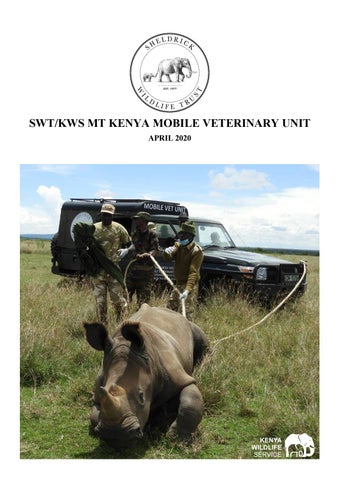
SWT/KWS MT KENYA MOBILE VETERINARY UNIT APRIL 2020
Introduction
5 Cases in April
2 Elephant Cases
2 Poaching Cases
April Report by Dr. Domnic Mijele During the month of April, 2020, the Mt Kenya Wildlife Veterinary unit attended to wildlife cases that required urgent veterinary intervention in the Laikipia ecosystem and Mt. Kenya region. Some of the wildlife veterinary cases attended to included treatment of an injured elephant calf in Mpala Wildlife Conservancy, surgical treatment of a common zebra with a squamous cell carcinoma tumor on the peri-anal region, de-snaring an elephant calf in Ol Pejeta Wildlife Conservancy, treatment of an adult female mountain bongo with diarrhoea and submandibular oedema in Mt. Kenya Wildlife Conservancy and repeat treatment of a sub-adult male white rhino in Solio Rhino Sanctuary as highlighted in the report below; Acknowledgement We acknowledge the continued and long-term support from Sheldrick Wildlife Trust (SWT), KWS and Wildlife Conservancies for their support that has enabled the Mt Kenya Veterinary Unit to respond promptly and offer medication to all wildlife emergency cases that required veterinary intervention during the month. This support has made it possible for the team to respond and treat wildlife that required urgent veterinary attention without which they would not have survived.
Case Details Date
Species
Area Found
Reason for Intervention
09-Apr-20
Elephant
Mpala Ranch, Laikipia
Bullet Wound
14-Apr-20
Zebra
Lewa Conservancy
Natural Causes
27-Apr-20
Bongo
Mt Kenya Wildlife Conservancy
Natural Causes
28-Apr-20
Elephant
Ol Pejeta Conservancy, Laikipia
Snared
30-Apr-20
Rhino White
Solio Ranch, Laikipia
Natural Causes
It had a deep penetrating wound through the elbow joint of the right front leg, the leg was heavily swollen and very painful It had a pendulous swelling on the peri-anal region. The swelling was cancerous and bleeding continuously One of the sub-adult male bongos was reported to have signs of profuse watery diarrhoea, poor body condition, rough hairs, and sub-mandibular swelling It had a tight wire snare that circled around the neck and shoulder several times and the calf had difficulties walking It had no external injury or wound but was walking slowly with tucked-in abdomen showing signs of pain
Outcome Successfully Treated Successfully Treated Successfully Treated Successfully Treated Successfully Treated
SWT/KWS Mt Kenya Mobile Vet Unit Treatment Locations April 2020
. Case
1 – 9th April 2020
Elephant
Bullet Wound
Mpala Ranch
This was a young female elephant calf of about 1 year old sighted within Mpala Wildlife Conservancy by Rangers with a deep penetrating wound through the elbow joint of the right front leg. The leg was heavily swollen and very painful, the calf was limping and unable to keep pace with the rest of the elephant herd. Immobilisation, examination and treatment The calf was darted with 3mgs of Etorphine and when the drugs took effect, the rest of the herd were chased away by vehicles. The mother refused to leave the calf, so was also darted and immobilized with 16mgs of Etorphine. The wound to the elbow joint was deep and had penetrated through the joint, exiting on the lateral side. It was suspected to be a bullet wound. The wound was probed with swabs attached to long forceps, then treated with Hydrogen peroxide, Iodine and Opticlox ointment. The calf was also given Procaine Penicillin and Flunixine meglumine to support the wound healing process. Finally, the wound was covered with green clay and sprayed with Oxytetracycline spray. Prognosis The calf and the mother were revived from the anaesthesia simultaneously and the team ensured that the calf successfully re-united with the mother. The prognosis is good after treatment as the calf is still strong supported by the mother.
Case 2 – 14th April 2020 Zebra
Natural Causes
Lewa Conservancy
An adult male common zebra had a pendulous swelling on the peri-anal region that was cancerous and bleeding continuously; it was infected, necrotic and quite painful to the animal so required immediate intervention. The Vet Unit teamed up with the Lewa Vet Unit for the operation. Immobilisation, examination and treatment The zebra was darted with 5mgs of Etorphine combined with 50mgs of Azaperone. It took about 5 minutes for the drug to take effect and for the zebra to become fully anaesthetised. Lignocaine 2% was infiltrated as a local anaesthesia around the anal area to ensure maximum analgesia during the surgical process. The zebra was placed on lateral recumbency to expose the affected area. The entire anal and peri-anal area was cleaned with ethanol disinfectant and surgical spirit then shaved clean to ensure no contamination during the surgery. The cancerous swelling was removed carefully with a surgical blade. The haemorrhage was controlled with haemostats and suture ligatures. The resulting surgical wound was immediately sutured with chromic cut-gut absorbable suture then treated with Opticlox ointment and Oytetracycline spray followed by intramuscular injection of Procaine penicillin to ensure no bacterial infection after the operation. Prognosis Prognosis was good after surgical removal of the cancerous swelling.
Case 3 – 27th April 2020 Bongo
Natural Causes
Mt Kenya Wildlife Conservancy
One of the sub-adult male bongos was reported to have signs of profuse watery diarrhea, poor body condition, rough hairs, and sub-mandibular swelling. This required urgent veterinary intervention to treat the animal. The bongo was tentatively diagnosed with coccidiosis and internal parasite infestation. Immobilisation, examination and treatment The bongo was weak and lethargic so it was physically restrained by hands. The animal was treated with oral Amprolium and Trimethoprim sulfonamides, then Procaine penicillin and Vitamin B12 (Cyanocobalamine), all administered intramuscularly. The bongo was also given Ivermectin by subcutaneous injection then sprayed with Frontline to eradicate all ectoparasites. Prognosis Prognosis was good after treatment and the animal has since recovered.
Case 4 – 28th April 2020 Elephant
Snared
Ol Pejeta Conservancy
This was a young elephant calf sighted within Ol Pejeta Wildlife Conservancy, it had a tight wire snare that circled around the neck and shoulder several times and the calf had difficulties walking since it was entangled in the snare. The calf was with the mother in a large family of about ten elephants. The Vet unit were assisted by the Ol Pejeta Conservancy Team to rescue this calf from the snare. Immobilisation, examination and treatment The snared calf was darted with 2.5mgs of Etorphine and when it became fully immobilized the rest of the herd were chased away by vehicles. The mother and the matriarch refused to leave the calf and so they were also darted with 16mgs of Etorphine in quick succession to enable the team access the calf. The snare was quite tight but had not inflicted any injury to the calf. The wire was quickly removed and the calf revived from the anaesthesia immediately. It was then physically restrained until the mother and the matriarch were revived and all of them were re-joined successfully. Prognosis Prognosis was good after removing the snare.
Case 5 – 30th April 2020 White Rhino
Natural Causes
Solio Ranch, Laikipia
A sick white rhino was reported by KWS security rangers patrolling Solio Rhino Sanctuary; the rhino was weak and preferred lying down most of the time. It had no external injury or wound but was walking slowly with a tucked-in painful abdomen. It had been hit and injured by another male white rhino when the mother was being mated. The rhino calf had previously been treated by the Meru Vet Unit and had shown signs of improvement but required an additional dose of antibiotics, anti-inflammatories and analgesics. Immobilisation, examination and treatment The rhino was darted from a vehicle with 3mgs Etorphine combined with 40mgs Azaperone tartrate. The anaesthesia took effect after 6 minutes and to improve the plane of anaesthesia and respiration, 20mgs of Butorphanol was administered. On examination, the rhino had no external injuries but had started losing body condition. It had serious internal injuries and most likely had internal haemorrhage and pain caused by a blunt injury. It was treated with high dosages of Procaine penicillin, Flunixine meglumine and multivitamins. Prognosis After treatment, the anaesthesia was reversed with 24mgs of Diprenorphine and 80mgs of Naltrexone through the ear vein, then 36mg of Diprenorphine administered intramuscularly. Recovery from anaesthesia was smooth. Prognosis was favourable after treatment and the rhino is being monitored.