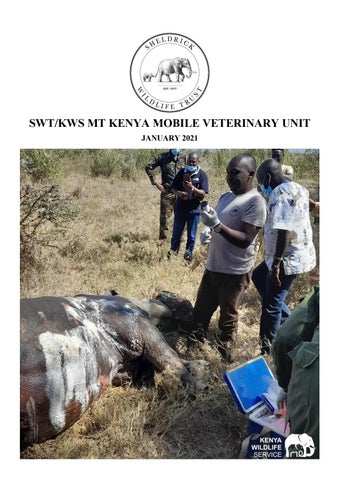
SWT/KWS MT KENYA MOBILE VETERINARY UNIT JANUARY 2021
Introduction
6 Cases in January
1 Poaching Case
2 Elephant Cases
January Report by Dr. Domnic Mijele During the month of January 2021, the Mt Kenya Wildlife Veterinary unit attended to a number of wildlife cases that required urgent veterinary intervention in the Laikipia ecosystem and Mt. Kenya region. Some of the veterinary cases attended to include removal of a snare from an elephant at Karatina, examination and rescue of a limping orphaned elephant calf at El Karama Conservancy, post-mortem of an eland and treatment of a bongo with an abscess at Mt. Kenya Wildlife Conservancy. Acknowledgement We greatly acknowledge Sheldrick Wildlife Trust (SWT) for their continued support that has enabled the Mt Kenya Veterinary Unit to respond promptly and offer treatment to all wildlife cases that required veterinary intervention during the month. This support has made it possible for the team to respond and save many animals that required urgent veterinary attention without which they would not have survived.
Case Details Date
Species
Area Found
Reason for Intervention
23-Jan-21
Elephant
Karatina, Mt Kenya NP
Snared
27-Jan-21
Eland
Wildlife Conservancy, Mt Kenya
Postmortem
27-Jan-21
Bongo
Wildlife Conservancy, Mt Kenya
Natural Causes
27-Jan-21
Bongo
Wildlife Conservancy, Mt Kenya
Natural Causes
30-Jan-21
Elephant
El karama, Laikipia
Rescue
31-Jan-21
Rhino Black
Lake Nakuru National park
Natural Causes
The rope snare was deeply embedded around the elephants left forelimb and had caused a deep, traumatic wound A female eland calf was found abandoned. The animal was reluctant to move with thick mucus drooling from the nose and mouth. Despite being rescued the animal developed seizures and head pressing, and died A mountain bongo calf named “Maringo” had signs of diarrhoea caused by helminthosis The swelling was examined and determined to be an abscess and lymphadenopathy of the right mandibular lymph node The animal had no major injuries or wounds but had a congenital deformity of both the hind legs, which curved outwards and formed a bow-legged shape The animal had filarial wounds ventrally under her chin extending to the neck and on her right trunk
Outcome Successfully Treated
Died
Successfully Treated Successfully Treated
Taken to Orphanage Successfully Treated
SWT/KWS Mt Kenya Mobile Vet Unit Treatment Locations January 2021
Case 1 – 23rd January 2021 Elephant
Snared
Mt Kenya Reserve, Karatina
Mt Kenya forest Rangers reported that there was an elephant with a snare on the right forelimb. The Mt Kenya Veterinary Unit aided by KWS vet Dr Njoroge and KWS rangers, responded promptly but the terrain was challenging as the bush was thick and the forest dense with some areas inaccessible. The teams spent 3 days tracking the elephant from the air and on foot, and after five days, the elephant was finally found. Immobilisation, examination and treatment The elephant was darted with 18mg Etorphine hydrochloride. Due to the thick terrain, the veterinarian needed to climb a tree to get proper visual of the animal for darting. There was a rope snare deeply embedded around the elephant’s left forelimb at the level of the metacarpals. It had caused a deep, traumatic wound (approx. 4cm deep), causing significant pain to the animal. The wound was first cleaned and flushed with Hydrogen peroxide and irrigated with Iodine for topical antibiotic cover. After cleaning, Opticlox ointment was applied to the wound and topical oxytetracycline spray applied. Prognosis Good. The animal had good body condition and the wound only involved musculature and not the skeletal system. The rangers were advised to monitor the elephant for the next week and report on its recovery.
Case 2 – 27th January 2021 Eland
Post-mortem
Mt Kenya Wildlife Conservancy
A female eland calf was found abandoned in Mt Kenya Wildlife Conservancy. The animal was reluctant to move with thick mucus drooling from the nose and mouth. The calf also had ticks, especially on the earpinnae and inguinal region. The calf was transferred to the orphanage and given supportive care and treatments for about three days, however, the animal developed seizures and head pressing, and was found dead at around 11am. Post-mortem examination The animal had bruises and wounds on the head and limbs that occurred due to the pressing of the head against the wall and seizures. The mucus membranes of the conjunctiva and mouth were pale. There was marked congestion in the lungs and the spleen. There were petechial haemorrhages and significant inflammation and oedema of the brain tissue. There was no significant pathology observed in other body systems. Cause of death The animal was suspected to have died of a bacterial infection of the central nervous system.
Case 3 – 27th January 2021 Bongo
Natural Causes
Mt Kenya Wildlife Conservancy
A mountain bongo calf named “Maringo” had signs of diarrhoea caused by helminthiasis; it was to be dewormed after examination of faeces revealed a high parasite egg count. Immobilisation, examination and treatment The bongo calf was darted in the left thigh muscle with 1mg Etorphine hydrochloride combined with 10mgs Azaperone tartate. The drugs took effect after 10 minutes and the animal became recumbent. A blindfold was placed on the animal’s head to prevent light stimulation. It was dewormed with 3ml of Fenbendazole (given orally), and 0.5ml 1% Ivermectin, which was given subcutaneously. Reversal and prognosis The anaesthetic was reversed with 12mgs of Diprenorphine injected intravenously through the jugular vein and the bongo was standing within a minute. The prognosis was good as the animal was feeding well and did not appear to have any other underlying conditions.
Case 4 – 27th January 2021 Bongo
Natural Causes
Mt Kenya Wildlife Conservancy
Denya, a 2-month-old female mountain bongo calf, was spotted with a large swelling on its right cheek. The swelling was noted to be growing larger as the days passed by Immobilisation, examination and treatment The bongo was darted in the left thigh muscle with 1mg Etorphine hydrochloride combined with 10mgs Azaperone tartate. The drug took effect after 6 minutes and the animal became recumbent. The anaesthetic was immediately reversed, and the animal was restrained manually. The swelling was an abscess and lymphadenopathy of the right mandibular lymph node. The abscess was shaved clean with a sterile scalpel blade and injected with 2% lignocaine local anaesthesia to minimize pain. The abscess was then lanced and drained. Thereafter, the wound was debrided with Hydrogen peroxide and Iodine was used to provide topical antibiotic cover. Dexamethasone (10mg) was administered for pain relief and to decrease inflammation. Penicillin (3,000mg) was administered for systemic antibiotic cover. Prognosis Prognosis was favourable as the abscess was managed in time and the animal is still young and healthy. The keepers were advised to ensure the animal is monitored for at least a week to assess the recovery process.
Case 5 – 30th January 2021 Elephant
Rescue
El Karama Conservancy, Laikipia
A young juvenile male elephant calf was noted to be limping by the staff at El Karama Conservancy. The calf was alone and was quite vulnerable to predators as there were no other elephants to protect him. Immobilisation, examination and treatment The elephant was immobilized with 4mgs Etorphine hydrochloride. The drug took effect after 7 minutes and the animal became recumbent. The animal had no major injuries or wounds but had a congenital deformity of both the hind legs, which were curved outwards. The anaesthetic was reversed but when the animal walked away, it was noticed to be “bow-legged” which was causing the animal to walk slowly. The elephant had been abandoned by its herd possibly because of this defect. It was therefore determined that he needed to be rescued and taken to the Sheldrick’s in Nairobi as he was an easy target for predators. On the day of the rescue, the elephant was immobilized with 3mgs Etorphine. The elephant was placed on a stretcher and gently lifted into the moving truck and correctly positioned. A well-designed elephant transportation truck from the Sheldrick Wildlife Trust was brought to to ensure stress-free transport of the calf. The calf was given an 20mgs Stresnil to decrease anxiety. To counter the effects of transportation stress, 20ml Amoxicillin and 10ml Dexamethasone. 10ml Ivermectin was also administered to counter any parasitic infestations. Prognosis The prognosis was good as the animal will receive high quality, specialised care.
Case 6 – 31st January 2021 Black Rhino
Natural Causes
Lake Nakuru National Park
A report was made to the KWS Veterinary Department of a limping adult female black rhino in Lake Nakuru National Park. The Mt. Kenya Veterinary unit was informed to attend to the rhino as soon as possible. Immobilisation, examination and treatment The animal was darted from a helicopter with 3.5mg of Etorphine and 60mg of Azaperone. The animal was given 20mgs of Butorphanol to improve respiration and was put on supplemental oxygen throughout the examination and treatment period. Examination showed that the rhino had filarial wounds ventrally under her chin extending to the neck and on her right side. These were cleaned with Hydrogen peroxide and Iodine then treated with antibiotic cream and sprayed with Oxytetracycline spray. Her right hind limb had decubital sores around the patella, but as there was no palpable fractures or visible wounds on the leg it was suspected to be due to her age, possibly arthritis. The rhino was given Amoxiicillin (15000mg), Phenylbutazone (40mls) and Multivitamin (20mls) Prognosis Prognosis was good after treatment with long-acting antibiotics and strong ant inflammatory drugs that will help minimise spread of joint inflammation.