SWT/KWS MERU MOBILE VETERINARY UNIT SEPTEMBER 2020
Introduction
3 Cases in September
1 HWC Case
2 Rhino Cases
September Report by Dr. Ndambiri Ephantus The month under review has witnessed high temperatures and strong winds within the Eastern Conservation Area. Trees have begun to flower which is attracting an abundance of bees; a sign that rain is imminent. All the wildlife is in good condition and we are optimistic that the remaining vegetation will see them through the dry season. There were only 3 cases attended to this month as there has been a reduction in human-wildlife conflict and poaching incidents. The Vet Unit attended one case, where two crocodiles were in a human inhabited area and the community were concerned as they bring their livestock to drink water daily. However, despite numerous attempts the crocodiles evaded capture as they were still small and slipped through the nets. The situation will be monitored. The other two cases involved a white and black rhino, that had sustained injuries in territorial fights. The white rhino had to be relocated as it knocked down a fence and left the protected area after the fight. Acknowledgement We sincerely acknowledge the immense support from the Unit sponsor The Sheldrick Wildlife Trust. It is through this facilitation that both near and far fletched cases have been attended to promptly. Appreciated also are the local conservancies and community members for their impeccable support during interventions.
Case Details Date
07-Sep-20
11-Sep-20
19-Sep-20
Species
Area Found
Reason for Intervention
Two problematic crocodiles had invaded a water pan and were regularly preying on Human Northern domestic animals and scaring the Crocodile Wildlife Kenya community. The two were reported to have Conflict come with flooding water from the Ewaso Nyiro River The Rhino had strayed outside the protected area in Solio Ranch on 10/9/2020. Rhino Solio Ranch Relocation This was due to a territorial fight which White forced the candidate to knock down the fence A ‘normal’ reddish scar was visible at the right groin which was mistakenly assumed Rhino Sera Wildlife Natural to be a raw penetrating wound. The right Black Conservancy Causes side of face suffered extensive combat bruises leading to bleeding
Outcome
Not Located
Task Successful
Successfully Treated
SWT/KWS Meru Mobile Vet Unit Treatment Locations September 2020
. Case
1 – 7th September 2020
Crocodile
Human-wildlife Conflict
Northern Kenya
Eresa Boru Community, through a local administrative chief, made a report to the Eastern Conservation Area Warden of two problematic crocodiles which had invaded a water pan and were regularly attacking domestic livestock. The two were reported to have come with flooding water from Ewaso Nyiro River during the heavy rains and have been in residence for over a year. Both the Veterinary Unit and Problematic Animal Control based in Meru National Park visited the site to offer appropriate intervention. Capture Attempt The team stayed at the Administration Police Camp, Eresa Boru for two days. Local administration was consulted through Chief Hersi who led the way to the water pan. The water pan is roughly a quarter acre with the deepest depth of 1.5 meters. The water is turbid and salty. The few thickets at the edges are the preferred hideout for the crocodiles and it is where the attacks on livestock have been most frequent. The thickets were cleared substantially to allow the capture teams movement with the nets. A capture net for small ungulates was improvised to act as a capturing net by sweeping through the water pan. The net was to be held perpendicularly with the bottom line maintained on the floor by stones which were anchored using the strings along the net line. This enabled the net to remain sunk with the other upper line floating above the water level.
Four people held each end of the net as they swept from one side to the other. The first sweep almost got the two outside the water at one edge, but both escaped from the net because the net holes were larger than the crocodiles. This confirmed that crocodiles were in residence. On the first day, four sweeps were made and the same escapes would occur either very close to the shore or at the shore. The net was set for the night and on the following morning upon inspection there was no capture. Another three sweeps were done producing similar results. Conclusion and way forward It was observed that the candidates were small and that the risk posed by them was low due to their size. They had attempted several times to capture donkeys but only managed to inflicting bite wounds. There was no human or shoat injury reported. This could be attributed to the fact that when shoats and humans come to the dam several people would keep guard and frighten the crocodiles by hitting water with sticks. The local administration was advised that the water levels, silt, net size and crocodile sizes posed a challenge for capturing. An alternative would be to pump a substantial amount of water from the water pan. This would be detrimental to the welfare of humans and animals as an alternative source of water was more than four kilometers away. It was agreed that the local administration would keep watch over the water level as water is utilized domestically and notify the capture team to intervene when levels are lower. Another capture net with narrow holes was also to be sought by the capture team so that escapes would be avoided.
Case 2 – 11th September 2020 White Rhino
Relocation
Solio Ranch
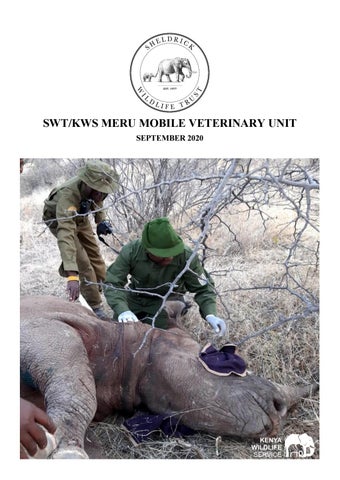
An adult male white rhino was reported by Solio rhino warden to have strayed outside a protected area in Solio Ranch on the 10/9/2020 after a territorial fight forced the candidate to knock down the fence during the ensuing chase. Efforts to drive it back to the sanctuary both on foot and with a vehicle was futile. It was afraid of any fence and gate it came across. The case was referred to KWS Vet Hqs for the capture team to aid in capture and translocation with eventual release inside the sanctuary. Immobilisation, examination and treatment The rhino was spotted from the air by KWS fixed wing, lying in the thicketed area. Rangers were directed to drive the rhino out of thickets to facilitate vehicle darting. It was darted with 4.5mgs Etorphine and 60mgs Azaperone and was completely sedated in 11 minutes. It was blindfolded and the anaesthesia was lightened by intravenous injection of 10mgs Butorphanol. Oxygen was supplied through the nostril and capnography meter was used to monitor carbon dioxide and heart rate. The rhino was ear notched as rhino no. 1 on the left ear to aid in post release monitoring. A crane lorry lowered a crate just in front of the sedated rhino. A guiding rope was tied around the head just behind the rear horn with a quick release knot. The same rope went through a hole at the middle of the front cage wall to the outside where it was anchored on to a vehicle bull bar. Another rope to counter rhino reversal was tied around the tail base. Tissue, whole blood, faeces and tick samples were taken for the sample bank. Relocation and Release The anaesthetic was reversed and the rhino was up in two minutes. It was immediately directed into the cage using the ropes. Once inside the cage the doors were safely secured and barred. The front rope was untied and the blind fold removed. The crate was lifted by the crane onto the lorry guided by two side ropes anchored on the crate front and back rail. The rhino was transported back into sanctuary and released near water in the Nakumat area. The crate was offloaded and placed on the ground with the back facing the water area. The lower door was opened only to reveal the rhino lying down. An injection into the muscle of 40mgs Naltrexone was done to cater for any re-narcotization. The metal bars were removed and the upper door was opened. The rhino was tapped with a stick and it reversed out of the crate strongly and it disappeared.
Case 3 – 19th September 2020 Black Rhino
Natural Causes
Sera Wildlife Conservancy
This adult male rhino named Locharo had fought an older male and lost the battle, sustaining various injuries. Immobilisation, examination and treatment The rhino was found under a thicket it was reluctant to get up or move but when prompted, showed severe right forelimb lameness. The area was inaccessible by vehicle, so a small team went on foot to dart the rhino. The rhino was alert and quick to run once it sensed the team. Since there was no air support, the team pursued on foot. After a protracted effort it was darted successfully with 4.5mg Etorphine and 60mg Azaperone. After darting, the rhino charged the team and made slight contact with one of the rangers. The rhinos footprints were traced and it was found lying down on the right side. 5mgs Butorphanol was used to lighten the anaesthesia. The right forelimb had a penetrating wound just above the middle toe about 5cmdeep. The right side of the face suffered extensive combat bruises and there were several skin lacerations. The wounds were cleaned with Hydrogen Peroxide and Iodine then sprayed with Oxytetracycline. The penetrating wound was infiltrated with wet green clay. It was also administered 15,000mgs Amoxicillin, 60mgs Dexamethasone as anti-inflammatory and 40ml Catosal. The rhino was turned for examination of the other wounds to the head and neck area, the right forelimb armpit, the rump and the right hindlimb around the pelvis and part of the prepuce. These wounds were treated in the same way as the other wounds. Prognosis Fair with hope that no internal injury was suffered.