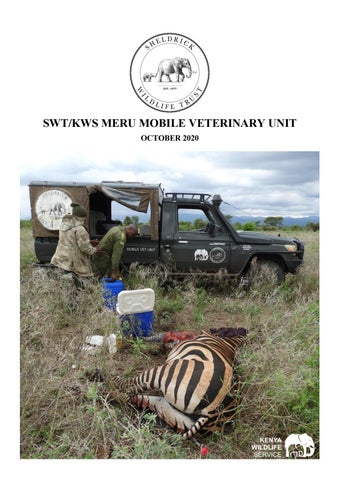
SWT/KWS MERU MOBILE VETERINARY UNIT OCTOBER 2020
Introduction
4 Cases in October
1 Poaching Case
100% Success
October Report by Dr. Ndambiri Ephantus October marks the beginning of the rainy season here in the Eastern Conservation Area, just like the rest of various parts of the country. Two weeks of rain has recovered what was meagre vegetation, which is a huge relief to the wildlife. Trees and shrubs are full of leaves and the savannahs are returning to green. Animals are enjoying the plentiful vegetation as they traverse different terrains picking their favourite menu. Rivers and streams are rising day by day as the runoff from the plains fills their banks. Hopefully, this will reduce animal-animal and/or human-wildlife conflicts. The Unit attended to 4 cases in the month of October. These included a white rhino that was injured in a fight with another male, the search for and assessment of 3 elephants reported to be injured in Abedares National Park, none of which required treatment, a zebra that was injured in a failed hyena attack and the snare removal and wound treatment of a giraffe. Acknowledgement The Unit is sincerely grateful for continued support from the Sheldrick Wildlife Trust (SWT). Timely intervention offering pain relief to wildlife in need has been achieved through this impeccable support. Commendable also are the other Conservation Partners who were involved in any simple way to help provide medical care to Kenya’s wildlife.
Case Details Date
Species
Area Found
16-Oct-20
Rhino White
Solio Ranch
Natural Causes
It had been suspected to have been involved in a fight with another male
Successfully Treated
17-Oct-20
Elephant
Aberdare NP
Natural Causes
3 elephants were reported with injuries that needed assessment, none required treatment
Task Successful
30-Oct-20
Zebra
Natural Causes
It had an extensive wound on the left foreleg caused by an unsuccessful hyena attack
Successfully Treated
30-Oct-20
Giraffe
Snared
It had a swollen left hind limb due to a double plain snare wire
Successfully Treated
Meru National Park Meru National Park
Reason for Intervention
Outcome
SWT/KWS Meru Mobile Vet Unit Treatment Locations October 2020
. Case
1 – 16th October 2020
White Rhino
Natural Causes
Solio Ranch
A lame adult male white rhino was spotted by Rangers in Solio Ranch. The rhino was with another adult male. It had been suspected to have been involved in a fight with another male. It was lame on the right hind limb more pronounced when the animal was running. There was no observable wound or discharge. Immobilisation, examination and treatment The rhino was darted from a vehicle with 4.5mgs Etorphine and 70mgs Azaperone. This was after carefully driving them out of the thickets. They ran to join two other rhinos who were resting 100m away and then the darted rhino became fully anaesthetized. The other three were chased away with a vehicle. There was one wound at the right armpit and two others running parallel to the prepuce on both sides. They were most likely caused by a rhino’s horn and were raw with no discharge but beginning to form scabs. Palpation of the lame limb yielded no crepitation, and it was assumed to have suffered a soft tissue injury. The wounds were cleaned with Hydrogen Peroxide and Iodine, then sprayed with Tetracycline Spray. The rhino was then administered 30,000mgs Tetracycline antibiotic, 80mgs Dexamethasone as an antiinflammatory and 50ml Catosal as a metabolic stimulant. Prognosis Prognosis was good because the wounds were superficial, and that gait was not severely affected.
Case 2 – 14th – 17th October 2020 Elephant
Natural Causes
Abedares National Park
The vet team was informed by the SW of three elephants at Aberdares National Park that needed veterinary attention. They had been spotted by a tourist camping at Rhino Retreat House. The Meru Mobile Vet Unit holding brief for Mountain Mobile Vet Unit set out for Aberdare on 14/10/2020. The exercise was carried out between 14th and 17th October 2020. Potential Candidates. • • •
An adult elephant appearing as having snare wire around its right forelimb fetlock An adult elephant with seemingly wounded trunk A dwarf elephant appearing lame on right forelimb
Surveillance The vet team carried out surveillance within the most probable sighting locations. These were the two waterholes; one located at the Rhino Retreat and another at Ark Lodge are known locations for mineral provisions in form of salt licks. All candidates had been spotted at the Rhino Retreat waterhole previously. On 15/10/2020; The team visited the two locations and the Rangers’ Rhino Base at Sub- Headquarters. Observed that day were two healthy adult males who appeared at the Rhino Retreat waterhole. On 16/10/2020; Several rounds were done between the two waterholes. A herd of 12 elephants were seen at the Retreat during the night but all were healthy. At the Ark, 17 individuals were seen in the morning and another 26 elephants were seen in the afternoon. All were healthy except one who was in the second herd and appeared to be candidate number 3. The candidate was an adult female as her tusks size compared to several other adults, but she was small in size. Her right forelimb was longer than the left one which made her ambulation difficult. There were no pathological swellings, but the limb had rigid segments and a flexed joint. The limb bones appeared fused all the way from scapular to radius. The metacarpus appeared posteriorly flexed and could not stretch forward even when in motion. This is Limb Length Discrepancy (LLD); a condition where one limb is longer than the other which could be congenital or acquired. LLD can be congenital or acquired later in life usually due to an injury to the growth plate by trauma, infection, radiation or tumor. LLD can occur secondary to a fracture of the long bones with malunion or non-union. Hip dysplasia and dislocation can also cause LLD.
6.81
Prognosis The candidate’s condition is long standing which makes her appear dwarfed and deformed. Apart from the abnormal gait, the candidate is healthy. Her prognosis is good because she can walk for browse and water which is plentiful in the Abedares all year round. There are also no large carnivores to pose predation risk. Surveillance On 17/10/2020, patrol and monitoring continued. There were no elephant activities recorded at the Retreat area. One individual was observed at the Ark but it was not a candidate. There was a family encountered browsing along the road in between the Ark and the Ark Gate but all were healthy. It was recommended to the Aberdare National Park Senior Warden that comprehensive monitoring needs to be done to ascertain the healthy status of elephants visiting the waterholes. Data of herd numbers and structures, frequency of their visits, their rotation within these waterholes/salt licks, individual health status whether tuskless, mono tusks, deformed or injured needs to be collected especially so those which need vet attention can be identified. This eventually will inform the Vet Team on how to organize the intervention, taking into account the number of days this will take, and whether several interventions will be needed. There is also a need to plan on how to encourage reporting from these vital observation points both from visitors and residents. A book can be provided for such observable recordings and then a way of synthesizing and processing the information provided for necessary action to be implemented.
Case 3 – 30th October 2020 Zebra
Natural Causes
Meru National Park
The Meru Mobile Vet Unit was on its way park to treat a snared Giraffe when a lone adult common zebra was spotted at the edge of the Murera Air Strip. It had an extensive wound on the lefte forearm. There was a dangling skin flap and some bloody discharge. This was most likely an unsuccessful hyena attack. Immobilisation, examination and treatment The zebra was very weary, but after several unsuccessful vehicle approaches within the rocky bushy terrain, it was driven to a relatively favourable terrain. The zebra was then successfully darted from the vehicle with 5mgs Etorphine and 70mgs Azaperone. It was maintained within the open savannah area until it went down. The skin flap was trimmed near the distal attachment to encourage healing. The trimmed edge had three main bleeders which were clamped and stitched. The wounds were then disinfected by pouring on Hydrogen peroxide and Iodine so as not to remove the already formed scabs. Green clay was generously applied followed by Tetracycline spray. The zebra was also administered 10,000mgs Tetracycline Hydrochloride antibiotic, 40mgs Dexamethasone as an anti-inflammatory and 40ml Catosal as a metabolic stimulant. A subcutaneous injection of 6mgs Ivermectin was given to protect against internal and external parasites. Prognosis It has a good prognosis as the wound was only slightly infected and it was attended to early.
Case 4 – 30th October 2020 Giraffe
Snared
Meru National Park
The Meru Mobile Vet Unit was informed of a lame giraffe by the Sheldrick Wildlife Trust Rhino Sanctuary Fence Personnel based within the Meru Rhino Sanctuary. As it was within a herd which was moving fast deep into thicketed area. The fence team was instructed to keep an eye on it until the vet team arrived. Immobilisation, examination and treatment It was found by the roadside with another young male. It was unable to keep up with the herd and the vegetation was irritating the wound. It had a swollen left hind limb caused by a double snare wire. There was pronounced lameness and the wound was heavily infected emanating bad odour and pus. It was approached with the vehicle and pushed away from the river and across the dirt road then darted with 10mgs Etorphine and 40mgs Azaperone. It kept walking for 7 minutes and was then roped down and manually restrained. The snare was severed with a wire cutter and carefully pulled out of the injury. The resultant wound was cleaned with Hydrogen Peroxide and all necrotic tissue removed. It was disinfected with Iodine then smeared with wet green clay followed by topical application of Tetracycline spray. It was injected with 20,000mgs Tetracycline antibiotics, 80mgs Dexamethasone and 100ml of Multivitamin injection. Prognosis It has a good prognosis now the snare has been removed and the infection treated.