SWT/KWS MERU MOBILE VETERINARY UNIT NOVEMBER 2020
Introduction
4 Cases in November
1 Elephant Case
100% Success
November Report by Dr. Ndambiri Ephantus November has been wet and green with both heavy and light rains experienced throughout. The rains have caused the seasonal streams to flow and the permanent rivers to increase in water volume. The vegetation has regenerated providing ample forage for wildlife which are all in good condition. The impeccable health status enabled the planning and execution of fitting monitoring aids/collars on chosen animal species. Hirolas, elephants and unusual white reticulated giraffe were all collared during the month and 1 lion was treated for an eye injury. Acknowledgement We would like to express our thanks to Sheldrick Wildlife Trust for unceasing sponsorship towards the Mobile Vet Unit Interventions. Also honoured are all other friends of conservation who assisted the Unit during the month as it carried out its’ mandate.
Case Details Date
Species
Area Found
02-Nov-20
Lion
El Karama Ranch
Natural Causes
06-Nov-20
Hirola
Ishagbin Conservancy
Collared
07-Nov-20
Elephant
Ishagbin Conservancy
Collared
Giraffe
Ishagbin Conservancy
Two white giraffes were reported to have been poached last March. This prompted Collared need to monitor the movements of the only one remaining within the same ecosystem
08-Nov-20
Reason for Intervention The right eye had complete corneal puncture with all eye content lost. Eye enucleation was not an option Males were targeted but one female was encountered during the exercise and it was also collared. A total of four males and one female were collared An elephant was collared to understand their migratory routes within the locality
Outcome Successfully Treated Task Successful Task Successful Task Successful
SWT/KWS Meru Mobile Vet Unit Treatment Locations November 2020
. Case
1 – 2nd November 2020
Lion
Natural Causes
El Karama Ranch
The lioness was reported to have a bleeding eye and exhibiting unusual inactivity by the manager of El Kalama Ranch. The lioness was found lying under a thicket alone. The right eye appeared reddish and lacrimation reddish discharge. Without disturbing it, the Unit withdrew to prepare dart. Immobilisation, examination and treatment The lion was darted from a vehicle with 475mgs Ketamine and 5mgs Medetomidine. It ran for 50 meters then lay down and eventually became immobilized on the right side within ten minutes. The right eye had a complete corneal puncture with all eye content lost. Eye enucleation was not an option due to trauma and the need for caging/hospitalization. The lion was given a sub-conjuctival injection of 300mgs Amoxicillin mixed with 1mgs Dexamethasone and the eye liberally applied with Cloxacillin ointment. The left metacarpal area also had a puncture wound. Other small penetrating wounds were observed on gluteal areas. All these seemed to have been inflicted by another lion less than 72 hours earlier. The wounds were cleaned with Hydrogen Peroxide and Iodine then sprayed with Tetracycline Wound Spray. The lion was also administered with 2,250mgs Amoxicillin as broad-spectrum antimicrobial cover, 20mgs Dexamethasone as an anti-inflammatory and 20ml Catosal as metabolic stimulant at different muscle sites. Prognosis Prognosis was fair though the lioness will have only one functioning eye for the rest of its life.
Case 2 – 6th November 2020 Hirola
Collared
Ishagbin Conservancy
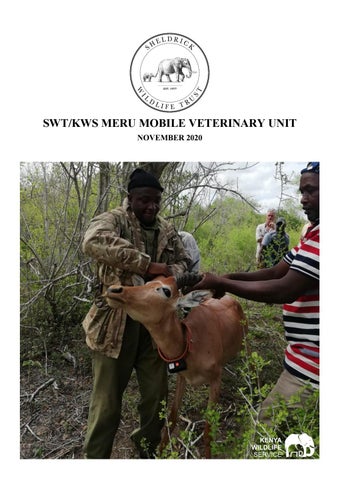
The hirola is recognized as a severely threatened species of antelope in the world. The most drastic decline occurred between 1983 and 1985 during major disease- rinderpest outbreak in the region. Since the 1990s the population continued to decline as a result of increasing rebel, military and refugee activities, habitat loss, predation and poaching in the region. There are no hirolas in captivity worldwide. With a founder population of 48 hirola in 2012, the Ishaqbin community created a predator free sanctuary and with a 15% annual growth rate, it reached a population of 130 and 140 individuals. To monitor the movement patterns of the hirolas within the sanctuary and to assist a possible expansion of the sanctuary, the Ishaqbin Community Conservancy Board requested KWS to collar some of the individuals. Immobilisation and collaring Due to the nature of the species the animals were difficult to dart as they are elusive and take flight, therefore they had to be darted from the air using a helicopter. Each individual was darted with 4mgs Etorphine and 40mgs Azaperone. The animals were at risk of overheating so were liberally dowsing with cold water and administered Dexamethasone. Blood samples were collected as well as tissue samples from the ear, faeces from the rectum, nasal and conjunctival swab and ticks for retrospective investigation. Male hirolas were targeted but one female was encountered during the exercise. In total, four males and one female were successfully collared. On average the collar fitting took approximately five minutes.
Case 3 – 7th November 2020 Elephant
Collaring
Ishagbin Conservancy
Four elephants were collared to understand their migratory routes between Garissa, Lamu, Taita Taveta, Samburu, Meru, Kitui, Laikipia, Marsabit and neighbouring countries. The date will help secure these routes and provide security as they have large trophies. This was done in conjunction with hirola collaring exercise. Three fixed wings were used to find the selected candidates within the vast challenging terrain. Thick canopies along the Tana River line made the search for the elephants difficult. Two candidates were collared with GPS collars each day after an average of five hours aerial search. Immobilisation, examination and treatment All the elephants were darted successfully from the helicopter and were immobilised within 10 – 15 minutes. One of the biggest challenges was to pass the collar under the neck when the elephant fell on lateral recumbence in full narcosis with only three personnel available. The terrain also presented a challenge, especially when one elephant became recumbent in thick thickets making access difficult. All the elephants were in good health and were successfully fitted with GPS collars then revived safely. None required medication other than infiltration of the dart wound with Cloxacillin antibiotic cream to prevent abscess formation.
Case 4 – 8th November 2020 Giraffe
Collaring
Ishagbin Conservancy
Two white giraffes within the area were reported to have been poached in March. This prompted need to monitor the movements of the only one remaining within the same ecosystem. The collaring exercise of the said candidate was coupled with the hirola and elephant collaring exercise. Two fixed wing aircrafts were flown for three hours for two days to cover the expansive thicketed ecosystem. The white giraffe was found in company of a breeding herd of fourteen individuals. Immobilisation, examination and treatment Due to challenging terrain, the giraffe was darted from a helicopter with 15mgs Etorphine and 30mgs Azaperone. It was fully immobilized in eight minutes and fell on the right side. The anaesthetic was immediately reversed and the animal was manually restrained for the exercise. The left ossicle was drilled to fit two bolts within the horn. The satellite was solar powered thus was strategically placed to access the sun and away from chance of injury particularly during necking. This was done with as little trauma as possible. The horn was sprayed with antibiotic spray and the dart wound was covered with antibiotic ointment. After manual restraint was removed the giraffe rose up and moved off to locate his herd members.