SWT/KWS MERU MOBILE VETERINARY UNIT MAY 2020
Introduction
6 Cases in May
50% Success
2 Elephant Cases
May Report by Dr. Ndambiri Ephantus The month under review was wet at the beginning with scarce rains culminating with dry and windy conditions towards the end. Vegetation within the Conservation areas has regenerated to heavy and thick bushes. Streams still continue to flow with substantial waters to water for the wildlife. The duration has witnessed cordial coexistence between human and wildlife with no reported case of Human-Wildlife Conflict. We are opportunistic that the same will be witnessed in the months ahead. Acknowledgement We would like to acknowledge the never-ending support by the Sheldrick Wildlife Trust initiatives in collaboration with Kenya Wildlife Service. In comprehensive partnership with all other partners in conservation all interventions have been attended conveniently.
Case Details Date
Species
Area Found
16-May-20
Elephant
Ol Donyiro, Laikipia
20-May-20
Zebra
20-May-20
Hippo
23-May-20
Elephant
25-May-20
Security Dog
29-May-20
Laughing Doves
Meru National Park Meru National Park Meru National Park Meru National Park Garissa, North East Kenya
Reason for Intervention
Outcome
A young adult elephant was reported to have gotten stuck in a water pan in Oldonyiro The wound appeared to have been caused by a predator through unsuccessful predation Post-mortem revealed two sets of penetrating wounds on each side of the neck corresponded to canine tusks
Successfully Treated
Natural Causes
Tentatively heavily pregnant. The swelling was contributed to excessive fetal fluids
Prognosis Poor
Natural Causes
It was presumed to be unspecific enteritis
Successfully Treated
Natural Causes
Doves were dying in large numbers though no any other bird or animal had been spotted with ill health
Died
Rescue Natural Causes Postmortem
Task Successful
Died
SWT/KWS Meru Mobile Vet Unit Treatment Locations May 2020
. Case
1 – 16th May 2020
Elephant
Rescue
Ol Donyiro, Laikipia
A young adult elephant was reported to have gotten stuck in a water pan in Oldonyiro. This report was received from Area KWS Station Commander. Silt thickness made it difficult for the elephant to walk out of the pan almost submerging it completely. The Unit set out immediately to rescue the elephant. Rescue The journey was long requiring over five hours to traverse the ragged roads to the destination. Along the journey heavy rains were encountered and at one point the Unit had to wait for the waters to subside so that we can cross the overflowing lugga from IL polei to Kimancho. I called the contact person who was KWS Corporal while at Kimancho only to learn that the community had successfully rescued the elephant out of the mud. This had taken over five hours to travel and there was still another twenty kilometres to go. The Unit turned back and travelled to Meru N.P. base. Prognosis Rescue was successful.
Case 2 – 20th May 2020 Zebra
Natural Causes
Meru National Park
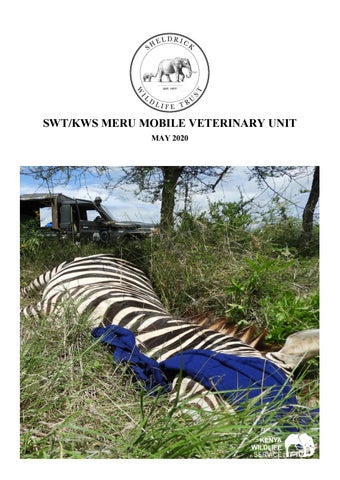
While on a mission to attend to a dead hippo within Meru N.P. two male common zebras were found at the edge of the road. One adult male appeared to trot on three legs and torn skin on the right fore limb was seen. The wound was less than three days old. The Unit decided to immobilize and treat the stallion. Immobilisation, examination and treatment The zebra was darted from the vehicle with 5mgs Etorphine and 60mgs Azaperone. The dart landed in the right rump and the zebra was completely immobilized within four minutes assuming left lateral recumbence. It was blind folded and water liberally poured on the body to control body temperature The wound appeared to have been caused by a predator during unsuccessful predation. There were also claw scratch wounds on the rump. The wound was cleaned with Hydrogen peroxide and Iodine. Wet green clay was generously packed into the wound followed by Tetracycline wound spray. It was also injected with 8000mgs Tetracycline Hydrochloride, 30mgs Dexamethasone and 25ml Multivitamin as well as 8mgs of Ivermectin under the skin. Prognosis The anaesthetic was reversed and it was up in two minutes energetically and walked away.
Case 3 – 20th May 2020 Hippo
Post-mortem
Meru National Park
The death report of a hippo was made by the Senior Warden Meru National Park to the Unit. Examination The carcass was found in the shallow waters of Rojewero at signage No. 15. It was on right lateral recumbence and was swollen depicting decomposition. There were several tears of different lengths all over the skin. Two bloody oozing wounds were seen on the left side of the neck. The carcass was dragged out of the water using straps anchored on the vehicle. Another two distinct wounds were observed on the right side of the neck. The two sets of penetrating wounds on each side of the neck corresponded to canine (tusk) injuries. These are thought to have been inflicted by another bull while fighting. Because of the crushing nature of the hippo jaw, it impacted fatally on the neck of the counterpart consequently resulting to death. Infection was ruled out as cause of death. Cause of Death Fatal injuries sustained in territorial fight.
Case 4 – 23rd May 2020 Elephant
Natural Causes
Meru National Park
In the evening, the Unit was on routine patrol within the park when a herd of elephant was sighted browsing. A closer look revealed an abnormal body of one of the females requiring further evaluation. Examination The female was browsing unperturbed by the Units presence. Both sides of the belly were equally swollen. Her gait was normal though slow because the herd was unexcited and browsing. Tentatively the female was presumed to be heavily pregnant and the swelling was contributed to excessive fetal fluids a condition thought to be Polyhydramnios. Polyhydramnios is a medical condition due to excess of amniotic fluid in the amniotic sac. With polyhydramnios, risk of the following complications is increased; -
Preterm contractions and possibly preterm labor Premature rupture of membranes Fetal malposition Maternal respiratory compromise Umbilical cord prolapse Uterine atony Abruptio placentae (placental abruption)
Common causes of polyhydramnios include gestational diabetes, multiple pregnancies, foetal anomalies with disturbed foetal swallowing of amniotic fluid, foetal infections among others. Diagnosis is confirmed by ultrasound. Polyhydramnios can impact negatively on to the health of foetus causing foetal anaemia, heart and or kidney problem. Prognosis The animal will be monitored daily to ascertain her wellbeing.
Case 5 – 23rd May 2020 Security Dog
Natural Causes
Meru National Park
The melanois security dog was reported by the handler to have voided feces with bloody specks for 24hrs followed by vomiting 12hrs later. A visit was done at the Meru N.P. canine unit. Immobilisation, examination and treatment It was noted through history that the dog had lost weight and lost its appetite. No faeces was presented for validation. Its demeanour was bright and the animal was active. The mucus membranes were pinkish (normal) and temperature was 38.1. Deworming and anti-tryps and DHLP vaccine were valid. There was no history of diet change or any foreseeable action. Palpation of belly depicted sore bowels as it showed kyphosis and the anal area was reddish depicting inflammation. It was presumed to be unspecific enteritis and a broad regime of management was applied in treatment. It was injected with 6mgs Dexamethasone into the muscles and 0.5mg Ivermectin, 3ml Multivitamin and 0.7ml Diminasine Aceturate under the skin. A half bolus of Sulphadimidine was administered orally immediately and another half to be administered 12hrs later followed by two halves 24hrs apart. Prognosis Prognosis is good. Normal routines including record keeping to be done regularly. Annual booster vaccinations are due by the end of this month and thus arrangements need to be done for the same to be administered in time. Antitryps will be administered after every two months because of high preference of tsetse population currently being experienced.
Case 6 – 29th May 2020 Laughing Doves
Natural Causes
Garissa, North East Kenya
Report of doves dying near water pans was made by area KWS Warden Garissa station on 28/5/2020. They were said to be dying in large numbers though no any other bird or animal had been spotted with ill health. Observation The areas were visited with the representatives from KWS Garissa Station, the County Veterinary Department and Regional Veterinary Investigation Laboratory. While at Ohio pan, the County Human Medical Team joined the teams after receiving the same report and they had come to evaluate the situation. Big populations of dead laughing doves were seen around the water pans. Some were dying in our presence. At Abdigap pan one ring necked dove was spotted dropping dead. Others were seen flocking in to quench and flying away. At junction pan dead numbers was relatively low. This could have been due to marabou stocks which were found within the area. Also, predator faeces were witnessed within the same area. It was assumed that the predators could have been coming in to eat the dove carcasses. These water pans are also utilized by other domestic animals such as shoats, cattle, camels and donkeys. The same water is also used by humans as they were witnessed fetching water for domestic use. The waters are turbid brown in colour but were reducing quickly as there hadn’t been a lot of rain. Despite the common usage for both wild and domestics no other unhealthy parameter was reported except dove deaths. Sampling At each water pan at least four doves were collected after being witnessed drop dead. These were packed in well labelled zip locks sachets which were transported and stored in cool-boxes containing ice packs. Four others including the ring-necked dove were autopsied, and brains, intestines, livers and kidneys were harvested then preserved in ethanol. Noticeable was general malaise, inability to perch or fly before birds died. Carcasses were emaciated and on opening, crops had very little contents, inside viscera appeared dry with hardly any cavity fluids be it peritoneal, pleural and pericardial. This depicted severe dehydration. There was hardly any observable abnormal pathology on internal viscera.
All these samples will be delivered to KWS Laboratory for analysis after the RVIL- Garissa confirmed that the requested test was not available. These samples will be subjected to NEWCASTLE DISEASE VIRUS (NDV) test. Discussion Similar deaths affecting laughing doves have been witnessed in the past few years. It is reported by area research scientist that annual deaths are usually witnessed during dry spells particularly between August and October. Areas where these have been reported are Korobesa, Bisnandi, Dujis and Mbalambala among many. An early investigation was undertaken by the KWS Veterinary Department within the mentioned areas and Newcastle Disease Virus (NDV) was incriminated as causative agent. This particular time deaths have been reported early outside the usual annual time bracket. This is a RNA virus (Paramyxovirus Type I). The virus causes respiratory and nervous syndromes. Birds depict gasping and coughing in respiratory syndrome. In nervous type, birds show depression, inappetence, muscular tremors, drooping wings, twisting of heads and necks, circling, complete paralysis. Others also show swelling of tissues around eyes and neck while others have greenish watery diarrhoea. Alternatively, viscera may not necessarily show any pathology. Some of the most susceptible species infected by NDV include domestic fowls and turkeys and wild pigeons and parrots. The disease is mild in ducks, geese, pheasants, guinea fowl, canaries and cormorants. The virus is spread by direct contact with droppings or respiratory discharges of infected birds. The virus can stay in manure for up to 2 months and in carcasses for up to 12 months. Fortunately, the virus is easily killed by disinfectants, fumigants and direct sunlight. NDV is closely related to measles and canine distemper virus both of which cause inflammatory demyelination in humans and dogs respectively. Zoonotic Risks: The virus can produce a transitory conjunctivitis in humans. This is limited primarily to lab workers, vaccination teams exposed to large quantities of virus and to crews eviscerating birds in processing plants. The disease has not been reported in people who rear poultry or eat poultry products. Recommendation The concerned partners consisting of Human Medical team, County Veterinary Department, RVIL-Garissa team and area KWS Station team will monitor the progress of the incidence, recording and communicating any variable observed awaiting laboratory analysis report to inform precisely the next course of action.