SWT/KWS MERU MOBILE VETERINARY UNIT JUNE 2020
Introduction
6 Cases in June
2 Poaching Cases
2 HWC Cases
Month Report by Dr. There were heavy rains in May which eased off in June resulting in vegetation drying out. There have also been strong winds and water levels in most of the streams running through park are starting to reduce. With challenging environmental conditions, animals and humans are sharing the remaining resources leading to an increase in human-wildlife conflict and poaching attempts. In the month of June, the Unit conducted a post-mortem on a bongo in Mount Kenya National Reserve, relocated a lion that was preying on livestock and a crocodile that was outside of the Meru National Park causing concern to the local community, treated a warthog for a snare and an elephant for a spear wound as well as treating a zebra for an injury caused by a fight with other zebras. Acknowledgement It is with able facilitation of the Sheldrick Wildlife Trust that the above cases have been attended to promptly and sufficiently. We hereby earnestly acknowledge the Trust. This was achieved in collaboration with KWS and other friends of conservation including the communities. Thank you all.
Case Details Date
Species
Area Found
09-Jun-20
Bongo
Mount Kenya NR
Postmortem
Investigation of the cause of death in one of the bongos which had died
Died
12-Jun-20
Lion
Laikipia
Human Wildlife Conflict
The lion had been identified as a cattle raider and security threat within the Laikipia east area
Task Successful
13-Jun-20
Zebra
Mpala Ranch
Natural Causes
Traumatic injury inflicted by another stallion in territorial fight or a mare during courtship
Successfully Treated
16-Jun-20
Elephant
Imenti Forest
Spear
Lameness was caused by an injury and a modified spear head was retrieved
Successfully Treated
16-Jun-20
Warthog
Meru National Park
Snared
Tethered by a snare wire around a small tree
Successfully Treated
Meru
Human Wildlife Conflict
Reported by Community members in a swampy area outside the park
Task Successful
18-Jun-20
Crocodile
Reason for Intervention
Outcome
SWT/KWS Meru Mobile Vet Unit Treatment Locations June 2020
. Case
1 – 9th June 2020
Bongo
Post-mortem
Mount Kenya National Reserve
The mountain bongo had been suffering from what can be called fading syndrome. The population is not increasing and appears to be decreasing at an unprecedented rate. This is thought to be due to rearing challenges due to the lack of rotational paddocking and bongos living in the same bomas for over thirty years. This leads to pathogen accumulation within the environment causing ecosystem imbalance. The Meru Mobile Vet Unit was called in to investigate the cause of death in two of the bongos which had died. Post-mortem The male –BAMBI BELLA; was over twenty-four hours old carcass while the second- SUSAN; was less than 6 hours old carcass. Important observations made in autopsies were comparable; -
Dehydration was evident as the animals had loose skin and sunken eyes Severe pale mucus membranes Foamy discharges from the mouth and nostrils anteriorly and greenish diarrhea posteriorly Viscera were pale with congested mesenteric blood vessels There were swollen mesenteric lymph nodes and loose stool in the colon and cecum
-
Glandular stomach depicted cigar shaped lesions and slight congestion Lungs were congested and emphysematous with areas of increased interstitial partitions Spleens appeared shrunk and fibrotic. Liver parenchyma and heart muscles depicted various types of congestion.
Cause of Death Mixed infections particularly with Theilerie and Anaplasma. Further Intervention Further observation of the other bongos within the vicinity, they were noted to be very dull, some depicting submandibular oedema, swollen bellies, diarrhoea and lethargic and a treatment regime was prescribed.
Review A review was carried out on the second day during after GEDI was reported to have died. She had been given a guarded prognosis during treatment the previous day as it was more severely affected than all the others. Its autopsy results were similar with others as indicated above in this report. Monitoring The other bongos were visited in the new boma where they had been taken to get relief from the pathogen loaded paddocks. One calf was missing only to be found under a thicket after it was killed by a predator. This candidate was identified as Lucy’s Calf. Most of the flesh had been consumed, there were teeth marks to the neck which was also twisted. The injuries were consistent with a leopard attack. The Conservancy team were instructed to lay a trap and use part of the carcass as bait. The leopard was successfully trapped that night. Samples and recommendations Tissue samples from the carcasses were taken composing of the heart, liver, spleen, various lymph nodes and bowels. They were frozen as they wait further analysis. The remaining population should be released from the pathogen laden paddocks either to the proposed bongo sanctuary or left to free roam.
Case 2 – 12th June 2020 Lion
Human-wildlife Conflict
Laikipia
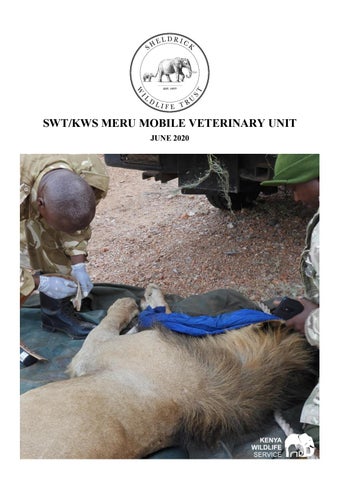
This lion was identified as a perennial cattle raider and security threat within the Laikipia east area. It had been trailed for over a month by the Laikipia KWS Station personnel till the night of 11/06/2020 when it was cornered within the village bomas. The Mobile Vet Unit based at Nanyuki was called in and darted the lion. It was caged and brought to the Nanyuki KWS Station. Immobilisation, examination and treatment The lion was brought by the Nanyuki KWS PAC Team to Meru. The MCA administration identified a site in Kora N.P. for release and a satellite collar was procured from BornFree Meru Lion Pride watchers. The adult male lion appeared tired and slightly dehydrated. It had fair body score though had a few wounds to the face as a result of self-infliction on the trap/cage. It was darted in the cage with 500mgs Ketamine and 7mgs Medetomidine. The cage was opened while still on the pick-up and the lion was taken out and placed on the ground. A blindfold was placed on the face. The collar was fitted and superficial wounds were sprayed with Tetracycline Topical Wound Spray. It was injected with 20ml Multivitamin subcutaneously, 3000mgs Amoxicillin and 30mgs Dexamethasone then the anaesthetic was reversed. Prognosis Prognosis is good and the lion will be monitored by the Senior Research Scientist Office.
Case 3 – 13th June 2020 Zebra
Natural Causes
Mpala Ranch
The adult grevy zebra was reported by the Mpala Ranch Manager to be severely lame on the right hind limb. Immobilisation, examination and treatment After spending time looking for the zebra in the bush, it was found with another young stallion, standing but bearing no weight on the right hind limb. It limped off when prompted to move but was severely lame and the right hock joint was swollen. The stallion was approached with a vehicle and darted in the rump with 6mgs Etorphine and 80mgs Azaperone. The stallion ran about 100 metres then fell onto sternal recumbence after five minutes. It was blind folded and placed on to left lateral recumbence for better examination. Examination showed no crepitation of the limb ruling out fracture. There was a small swelling on the right hock joint which yielded bloody discharge on aspiration. This depicted a traumatic injury inflicted by another stallion in a territorial fight or a mare during courtship. The zebra was injected with 6mgs Ivermectin under the skin, then 3,000mgs, 20ml Catosal and 30mgs Dexamethasone into the muscles. Prognosis Prognosis is fair as long as it doesn’t get caught by a predator while injured.
Case 4 – 16th June 2020 Elephant
Spear
Imenti Forest, Meru
The lame elephant was reported by the Warden of the Meru KWS station to Meru MVU. Immobilisation, examination and treatment The KWS Ruiri PAC team tracked the elephant for the whole day and led the Unit on foot due to thick bush, to the location. It was found alone, browsing, but with severe lameness of the right fore limb. There was an injury on the scapular area which was exuding copious thick creamy pus. It was darted in the rump with 18mgs Etorphine. It turned to face where the dart came from but didn’t move due to lameness. After immobilization, the wound exploration yielded a metallic foreign object which was a modified spear head. It was over half a meter long and almost 10cm wide. The wound was flushed with Hydrogen Peroxide and tincture of Iodine. 50ml of Tetracycline wound spray was inserted inside the pouch which was then packed with wet green clay. The elephant was also injected with 30000mgs Amoxicillin, 25mgs Dexamethasone and 100ml of Catosal was administered into muscles. Prognosis The anaesthetic was reversed, the elephant got up after two minutes and remained static inspecting the injury with his trunk. The PAC team will monitor him and the Vet Unit will review after 10 days if needed.
Case 5 – 16th June 2020 Warthog
Snare
Meru National Park
This male was found by the Meru SWT de-snaring team ‘tethered’ by a snare around a small tree. The vet team was informed and responded quickly.
Immobilisation, examination and treatment The warthog was found panting heavily without shade attempting to break the tether. It had a snoop around the left forelock causing a slight traumatic injury. The snare had also hooked around the snout making breathing difficult. It tried to charge the rescue team and the snare was about five meters long. Darting was not an option due to the risk of over-heating and respiratory depression associated with sedatives. The team moved in and grabbed the two hind limbs while it was lying down panting. While the team were maintaining a firm hold of the legs a blindfold was thrown around the head. A wire cutter was used to sever the snout snoop then the knot at the fetlock was removed. Carefully, the warthog was set free. Prognosis After snare removal, the warthog was released and took off, disappearing into the bush. Prognosis is good.
Case 6 – 18th June 2020 Crocodile
Human-wildlife Conflict
Region/Environ
The approximately 1m long croc was reported by community members to the Community Warden of Meru National Park as it was in a swampy area outside the park. The shallow water pan was overgrown with water weeds and turbid water. The croc was hidden under the water and the team had to verify it was a crocodile because the reptile can be confused with monitor lizard.
Capture and relocation Three crew members with long sticks probed the mud laden water pan. After five minutes, one of the team members stepped on the reptile and it sprung up startling the crew. It hid under the plant growth and a capture net was laid. When probed, it charged and the net entrapped the reptile. It was fished out of the water then a snoop was placed around the upper and lower jaw. Prognosis It was transported, while entangled in the net, and held manually by the tail to the release site inside the park at Murera River drift. It was off-loaded and the net undone. It was taken to a drift with shallow water and the jaws were untied carefully. It was let loose and swam away energetically.