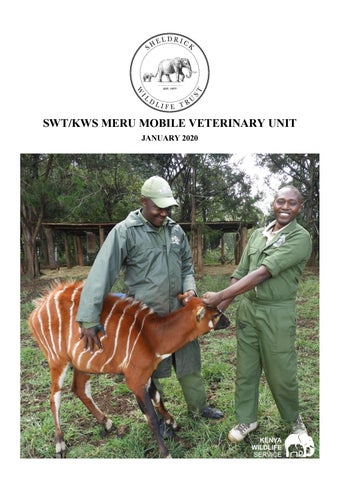
SWT/KWS MERU MOBILE VETERINARY UNIT JANUARY 2020
Introduction
6 Cases in January
67% Success
1 Elephant Case
January 2020 Report by Dr. Bernard Rono This report describes activities of the Meru Veterinary Unit in January 2020. In Mount Kenya Game Ranch, the Unit attended to a Mountain bongo which had overgrown hooves and two sub-adult bongos which were examined and treated after they showed a loss of body condition. In Meru National Park, a reticulated giraffe was immobilized to investigate the cause of lameness while in lower Imenti Forest examination of an elephant carcass revealed that it died from an obstructed birth. In Isiolo county, two hand raised ostriches in Community land were captured and relocated to a game farm to reduce risk of human and animal injury. Acknowledgement The Meru veterinary unit is supported by Sheldrick Wildlife Trust (SWT) which provides financial and logistical support. The Unit also acknowledges support from KWS management and rangers in the field who monitor wildlife and report cases for treatment
Case Details Date
Species
07-Jan-20
Bongo
07-Jan-20
Bongo
07-Jan-20
Bongo
15-Jan-20
Ostrich
17-Jan-20 20-Jan-20
Area Found Mount Kenya Game Ranch Mount Kenya Game Ranch Mount Kenya Game Ranch
Reason for Intervention
Outcome
Technical Case
Two bongo were reported to have a poor body condition
Task Successful
Postmortem
It had shown anorexia, tenesmus and profuse watery diarrhea
Died
Technical Case
Examination showed overgrown hooves on both front legs
Successfully Treated
Isiolo county
Human Wildlife Conflict
Two chicks were rescued and hand raised but had to be relocated as adults as they posed a threat to the community
Task Successful
Elephant
Imenti Forest, Meru
Postmortem
examination of an elephant which was found dead by rangers during routine patrol
Died
Giraffe
Meru National Park
Natural Causes
A dislocation of its left elbow joint which may have been sustained in a territorial fight
Successfully Treated
SWT/KWS Meru Mobile Vet Unit Treatment Locations January 2020
. Case
1 – 7th January 2020
Bongo
Technical Case
Mount Kenya Game Ranch
Two sub-adult bongo were reported to have a poor body condition and were unthrifty. They were manually restrained for examination.
Immobilisation, examination and treatment The Vet Unit manually restrained the animals for examination and found that they did have poor body condition. However, no other signs of illness were found on physical examination. The Vet suggested diet supplementation with proteins. Multivitamins and an ivermectin injection were also administered to control parasites. Prognosis The bongos should make a full recovery following the treatment and diet supplementations. Management will monitor the bongos condition and alert the vet if further treatments are required.
Case 2 – 7th January 2020 Bongo
Post-mortem
Mount Kenya Game Ranch
This bongo which was found dead in its enclosure and had shown anorexia, tenesmus and profuse watery diarrhea for one day. General Examination The Vet performed an examination to determine cause of death. The post-mortem findings were as follows: •
Emaciation, dehydration and anaemia
• • • •
Enlarged mesenteric lymph nodes Enteritis Parasitic cyst in the myocardium from migratory helminths All other organs appeared normal
Cause of death The bongo died from Helminthiasis, a parasite co-infection. Kidney, liver and intestinal samples were collected and preserved in formalin for histopathology. Routine faecal samples need to be tested and anthelminthic drugs given if positive for helminths
Case 3 – 7th January 2020 Bongo
Technical Case
Mount Kenya Game Ranch
This male bongo showed progressive lameness on its front legs. It was immobilized for examination and treatment.
Immobilisation, examination and treatment The bongo was darted with a combination of 7mg Etorphine hydrochloride and 50mg Azaperone tartate. It was darted from foot with the dart placed into its gluteal muscle. It went down in 9 minutes. Examination showed overgrown hooves on both front legs. The hooves were trimmed with a hoof trimmer. The bongo was then given Antibiotics and anti-inflammatory injections. Reversal and Prognosis The anaesthesia was reversed by injection of 120mg Naltrexone hydrochloride intravenously through the jugular vein. This bongo was on standing position three minutes later. Its posture and gait improved immediately and it is expected to recover completely.
Case 4 – 15th January 2020 Ostrich
Human-wildlife conflict
Gafarsa, Isiolo County
Two ostrich chicks which were abandoned by their mother were rescued and hand raised by a community member living in Gafarsa, Isiolo county in March 2019. Now that they had grown, they posed a risk to people and young livestock in the homestead. The community requested for relocation to a safe area where they can be raised. The ostriches were relocated to a licensed game farm in Isiolo county. Capture and Transportation Both Ostriches were darted, then restrained manually. A blindfold was applied and they were transferred on a carrying rug to a truck with the neck held above the body to prevent regurgitation of ingested food and aspiration into the lungs. The floor of the transportation truck was cushioned with a six inch layer of sand to prevent slipping. The Anaesthesia was reversed, and the ostriches were assisted to standing position. During transport the ostriches were either standing or lying down and appeared calm as they were used to handling. Release and Prognosis A makeshift ramp was prepared using bales of hay at the release site. The ostriches were then prodded to walk out of the truck into large enclosures where they will be provided with feed and water. The relocation was successful and we hope this decision will eliminate risk of human or animal injury while the ostriches thrive at the farm.
Case 5 – 17th January 2020 Elephant
Post-mortem
Lower Imenti Forest, Meru
The KWS officer in charge of Meru station requested for a post-mortem examination of an elephant which was found dead by rangers during routine patrol in Lower Imenti Forest. General Examination The Vet Unit conducted an investigation and examination revealed the following; •
The carcass was fresh and swollen on its perineum.
• •
Both tusks were found intact, later removed and taken to safe custody at the Meru station. On genital examination necrotic fetal parts were found.
Cause of death The Vet Unit concluded that the elephant died due to toxaemia from an obstructed birth.
Case 6 – 20th January 2020 Giraffe
Natural Causes
Meru National Park
A routine patrol reported a giraffe showing severe lameness of its front legs and low body condition in Mururi swamp, Meru national park. We immobilized it to investigate the cause of lameness and treat. Capture and Transportation The giraffe was approached with a vehicle and darted in its left rump with a combination of 13mg Etorphine and 60mg Azaperone tartate. Five minutes later it fell on left lateral recumbence. A blind fold was applied, then it was restrained physically by its neck and revived from anaesthesia using 36mg Diprenophine injected intravenously through the jugular vein. Examination showed a swelling and dislocation of its left elbow joint which may have been sustained in a territorial fight. No wounds were found. The giraffe was treated with anti-inflammatory and multivitamin injections. It was assisted to a standing position 15 minutes after immobilization. Release and Prognosis This giraffe has a good prognosis for recovery considering there is plenty of browse and water.