SWT/KWS MERU MOBILE VETERINARY UNIT AUGUST 2020
Introduction
4 Cases in August
1 Poaching Case
100% Success
August Report by Dr. Ndambiri Ephantus The Eastern Conservation Area continues to have a dry spell resulting in a large percentage of vegetation becoming dry. All measures are being taken to prevent fire outbreak within the conservation area as this would devastating for the habitat and the wildlife. Wild animals continue to enjoy the remaining forage and water within the park. Within the month under review, the Unit relocated a lioness that was preying on livestock, relocated 3 rhinos that had moved outside of a protected area, vaccinated a security/tracker dog and de-snared a zebra. This indicated that there are possibilities of park infiltration by poachers which calls for active monitoring to understand the circumstances surrounding the incidence so that necessary measures can be instituted. Acknowledgement The Vet Unit would like to appreciate the never ceasing support and facilitation from The Sheldrick Wildlife Trust through which timely and professional interventions have been made possible in order to alleviate animal suffering. All of the cases were carried out in conjunction with other partners in conservation including community efficient responses. We thank all those that have contributed to the Meru Vet Unit.
Case Details Date
Species
07-Aug-20
Lion
16-Aug-20
Rhino White
16-Aug-20
Security Dog
31-Aug-20
Zebra
Area Found Solio Ranch Meru National Park Meru National Park Meru National Park
Reason for Intervention
Outcome
Human Wildlife Conflict
Solio Ranch has been experiencing cattle raids by suspected lions
Task Successful
Relocation
Three white rhinos (male female with 1 calf) were spotted by a local tourist outside the rhino protection zone
Task Successful
Technical Cases
The KWS tracker dog was due for vaccinations as routine practice
Task Successful
Snared
The plain snare wire had a tight traumatic snoop around the right fore fetlock with resultant raw traumatic wound
Successfully Treated
SWT/KWS Meru Mobile Vet Unit Treatment Locations August 2020
. Case
1 – 7th August 2020
Lion
Human-Wildlife Conflict
Solio Ranch
Solio Ranch has been experiencing cattle raids by suspected lions. Following a raid on the 6/8/2020, where one cow was killed, a trap was set and the lioness was caught. The administration of Meru National Park agreed that the lioness should be released in Meru National Park. Immobilisation, examination and treatment A pickup with the lioness in the cage arrived at Meru N.P. on 7/8/2020. A GPS Collar was going to be fitted but the lioness was heavily pregnant and had a swollen head and bruised face and shoulders. The swelling was attributed to oedema/bruises which she self-inflicted while inside the cage. The lioness was ruled as a poor candidate for immobilization because of the head oedema and gestation status. This ruled out collar fitting but the lioness’ left ear had a visible notch which could be used later as a post release monitoring aid. It is suspected that the lioness had been darted earlier in May during translocation of lions from Solio Ranch but was a risky candidate for translocation due to heavy pregnancy. She was ear notched and released outside the ranch. It suspected she went back to the ranch and begun raiding cattle again. Release and prognosis The lioness was released at Mugunga Campsite inside Meru N.P. The trap was not offloaded from the pickup but instead the door was quietly opened by a ranger on the rooftop, camouflaged with a tent canvas, while the rest of the personnel locked themselves inside the vehicles. She dashed out of the trap and ran away into the thickets at the edge of the Murika river. Prognosis is guarded until it is established that she has settled down after joining and being accepted by the resident population.
Case 2 – 16th August 2020 White Rhino
Relocation
Meru National Park
Three white rhinos were spotted by a local tourist past Elsa’s Lodge. The visitor immediately informed the administration. A concerted effort was planned to locate and drive the trio back to Meru Rhino Sanctuary. Immobilisation, examination and treatment The trio had been sighted around No. 18. and Rangers tracked the footprints from there. A substantial search was conducted but the terrain proved a challenge. Vehicles were positioned strategically to help search and/or sight the trio if they crossed a road. The three were sighted within the bush five hours later. The Sheldrick fence team pulled down the sanctuary fence. Three landcruisers pushed the rhinos whilst the rest of the vehicles were positioned to funnel the rhinos towards the dropped fence. After a thirty-minute struggle the trio were successfully pushed back to the sanctuary and then the fence was re-established. The AD ECA Mr. Bakari who coordinated the exercise directed that the exit point be identified, monitoring to be increased and necessary measures taken to prevent reoccurrence of the incidence. Recommendation The water levels at the exit river point needs to be monitored so that electric fence strands can be dropped as required as water volume drop.
Case 3 – 16th August 2020 Security Dog
Technical Case
Meru National Park
The KWS tracker dog was due for vaccinations as routine practice. The canine aids in rhino monitoring particularly during poacher incidences when it is deployed to track down the culprits. Immobilisation, examination and treatment The canine is usually covered against tryps which have proven to be deadly in the past for the KWS canine population. This is usually done every three months as a prophylaxis measure due to tsetse presence in the working environment. This was accompanied by deworming which is also done every three months. Other routine annual boosters, which were due, were administered included Feline Panleucopenia, Canine Distemper, Leptospirosis, Herpetitis and anti-rabies vaccinations. The anti-tryps used was Diminazene Diaceturate which is highly active against both Trypanosomes and Babesia spp. It was administered by deep intramuscular injection at the rate of 3.5mg per kg bodyweight. A metabolic stimulant as a multivitamin was also indicated to help boost the appetite following the multiple vaccinations. The canine was recommended to be rested for three days after vaccination to help it recover smoothly. Recommendations The anti-tryps and deworming will be done after three months which will be on 16/11/2020.
Case 4 – 31st August 2020 Zebra
Snared
Meru National Park
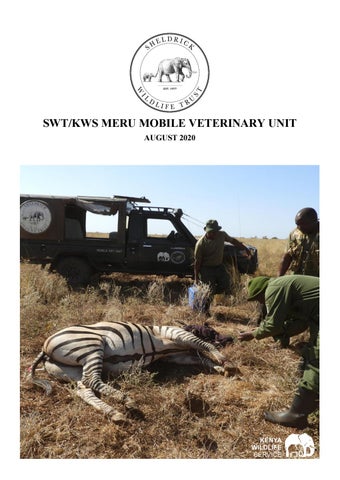
The common zebra was reported by a Ranger while driving within the park in the early morning. The zebra was among a group of several others but was struggling to keep up with the herd. The zebra had a tight snare, meant for small game, around the right fore fetlock that was barely a week old. Immobilisation, examination and treatment The zebra was sedated using 5mgs Etorphine and 60mgs Azaperone. It was approached carefully with the vehicle and despite being scared, the dart was placed well in the left rump. It went down on left lateral recumbence in six minutes. It was blindfolded. The snare wire was loosened and taken off the limb gently to reduce trauma. The wound was debrided with Hydrogen Peroxide followed by tincture of Iodine. Wetted green clay was smeared liberally on the wound followed by Tetracycline wound spray. Systemically it was injected with 4000mgs Tetracycline and 20ml Multivitamin into different muscle sites. 6mgs of Ivermectin was administered under the skin as a de-wormer. Prognosis The anaesthetic was reversed and the zebra got up energetically and ran to join the herd. Prognosis is good as the joint integrity had not been interfered with, depicted by lack of lameness post treatment.