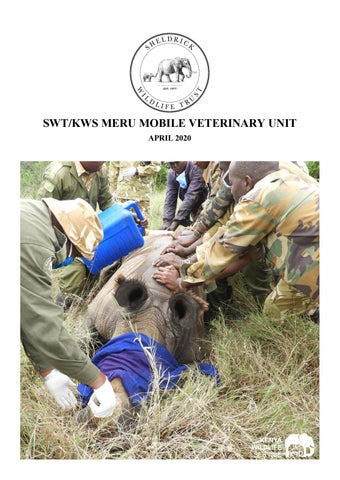
SWT/KWS MERU MOBILE VETERINARY UNIT APRIL 2020
Introduction
8 Cases in April
2 HWC Cases
4 Poaching Cases
April Report by Dr. Ndambiri Ephantus
There were heavy down pours in April so the habitats are rich in vegetation and there is plenty of water. It was very busy towards the end of April and the Unit had to travel far from base to attend cases. Human involvement was evident in snares experienced as well as one bullet wound cases and two human-wildlife conflict cases. Acknowledgement In summation the Meru Unit acknowledges the overwhelming support from SWT initiatives which enables the cases to be attended. Other stakeholders, including Community Conservancies/Ranches, and the people of good will cannot be forgotten. Through the established partnership we endeavour to achieve more.
Case Details Date
Species
Area Found
12-Apr-20
Elephant
Tigania, Meru Region
Bullet Wound
Post-mortem revealed a bullet wound and the tusks had been removed
Poaching Death
15-Apr-20
Striped Hyena
Community Area, Meru
Human Wildlife Conflict
The community reported a striped hyena that was a frequent raider of goats and required locating
Task Successful
16-Apr-20
Laughing Doves
Meru National Park
Natural Causes
Dead dove carcasses were seen all over the area within a diameter of about fifty meters
Died
23-Apr-20
Rhino White
Solio Ranch, Laikipia
Natural Causes
23-Apr-20
Python
Rhino Gate Camp, Meru
Human Wildlife Conflict
24-Apr-20
Giraffe
26-Apr-20
Zebra
26-Apr-20
Giraffe
Loisaba Ranch, Laikipia Mwea National Park Mwea National Park
Reason for Intervention
Snared
A 2-year-old male white rhino was reported to be lethargic and unable to keep up with the mother The serpent was reported to have caused panic in the camp outside the park after killing two domestic dogs The braided plain wire snare was tightly around the right fore fetlock causing lameness
Outcome
Successfully Treated Task Successful Successfully Treated
Snared
It had a wedge snare wire tightly around the left hind fetlock making it lame
Successfully Treated
Snared
Retreatment after being snared in February
Successfully Treated
SWT/KWS Meru Mobile Vet Unit Treatment Locations April 2020
. Case
1 – 12th April 2020
Elephant
Bullet Wound
Tigania, Meru
A young adult elephant approximately 15 years old weighing over one and half tons was reported by AD Eastern Conservation Area to have been found dead on 11/4/2020. It was within Gambela location, Tigania East, Meru county. A postmortem was requested to be carried out to ascertain the cause of death. The report was made late afternoon necessitating the postmortem to be done the following day on 12/4/2020. Examination • •
The carcass had been destroyed by predators with internal organs spread all over the scene Carcass was found on sternal recumbence and was relatively fresh (less than 48 hours old)
• •
The trunk was dislodged from the head and two tusks missing The skull had no skin or fresh dorsally. Rostrally it had chop marks on the frontal bones destroying trunk bases/beds and exposing sinuses
The tusks were removed with an electric powered bone cutter and the sternal position depicted instant paralysis/immediate death without any struggle. The missing trophies indicate poaching activity and Instant paralysis of the elephant can only be attributed to use of lethal trauma from a powerful gunshot to the head. Cause of Death Death by gunshot.
Case 2 – 15th April 2020 Hyena
Human-wildlife conflict
Meru
This striped hyena was reported by the community to the Problem Animal Control team (PAC) of Meru NP as a frequent raider of their goats. A trap was laid overnight on the 14/4/2020 using a goat kid as bait. The hyena was successfully trapped and the community expressed their anger by attempting to kill it but the PAC team intervened hurriedly. It was collected and transported to Meru NP for treatment before release. Management The adult male was panting exposing bleeding gums. It had a scar around the neck likely caused by a snare. The hyena had attempted to liberate itself by biting the mesh which was enough for the head to pass through but not the chest. The struggle resulted in wounds around the neck. The animal was dowsed liberally with water while inside the trap. All wounds were generously cleaned with Hydrogen Peroxide, rinsed with tincture of Iodine then sprayed topically with Tetracycline wound spray. Systemically the hyena was injected with 600mgs Amoxicillin mixed with 8mgs Dexamethasone and 4ml of Catosal. Release Prognosis is fair. Post release monitoring could have been aided with a GSM collar but one could not be secured. The hyena was released far inside the park. The trap door was opened and the hyena jumped out energetically and vanished in the nearby thicket.
Case 3 – 16th April 2020 Laughing Doves
Natural Causes
Meru National Park
Deaths of laughing doves had been observed for over two weeks by KWS Korobesa Rangers’ camp. This was reported to a Meru research scientist who reported the matter to Vet Unit on the 15/4/2020 in the evening. Examination Three KWS rangers from the camp joined the vet team at the watering hole. There are two water troughs about 10m apart and a water well about 10m from one of the water troughs. Flowing parallel to these three structures is the spring water. Dead dove carcasses were seen all over the area within a diameter of about 50m. Carcasses were of different ages with some very old, relatively old, very fresh as well as some neardeath birds. The near-death doves were weak, unable to fly or perch. All depicted yellow/creamy greenish diarrhoea. Other birds observed within the same area were moaning and ring-necked doves, Egyptian goose, glossy ibis, striated heron and spur wing plover among others. There were no deaths reported in other species. Within the rangers’ camp a francolin was spotted unable to fly and circling with torticollis signs. Management Three fresh dove carcasses were collected and the francolin was euthanized for sampling. Massive deaths of the same species have been incriminated to Newcastle infection. Monitoring was advised in order to note whether other species will be affected, numbers involved and if deaths continue.
Case 4 – 23rd April 2020 White Rhino
Natural Causes
Solio Ranch, Laikipia
This two-year-old male white rhino was reported on the 22/4/2020 by OC Rhino as being lethargic and unable to keep up with its mother. The unit travelled from Meru NP to Solio Ranch to cover for the residential vet who was away. It was found with its mother, depicting kyphosis, calculated steps on ambulation, swollen tummy, shallow rapid breath and exercise intolerance. It was tentatively diagnosed as having colic. Immobilisation, examination and treatment It was darted from a vehicle with 2.5mgs Etorphine and 25mgs Azaperone. The first dart failed to discharge and another was quickly done which set the two rhinos running into the nearby thickets. The footprints were traced and it was found ten minutes later, lying on its left side with its mother on guard. The mother was chased off so the rhino could be treated. Rectal examination yielded faeces of normal consistency and quantity. It was treated with 10ml Flunixin Meglumine as a bowel relaxant, 40mgs of Dexamethasone, 6000mgs Amoxicillin and 40ml Catosal all administered into different muscle sites. Prognosis and recommendation The anaesthetic was reversed twenty minutes post darting and it was up aggressively in two minutes charging the vehicles. Prognosis is fair. Instructions were given for continuous monitoring and for it to be reviewed after 48hrs if the animal did not improve substantially.
#
Case 5 – 23rd April 2020 Python
Human-Wildlife Conflict
Rhino Gate Camp, Meru
The serpent was reported by Meru NP Community Warden as having caused panic in the camp outside the park after killing two domestic dogs and swallowing one. The Unit rushed to rescue it. It was found coiled in the bush with another dog nearby. The community had tried to fight it causing breaks to the skin though not life threatening. It had a bump at the middle of the body depicting the engorged dog.
Immobilisation and management A piece of Y-stick was used to pin the head down. The neck was grabbed by hand and with the support of another person on the tail, it was retrieved from the thickets and carried to the open pick-up. It was transported whilst being manually restrained because there was no sac to secure it in. It was transported and released in the park. It regurgitated the swallowed dog making it lighter and easier to handle. It slithered into the nearby grass thickets. Prognosis Good because the injuries were shallow and not life threatening.
Case 6 – 24th April 2020 Giraffe
Snared
Loisaba Ranch, Laikipia
The snared adult male giraffe was reported by Conservancy Security on the morning of 24th. An intervention ensued immediately. Despite heavy rain from Meru NP all the way to Loisaba, the giraffe remained in sight. It was found isolated because it could not keep up with the herd. The braided plain snare wire was tightly anchored around the right fore fetlock causing lameness. The snare was meant for small game.
Immobilisation, examination and treatment It was approached with a vehicle and darted with 15mgs Etorphine and 40mgs Azaperone. After darting it ran off and fell into a seasonal drain on his right side. It was blind folded and immediately revived. It remained pinned down manually by several personnel. The snare was loosened and taken off the limb. There was no resultant traumatic wound. It was injected with 100mgs Dexamethasone into muscles to take care of muscle fatigue. Prognosis The anaesthetic was reversed as soon as the animal went down. Following treatment, it got up on the third attempt and walked away. Prognosis is good.
Case 7– 26th April 2020 Zebra
Snared
Mwea National Park
The snared zebra was reported by the Deputy Warden of the Reserve on the 26th. An intervention was planned immediately. It had a wedge snare wire tightly around left hind fetlock making it lame. The snare was about three days old and only caused a small traumatic wound. The wire is presumed to be one used as clutch cable by the motorbike. It was found close to the office together with a few others.
Immobilisation, examination and treatment It was immobilized with 5mgs Etorphine and 50mgs Azaperone. The first dart went straight into the nuchal ligament but was not effective. The second dart went into the rump and it was sedated after five minutes. It fell on its left side and a blind fold was placed on the head. The snare was severed with a wire cutter and the wound cleaned with Hydrogen Peroxide and tincture of Iodine. Green clay and wound spray were also applied topically to the wound. The zebra was also given 4500mgs Amoxicillin, 20ml Catosal and 40mgs Dexamethasone into different muscle sites. The dart wound was infiltrated with 5gms Cloxacillin cream. Prognosis Following treatment, it took three minutes to recover from the anaesthesia. Prognosis is good.
Case 8 – 26th April 2020 Giraffe
Snared
Mwea National Reserve
It was spotted with lameness and a swollen wounded left foreleg while on a patrol within the reserve. After enquiring it was discovered that it had been de-snared on 3/2/2020. A decision to do a second treatment was made. She was in a large group of others and close by was her less than one-year old foal. Immobilisation, examination and treatment Sedation was achieved by use of 8mgs Etorphine and 25mgs Azaperone. The giraffe was darted from a vehicle and the dart was placed in the left gluteal muscles. She started running and was tripped by a thicket and fell on left lateral recumbence, seven minutes post darting. Her head and neck were restrained manually and the anaesthetic immediately reversed. The wound was cleaned with Hydrogen Peroxide and tincture of Iodine without dislodging the scab that had formed. Green clay and Tetracycline wound spray were also applied on the wound. It was injected with 20mgs Ivermectin under the skin; 80mgs Dexamethasone, 40ml Catosal and 15,000mgs Amoxicillin into different muscle sites. Prognosis After about twenty minutes post darting the physical restraint was removed and it sprung up energetically and ran off. Prognosis is good.