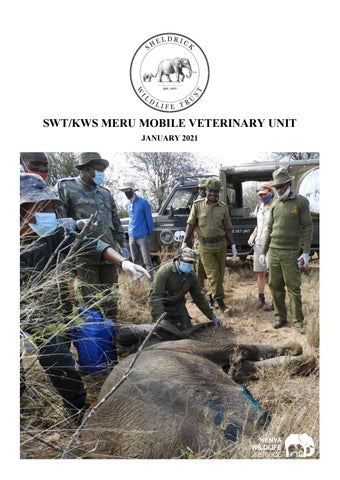
SWT/KWS MERU MOBILE VETERINARY UNIT JANUARY 2021
Introduction
4 Cases in January
1 HWC Case
1 Elephant Case
January Report by Dr. Ndambiri Ephantus The month under review ushers in a new year. A year which is expected optimistically to be much kinder than the previous year which was torn apart by the Corona pandemic. Within the Eastern Conservation Area, the year starts with lots of promises as the ecosystem has plenty of vegetation for wild animals. The area is yet to experience strong sun to dry the vegetation cover thus animals are at their peak health wise and rivers continue to flow into and out of park. Hopefully the expected dry season ahead won’t be devastating to the welfare of wild animals within the ecosystem. Acknowledgement We would like to salute the kind sponsorship of The Sheldrick Wildlife Trust through which every intervention has been acted on. The Mobile Vet Unit continues to blossom and offer the ever-needed timely interventions. May all partners involved continue to share out mercifully for the welfare of the wild animals so that they can enjoy their survival.
Case Details Date
Species
Area Found
Reason for Intervention
07-Jan-21
Zebra
Wildlife Conservancy, Mt Kenya
Natural Causes
18-Jan-21
Bongo
Wildlife Conservancy, Mt Kenya
Natural Causes
24-Jan-21
Elephant
Mpala Ranch, Laikipia
Natural Causes
27-Jan-21
Zebra
Meru National Park
Human Wildlife Conflict
Had lameness of the right forelimb. There was build-up of material and stones in the hoof but the sole and frog were clear of any injuries Had multiple vaginal prolapse that has been treated several times surgically but the problem recurs. This was another recurrence of a prolapse The elephant had four puncture wounds on the left hindlimb at the level below the knee that was affecting the movement Had a deep incision wound, with smooth edges and no accompanying scratches which rules out a predation attempt. A barbed wire fence could have caused the injury and needs to be removed.
Outcome Successfully Treated
Successfully Treated Successfully Treated
Successfully Treated
SWT/KWS Meru Mobile Vet Unit Treatment Locations January 2021
Case 1 – 7th January 2021 Zebra
Natural Causes
Wildlife Conservancy, Mt Kenya
The stallion had a straight back when standing but when walking or galloping there was obvious lameness of the right forelimb. The stallion was reluctant to bear weight on the affected limb and there was marked head-bobbing indicating that the zebra was in pain. Immobilisation, examination and treatment The zebra was darted from a vehicle with 7mg Etorphine mixed with 80mg Azaperone. The affected limb was examined for any external injuries or significant problems. The skin and limb integrity were fine. The joints were flexed and extended to feel for any abnormalities, crepitation, change in temperature that would indicate inflammation, and swellings/growths. The right limb was sound, but the left pastern joint had crepitation due to shifting weight to the unaffected limb (compensatory lameness). The hoof’s sole and frog were uninjured, but the hoof wall was overgrown and had a vertical crack. The hooves were trimmed to reduce the uneven weight bearing that was causing strain on the flexor tendons and the navicular bone. All the dirt that was lodged between the frog and bars of the hoof was removed. The zebra was also given 2,000mg Enrofloxacin, 320mg of Tripelennamine Hydrochloride, 40ml Multivitamin and 80mg Ivermectin. Prognosis Prognosis was fair as the hoof trim will reduce the strain placed on the ligaments and navicular bone.
Case 2 – 18th January 2021 Bongo
Natural Causes
Wildlife Conservancy, Mt Kenya
The bongo named Kipenzi had her first prolapse last year after she gave birth to her first calf. This was corrected successfully. However, the prolapse recurred several times and each time had to be surgically corrected. She was in an enclosure with young males and a mating may have caused one of the prolapses, so she was moved and taken to an enclosure where she was alone. The team were informed the vaginal prolapse recurred again and responded to treat the bongo and to investigate why it continues to happen. Immobilisation, examination and treatment She had an arched back when standing and moving indicating she was in pain and discomfort. When she was lying down the prolapse was very pronounced but when she stood up it would return inside a little. The bongo was immobilised for treatment with 4mg Etorphine and 50mg Azaperone. The vaginal tissue was clean, not infected and suitable for return. The tissue was irrigated with saline to keep the tissue moist and clean. An antibiotic pessary containing Oxytetracycline was placed in the canal before gently and firmly pushing the tissue back into position then held in place with sutures. The area was irrigated with Penicillin, to prevent infection around the sutured area. The bongo was also given 10ml Multivitamin, 1,000mg Gentamycin, 200mg of Tipelennamine and 600mg Medroxyprogesterone. A blood sample was taken to determine the reproductive hormones levels. Prognosis The prognosis was fair, however, as this is a recurring condition, she has poor reproductive prospects. If she is already pregnant then as the pregnancy progresses and the foetus grows there will be expansion of the uterus and increased pressure exerted on the vaginal opening predisposing her to another prolapse. Predisposing factors of vaginal prolapse include increased intra-abdominal pressure due to pregnancy, increase in estrogen levels which can cause relaxation in the reproductive tract muscles when the animal strains during urination or defecating, inherited traits, twinning, nutrition, and dystocia (difficulty calving). The best action is to completely keep her from breeding and associating with males, thus, making her an ornamental animal rather than a breeder. The other alternative is to put her on hormonal treatment and see if it helps with keeping the vulvar wall and associated structures strong and retaining its elasticity.
Case 3 – 24th January 2021 Elephant
Natural Causes
Mpala Ranch, Laikipia
A young elephant was seen trailing its herd and walking with difficulty. The elephant appeared to be in pain, and moved between waterholes, dowsing the left hindlimb to soothe the wound and displace flies. Immobilisation, examination and treatment The animal was immobilised with 5mg Etorphine and went down in 4 minutes. His general body condition was poor as the spine and hip bones were slightly prominent. The elephant had four puncture wounds to the left hindlimb below the knee. Two of the wounds were big and connecting with one another. The other two were deep but not connected. There was also a wound to the right abdominal area and scratch marks on the rump indicating the wounds were inflicted by predators. All wounds were flushed with Hydrogen peroxide to remove pus and dead tissue, then irrigated with Iodine. The connecting wounds were packed with an Oxytetracycline pessary and the other wounds with Opticlox. All wounds were then sealed with green clay and sprayed with topical Oxytetracycline. The elephant then had to be turned to access the bigger wound on the right abdominal side which was treated in the same manner. The elephant was also given 1,000mg Enrofloxacin, 20mg Dexamethasone and 20ml of Multivitamin. Prognosis Prognosis was fair as the wounds were treated and the family was nearby to protect it from further attacks. It will be monitored by Scouts to ensure the elephant’s safety and in case a second treatment is needed.
Case 4 – 27th January 2021 Zebra
Natural Causes
Meru National Park
The SWT rhino-fence patrol team reported an injured zebra in a herd of six individuals. The injury was fresh and on the right hind leg thigh. The zebra had a good body condition and mobility was not affected. She was very healthy and appeared to be the leader of the group. She was also in the late stages of pregnancy. Immobilisation, examination and treatment The zebra was darted from a vehicle with 5mg Etorphine mixed with 70mg Azaperone. She ran quite a distance before calming down. The effects of the drug, however, did not set in as she was still strong enough to run and be aware of her surroundings, so she was darted again with 4mg Etorphine and 40mg Azaperone. The wound was a very fresh and there were no accompanying wounds or scratches which ruled out a predator attack. The edges were also smooth and evenly deep from one end to another. The wound was cleaned with Hydrogen peroxide to remove the dead tissue, then disinfected with Iodine, packed with green clay and sprayed with Oxytetracycline. The zebra was also administered with 4,500mg of Amoxicillin, 20ml of Multivitamin and 60mg Ivermectin to cover against ectoparasites and endoparasites. Prognosis Prognosis was good as the wound was treated early and there was little to no contamination. The mare was also very healthy with good body condition. The wound was caused by a sharp object and an investigation led the team to a barbed wire fence. It’s likely the cause of the zebra’s injury and should be removed.