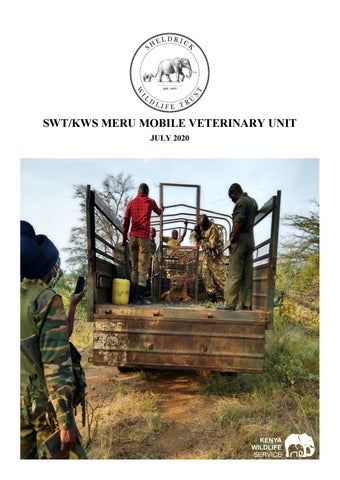
SWT/KWS MERU MOBILE VETERINARY UNIT JULY 2020
Introduction
5 Cases in July
2 Human-Wildlife Cases
3 Lion Cases
July Report by Dr. Ndambiri Ephantus The dry season is definitely here and the vegetation is almost completely dry. There is a lot of strong winds and most seasonal streams have dried up. Rivers flowing through the park have substantially reduced in flow and volume due to cessation of rains and heavy use upstream by farmers to irrigate farms. Hopefully despite water utilization by farmers’ the volume of water will still be sufficient to flow through the park. July has been a big cat month as lions have been the heart of interventions. The problematic candidates are the ones who were released into the Meru Conservation Area in the recent past. As they search for territory in acclimatizing to the new area, they find themselves outside the Conservation Area or in new/occupied territory resulting in carnivore-human conflict or territorial fights. Acknowledgement We are indebted to have had a sufficient facilitation from the Sheldrick Wildlife Trust (SWT) which enabled the Unit to respond in time whenever the Unit services were required. This was in commendable collaboration with KWS area stations together with the area’s community and conservancies.
Case Details Date
Species
Area Found
04-Jul-20
Lion
Kamaganjiiu, Meru
Human Wildlife Conflict
16-Jul-20
Rhino Black
Sera Wildlife Conservancy
Natural Causes
18-Jul-20
Lion
Kinnah, Meru
Human Wildlife Conflict
24-Jul-20
Lion
25-Jul-20
Buffalo
Meru National Park Meru National Park
Reason for Intervention
Postmortem
The lioness was reported to have killed a cow. The lioness and her male and female cubs were relocated This rhino was originally hand raised and then translocated to Sera for slow release into the wild. Lojipu was noted to be off feed with diarrhoea. The lioness killed a goat and the community responded and surrounded the cat leading to an attack on one of the community members almost causing lower jaw dislocation It was concluded that the cub died of fatal attack injuries sustained during an attack by another lion
Postmortem
There were extensive mauling marks caused by claws and teeth marks
Outcome Task Successful Prognosis Poor
HWC Death
Died
Died
SWT/KWS Meru Mobile Vet Unit Treatment Locations July 2020
. Case
1 – 4th July 2020
Lion
Human-Wildlife Conflict
Kamaganjiiu, Meru
This pride, consisting of a lioness and two cubs, were among the 18 lions captured at Solio Ranch and translocated to Meru National Park in mid-June this year. They had become a menace at the ranch due to cattle predation. The pride were released at Mugunga Campsite in Meru N.P. On the 27/06/2020, the lioness was reported to have snatched a cow from a herder at lunch time as the animals were coming from the river. It successfully killed the cow but was chased away by the community without feeding. This was at Kiamiramba about 60kms from release site. A trap was transported to the site but it had to be trapped the next day as it was too dark. On 28/06/2020, it had moved 2 kilomenteres away and was sighted accompanied by two cubs. Call backs were played to entice the lioness to the bait tied on a stump but it didn’t work. A trap was set at that site with a live and dead bait but the lioness didn’t appear. On 29/06/2020, it was reported to have killed two pregnant cows, 4kms away at Gisegeria Ngiri area. They left without feeding as the community scared them away. Problematic Animal Control tracked the trio and followed them through Ndia King’ang’i then to Maranthio where night fall forced the team to stop tracking. On the 30/6/2020 a helicopter wass sought but was out of service. On 1/7/2020, the trio were tracked down to Kamaganjiu Kathangacini 40kms away. That particular day a helicopter was available for search and possible capture.
Immobilisation, collaring and relocation The lioness was very elusive after separating from her cubs. Her hiding placed forced the Unit to dart her from foot. With aerial support, the PAC and Vet team approached and successfully darted the lioness with 500mgs Ketamine and 7mgs Medetomidine. She ran off but was watched by the helicopter until she was immobilized. She was retrieved and loaded into the helicopter and flown the 3kms to the cage. She was caged and the collar was fitted while inside the cage. After securing the cage, it was moved to a calm shady place away from the community whilst the team searched for the cubs. The cubs remained elusive despite an extensive search by ground teams. The teams found footprints so the mothers cage was moved to the area. Communication was heard between the mother and cubs over night but the trap was unsuccessful. The team found the cubs footprints again the following day and the mothers cage was moved to the location resulting in the successful capture of the female cub. Both mother and cub were fed and watered. There was further communication between the mother and second cub that night and finally on the 4th July the male cub was captured. All three were then relocated to Kora National Park.
Case 2 – 16th July 2020 Black Rhino
Natural Causes
Sera Wildlife Conservancy
This rhino was abandoned by the mother after they were translocated to Sera from Lewa. The mother had a history of abandoning her calves as she had abandoned her first whilst at Lewa. After the abandonment of the second calf it was taken to Reteti to be hand raised and named Lojipu. Once matured it was returned to Sera Conservancy to be reintroduced into the wild. Lojipu was noted to be off feed with diarrhoea. Immobilisation, examination and treatment Lojipu was observed to be dehydrated and voiding bloody fetid mucoid diarrhoea. It was aware of the surrounding but lethargic and had lost body condition. The faeces contained polythene and plastic materials. A tentative diagnosis of Salmonellosis was given and Lojipi was given a broad-spectrum antibiotic, metabolic stimulant, anti-inflammatory and de-wormer. Rehydrants, both per oral and systemic, were prescribed. Before sedation, oral rehydrants composing of milk replacement, glucose and Sodium Bicarbonate were administered. An hour later, Lojipu was immobilized with 2.5mgs Etorphine and 40mgs Azaperone to administer the treatment. It is semi-tame so was easily darted from foot within the Rangers Camp. Prognosis The prognosis is guarded and the rhino should be kept away from the residential camp to discourage the rhino from eating garbage and refuge within the dumping sites.
Case 3 – 18th July 2020 Lion
Human-Wildlife Conflict
Kinnah, Meru
The lioness had been reported by the Meru Community Warden to the Vet Unit. It had attacked and killed a goat within the outskirts of Kinnah. The community had responded and surrounded the cat in a vegetated area. The cat felt corned and therefore attacked one of the community adult males, almost causing a lower jaw dislocation. A joint operation commenced involving the Vet and PAC teams with the aim to capture, relocate and release the lion. Search and conclusion A search ensued and all community members were instructed to withdraw as there was the potential danger of a second attack by the lion. The teams searched thoroughly for two hours but the cat either ran off or ran at the team. After almost giving up, the lion finally sprung in an attempt to attack one of the rangers. The ranger responded in self-defence and fatally shot the lion. The lioness was established to be one of the other seventeen lions which had been released less than two months earlier into Meru N.P. from Solio Ranch. This was confirmed by a notch on the right ear. Unfortunately there has been increased human-wildlife conflict as the lions try to identify new territory.
Case 4 – 24th July 2020 Lion
Post-mortem
Meru National Park
The young female cub was reported by the SW Meru Conservation Area to the vet unit after finding the carcass. They requested a post-mortem to establish the cause of death. Examination and post-mortem The carcass was found on its right side and was about one day old. The cub was less than one year old. It was in poor body condition of less than 2.5 out of 5.0. A pool of blood had exuded from the mouth and nostrils. There was creamy pus in the wounds, which looked like bite wounds, on the rump and the elbows of the hind limbs. Examination revealed suffocation bite marks under the neck and another bite on the front limb. These were all exuding bloody discharges showing that they were fresher than the pus discharging ones. Observation around the scene depicted dragging marks which when followed led to the attack site about 25meters away from the death site. At the attack area there were signs of a struggle and lion footprints bigger in size than the cub’s. Another blood clot was seen on the ground. Cause of Death It was concluded that the cub died of fatal attack injuries sustained during an attack by another lion.
Case 5 – 25th July 2020 Buffalo
Post-mortem
Meru National Park
The dead buffalo was reported by the SW Meru National Park. An intervention was to be carried out to establish the tentative cause of death. Examination and post-mortem The carcass was found on right lateral recumbence under a thicket near the Rhino Sanctuary edge. Observation around the location revealed signs of a struggle. There were extensive mauling marks, particularly on the posterior side of the carcass, concurrent with claw and teeth marks. Anteriorly the muzzle had been severely damaged during what appeared to be suffocation during a prey-predator encounter. The carcass had also been devoured on the rump and left hock joint. Across the nearby electric fence there were a lot of hoofprints which were thought to have been from a herd of buffalo; they possibly responded to the commotion and scared off the predators. Cause of Death Death was attributed to lion predation.