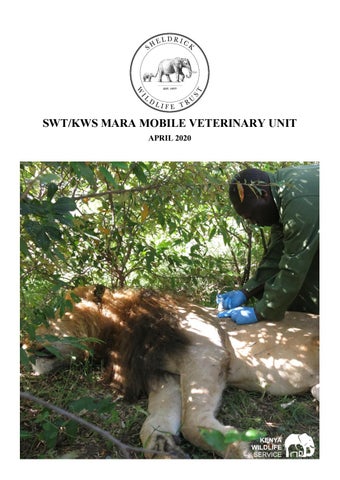
SWT/KWS MARA MOBILE VETERINARY UNIT APRIL 2020
Introduction
5 Cases in April
2 Lion Cases
3 Poaching Cases
April Report by Dr. Campaign Limo
The month was characterised by a drop in visitor numbers to conservation areas within the Mara due to the COVID-19 pandemic. Tour guides and visitors have been instrumental in spotting animals needing help and over the years have been contributing significantly to case interventions. The Mara Conservation Area has also had unusually high precipitation with most areas flooded and roads destroyed rendering movement difficult. This however comes as a blessing to many herbivores who have plenty of fodder and water to use. Acknowledgement The Mara Mobile Veterinary Unit would like to thank all stakeholders who offered their support in terms of reporting and assisting during treatment of affected animals. Thanks to the Minara Foundation through SWT for the continuous facilitation of the unit. Thanks to KWS management for their advice and technical support to the unit.
Case Details Date
Species
Area Found
12-Apr-20
Lion
Ol Kinyei Conservancy
Snared
16-Apr-20
Zebra
Olarro Conservancy
Snared
19-Apr-20
Lion
Masai Mara NR
Human Wildlife Conflict
20-Apr-20
Eland
Masai Mara NR
Natural Causes
The left eye appeared injured with excessive lacrimation and signs of photophobia
Successfully Treated
Elephant
Naboisho Conservancy
Spear
He had multiple septic wounds estimated to be less than a week old and infested with maggots caused by spearing
Prognosis Poor
22-Apr-20
Reason for Intervention A lion had a tight snare round his neck which could potentially have strangulated him Had a plain wire snare round his left foreleg below the carpus. Though the snare was not tight, it had caused bleeding He had a spearhead firmly embedded in the left side slightly off the spine at the thoracolumbar border. Ten inches of the spear head had penetrated causing severe organ injuries
Outcome Successfully Treated Successfully Treated
HWC Death
SWT/KWS Mara Mobile Vet Unit Treatment Locations April 2020
. Case
1 – 12th April 2020
Lion
Snared
Ol Kinyei Conservancy
This big male christened ‘Green eyes’ was seen by Conservancy Rangers with a wire snare around his neck. He was moving fast and by the time they informed the Veterinary Unit, the lion had disappeared. The Unit responded and assisted in the search for most of the day. He was finally seen three days later with two other males, several kilometers away. The Veterinary Unit found him lying in a small bush a few meters from the other males. All of them appeared well fed and likely had recently made a kill. Immobilisation, examination and treatment The lion was darted from a vehicle with a combination of 6mgs Medetomidine hydrochloride and 260mgs Ketamine hydrochloride. The lion was fully anaesthetized after ten minutes and after making sure he was stable an examination was conducted at the site. There was a tight snare round his neck which could potentially have strangulated him. This was a well-set snare likely targeting other animals. The snare was removed gently and the resultant wound was cleaned with water and disinfected with iodine. Oxytetracycline aerosol spray was then applied topically. Other treatments given included parenteral administration of Amoxicillin antibiotics and Ivermectin parasiticide to control internal and external parasites. Prognosis The anaesthetic was reversed and he joined the other males. Prognosis for full recovery is good.
Case 2 – 16th April 2020 Zebra
Snared
Olarro Conservancy
This zebra was seen dragging a plain wire snare from his left front leg by Olarro Conservancy Rangers who called the Veterinary Unit for help. He was with a herd of other zebras and wildebeests in a semi open area. He appeared to be in significant pain with an obvious limp on ambulation. He also appeared nervous on approach preferring to follow the wildebeests as they moved around.
Immobilisation, examination and treatment Restraint was achieved by with a combination of 4mgs Etorphine hydrochloride and 40mgs Azaperone tartarate. He was darted from a vehicle and was fully anaesthetized after four minutes. Examination revealed a plain wire snare round his left foreleg below the carpus. Though the snare was not tight, it had caused bleeding abrasions. The snare was removed and the resultant wound cleaned with copious amount of water. Tincture of iodine was used for disinfection before Oxytetracycline topical spray was applied topically. Other treatments included parenteral administration of Amoxicillin antibiotics and Flunixin meglumine antiinflammatories. Prognosis The anaesthetic was reversed and he soon joined the rest of the herd. Prognosis for full recovery is good.
Case 3 – 19th April 2020 Lion
Human-wildlife Conflict
Masai Mara National Reserve
This lion christened ‘King of Sarova’ was a regular sighting around the Sarova lodge within the Masai Mara Reserve. His speared carcass was found by Mara Reserve Rangers on their daily patrols. Examination The carcass was found on left recumbency in a relatively fresh state approximately 800 metres from the Reserve border and the community settlements. Closer examination revealed the following; •
He was in good body condition before death, a score of 4 out of 5 (where 1 is poor and 5 perfect)
• • • •
Rigor mortis was evident and the carcass was estimated to be less than 12 hours old There were a few healing fight wounds on his front legs, likely from territorial fights with other males He had a spearhead embedded in his left side slightly off the spine at the thoraco-lumbar border Ten inches of the spear head had penetrated causing severe organ injuries with subsequent internal abdominal bleeding The spear head was retrieved and handed over to the security teams to help in the investigation
•
Cause of Death This lion died as a result of injuries sustained from spearing; most likely a victim of human wildlife conflict. The carcass was in good condition and was considered a good specimen for taxidermy hence minimum tampering was allowed.
Case 4 – 20th April 2020 Eland
Natural Causes
Masai Mara National Reserve
This mature female eland is a semi-captive individual who was rescued but stayed around Talek gate within the Masai Mara Reserve. She is commonly seen near the gate intermingling with visitors and occasionally moving into the nearby shopping center. She was seen with an injured left eye by Mara Reserve Rangers who called the Mobile Veterinary Unit. She was found within an enclosure belonging to a bank within Talek and the left eye appeared injured with excessive lacrimation and signs of photophobia. Immobilisation, examination and treatment The eland was darted from foot with a combination of 9mgs Etorphine hydrochloride and 80mgs Azaperone tartarate. She was fully narcotized after ten minutes and fell on her left side. She was gently rolled over to lie on her right side for easier examination of the affected eye. The eyeball was intact though inflamed from a possible blow, with an injury detected on the lower conjunctiva towards the medial cantus. The eye was cleaned with water and then Cloxacillin eye ointment applied. She was also given subconjunctival injection of a combination of long acting Amoxicillin antibiotic and Dexamethasone sodium anti-inflammatory. Prognosis Immediately after treatment, the anaesthetic was reversed to avoid complications from possible bloating. Prognosis for a full recovery is good.
Case 5 – 22nd April 2020 Elephant
Spear
Naboisho Conservancy
This old and massive bull was seen alone with multiple wounds by Naboisho Conservancy Rangers. Immobilisation, examination and treatment The Unit found this bull in a small bush near a river. He was guided to an open area before being darted with 17mgs Etorphine from a vehicle. He fell on his left side which allowed the team to conduct a thorough examination as all the injuries were on the right side. He had multiple septic wounds estimated to be less than a week old and infested with maggots likely caused by spearing. These wounds were as follows; • • • •
An open wound on the right pinna of the ear shattering the cartilage An open wound on the right side of his neck just behind the ear A penetrating wound on the lateral mid right thoracic area and on the right side by the thoracic spine A penetrating wound on his perineum
All the wounds were debrided with Hydrogen peroxide and the maggots removed manually. The wounds were rinsed with water and disinfected with Iodine before green clay was applied. He was also given Amoxicillin antibiotics, Flunixin meglumine anti-inflammatories and Ivermectin parasiticide. Prognosis Prognosis is guarded. Follow up will be made and if necessary, another treatment will be given.