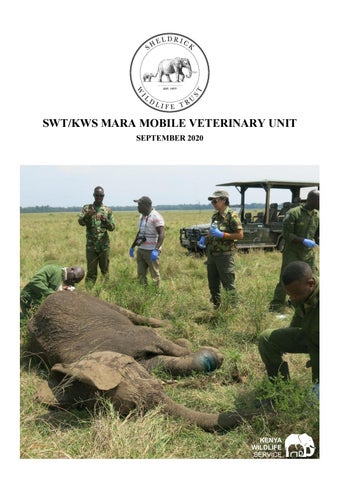
SWT/KWS MARA MOBILE VETERINARY UNIT SEPTEMBER 2020
Introduction
6 Cases in September
3 Poaching Cases
2 Elephant Cases
September Report by Dr. Campaign Limo The period under review was characterised by sporadic rains with food and water abundantly available for all species. Migratory wildebeests are still around with most predators taking advantage to prey on them. Fewer number of conflict cases were reported, though one elephant was treated for a spear wound and another for an arrow wound. A lodged spear was also removed from a giraffe bull. Two lions and 1 white rhino were treated for natural causes. Acknowledgement The Mara Mobile Veterinary Unit is pleased to acknowledge support given to them by various stakeholders who helped in reporting cases and participating in the processes of intervention. Thanks to Minara Foundation through The SWT for their continuous facilitation of the unit. Thanks to management of KWS for their technical support.
Case Details Date
Species
Area Found
Reason for Intervention
08-Sep-20
Elephant
Mara Triangle
Spear
08-Sep-20
Rhino White
Ol Choro Oiroua Conservancy
Natural Causes
13-Sep-20
Lion
Masai Mara NR
Natural Causes
16-Sep-20
Lion
Masai Mara NR
Natural Causes
18-Sep-20
Elephant
Siana Conservancy
Arrow
25-Sep-20
Giraffe
Masai Mara NR
Spear
Examination revealed a relatively fresh deep wound on the caudal aspect of her right carpal joint likely caused by a spear This white rhino christened ‘Koffi’ is one of the two rhinos kept in this Conservancy in a semicaptive environment. Koffi developed some seizures, falling down and subsequently losing balance briefly when waking up This male called ‘Jesse’ was seen with a severe injury to his back caused by a fight with other lions. He was in great pain and hardly made a move Examination revealed a deep penetrating wound likely caused by warthog tusks. The wound appeared relatively clean Examination revealed that all old wounds had healed but the left carpus was swollen with a discharging wound. The wound was probed and a poisoned arrowhead was deeply embedded within the joint The spear could be seen firmly attached in his left thigh and he had difficulties walking
Outcome Prognosis Poor
Successfully Treated
Successfully Treated Successfully Treated
Successfully Treated successfully Treated
SWT/KWS Mara Mobile Vet Unit Treatment Locations September 2020
. Case
1 – 8th September 2020
Elephant
Spear
Mara Triangle
This calf was seen by the Conservancy Rangers while on their daily patrols. They described her as moving with difficulty with an injury to her front right limb. Her body condition appeared okay. Immobilisation, examination and treatment This young elephant was darted from a vehicle with 3mls Etorphine hydrochloride. It took seven minutes for the drugs to take effect with the family members including the mother staying close to protect her. The family members were gently driven away with vehicles to allow the team to attend to the injured. Examination revealed a relatively fresh deep wound, approximately a week old, to her right carpal joint likely caused by a spear. There was some swelling around the area, but the joint structures were intact and only soft tissue damage was noted. Due to the position of the injury, constant movement of the joint, which involves flexion and extension, caused a lot of pain. The wound was debrided with Hydrogen peroxide, rinsed with clean water, disinfected with Iodine and infused with Cloxacillin ointment before green clay was packed into the wound to prevent sepsis. Luckily, no necrotic tissues were found as the wound appeared relatively fresh. Other treatments given include Clindamycin antibiotics and Flunixin meglumine anti-inflammatories. Prognosis Favourable. The location of the injury causes constant flexion and extension which opens up the wound and is painful. It might take some time before she fully uses the leg. The Rangers will continue to monitor her.
Case 2 – 8th September 2020 White Rhino
Natural Causes
Ol Choro Oiroua Conservancy
This white rhino christened ‘Koffi’ is one of two rhinos kept in this Conservancy. The other rhino is an older female and both are kept in a semi-captive environment. The management of the Conservancy reported that Koffi developed seizures and would fall down, subsequently losing balance upon waking up. He appeared lethargic and grazed poorly. He had been treated for a similar condition two years ago and responded well. Immobilisation, examination and treatment Koffi was found outside the boma with his companion. He appeared calm and grazing lethargically. Due to his condition, he was considered an anaesthetic risk so he was handled without anaesthesia. One of his keepers caressed him as the veterinarian examined him and he remained calm throughout. It was thought he had possibly suffered brain oedema and potential causes were considered. This is a tsetse infested zone with Trypanosomosis rampant. He was given Quinapyramine trypanocide, at a curative and prophylactic dose, Antibiotics and Dexamethasone anti-inflammatory to reduce pain and relieve oedema. All these injections were given intramuscularly by hand injection. Prognosis He was monitored closely for the next one week. Great improvement was noted, and he has since recovered.
. Case
3 – 13th September 2020
Lion
Natural Causes
Masai Mara National Reserve
This big black maned male christened ‘Jesse’ was seen with a severe injury on his back by a visiting tourist. He was in great pain and could hardly made a move. The Vet Unit “Jesse” was found alone in a small thicket lying in the shade. He appeared to be in deep pain as he hardly moved on approach. A big wound was seen on his mid spine. Less severe bite wounds were distributed on his flanks and hind legs. Immobilisation, examination and treatment This lion was immobilised from a vehicle with 6mgs Medetomidine and 250mgs Ketamine hydrochloride. Examination revealed deep bite wounds caused by a fight with other lions in defence of his territory. The wounds were septic and maggots infesting the big spine wound. The lumbar section was involved with slight damage to some of the articular cartilage. The fragments were removed and the maggots were manually removed from the wound. Necrotic tissues were removed with Hydrogen peroxide. The wound was rinsed with clean water, before tincture of iodine was applied for disinfection. Cloxacillin antibiotic was then infused into the wound. The other wounds were managed the same way. Other treatments given included administration of Amoxicillin antibiotics and Dexamethasone anti-inflammatory to reduce the pain. Luckily, the integrity of the spinal cord and associated nerves were not affected. Prognosis The anaesthetic was reversed, he rose up in 10 minutes and moved a few steps before settling under a shrub.
Case 4 – 16th September Lion
Natural Causes
Masai Mara National Reserve
This lion, a member of the Black Rock Pride, was seen by the Mara Predator Project team on their normal lion monitoring exercise. He had a deep wound on the lateral aspect of his left thigh. The Mara Mobile Veterinary team was within the vicinity and took the chance to examine this lion. He stayed away from the other pride members opting to lie in the shade in a slightly secluded area.
Immobilisation, examination and treatment Immobilization was achieved chemically with 4.8mgs Medetomidine and 200mgs Ketamine hydrochloride. It took 11 minutes for the drugs to take full effect, then eye ointment was applied and a blindfold put in place. Examination revealed a deep penetrating wound likely caused by warthog tusks. The wound appeared relatively clean. Sterile swabs soaked with clean water were used to remove any dirt from the wound before tincture of Iodine was applied as a disinfectant. Cloxacillin ointment was then infused into the wound and Oxytetracycline spray was applied topically. The lion was also given Amoxicillin antibiotic and an appropriate anti-inflammatory parenterally. Prognosis He woke up 8 minutes after reversal of the anaesthetic and moved to another shady area. Prognosis is good.
Case 5 – 18th September 2020 Elephant
Arrow
Siana Conservancy
This big bull was treated three months ago for several arrow inflicted wounds and a severe spear wound to his trunk. Olarro Conservancy Rangers were monitoring his progress with early reports indicated he was improving. He then disappeared and reappeared with a swollen left front foot. Immobilisation, examination and treatment He was traced to a rocky bushy hill close to a big herd. His lower left forelimb was swollen with some discharge. He used this leg sparingly and walked with a limp. His body condition was good. Due to terrain challenges, the bull had to be darted from foot with 17mgs Etorphine. After ten minutes, the drugs took effect and the big bull fell on the left side. For better examination, he was turned over with the help of a vehicle. Examination revealed the old wounds had healed but the left carpus was swollen with a discharging wound. The wound was thoroughly probed and a poisoned arrowhead was found deeply embedded within the joint. This barbed arrow was gently worked back to minimize damage to the joint and removed. The wound was debrided with Hydrogen peroxide, rinsed with clean water, disinfected with Iodine then packed with green clay to absorb toxins and prevent sepsis .The elephant was also administered Clindamycin and Amoxicillin antibiotics as well as Flunixin meglumine anti-inflammatories. Prognosis Favourable. Teams on the ground have been advised to monitor him and report progress.
Case 6 – 25th September 2020 Giraffe
Spear
Masai Mara National Reserve
This big bull was spotted with a spear lodged in the lateral aspect of his left thigh by the Ann Taylor Foundation Scouts. They notified the Mara Triangle management who called the Mara Veterinary Unit. Immobilisation, examination and treatment He was found with other giraffes in a light thicket. The spear could be seen firmly stuck in his left thigh and he had difficulties walking. He was darted from a vehicle with 12mgs Etorphine and 60mgs Azaperone. The drugs took full effect after 8 minutes, then he was roped to the ground. The anaesthetic was immediately reversed to avoid anaesthesia induced complications that are common in giraffes. With this giraffe held manually on the ground, the spear was removed and then treatment was carried out. There were maggots in the resultant wound which were manually removed. The wound was debrided with Hydrogen peroxide, rinsed with clean water, disinfected with Iodine and infused with Cloxacillin antibiotic cream. The giraffe was also administered Amoxicillin antibiotics and Flunixin meglumine anti-inflammatories. Prognosis He was released after treatment and he got up, then moved to join the other giraffes. Prognosis is good