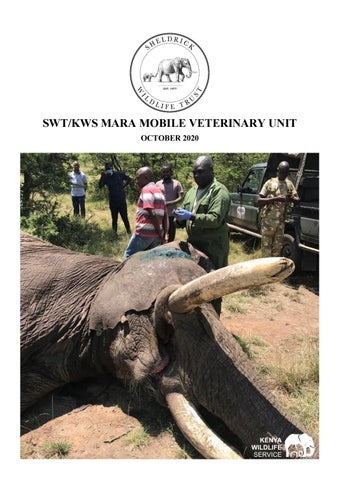
SWT/KWS MARA MOBILE VETERINARY UNIT OCTOBER 2020
Introduction
8 Cases in October
3 Poaching Cases
5 Elephant Cases
October Report by Dr. Campaign Limo
The period under review was characterised by sporadic rain showers that occurred from the middle of the month. Food and water for all wildlife species is readily available. Animals who were treated last month, including the injured elephant calf at Mara Triangle Conservancy, have been constantly monitored. All have shown improvement and are on their way to a full recovery. The lion population has regained strength and body condition as the wildebeest migration have provided plentiful prey. This has led to lion prides challenging for territories leading to several territorial fights and bite related injuries. Sikio, the old male lion treated two months ago for a head injury, was a victim of fighting and needed treatment for septic and maggot infested bite wounds. Acknowledgement The Mara Mobile Veterinary Unit would like to extend gratitude to all stakeholders who partnered with them in handling wildlife cases during the period. Thanks to Minara Foundation through SWT for their continued support to the Unit. Thanks too to KWS management for the technical support to the unit.
Case Details Date
Species
Area Found
10-Oct-20
Elephant
Oloisukut Conservancy
Arrow
A small septic wound on his right hind leg likely caused by an arrow
Successfully Treated
10-Oct-20
Elephant
Ol Chorro Conservancy
Postmortem
The carcass of this elephant was found and a post-mortem conducted
Died
12-Oct-20
Lion
Masai Mara NR
Natural Causes
Multiple bite wounds inflicted by other lions when fighting to defend his territory.
Successfully Treated
13-Oct-20
Lion
Masai Mara NR
Natural Causes
Multiple bite wounds caused by a fight with other lions. These wounds were deep, septic and maggot infested
Successfully Treated
15-Oct-20
Elephant
Oloisukut Conservancy
Arrow
The wound appeared to have been caused by an arrow
Successfully Treated
15-Oct-20
Elephant
Mara Triangle
Natural Causes
This female was found lying down a few meters away from a stream. She could hardly even move her trunk
Died
24-Oct-20
Giraffe
Olarro Conservancy
Spear
He walked with difficulty with the spear head clearly visible
Successfully Treated
27-Oct-20
Elephant
Siana Conservancy
Postmortem
This calf was found lying on her left lateral recumbency with no injury detected
Died
Reason for Intervention
Outcome
SWT/KWS Mara Mobile Vet Unit Treatment Locations October 2020
. Case
1 – 10th October 2020
Elephant
Arrow
Oloisukut Conservancy
This big bull was spotted walking with a limp by Mara Elephant Project Chief Executive Officer while driving a herd of elephants from a settlement area with a helicopter. He had a small discharging wound on the medial aspect of his right hind leg just below the knee joint. He called the mobile veterinary unit for help. Immobilisation, examination and treatment He was found alone relaxing under a tree in a small thicket. When he was approached, he moved out of the bush into an open area with the small discharging wound visible. He appeared nervous but was eventually darted, whilst running from a vehicle, with 17mgs Etorphine hydrochloride. It took ten minutes for this elephant to be fully immobilized and he fell on his left side. Examination revealed a small septic wound on his right hind leg likely caused by an arrow. Probing of the wound yielded no foreign body. This was also confirmed by a metal detector. The wound was debrided with Hydrogen peroxide and all necrotic tissues were removed. The wound was rinsed with water, disinfected with Iodine and infused with Cloxacillin antibiotic ointment then sprayed with Oxytetracycline spray. Other treatments included parenteral administration of Amoxicillin antibiotics and Flunixin meglumine antiinflammatories. Prognosis The anaesthetic was reversed, he got up in three minutes and moved away. Prognosis is Good.
Case 2 – 10th October 2020 Elephant
Post-mortem
Ol Chorro Conservancy
The carcass of this elephant was seen by Olchorro Conservancy Rangers on their normal patrols in an open field within the Conservancy. They requested the Veterinary Units services to determine cause of death. Post-mortem examination It was a relatively fresh carcass estimated to be less than 12 hours old. There was evidence of a slight struggle at the scene before death. The carcass appeared unusually bloated with some degree of rectal prolapse. No cutaneous injury was found and nothing detected after scanning the whole body with a metal detector. This was an elephant in good body condition approximated to have a score of 4 of a scale of 1-5. On opening the carcass, the following findings were noted: The cardiovascular system was normal apart from haemorrhagic and congested mesenteric vessels. The heart was normal in shape and size. The trachea patent and lungs appeared normal. The entire urinary system appeared normal. She was carrying a 16-18-monthold calf with intact placenta and other membranes. It is thought the calf died upon death of the mother. The liver and spleen appeared normal in colour, but both were slightly congested. The small intestines were twisted with accumulation of gas leading to bloat. Cause of death Intestinal torsion is an emergency that can often leads to death without intervention. This elephant died from complications associated with intestinal torsion. Cause of torsion could not easily be determined
Case 3 – 12th October Lion
Natural Causes
Masai Mara National Reserve
This big famous male christened ‘Morris’ was seen injured and moving with great difficulty by the Reserve Rangers on their daily patrols. They notified the Chief Park Warden who called the Veterinary Unit for help. Immobilisation, examination and treatment Morris was traced to a culvert having taken refuge there. He appeared to be in great pain and refused to come out from the culvert even with agitation. It was decided to immobilise him in-situ and bring him out once under complete anaesthesia given that he was close to the culvert inlet. He was darted with 250mgs Ketamine and 6mgs Medetomidine from a vehicle. Full anaesthesia was confirmed by probing him from a distance, he was then carried out of the culvert. He had suffered multiple bite wounds inflicted by other lions when fighting to defend his territory. These were fresh wounds hardly a day old and appeared clean. All wounds were debrided with Hydrogen peroxide and rinsed with clean water. Tincture of iodine was applied and Cloxacillin antibiotic ointment infused. Other treatments given include parenteral administration of Amoxicillin antibiotics and Ivermectin parasiticide. Prognosis This lion is expected to heal with no complications.
Case 4 – 13th October Lion
Natural Causes
Masai Mara National Reserve
This old male christened ‘Sikio’ was seen by visiting tourists injured and walking with difficulty. Sikio had been treated three months before for a head injury suspected to have been caused while hunting. This time, he had been attacked by other males who wanted to take over his territory. Immobilisation, examination and treatment Sikio was found lying in the shade near a Lugga. He appeared lethargic and looked like he was in a lot of pain. He was darted from a vehicle with 6mgs Medetomidine and 240mgs Ketamine. It took ten minutes for the drugs to take full effect. After confirming he was under anaesthesia, Sikio was carried to a nearby shady area. Examination revealed multiple bite wounds caused by a fight with other lions. These wounds were deep, septic and maggot infested. All the maggots were manually removed then the wounds were debrided with Hydrogen peroxide. All necrotic tissues were removed and then the wounds were rinsed with clean water, disinfected with iodine and packed with green clay. Sikio was also administered Amoxicillin antibiotics, Ivermectin parasiticides and Dexamethasone as an anti-inflammatory. Prognosis He woke up from anaesthesia ten minutes after reversal and moved to the next shade. Prognosis is good.
Case 5 – 15th October Elephant
Arrow
Oloisukut Conservancy
This bull was seen with a suppurating wound on his left abdomen by Mara Elephant Team when they responded to a call to drive away a herd of elephants from settlement areas. Immobilisation, examination and treatment This elephant with 20 other elephants had crossed Mara River to Oloisukut Conservancy after being driven from the Community area by the helicopter. The herd was nervous and could only be examined from the air. The affected bull was identified and had purulent discharge from the left side of his abdomen. Given the challenges of terrain and uneasiness of the herd, the elephant was darted from the helicopter with 17mgs Etorphine hydrochloride. It took ten minutes for the drugs to take full effect with this elephant assuming sternal recumbency near a pool. He was immediately pushed to lie on his right side for comfort. The wound appeared to have been caused by an arrow. Probing of the wound was negative for any foreign body which was confirmed with the metal detector. The wound was debrided with Hydrogen peroxide and all necrotic tissues removed. The wound was rinsed with water and disinfected with Iodine. The elephant was also given Amoxicillin antibiotics and Flunixin meglumine anti-inflammatories. Prognosis He rose up three minutes after reversal of the anaesthetic to join the rest of the herd. Prognosis is good.
Case 6 – 15th October 2020 Elephant
Natural Causes
Mara Triangle
This elephant cow was seen recumbent and flapping her ears by visitors on horse riding adventures across the Mara Triangle Conservancy. They notified Mara Elephant Project and Mara Triangle Management. Post-mortem examination This female was found on her life side, a few meters away from a stream. She was barely responsive and could hardly move her trunk or flap her ears. She seemed to have been in this position for a while, possibly more than three days, and sloughing of the skin underneath her was evident. She was turned over, but no physical injuries were noted other than cutaneous sores from prolonged recumbency. She was doused with cold water to cool her and several unsuccessful attempts were made to pull her up. Intravenous rehydration was attempted with no changes seen. Her condition had deteriorated and she was given a grave prognosis. Post-mortem examination After exhausting all options to save this elephant, the team agreed that it was best to end her suffering and she was euthanised. A post-mortem was then carried out to ascertain the cause of her recumbency. On opening the carcass, this elephant was found to have been heavily gravid with a fully developed foetus ready for expulsion but with an inadequately dilated cervix. The fully formed calf could have died within the uterus as the mother was trying to push him out due to the poorly dilated cervix. All other organs appeared normal. Cause of death This elephant suffered complications from dystocia. Prolonged recumbency led to muscle and tissue damage.
Case 7 – 24th October Giraffe
Spear
Olarro Conservancy
This big bull was seen by Olarro Conservancy Rangers with a spear head lodged in his left thigh while on their daily patrols. They notified their management who called the mobile veterinary unit for help. Immobilisation, examination and treatment The giraffe was darted from a vehicle with 60mgs Azaperone and 12mgs Etorphine hydrochloride with the drugs taking full effect after eight minutes. He was manually roped down to achieve maximum restraint and reversed immediately with administration of 36mgs Diprenorphine hydrochloride through the jugular vein. The head was pinned down and the spear was removed. He was estimated to have been speared one day before intervention as the wound was still fresh. It was debrided with Hydrogen peroxide and rinsed with clean water. Tincture of iodine was then used for disinfection and Oxytetracycline wound spray applied topically. The giraffe was also given Amoxicillin antibiotics, Flunixin meglumine anti-inflammatories and Ivermectin parasiticides. Prognosis He was released after treatment and he galloped towards where the other giraffes were. Prognosis is good.
Case 8 – 27th October 2020 Elephant
Post-mortem
Siana Conservancy
This young female was treated in August 2020 for a deep spear injury to her left knee. She was being monitored and had completely healed from the injury but walked with a limp. However it was reported that she was seen in the afternoon of 26th October, lying down seemingly struggling to rise up but eventually stood up and continued to browse. Later on in the evening she was reported dead. Post-mortem examination This juvenile was found lying on her left side with no injury detected except abrasion wounds on her right hip. She appeared moderately bloated. The spear injury had completely healed and her body condition looking satisfactory. A metal detector was used to scan her entire body with negative results. On opening the carcass, the following findings were noted; There was generalised subcutaneous emphysema. The kidneys and the entire urinary system appeared normal. The liver was normal in shape and size. There was evidence of excessive accumulation of bile within the bile canaliculi. The mesenteric vessels were congested with the accumulation of gas within the large and small intestines. There was scanty food within the stomach and intestines. There was no faecal material ready for expulsion in the colon and lower gastrointestinal tract. Though normal in size, the lungs were fibrotic. The heart was normal in shape, but the left chamber appeared abnormally muscular. The myocardium was thicker than expected. All other organs appeared normal. Cause of death The cardiopulmonary changes were abnormal and likely occurred over a period of time. However, aetiology of these changes could not be established. These abnormalities could have contributed to the death of this elephant.